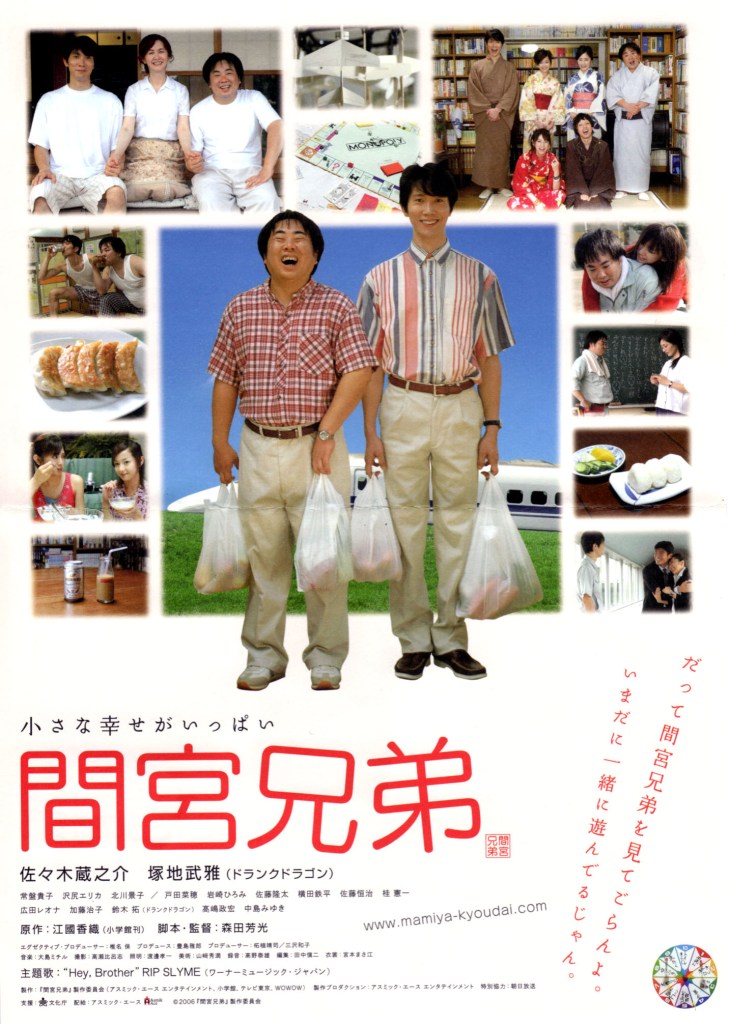
 Ever the populist, Yoshitmitsu Morita returns to the world of quirky comedy during the genre’s heyday in the first decade of the 21st century. Adapting a novel by Kaori Ekuni, The Mamiya Brothers (間宮兄弟, Mamiya Kyodai) centres on the unchanging world of its arrested central duo who, whilst leading perfectly successful, independent adult lives outside the home, seem incapable of leaving their boyhood bond behind in order to create new families of their own.
Older bother Akinobu (Kuranosuke Sasaki) and younger brother Tetsunobu (Muga Tsukaji) live together in a small apartment in Tokyo where they enjoy hanging out keeping track of baseball games and watching movies rented from the local store where Akinobu has a crush on the cashier, Naomi (Erika Sawajiri). They are perfectly happy but sometimes frustrated that they don’t have girlfriends so they decide to host a curry party and invite Naomi over in the hopes that she might develop an affection for Akinobu. So that she won’t feel weird about going to the house of two middle-aged guys she doesn’t really know, Tetsunobu invites a reserved teacher, Yoriko (Takako Tokiwa), from the primary school he works at as a caretaker though he “never dates coworkers” and is only really asking her as a backup for Akinobu.
Against expectation the both ladies agree to attend the curry party which actually goes pretty well though neither man is fully capable of following up on the opportunities presented to him. Outside events provide a distraction as Akinobu is swept into his adulterous boss’ divorce crisis and Tetsunobu becomes fixated on a damsel in distress who has no desire to be rescued by him. As much as the boys might want to form independent relationships for female companionship, their brotherly bond is more akin to a marriage in itself leaving both of them unwilling to abandon the status quo for a new kind of happiness.
These kinds of closely interdependent sibling relationships are more often seen between sisters, often as one or both of them has rejected offers of marriage for fear of leaving the other on the shelf. Elderly spinsters and their histories of unhappy romance are almost a genre in themselves though they often present the peaceful co-existence of the two women as a double failure and ongoing tragedy rather than a perfectly legitimate choice each may have made to reject the normal social path and rely solely on each other. The Mamiya Brothers neatly subverts this stereotype, presenting the relationship of the two men as a broadly happy one though perhaps tinged with sadness as it becomes clear that the intense bond they share is holding each of them back in a kind of never ending childhood.
Indeed, though they live alone together and have steady jobs, whilst in each other’s company the brothers regress back to childhood by spending their spare time riding bikes around the neighbourhood and playing on the beach. They are each keenly aware of how they must appear to members of the opposite sex and are always mindful not to appear “creepy”. Accordingly, they’re careful about which DVDs they check out so that Naomi doesn’t get a bad impression of them, and they’re sure to make it clear that both girls can bring other people to their parties so they won’t think there’s anything untoward going on. Throwing quick fire questions back for and constantly making references to private jokes the boys are effectively a manzai duo performing for an audience of two, perpetually suffocating inside their self made bubble.
Though they might not find love, the boys do at least make some new friends. Naomi’s sister, Yumi (Keiko Kitagawa), is exactly the kind of girl they’d usually steer clear of lest she begins to make fun of their old fashioned ways yet she actually becomes an ally and even a friend after spending time hanging out in the brothers’ odd little world. Yumi and Naomi are, in many ways, almost as closely connected as Akinobu and Tetsunobu though they both currently have boyfriends even if they find them equally disappointing.
The teacher, Yoriko, also finds herself unlucky in love as she pursues a relationship with a colleague who doesn’t seem particularly invested in her and is lackadaisical about even the smallest forms of commitment. Tetsunobu seems to have discounted her as a romantic partner under his “no coworkers” rule and is either unaware or deliberately ignoring her growing feelings for him. It may be that he invited Yoriko as a love interest for his brother precisely because he was interested himself and wanted to eliminate the problem, but he may come to regret outwardly rejecting this chance of mutual affection turning into something more solid.
When push comes to shove it might just be that the Mamiya Brothers are happiest in their own company and have no desire to move on and leave their arrested development behind. Though tinged with a degree of lingering sadness as it appears the boys do have a desire to form bonds outside of their mutually dependent bubble, they are after all quite happy and mostly fulfilled in their life together. Cute and quirky, if at times melancholic, The Mamiya Brothers is a strange tale of modern romance in a world where no one really grows up anymore. The brothers are clearly not afraid of broadening their horizons, but might prefer to continue doing so together rather than finding their own, independent, paths.
Original trailer (no subtitles)
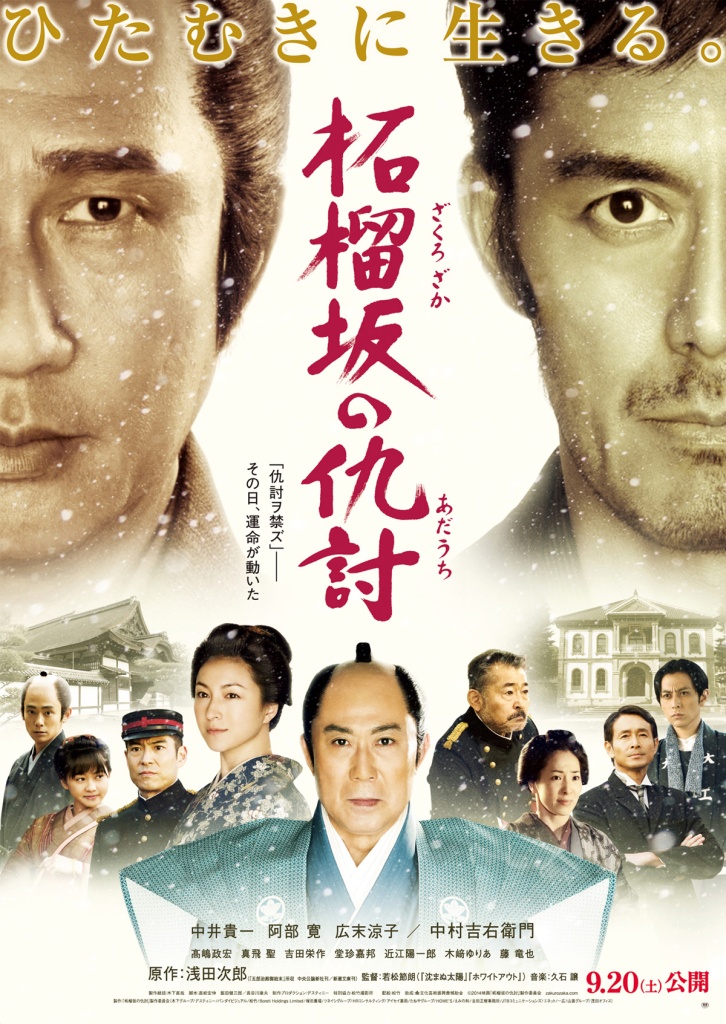 Times change, and men must change with them or they must die. When Japan was forced to open up to the rest of the world after centuries of isolation, its ancient order of samurai with their feudal lords and subjugated peasantry was abandoned in favour of a more Western looking democratic solution to social stratification. Suddenly the entirety of a man’s life was rendered nil – no more lords to serve, a man must his make his own way now. However, for some, old wounds continue to fester, making it impossible for them to embrace this entirely new way of thinking.
 Windows on Worlds