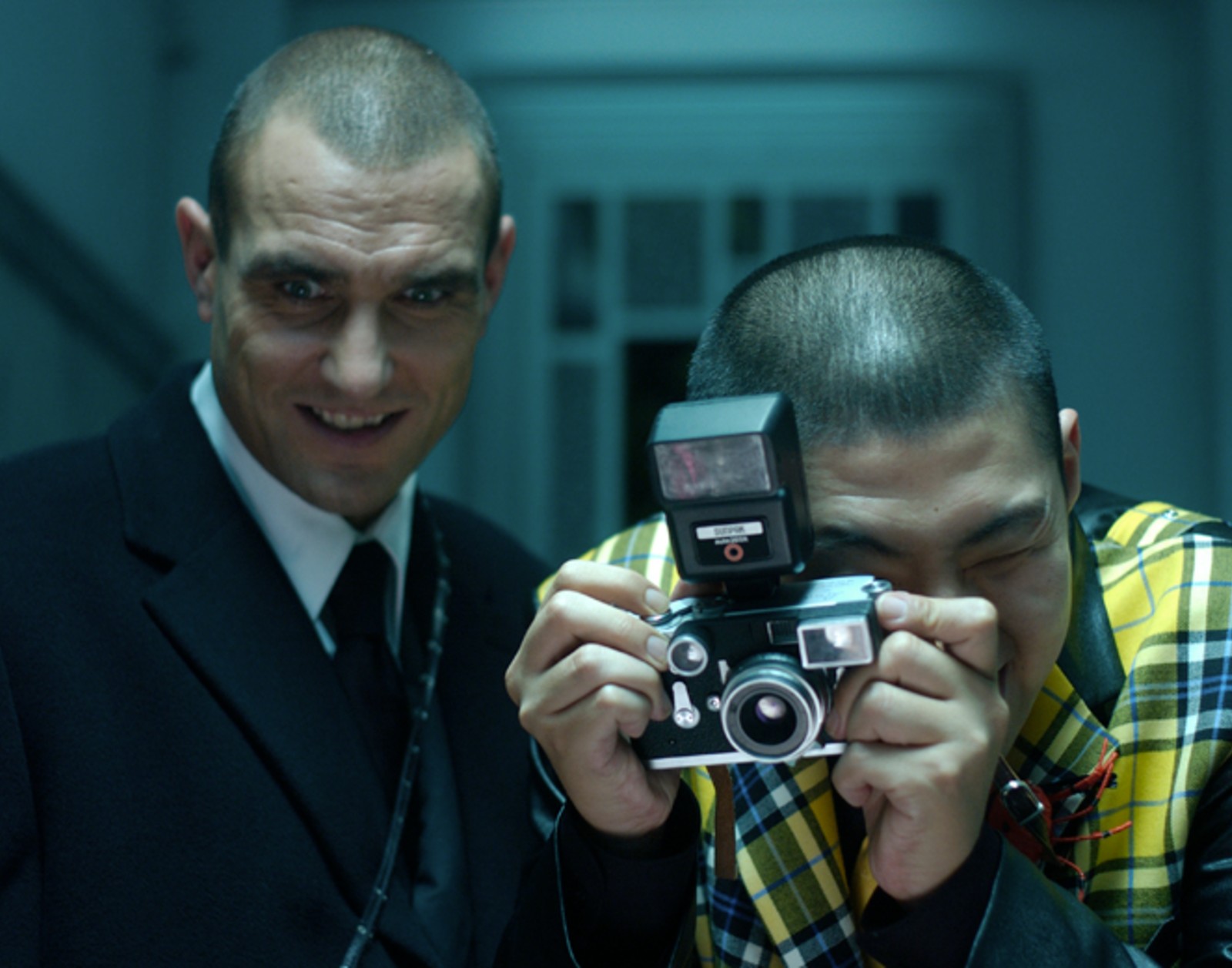
Survive Style 5+ (Gen Sekiguchi, 2004)

“What is your function in life?” It is, after all, quite a difficult question as an air stewardess (Tae Kimura) points out when interrogated by an irate British hitman (Vinnie Jones), and perhaps one that most people never really think about. Indeed, many of those questioned struggle with the meaning of “function”, replying with the most obvious answer of their occupation or job title without really considering any deeper implications or whether their existence is really meaningful. The hitman seems to have a secondary mission of eliminating those whom he deems “unnecessary”, while simultaneously giving his only sign of approval to a man who straightforwardly tells him that he doesn’t have one.

Gen Sekiguchi’s Survive Style 5+ is full of this kind of questioning but ultimately a tale of how one learns to survive in an often absurd world. Like many films from the mid-2000s, it cuts between several interwoven plot threads that at first seem nonsensical but finally coalesce into a complete whole. An artist (Tadanobu Asano) repeatedly kills his wife (Reika Hashimoto) who is forever trying to kill him in bizarre ways only for her to respawn back at their very weird Western-style country lodge in the woods. An ad executive (Kyoko Koizumi) becomes fed up with her vain hypnotist boyfriend (Hiroshi Abe) who mocks her career. A salaryman (Ittoku Kishibe) is hypnotised to think that he’s a chicken, and a trio of burglars (Kanji Tsuda, Yoshiyuki Morishita, Jai West) deal with repressed emotion and romantic longing. 

They are all to some extent trying to find some way to survive along with a sense of purpose in their lives. Ad executive Yoko is forever coming up with zany ideas for TV adverts that she records on her dictaphone, sniggering to herself at their surreal humour though she is the only one who finds them funny and her work is often dismissed by her corporate clients who complain that her ads don’t do anything to inform the prospective customer about the nature of the product. Sekiguchi was himself also a director of TV adverts which informs the film’s short and snappy style, and Yoko’s artistic frustrations perhaps echo his own as she tries to fulfil herself creatively while meeting the client’s demands. 

The CEO of the pharmaceuticals company she’s working with (Shinichi Chiba) is forever taking “emergency” calls from his wife about such important issues as the bulb having gone in the bathroom which he treats with the upmost seriousness while admitting that he really doesn’t know how to address any of these domestic issues. Similarly, the salaryman is prevented from living a full family life because of the demands of his job, but becomes a temporary hero after getting tickets to see the sold-out hypnotist. In someways, he might even be happier as a bird which after all offers more “freedom” if only he could learn to fly. While his wife and daughter are most interested in curing him so that he can become a stereotypical salaryman again and fulfil the roles of father and husband by providing for the family, only his son determines to accept his father’s new reality and love him for who he is now. 

The family’s home is designed with an artificial quality giving it the appearance of the set for a TV sitcom, bearing out the ersatz nature of conventional family life in which everyone is forced to bear out their particular “function” without imbuing it with much meaning. When the burglars break in, they too inhabit this space as if they were children who’ve come over to play by sitting down and playing cards rather than looting the place, though it turns out the family don’t actually have very much worth stealing. While Tsuda is forever taking calls from a girlfriend, Morishita and J exchange a series of longing looks but are otherwise unable to express their feelings for each other due to lingering societal homophobia and emotional vulnerability. Only when challenged by the hitman are they able to express their feelings after questioning their own “function in life”.

Jones was clearly hired for his hardman image which he’d successfully brought off the football pitch and into a series of gangster movies in the late 90s, imbuing each of his lines with an absurd intensity which is equally matched by Yoshiyoshi Arawakawa’s comical attempts to echo his intimidating speech patterns as his interpreter though without the physical presence to pull it off. The hitman is quite clearly a harbinger of death, but at the same time it’s his existential probing that points the way towards survival as his various targets are forced to consider what their “function in life” really is and if they’re living in ways that are meaningful and fulfilling. The film’s anarchic production design and deadpan humour add to the sense of surreality as Sekiguchi gleefully ricochets between one storyline and another looking for new modes of survival in an increasingly absurd world.


Survive Style 5+ is currently screening in select UK cinemas and released on UHD/Bluray on 19th October courtesy of Third Window Films.

Trailer (dialogue free)

The Tale of Nishino (ニシノユキヒコの恋と冒険, Nami Iguchi, 2014)

tale of nishinoEvery love story is a ghost story, as the aphorism made popular (though not perhaps coined) by David Foster Wallace goes. For The Tale of Nishio (ニシノユキヒコの恋と冒険, Nishino Yukihiko no Koi to Boken), adapted from the novel by Hiromi Kawakami, this is a literal truth as the hero dies not long after the film begins and then returns to visit an old lover, only to find her gone, having ghosted her own family including a now teenage daughter. The Japanese title, which is identical to Kawakami’s novel, means something more like Yukihiko Nishino’s Adventures in Love which might give more of an indication into his repeated failures to find the “normal” family life he apparently sought, but then his life is a kind of cautionary tale offered up as a fable. What looks like kindness sometimes isn’t, and things done for others can in fact be for the most selfish of reasons.
Ten years prior to his death in a traffic accident, Yukihiko Nishino (Yutaka Takenouchi) has taken a (former?) lover and her little girl out for drinks and parfait at a lovely seaside cafe. The woman, Natsumi (Kumiko Aso), declines the offer of dessert but Nishino orders two anyway – one for himself and one for the little girl, Minami, though it seems neither of them really wanted one anyway. An odd flirtation exists between the adults but Nishino laments his ability to gain exactly what this situation might look like from the outside – a “normal” family. He wants to get married, have a daughter of his own, but his relationships always end in failure. Natsumi tells him why – he always gives women exactly what they want, which sounds good, but really isn’t.

Nishino’s problem is that he’s almost irresistible to women, but sooner or later they all leave him. He believes he has an almost telepathic ability to figure out what it is women want from him coupled with an intense need to satisfy their innermost desires. Ironically enough, it’s this strange kindness that eventually leads to his death when he runs into an old friend at a crowded marketplace. Excited to see him she calls and waves, dropping her shopping and losing one of her crutches in the process. Rushing to help, Nishino does not see an oncoming van and is run over. Quite literally the story of his life.

Reappearing as a ghost he attempts to pay a visit to Natsumi, having jokingly promised to do so while they were dating. Natsumi, however, is nowhere to be found and so Nishino is left to exorcise his demons with the now teenage Minami (Yurika Nakamura) who decides to attend his funeral in case her long absent mother decides to pay her respects. It’s here that she begins to learn a little of Nishino’s sad romantic history courtesy of an older woman who became a friend and confident rather than a lover (and consequently remained in his life a little longer).

The problem is, Nishino’s desire to be eternally helpful means that he’s always pulled in more than one direction. A slow burn affair with shy and retiring superior Manami (Machiko Ono) looks as if it could be the one, but she eventually points out to him that he’s not the sort of man who can have the life he craves because he never fully commits to any one person and never truly loves anyone. His irresistibility apparently even extends to one half of the lesbian couple from next door though, notably, not the half you’d expect.

Nishino first gets to know Tama (Fumino Kimura) and Subaru (Riko Narumi) when their cat, Nau, invites himself over, after which the feline Subaru decides to do the same, flirting away with her uptight girlfriend presumably going crazy in an adjacent room. Subaru is Nishino’s opposing number, the kind of girl that gets everything done for her, but there are obvious cracks in the strained relationship between the two women and it’s the neurotic Tama he finally bonds with after an unusually perceptive conversation over convenience store ice cream. Nishino, as he later puts it, is faithful in mind if not in body but satisfying immediate desires is not always the best idea. Trying to provide comfort, Nishino adds even more confusion to a messy situation and, even if it perhaps works out for the best, Nishino is left alone once again.

A botched proposal leads Nishino to let slip the real reason for his boundless desire to please – it’s because he’s lonely. Desiring to keep these women around him, he gives them whatever it is they want to stay. Just like Tama has effectively relegated Subaru to the same level as their cat – giving in to her every demand in the terror that she will leave, Nishino loses the women he loves by embracing his selfish desire to keep them rather than acting in their best interests and recognising the true depth of love which may not always work out in his favour. The interfering spectre of old girlfriend Kanoko (Tsubasa Honda) who can’t let go even though the relationship is over is a lingering hangover of this tendency as she too cannot seem to commit and wants to keep Nishino as a backup plan, resenting his interest in other women yet not willing to make a permanent decision to stay with him.

A whimsical fable of a man looking for love in all the wrong places, The Tale of Nishino is a long, melancholy journey through modern relationships in which not just romantic but platonic and familial love find themselves under the microscope. As Manami points out, you can’t share loneliness – Nishino’s need to be needed eventually drives a wedge between himself and everything he wanted. Natsumi’s words of wisdom for her injured daughter offer only that romantic love necessarily ends, whereas a mother’s love for her child is ever lasting even if it does not necessarily look that way. Iguchi’s style is typical of the “quirkier” end of Japanese indie, shooting with a deadpan abstraction, but the slight feeling of alienation works well with Nishino’s ultimate refusal to bare his heart in a more “straightforward” manner. A bittersweet story of love lost and found, Nishino may have given up the ghost but perhaps he did find that family after all, in a way, even if it was not his own.


Original trailer (no subtitles)

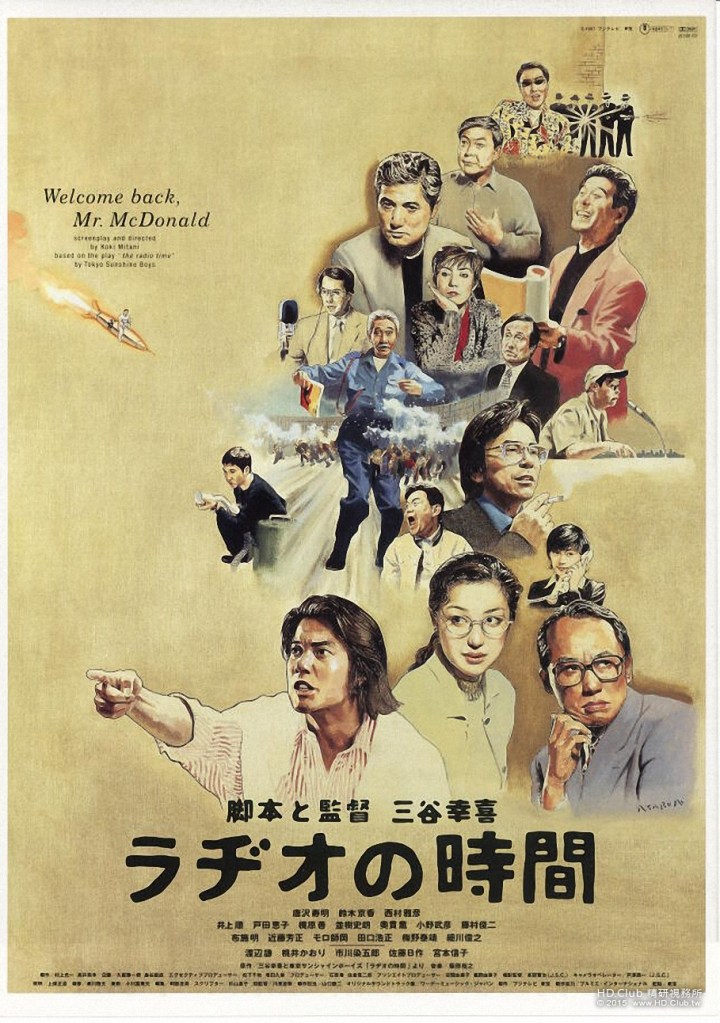
Welcome Back, Mr. McDonald (ラヂオの時間, Koki Mitani, 1997)

Welcome Back Mr. McDonaldKoki Mitani is one of the most bankable mainstream directors in Japan though his work has rarely travelled outside of his native land. Beginning his career in the theatre, Mitani is the master of modern comedic farce and has the rare talent of being able to ground often absurd scenarios in the  humour that is very much a part of everyday life. Welcome Back, Mr. McDonald (ラヂオの時間, Radio no Jikan) is Mitani’s debut feature in the director’s chair though he previously adapted his own stage plays as screenplays for other directors. This time he sets his scene in the high pressure environment of the production booth of a live radio drama broadcast as the debut script of a shy competition winner is about to get torn to bits by egotistical actors and marred by technical hitches.
Mild-mannered housewife Miyako Suzuki (Kyoka Suzuki ) has won a competition to get her radio play, titled “Woman of Destiny”, on air. A romantic tale of a bored housewife unexpectedly finding love at the pachinko parlour, her story may have a thin layer of autobiography or at least wish fulfilment but at any rate she is very close to her material. Unfortunately, “difficult” actress Nokko (Keiko Toda) has been foisted on the production crew due to entertainment world politics and objects to her character’s name because she once dated a married guy whose wife shared it. Eventually Nokko demands to be called something more interesting like “Mary Jane” (the irony!). At this point, all the other actors start wanting changes too and before you know it Miyako’s gentle tale of forbidden romance has become a gangster crime thriller set in Chicago filled with mobsters and tommy guns!

The writer is god, in one sense. Only, god has been locked out of the room leading to total chaos. Each small change necessitates a series of other changes and seeing as this is all being done live and on the hoof, no one is quite thinking through the implications of each decision. When the actor playing “Mary Jane’s” love interest suddenly goes off book and declares his name is “Donald McDonald” (inspired by left over fast food cartons) and he’s a pilot not a fisherman as agreed (though why would a fisherman be in the mountains of Chicago anyway?), everything goes completely haywire eventually ending up in an outer space based love crisis!

If all this wasn’t enough, someone has also wandered off with the key to the sound effects machine which would be fine if they hadn’t added all the gangster shenanigans in the first place. The show’s producer, Ushijima (Masahiko Nishimura), explains to Miyako at one point that radio has a very important advantage over visual media as you really can do anything even on no budget because your biggest resource is your audience’s imaginations. He has a very real point, though the completely bizarre saga of “sexy female lawyer” Mary Jane, her “Nasa Pilot” (a quick save after “Donald’s” plane is reported missing and someone remembers this slot is sponsored by an airline) true love, and her husband who for some reason is a random German named Heinrich is going to require a significant suspension of disbelief from the confused listeners at home.

As a theatre practitioner Mitani is an expert at creating ensemble comedy and even though he is playing with a large cast and a fast moving environment each of his characters is extremely well drawn. We see the shy writer beginning to lose heart after her story is shredded by the unforgiving production environment whilst also trying to persuade her husband who has turned up unexpectedly to go home before he figures out her script is suspiciously close to their real lives. We also see the production team frantically trying to fulfil their obligations so they can avoid getting into trouble with the higher ups and finally go home for the day. Ushijima is caught in the middle, surrounded by nonchalant yes men and lazy bosses, he’s desperately trying to compromise to keep everything on schedule whereas the jaded director just wants to do his job as written. However, it’s the director who is ultimately most moved by Miyako’s script and eventually decides it does deserve the happy ending that Miyako has been longing for.

By the end of the recording, something of the old magic has returned to the otherwise work-a-day world of the radio studio. They’ve even brought back old fashioned foley effects and retrieved the old school sound guy who’d been relegated to playing his gameboy in the security booth because no one needed his expertise anymore. Nothing went as planned, but everything worked out in the end and it’s happy endings all round both in the real world and in the completely surreal radio play. They might even do a sequel!

Mitani breaks the action every now and then to take us outside of the studio environment and into the cab of a petrol tanker being driven by a strangely dressed trucker (in a brief cameo from Ken Watanabe, no less!) who keeps trying to change the channel for more country influenced Enka but finds himself enthralled by the strange tale of the true love between Mary Jane and Donald mcDonald. We might not be quite as moved as he is, having been party to all the backstage goings on, but we have perhaps laughed more than cried through the almost screwball comedy and farcical set up of Mitani’s spot on depiction of the less than glamorous workings of the fast paced live production environment.


English subtitled trailer:

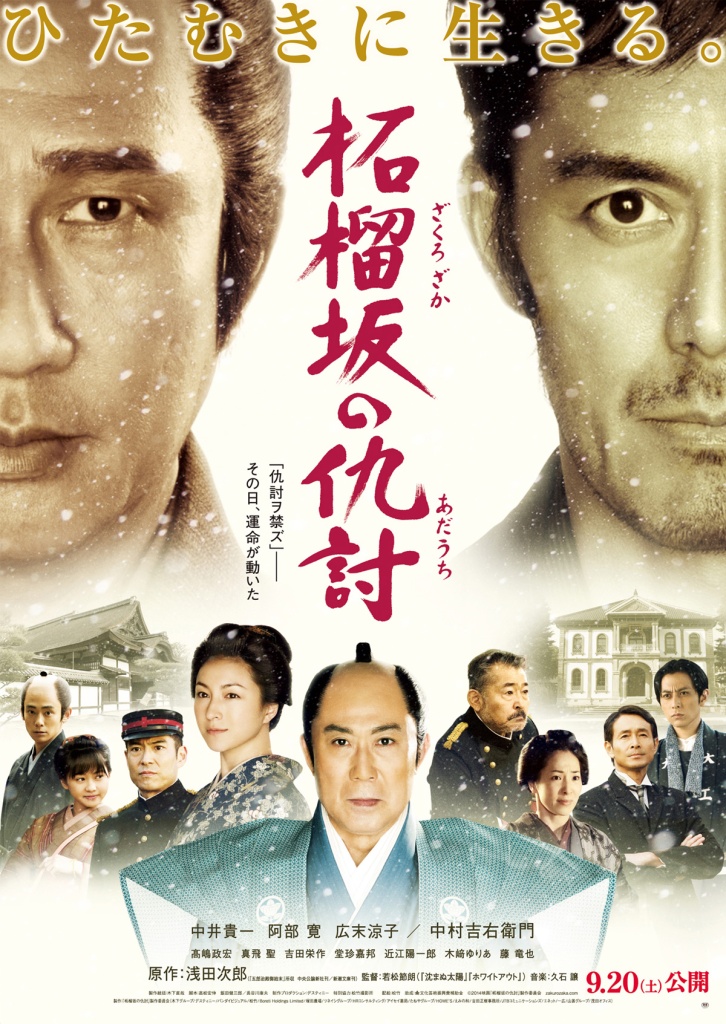
Snow on the Blades (柘榴坂の仇討, Setsuro Wakamatsu, 2014)

Snow on the Blades 2Times change, and men must change with them or they must die. When Japan was forced to open up to the rest of the world after centuries of isolation, its ancient order of samurai with their feudal lords and subjugated peasantry was abandoned in favour of a more Western looking democratic solution to social stratification. Suddenly the entirety of a man’s life was rendered nil – no more lords to serve, a man must his make his own way now. However, for some, old wounds continue to fester, making it impossible for them to embrace this entirely new way of thinking.

Kingo is one such man who finds himself frustrated by history in Setsuro Wakamatsu’s adaptation of a novel by Jiro Asada, Snow on the Blades (柘榴坂の仇討, Zakurozaka no Adauchi). In 1860 (as we count it) he married a beautiful young woman and received a promotion as the bodyguard for his lord, Ii Naosuke. However, one fateful day his progressive master is ambushed by a rival clan making a pretence of arriving with a petition that needs to be heard. Kingo and his men fail in protecting their lord and though many of the survivors commit suicide in shame, Kingo is charged with finding the remaining perpetrators and exacting his revenge. His quest spans almost fifteen years of turbulent Meiji era history as he trudges all over Japan looking for rumours of men who no longer quite exist all the while a lonely wife waits for him at home, becoming the sole breadwinner for this new life of forced “equality”.

The man Kingo has been looking for, Naokichi, is also living an unfulfilling life, hiding from retribution but also from himself and his own remorse over the deeds of a young man whom he no longer recognises. He has the possibility of building a new life with a local widow and her sweet little daughter who’s taken a liking to him, but like Kingo he’s held frozen by the old ways and can’t quite allow himself to bring a woman and child into his life of shame and fear.

Both men have been left behind by history. Kingo is the more obvious relic with his anachronistic top knot and old fashioned Japanese dress but Naokichi is also unable to move forward until he faces his past. For much of the running time Snow on the Blades plays out like a conventional mystery or revenge tale with Kingo on the road trying to track down those who he believes wronged his master in an attempt to atone for his failures through vengeance, but all that awaits him at the end of his journey is a lonely grave. The problem is, he liked his lord who was good and progressive man, filled with kindness and poetic sentiments. His regret over not being able to save him is more than failed duty, it is also personal grief and guilt though he finds little comfort in pursing those he believes to responsible.

Having spent thirteen years striving for something Kingo suddenly finds himself adapting to the times and beginning to believe perhaps this isn’t what his lord would have wanted anyway. Both men, confronted by each other and by several different kinds of history, are forced to face themselves as they are now and as they were then and assess what all of these codes and honour systems are really worth. Snow on the Blades is often beautifully photographed and filled with scenes as lovely as any woodblock painting but, it has to be said, somewhat dull as its central psychological dramas fail to ignite. Impressive production values and universally strong performances from its high profile cast lift the film above its fairly generic narrative but can’t quite save it from its rather trite message and run of the mill period drama aesthetic.


The assassination at Sakuradamon or Sakuradamon Incident is a real historical event in which the Japanese Chief Minister Ii Naosuke was murdered by ronin samurai working for the Mito clan outside the Sakurada Gate of Edo Castle in 1860. Ii Naosuke was a leading proponent of opening up to foreign powers (albeit as a sort of defense mechanism) but made an enemy of just about everyone through his tyrranical actions and was a very unpopular figure at the time of his death though his image has now been somewhat rehabilitated.