

After centuries of conflict, two feuding countries finally begin to put the past behind them to work for a common future in Kotono Watanabe’s animated fantasy romance, Gold Kingdom and Water Kingdom (金の国 水の国, Kin no Kuni Mizu no Kuni). Adapted from the manga by Nao Iwamoto, this is very much a story of coming together to create a better future for all in which it’s always better to follow the most difficult path if it leads to longterm peace rather than opting for a quick fix like a dynastic marriage that won’t take place for another fifty years.
In this case, the dynastic marriage actually works out but only because romantic heroes Sara (Minami Hamabe) and Naranbayar (Kento Kaku) end up meeting by chance and falling in love organically despite the class disparity and cultural differences between them. The kingdoms of Alhamit and Balkari had been feuding in part for the petty reasons of a dog and cat respectively doing their business on the wrong side of the border wall erected after previous war. Neither nation being very much interested in the dynastic marriage proposed by the previous generation in which Alhamit would give its most beautiful woman as a wife to Balkari’s cleverest man, Alhamit sent a cat instead while Balkari sent a dog. Poor Balkari engineer Naranbayar simply laughed off his new “bride” while Princess Sara of Alhamit decided to go along with the ruse knowing that to kick up a fuss would likely send both nations back to war.
They happen to meet when Sara transgressively ventures beyond the wall in search of her dog, Lukman, who has fallen in a hole in the forest. With her pretty sisters needling her, Sara asks Naranbayar to pretend to be her new husband, little realising that he is the man she is intended to marry. The youngest of four sisters, Sara has always felt inferior and fears that she cannot live up to the title of Alhamit’s most beautiful woman but begins to fall for Naranbayar who is in fact very clever but also kind in the way most of her family aren’t. Naranbayar genuinely cares about the people of Alhamit and quickly works out that in this incredibly wealthy, “golden” desert city they will run out of water within 50 years while water is something the poor nation of Balkari has in abundance.
An alliance will save the lives of people in Alhamit, but also also benefit those of Balkari in boosting its economy but not everyone is motivated towards a diplomatic solution with many in the court clearly agitating for war in which they would simply conquer Balkari to capture its resources. The King is under pressure in thinking of his historical legacy, not wanting to be seen as a weak monarch as his namesake earlier was in having restored with relations with Balkari rather than seeking to dominate it militarily. Under the sway of potentially corrupt shaman Piripappa (Chafurin) he rules with an authoritarian fist, while his haughty daughter Leopoldine (Keiko Toda) has appointed a handsome actor as an advisor to signal her opposition.
Only through the genuine love which emerges between Sara and Naranbayar can the country be saved in turning away from pointless acrimony towards a more open future marked by mutual cooperation and friendship between two equal nations. Through falling in love with Naranbayar, Sara grows in confidence and learns to see herself as beautiful no longer inferior to her sisters but playing a full part in the life of the court as they work together to solve the water issue and return life to their arid land. Beautifully designed with its Middle-Eastern aesthetics and strong contrast between the desert kingdom of Alhamit and the beautiful forests of Balkari, the film also features charming paper art bookends and a watercolour credits sequence depicting a happier future for both nations as they forge a new society together. Heartfelt in its central romance, Watanabe’s charming love story positions cross cultural connection as the best means of overcoming centuries of pointless conflict along with allowing each of its heroes to become more of themselves as they work together to create a new world of love and peace in which all can prosper and live in happy harmony.
Gold Kingdom and Water Kingdom screened as part of this year’s Nippon Connection.
International trailer (English subtitles)

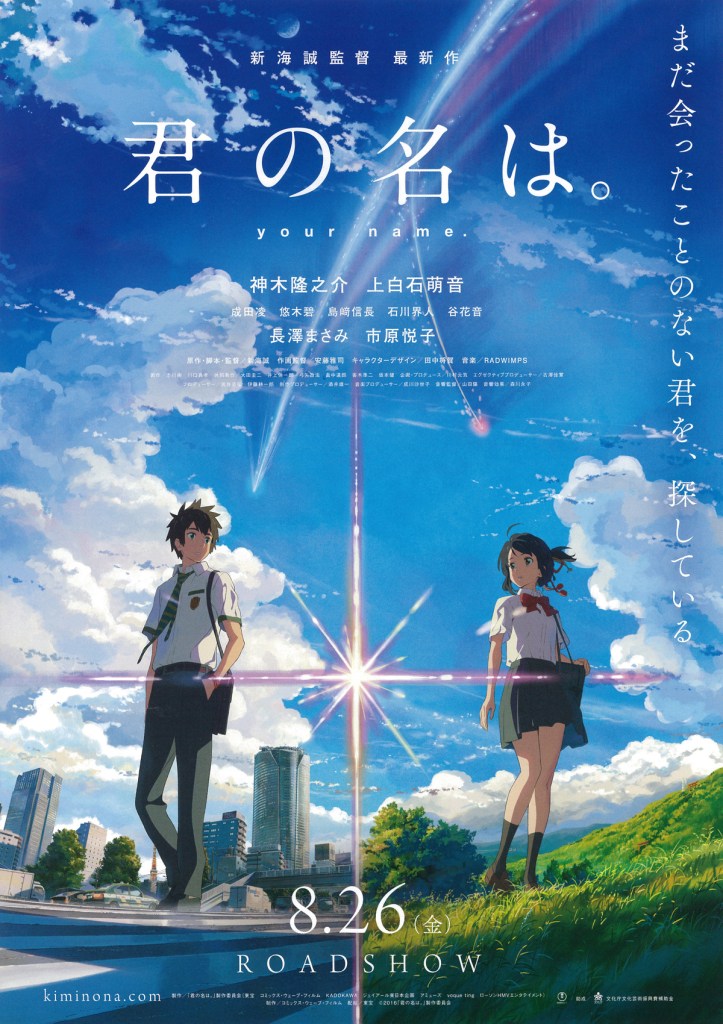 Indie animation talent Makoto Shinkai has been making an impact with his beautifully drawn tales of heartbreaking, unresolvable romance for well over a decade and now with Your Name (君の名は, Kimi no Na wa) he’s finally hit the mainstream with an increased budget and distribution from major Japanese studio Toho. Noticeably more upbeat than his previous work, Your Name takes on the star-crossed lovers motif as two teenagers from different worlds come to know each other intimately without ever meeting only to find their youthful romance frustrated by the vagaries of time and fate.
 Windows on Worlds