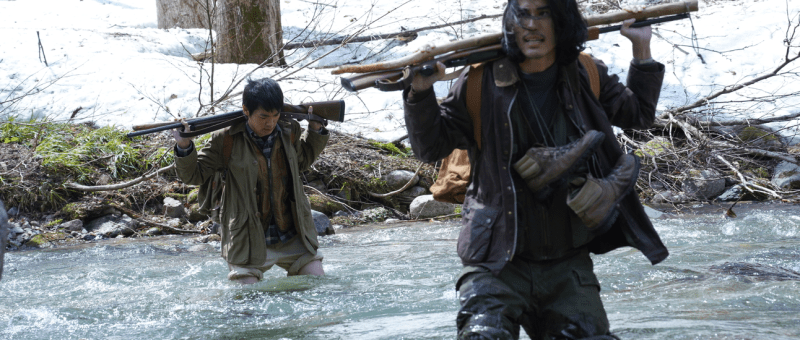
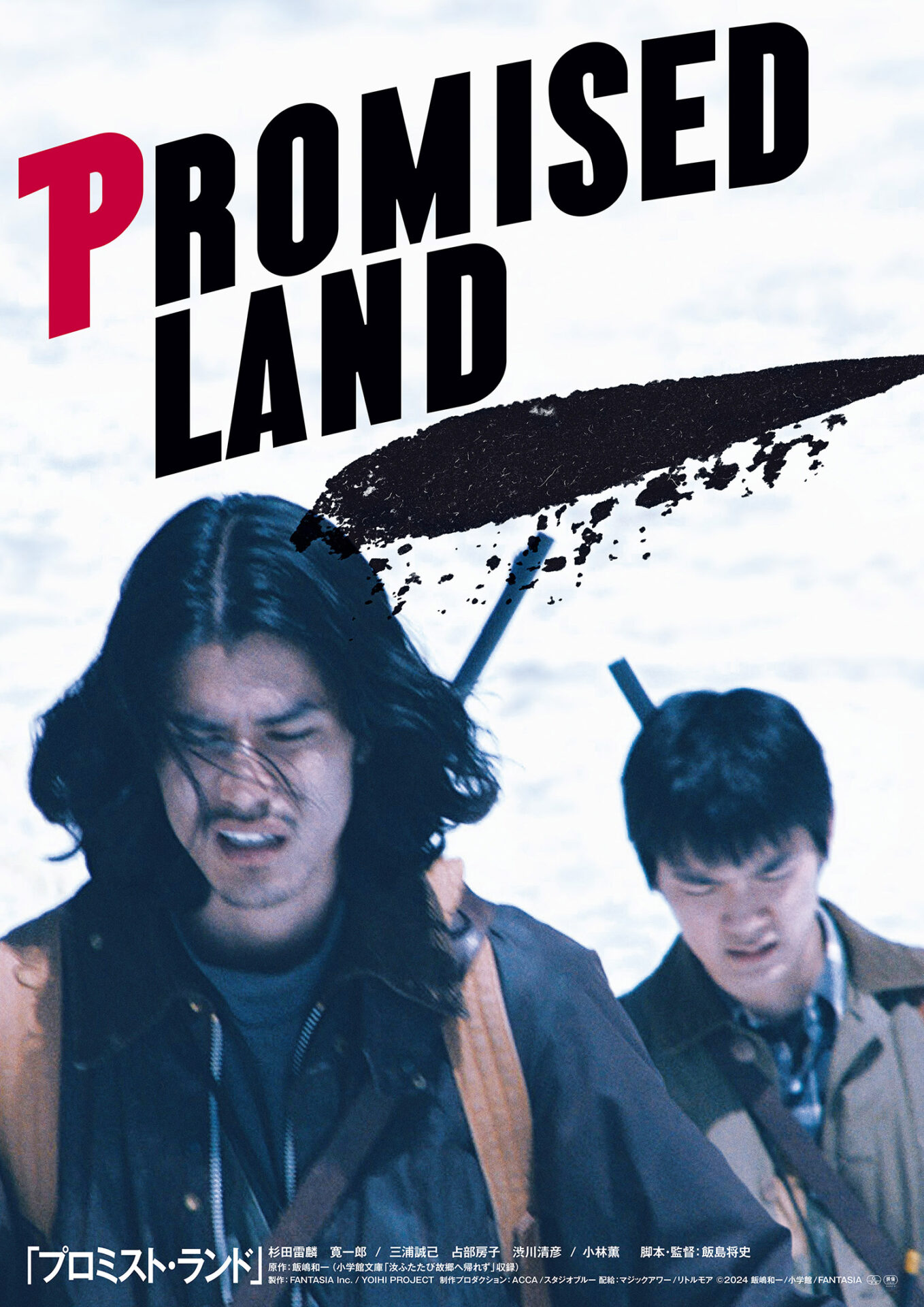
An avalanche approaches a small town in Japan, a harbinger of change in which the centuries old practice of bear hunting has finally been put to rest by government directive. The buried question at the centre of Masashi Iijima’s Promised Land (プロミスト・ランド) is who exactly that land has been promised to and what the rights and responsibilities surrounding it are in the midst of a changing society in which there may longer be a place for the hunter.
Some might argue that there shouldn’t be, and it has to be said this is one ancient tradition that’s increasingly hard to defend. Set in 1983, the film finds the “Matagi”, or traditional hunter, already all but extinct even before the head of the local association (which appears to only have five members) calls them all together and tells them the hunt is off for that year due to a preservation order by local government. One of the younger members, Rei (Kanichiro), immediately objects sensing that if the hunt is canceled this year it will never be held again. He says he thinks it’s unfair as it’s industry encroaching on the forests that has led to a decrease in the bear population rather than overhunting while another of the men takes constant pops at rich men from the city who come in and treat hunting like a hobby failing to abide by any of their rules such as not shooting mothers with their cubs.
The hunters seem to think of themselves as keeping nature in check, “culling” the bears to keep the mountain safe though there’s no sign that they are any real danger to humans and anyway their numbers are now depleted. There doesn’t seem to be any other way to defend this practice outside of tradition, but it’s evidently something very important to Rei, important enough to constitute a large part of his identity. Thus he alone is determined to defy the order and kill a bear anyway even though he knows there’s a good chance of going to prison for illegal hunting and being branded a poacher.
Rei ropes in Nobu (Rairu Sugita), a childhood friend who apparently owes a debt to him having received a blood transfusion from him when he was four and now deeply resents having that fact wielded against him all these years later. Unlike Rei, Nobu is a much more modern young man whose father makes fun of him for wearing fashionable clothes and perfume. He hates working on his father’s farm and longs to escape the moribund small town and its brutal traditions such as the bear hunt he’s been roped into since birth just because like many things his ancestors always did it. While hunting for a bear, the pair have an opportunity to talk, Rei admitting that hunting and the gun represent for him the essence of the man he once was while reeling from the breakdown of his marriage to a woman he failed to support when she failed to fit in to village life. He recounts the story of a banker he did some work for who says that he envies the freedom of his life as a landscape gardener while he sits in a prison all day counting other people’s money but when he asks him why he does’t give it a try the man just backtracks and starts making excuses.
Rei seems to be wondering what true freedom means and perhaps feels he doesn’t really have it, asserting dominance over the mountain by killing the bear to regain control over his life. He calls the bears a gift from the mountain god as if they existed only for him to kill, though it’s difficult to see why his tradition or need for raw masculinity is worth more than a living creature’s life. When he eventually kills a bear, the film hovers on the ritualistic quality of the act as Nobu and Rei bend over the body, wafting it with leaves, and skinning its pelt before drinking its blood. This is an act of cruelty more of necessity. They have no need of the pelt or meat, do not make a major part of their income from selling them, and the bear did not threaten them. This is in short a tradition that can safely be left by the wayside, but by the film’s conclusion the two men seem to have switched positions Rei now pondering leaving the village while Nobu seemingly has a renewed desire to stay and preserve these old traditions. Perhaps it is his promised land after all, or else was intended to exist for the bears as creatures of nature free from the destructive forces of humanity.
Promised Land screened as part of this year’s Camera Japan.
Original trailer (no subtitles)
 Windows on Worlds