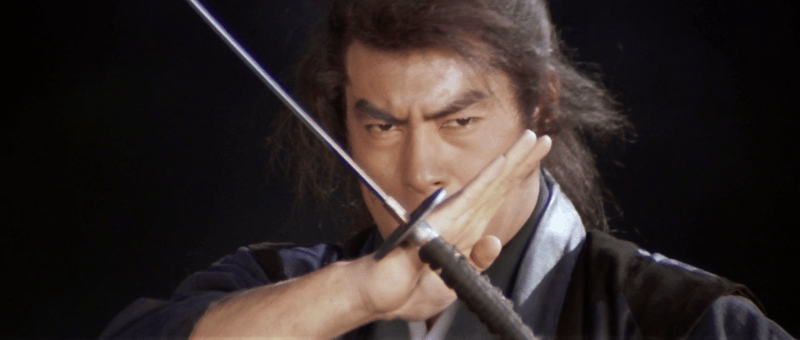
Haunted Samurai (土忍記 風の天狗, Keiichi Ozawa, 1970)

An exiled spy is confronted by the cruel inequalities of the feudal era in Keiichi Ozawa’s possibly mistitled ninja drama Haunted Samurai (土忍記 風の天狗, Doninki Kaze no Tengu). There is a kind of fatalism that follows him, and he is in some senses haunted not only by men like himself charged with the neutralisation of a deserter but by the ills of a corrupt society, though the only ghost here may be himself. Based on a manga by Goseki Kojima who illustrated Lone Wolf and Cub, the film ultimately suggests that to be a good man necessarily means to walk alone as a melancholy exile from a society founded on greed and power.

Indeed, Rokuheita’s (Hideki Takahashi) sole desire is to live a “simple and decent” life as an ordinary farmer. The film opens with him squaring off against a childhood friend, who is also his sister’s love interest, having been ordered to execute him for deserting from their ninja clan. His friend no longer wants to live “like a beast”, and so there’s nothing more either of them can really do in this situation. Rokuheita carries out his duty, and his sister takes her own life in despair. When he’s given another similar mission, he questions it but again resolves that he has no real choice. Only he discovers that his target, Ushizo (Yuji Odaka), has chosen to desert after marrying and having a child. When his family suddenly show up just as he’s contemplating delivering the final blow, Rokuheita decides to let him go warning Ushizo that the Yagyu will never give up and he’ll be haunted all his life so he should try to live it well for as long as it lasts. 

But this also makes Rokuheita an exile too, himself now a target and on the run from the Yagyu and his clan. On his travels, he runs into a small family who’ve been attacked by bandits while returning from town to buy wheat seeds because their harvest has failed in the drought and they’re facing onerous taxes from an unforgiving lord. Rokuheita decides to stay in the village hoping to become an ordinary farmer but is regarded with suspicion by some because of his samurai status, while there is also another samurai exile in town, Tarao (Seiichiro Kameishi) who first worked hard to be a part of the community but has since become lazy and aloof.

Tarao is also suspicious of Rokuheita but mostly fearing that either he’s come to make trouble for him or is a fugitive who will lead trouble their way. Unlike Rokuheita, Tarao was kicked out of his clan for stealing and now lives a slightly disreputable life made all the more so by his attempts to pan gold from the local river. Rokuheita fears that if the villagers find out about Tarao and the gold it will only cause chaos and the obsession with easy riches will in the end be much worse for them than the famine. Even Tarao’s wife Oryo (Utako Shibusawa) insists they’ve already got plenty to live on and should simply go somewhere else to lead a quiet life but Tarao wants more, his hand reaching out for his purse even while attacked by corrupt retainers themselves intent on discovering the gold and keeping it a secret from their lecherous lord. 

The retainers have been taking one life for every bale of “hidden” rice, carting off young women from the village to place into sexual slavery. Rokuheita tries to teach the villagers how to skirt the feudal order by secretly farming on rough terrain to evade taxes and ensure their own food supply, but this simply incurs harsher penalties even as one of the young men points out hungry farmers can produce nothing at all. Yet there’s nothing Rokuheita can really do for the villagers because it is the feudal order which is most at fault, an order which his ninja clan supports through their spy activities. The man who tracks him, Matahei (Isao Natsuyagi), says he does so as a means of appeasing the Yagyu and protecting his home territory from them but to do he must choose a lesser evil in killing those who have chosen to try to live “simple and decent” lives outside of this system.

Ozawa brings them together in a supernaturally charged conclusion which takes place during a solar eclipse marked by the eerie winds of the Japanese title but finds them both defeated, left with only the melancholy acceptance of their rootlessness as men who will always be pursued by the invisible hands of the feudal order. Utilising wuxia-esque jump cuts to recreate the ninja magic of Rokuheita’s spy craft along with a degree of surrealism in the underwater sequence in which he is attacked by a band of topless female ninjas the film seems to edge towards a more contemporary reading of jidaigeki and not least in the unexpected violence of its final scenes.
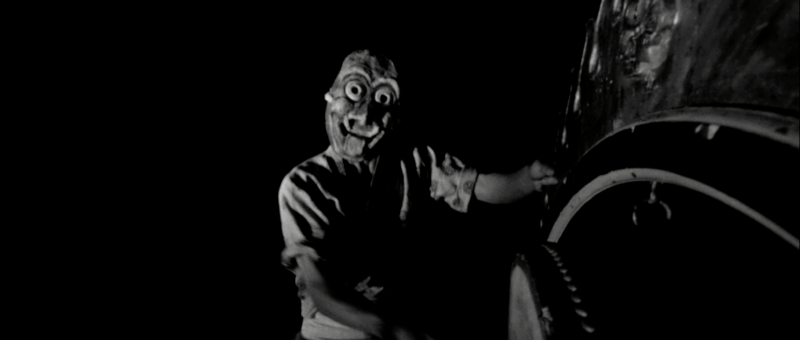

Mandala (曼陀羅, Akio Jissoji, 1971)

Mandala jissoji poster 2Politically speaking, the Japan of 1971 was trapped in a kind of limbo. The student movement had been dealt a serious blow with widespread supressionary measures in the run-up to the renewal of the ANPO treaty in 1970, which was finally signed despite opposition. It was not, however, yet dead and would stumble on, losing its way, until the climactic events of Asama-Sanso in 1972. Following hot on the heels of his radical This Transient Life, Akio Jissoji’s second film for ATG Mandala (曼陀羅) finds him exploring just this conflict as two young men look for “utopia” in an escape from the tyranny of time.

Kyoto uni students Shinichi (Koji Shimizu) and Hiroshi (Ryo Tamura) have taken their girlfriends to a strange little beachside inn for a spot of wife swapping. Where Shinichi’s girlfriend Yukiko (Akiko Mori) is only too happy to oblige her boyfriend’s whims, Hiroshi’s squeeze Yasuko (Ryo Tamura) goes along with it but instantly regrets her decision. Meanwhile, unbeknownst to them, the couples are being spied on by weird ultra-Buddhist cult leader Maki (Shin Kishida) who comes to the conclusion that Shinichi and Yukiko are good candidates to add to their commune which is built around the concepts of agriculture and eroticism. Maki’s violent recruitment method is knocking out the guys and then subduing the women so they can be raped by cult members and thereby inducted.

Maki’s strange philosophy which posits a new “utopian” future born of a return to a more primitive way of life in which love does not exist and sex is a free and natural act whose only purpose is reproduction, wins an acolyte of Shinichi because of its key offering – the ability to stall time. Always looking for a way to be dead yet alive, Shinichi is obsessed with the idea of stillness. Movement is the image of time passing. Coming to and finding the comatose, naked body of Yukiko lying on the beach after being raped by Maki’s minions, Shinichi cannot resist the urge to have sex with her “lifeless” body (which she apparently consents to, playing dead even after regaining consciousness part way through). Yukiko too confesses her own fantasy of being ravished as a corpse, a body outside of conscious time.

Shinichi, proclaiming he no longer believes in the future or in that a classless anti-State will ever arise, leaves the struggle and joins Maki’s atavistic utopia to which only those who “deny time and history” are permitted. Hiroshi, meanwhile, berates him for betraying the “continuous revolution” while he himself is on the run having left university after a disagreement with his Trotskyist protest group. The two men are each fleeing the centre and heading in different directions if perhaps ultimately bound for a similar destination. A hyper individualist, Hiroshi declares that there is no such thing as mankind, only a confluence of individuals, with the exception perhaps of those who have dedicated themselves to religion. He doesn’t want the child that Yasuko is carrying, not because he fears it may be Shinichi’s, but because he does not see the point in contributing to “the multiplication of mankind”, which is a key tenet of of Maki’s primitivist manifesto.

Unlike Hiroshi, Yasuko is not seeking revolution but conventionality. She wants the baby, and perhaps a marriage. At the end of her tether, having suffered horribly at the hands of Maki’s minions, she draws a small cottage with a friendly bird flying above as if to symbolise the simple dream that has been destroyed by the cruelty of men. Too late, Hiroshi realises that his irritation with Yasuko was simply a reaction against the shadow of himself he saw reflected in her, and he cannot forgive those who have caused her harm.

Harm there is plenty. Maki’s vile philosophy, overseen by his shaman wife (Yoshihiro Wakabayashi), supposedly the embodiment of many gods, strips women of their right to autonomy, insisting that “love” is an unwelcome modern sophistication which should be replaced by “benevolence” in an egalitarian affection for all mankind. In “ancient times”, he says, a woman would willingly submit to a man and, therefore, there was no such thing as “rape”. “A woman’s silence and resistance make a man a rapist” he tells his minions while Shinichi is busy raping the latest kidnap victim in a room equipped with CCTV for Maki to watch from behind a screen. His tenet of fecundity, both in terms of agriculture and human reproduction, comes at the cost of basic human decency and reduces the role of women to mere vessels for men’s desires.

Throughout the history of Japanese cinema, “love” has indeed been the destabilising, individualising force which threatens the social fabric, but for Maki it serves as a palpable evil. Like Hiroshi, he too believes that men exist as individuals, but also that “benevolence” could raise them to become a “community”. Hiroshi wants to live in a world of revolution, free of charisma and religion, but Shinichi seems to have found peace in atavistic simplicity. Faced with the choice, Hiroshi again chooses individualism, declaring that he would rather die alone than go mad along with everyone else. Yet his frustration may perhaps take him to a dark and unexpected place that sees him pick up a sword and a copy of the Manyoshu as if on some sort of nationalistic mission of revenge against an intransigent government and society. Revolutions fail, and then they start again. Hiroshi has perhaps picked a side, even if that side is merely opposition, but what he’s chosen is movement, action, maybe even life however fleeting, over the cold meaninglessness of Maki’s grand plan for a primitivist utopia.


Mandala is the second of four films included in Arrow’s Akio Jissoji: The Buddhist Trilogy box set which also features an introduction and selected scene commentaries by scholar of the Japanese New Wave David Desser plus a 60-page booklet with new writing by Tom Mes and Anton Bitel.

Original trailer (English subtitles, NSFW)