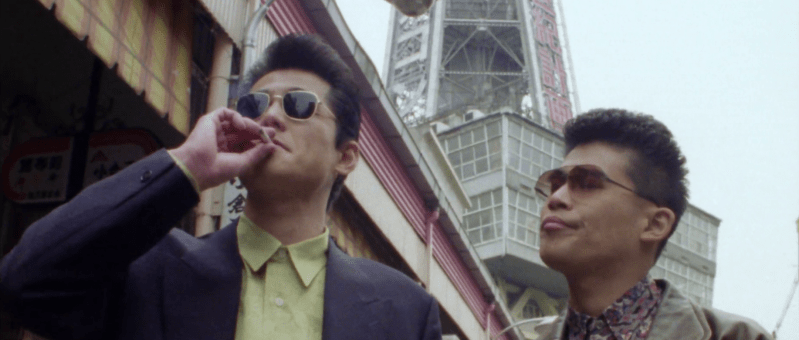
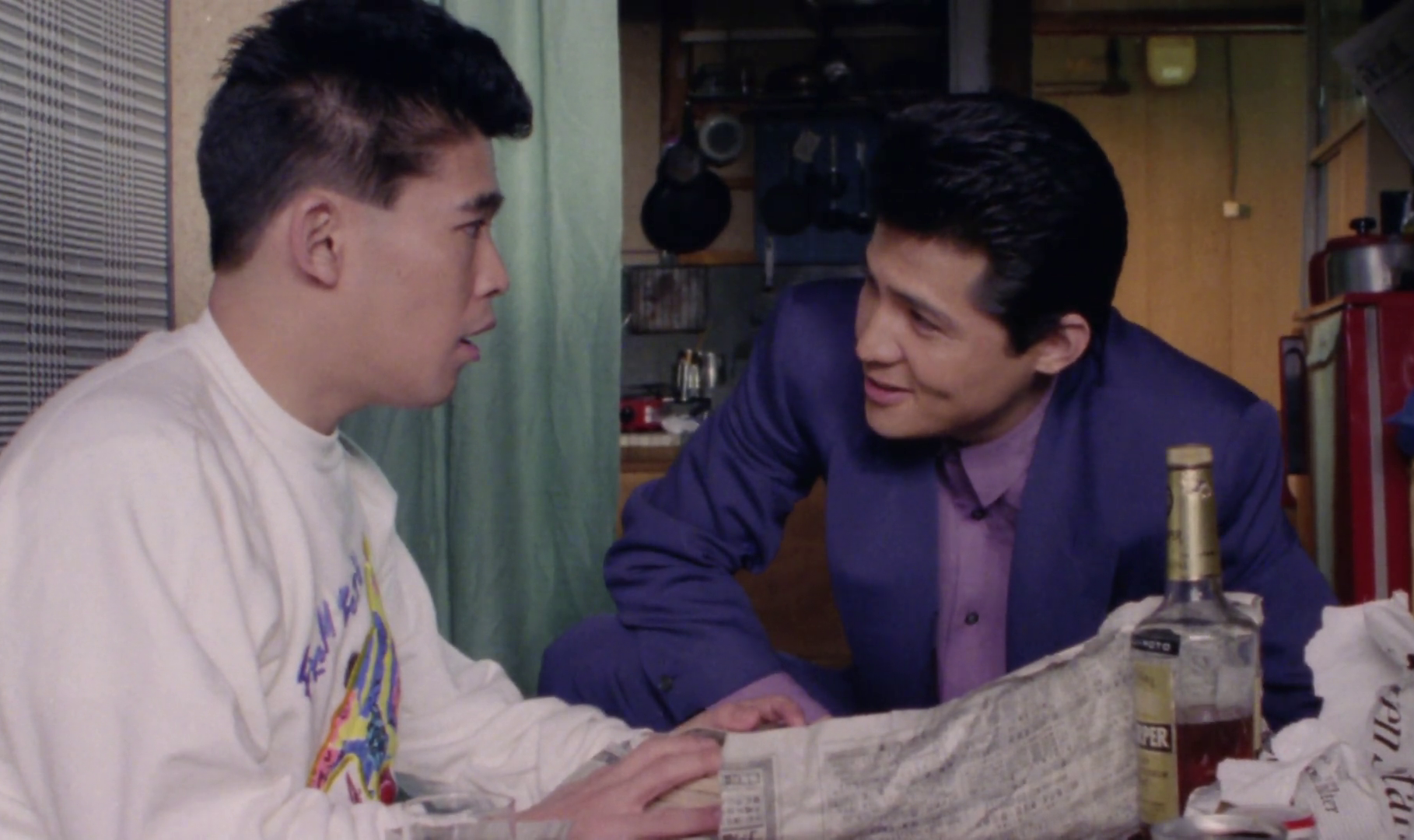
The King of Minami: Ginjiro Manda (難波金融伝 ミナミの帝王1 トイチの萬田銀次郎, Sadaaki Haginiwa, 1992)

“The one holding the money calls the shots,” according to a particularly sticky debtor in Sadaaki Haginiwa’s The King of Minami, though that turns out not quite to be the case. After all, though the money may be in his possession, technically it belongs to Ginjiro (Riki Takeuchi) and when they don’t return it to him, he begins to feel offended. Reflective of a kind of post-bubble malaise, the film has a rather cynical take on money and finance, but at the same time a weird kind of wholesomeness.

Ginjiro may be the King of Minami, but he sees himself as a saviour of the poor. Questioned by new underling Ryuichi, he brushes off concerns that people can be driven to suicide over debt by claiming that the loans he offers may save their lives. But though Ginjiro may claim to be somehow better than his yakuza counterparts in refusing to resort to violence, he’s ruthless in other ways and certain that debts must be repaid. Once he’s cheated by an old man, Tokugawa, who refuses to pay the interest on his loan, Ginjiro knows theres’s no point pressing him and decides to go after his daughter instead. She, however, has already maxed out all her card trying to save her dad’s business. 

For his righteousness, explaining that he’ll never end up with sometime love interest Asako because a loan shark has no room for relationships, Ginjiro’s world is essentially misogynistic. Sent after a runaway bar hostess, Ginjiro tells Ryuichi that women always have ways of making money with a note of envy in his voice as if he resented this essential unfairness on behalf of impoverished men. Of course, this way of making money is open to them too, though they wouldn’t consider it and no one would put it forward as an option or view their body as a commodity that should be traded away when one has debts. He says something similar to Tokunaga’s schoolteacher daughter Machiko too, agreeing that night work is the way to make a lot of money relatively quickly. Machiko has, however, already been forced into sexual slavery by Narita, a rival yakuza loanshark, who extorts sexual favours in lieu of money. 

Young Ryuichi is quite touched by her story and even falls in love with her a little bot despite Ginjiro’s warnings that a loanshark can’t afford to let his emotions overcome his reason. Even if he remains willing to make Machiko pay for her father’s transgressions, Ginjiro is equally angry with Tokunaga for rejecting this essential law that money should always find its way to its point of origin. Taking him to task for his immoral vices such as a gambling addiction that’s ruined his business, finances, and relationships, Ginjiro tells him that he ought to pay his debts himself rather than push them on his daughter. He seems to have contempt for people who do this to themselves through what he sees as their own poor choices, but less so for those like Machiko who end up needing his services through no fault of their own or an ironic sense of indebtedness to someone else.

In any case, he stands a kind of counter to those like Narita who only want to exploit people’s weaknesses and use violence to get their way. The two of them end up in a financial sparring match as Narita sets Girjio up with a deliberately bad debt, while he, in turn, masterminds a counter scam under the tutelage of his “financial teacher” who knows all sorts of underhanded ways to make money like selling land that doesn’t belong to you. One could say that he’s teaching Ryuichi all the wrong lessons, but then his behaviour is more roguish than dangerous and he’s obviously more morally righteous than the sneering Narita who seems to feed off human pain so it’s satisfying to see him win and humiliate the predatory yakuza. Ginjiro agrees that it’s a sad world in which people die over money, but, at the same time, has a healthy disregard for it. He tells Ryuichi that he should think of money in the same as a greengrocer thinks of vegetables and that he needs to lose his reverence for it if he’s to make it as a loanshark. That might, after all, be how he became the king of Minami, laughing at the ridiculousness of a world in which those with money call the shots while simultaneously holding all the cards himself.

Evil of Dracula (血を吸う薔薇, Michio Yamamoto, 1974)

Evil of Dracula posterThe first two of Michio Yamamoto’s “vampire” movies for Toho made a valiant attempt to repurpose the idea of the bloodsucking ghoul to explore something other than their usual reason for being. In The Vampire Doll, the vampiress at the centre was a knife wilding, grudge bearing ghost of vengeance in keeping with the familiar image from Japanese folklore. In Lake of Dracula, Dracula was (uncomfortably) a bearer of bad blood and a symbol of the destructive capabilities of a repressed memory. Evil of Dracula (血を吸う薔薇, Chi wo Su Bara) takes us back to source as this time Dracula really is a sex crazed, bloodsucking maniac with a sideline in strange ambitions which include being the headmaster of an all girls’ high school in a no horse town somewhere in the frozen north.

Professor Shiraki (Toshio Kurosawa) gets off the train in a tiny provincial town but there’s no welcoming party there to great him. The station seems to work on an honour system and he drops his money in the box, but when Shiraki walks past the ticket office there is an employee, only he seems to be allergic to customers. The attendant gruffly explains that there are no busses running today and goes back to his paper, leaving Shiraki to wonder what to do next. Someone from the school he’ll shortly be working at eventually comes to fetch him but Mr. Yoshii (Katsuhiko Sasaki) is a bit strange too. It’s nothing, however, next to his new employer (Shin Kishida) whom, he learns, was widowed a few days ago when his wife died in a terrible car accident. In fact the headmaster’s wife is still at rest in the cellar – a “local custom” apparently demands holding off on burial for seven days while praying for the deceased’s “resurrection”. Shiraki is surprised to learn from the headmaster that he is being groomed as a potential successor which is why he asks him to stay over so they can get to know each other better. Whilst there, however, Shiraki has a “dream” in which he’s attacked by (he presumes) the headmaster’s wife and another much younger woman dressed in blue…

Evil of Dracula situates itself neatly in the middle of the girls’ school exposé, upping the camp factor with its overexcited adolescent girls apparently chomping at the bit for a little male attention. Shiraki is the new psychology teacher and one would expect him to be a paragon of ethics and an astute judge of character. He is, however, very much of his time and has a distinctly ‘70s approach to sexual politics. When the girls, flirting with him while he (refusing to deflect) appears flattered, complain to him about the “creepy” Mr. Yoshii who keeps leering at them from behind chainlink fences, he tells them Yoshii can’t be blamed because the girls are all so pretty to which they giggle and turn coy. Of course, they’ve all instantly fallen in love with Mr. Shiraki but unbeknownst to them there’s much more going on with creepy guys at the school than they could ever have guessed.

Shiraki finds out a girl recently went missing (apparently that’s something that happens often enough that no one thinks much of it), and can’t get it out of his mind that that’s the girl he saw in his “dream” even though he obviously didn’t know what she looked like. Meanwhile another of his charges, Kyoko (Keiko Aramaki), has turned pale and entered a semi-catatonic state. Her friends have agreed to stay behind and look after her while everyone else goes on vacation but Shiraki remains worried, especially as the school’s folklore obsessed doctor (Kunie Tanaka) has told him what happened to his predecessor.

Yamamoto goes back to source in partially blaming the girls for being led to destruction, allowing their nascent sexuality to pull them into the path of a supernatural evil rather than remaining chaste and innocent as schoolgirls should, punishing them for being flattered when Shiraki (with a slightly condescending air) tells them they can’t be annoyed by men looking them because that’s their fault too in being so very “pretty”. This time around the vampires like to bite their prey above the heart which takes us into the artier realms of exploitation as blood drips salacious from the girls’ bared breasts, though Yamamoto does his best to mitigate the sleaze factor by pushing a heavily romanticised gothic aesthetic complete with innocent white roses which ultimately turn a violent blood red once the vampires have had their way.

Once again, the “corruption” is foreign born though this time it has a Japanese catalyst, as folklore expert Dr. Shimomura explains. Long ago, a European washed up in Japan after a shipwreck, but he was a Christian when Christianity was illegal. He was persecuted, they made him betray his god and it turned him into a bloodsucking demon whose rage has lived on through a succession of Japanese hosts for more than a century. Why he particularly wants to be the headmaster of an elite girls boarding school in the middle of nowhere is never explained but it does at least seem to give him ready access not only to young and innocent victims, but also to weak willed minions.

The police, deciding vampires aren’t in their remit, declare themselves disinterested leaving Shiraki all that stands between the innocent young girls and the bloodsucking predator. The atmosphere is florid in the extreme, each frame filled with a macabre beauty as bodies fall artfully and vampires move with the elegance of dancers, but Yamamato also gives free reign to Hammer-inflected camp humour as hands almost wave from an open coffin behind the still unsuspecting Shiraki and the headmaster comes to a sticky end on the point of his own poker. Repeating the death motif from the second film which itself echoed Christopher Lee’s demise in the 1958 Hammer classic, romanticism is where Yamamoto chooses to end as his vampires decay, melting into skeletons but together, caught in one last gesture of an oddly eternal “love”.


Evil of Dracula is the third of three films included in Arrow’s Bloodthirsty Trilogy box set which also includes extensive liner notes by Jasper Sharp detailing the history of vampires and horror cinema in Japan.

Original trailer (no subtitles)