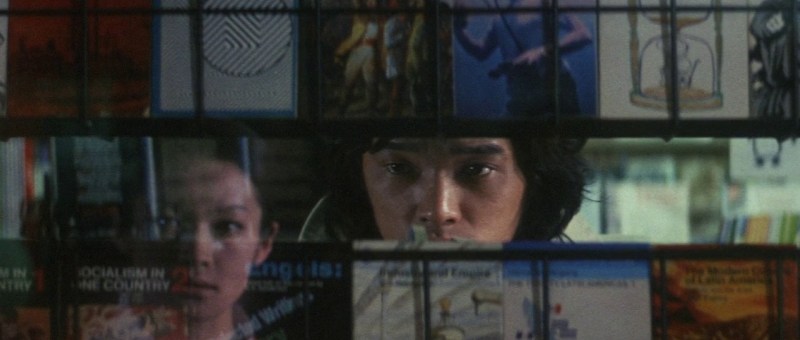
The Petrified Forest (化石の森, Masahiro Shinoda, 1973)

An angst-ridden medical student wrestles with truth and responsibility while drawn into a toxic relationship with a childhood friend and trying to avoid the estranged mother he resents in Masahiro Shinoda’s dread-laden melodrama The Petrified Forest (化石の森, Kaseki no Mori). Based on a novel by Shintaro Ishihara who later became a very conservative mayor of Tokyo and made his name with a series of “Sun Tribe” novels centring on the nihilistic hedonism of wealthy post-war youth, Shinoda’s noirish drama paints contemporary Tokyo as a duplicitous place in which hate is the only possible emotion and self-delusion the only path out of existential loneliness. 

Haruo’s (Kenichi Hagiwara) first conflict, however, is with the medical profession. He objects to the old-fashioned methods of his professor, Miyaji (Torahiko Hamada), who adopts the position of the physician as god only giving his patients the information he thinks they should have rather than the truth. A young boy, Kazuhiko (Masami Horiuchi ), is brought in with an aggressive brain tumour. Given how how quickly it regrows, there is a possibility that the boy cannot be cured while operating will likely mean he will lose his hearing. Though Miyaji knows all of this, he continues to give false reassurance to the boy’s mother, Kikue (Masako Yagi), even after making a snap decision on the table to excise the tumour knowing it will leave him deaf telling her that her son’s hearing might come back in time. Pressed for an answer, Haruo gives her the more honest prognosis that it “might”, “if he’s lucky”, but resents himself for “lying” knowing that Kazuhiko will be deaf all his life and the tumour may still recur. One of the reasons he wants Miyaji to tell the truth is so that the family can accept the situation and start working on the best ways to help Kazuhiko adjust, but Miyaji refuses to explain and in fact threatens to fire him if he won’t do as he’s told.

This resistance to a male authority figure might explain why he identifies so closely with childhood friend Eiko (Sayoko Ninomiya) now in Tokyo working at a barber’s offering male beauty treatments. Eiko is being sexually harassed by her middle-aged boss who is jealous and possessive. At one point she claims that he beat her and locked her up in a cupboard for two days after she told him she had slept with Haruo. The pair agree that he boss needs to die, rebelling against his corrupt and patriarchal authority. ”When you hate you must hate all the way” Haruo insists, explaining that the human race is “petrified”. They can only hate and loathe and lie to themselves in order to bear it. Haruo suggests they’ll eventually come to hate each other, but Eiko is certain that he’s her one exception though as will be revealed hate is eventually where they will end up. 

Fascinated by a high tech pesticide supposedly discovered by the Germans while they were testing poisonous gases but perfected by Japan Pharma, Haruo decides to use it poison to Eiko’s boss suggesting she put it in nail varnish and offer him a manicure. But once the deed is done he finds himself conflicted, unable to live with himself as a murderer which he now is seeing as he was present and applied the gauze soaked in the poison to the boss’ face while “treating” him after he had been “taken ill”. He distances himself from Eiko who irritates him by bringing over her hoover, somehow confused by her intention to move in now that they are married not least by their crime. Eiko, however, allies herself with his estranged mother Tatsuko (Haruko Sugimura) who is desperate to live with Haruo as it turns out by any means possible. 

There is an undeniable whiff of misogyny in the depiction of the two women, Eiko less damsel in distress than wilful manipulator and Tatsuko a classic overbearing mother though one apparently indifferent to her other two children including an apparently doting younger son. Haruo is caught between the two while otherwise drawn to Kikue in part because of her relationship with her son laying bare the apparent mother complex which defines his life as Eiko eventually points out calling him a coward who secretly craves his mother’s approval. Haruo’s resentment towards Tatsuko stems from having caught her with another man, his reaction both sexual jealously and puritanism unable to forgive for the transgression of adultery. Yet history later repeats itself, Kazuhiko who is at that point deaf walking in on Haruo and his mother. Haruo hugs him and covers his eyes only for the boy to later lose his sight and Kikue to go out of her mind wailing that she has destroyed her son through her sexual transgressions. 

Kikue had taken Haruo to a strange cult where she hoped Kazuhiko would be cured though he wouldn’t enter the church and later got into a conversation with the monk who is a former doctor but now believes medicine is a con because it cannot offer you salvation tacitly agreeing with Haruo’s assertion that doctors too are dishonest. This tendency to hate has rendered everyone lonely, Tatsuko’s daughter reminding her that she is lonely too even with her husband and children while Tatsuko later cruelly uses Eiko’s loneliness against her as a tool of manipulation. “Eiko trusted me too much” she explains, her attempt at female solidarity and forging a bond through their shared desire to possess Haruo obviously failing to overcome Tatsuko’s matriarchal machinations. The eerie blue colour of the poison vial, mirrored in the nebuliser forever used by Tatsuko, seems to loom behind them as a reminder of human loathing while mother and son are frequently caught in multiple mirrors in an echo of their duplicity yet in the end as Tatsuko says they share the same sin and it seems Haruo will never really be able to escape the matriarchal net.


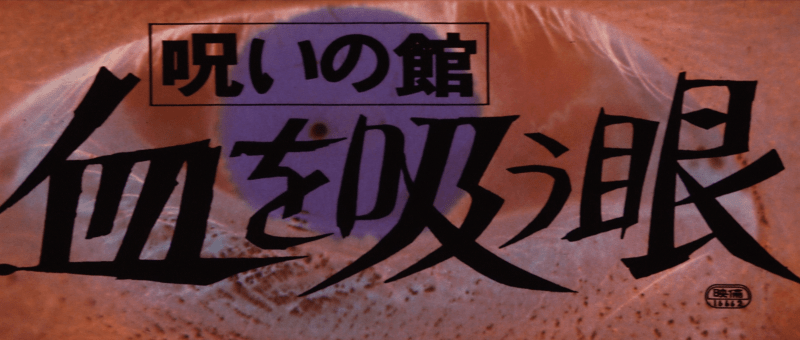
Evil of Dracula (血を吸う薔薇, Michio Yamamoto, 1974)

Evil of Dracula posterThe first two of Michio Yamamoto’s “vampire” movies for Toho made a valiant attempt to repurpose the idea of the bloodsucking ghoul to explore something other than their usual reason for being. In The Vampire Doll, the vampiress at the centre was a knife wilding, grudge bearing ghost of vengeance in keeping with the familiar image from Japanese folklore. In Lake of Dracula, Dracula was (uncomfortably) a bearer of bad blood and a symbol of the destructive capabilities of a repressed memory. Evil of Dracula (血を吸う薔薇, Chi wo Su Bara) takes us back to source as this time Dracula really is a sex crazed, bloodsucking maniac with a sideline in strange ambitions which include being the headmaster of an all girls’ high school in a no horse town somewhere in the frozen north.

Professor Shiraki (Toshio Kurosawa) gets off the train in a tiny provincial town but there’s no welcoming party there to great him. The station seems to work on an honour system and he drops his money in the box, but when Shiraki walks past the ticket office there is an employee, only he seems to be allergic to customers. The attendant gruffly explains that there are no busses running today and goes back to his paper, leaving Shiraki to wonder what to do next. Someone from the school he’ll shortly be working at eventually comes to fetch him but Mr. Yoshii (Katsuhiko Sasaki) is a bit strange too. It’s nothing, however, next to his new employer (Shin Kishida) whom, he learns, was widowed a few days ago when his wife died in a terrible car accident. In fact the headmaster’s wife is still at rest in the cellar – a “local custom” apparently demands holding off on burial for seven days while praying for the deceased’s “resurrection”. Shiraki is surprised to learn from the headmaster that he is being groomed as a potential successor which is why he asks him to stay over so they can get to know each other better. Whilst there, however, Shiraki has a “dream” in which he’s attacked by (he presumes) the headmaster’s wife and another much younger woman dressed in blue…

Evil of Dracula situates itself neatly in the middle of the girls’ school exposé, upping the camp factor with its overexcited adolescent girls apparently chomping at the bit for a little male attention. Shiraki is the new psychology teacher and one would expect him to be a paragon of ethics and an astute judge of character. He is, however, very much of his time and has a distinctly ‘70s approach to sexual politics. When the girls, flirting with him while he (refusing to deflect) appears flattered, complain to him about the “creepy” Mr. Yoshii who keeps leering at them from behind chainlink fences, he tells them Yoshii can’t be blamed because the girls are all so pretty to which they giggle and turn coy. Of course, they’ve all instantly fallen in love with Mr. Shiraki but unbeknownst to them there’s much more going on with creepy guys at the school than they could ever have guessed.

Shiraki finds out a girl recently went missing (apparently that’s something that happens often enough that no one thinks much of it), and can’t get it out of his mind that that’s the girl he saw in his “dream” even though he obviously didn’t know what she looked like. Meanwhile another of his charges, Kyoko (Keiko Aramaki), has turned pale and entered a semi-catatonic state. Her friends have agreed to stay behind and look after her while everyone else goes on vacation but Shiraki remains worried, especially as the school’s folklore obsessed doctor (Kunie Tanaka) has told him what happened to his predecessor.

Yamamoto goes back to source in partially blaming the girls for being led to destruction, allowing their nascent sexuality to pull them into the path of a supernatural evil rather than remaining chaste and innocent as schoolgirls should, punishing them for being flattered when Shiraki (with a slightly condescending air) tells them they can’t be annoyed by men looking them because that’s their fault too in being so very “pretty”. This time around the vampires like to bite their prey above the heart which takes us into the artier realms of exploitation as blood drips salacious from the girls’ bared breasts, though Yamamoto does his best to mitigate the sleaze factor by pushing a heavily romanticised gothic aesthetic complete with innocent white roses which ultimately turn a violent blood red once the vampires have had their way.

Once again, the “corruption” is foreign born though this time it has a Japanese catalyst, as folklore expert Dr. Shimomura explains. Long ago, a European washed up in Japan after a shipwreck, but he was a Christian when Christianity was illegal. He was persecuted, they made him betray his god and it turned him into a bloodsucking demon whose rage has lived on through a succession of Japanese hosts for more than a century. Why he particularly wants to be the headmaster of an elite girls boarding school in the middle of nowhere is never explained but it does at least seem to give him ready access not only to young and innocent victims, but also to weak willed minions.

The police, deciding vampires aren’t in their remit, declare themselves disinterested leaving Shiraki all that stands between the innocent young girls and the bloodsucking predator. The atmosphere is florid in the extreme, each frame filled with a macabre beauty as bodies fall artfully and vampires move with the elegance of dancers, but Yamamato also gives free reign to Hammer-inflected camp humour as hands almost wave from an open coffin behind the still unsuspecting Shiraki and the headmaster comes to a sticky end on the point of his own poker. Repeating the death motif from the second film which itself echoed Christopher Lee’s demise in the 1958 Hammer classic, romanticism is where Yamamoto chooses to end as his vampires decay, melting into skeletons but together, caught in one last gesture of an oddly eternal “love”.


Evil of Dracula is the third of three films included in Arrow’s Bloodthirsty Trilogy box set which also includes extensive liner notes by Jasper Sharp detailing the history of vampires and horror cinema in Japan.

Original trailer (no subtitles)

https://www.youtube.com/watch?v=Wg5S1fchDtw

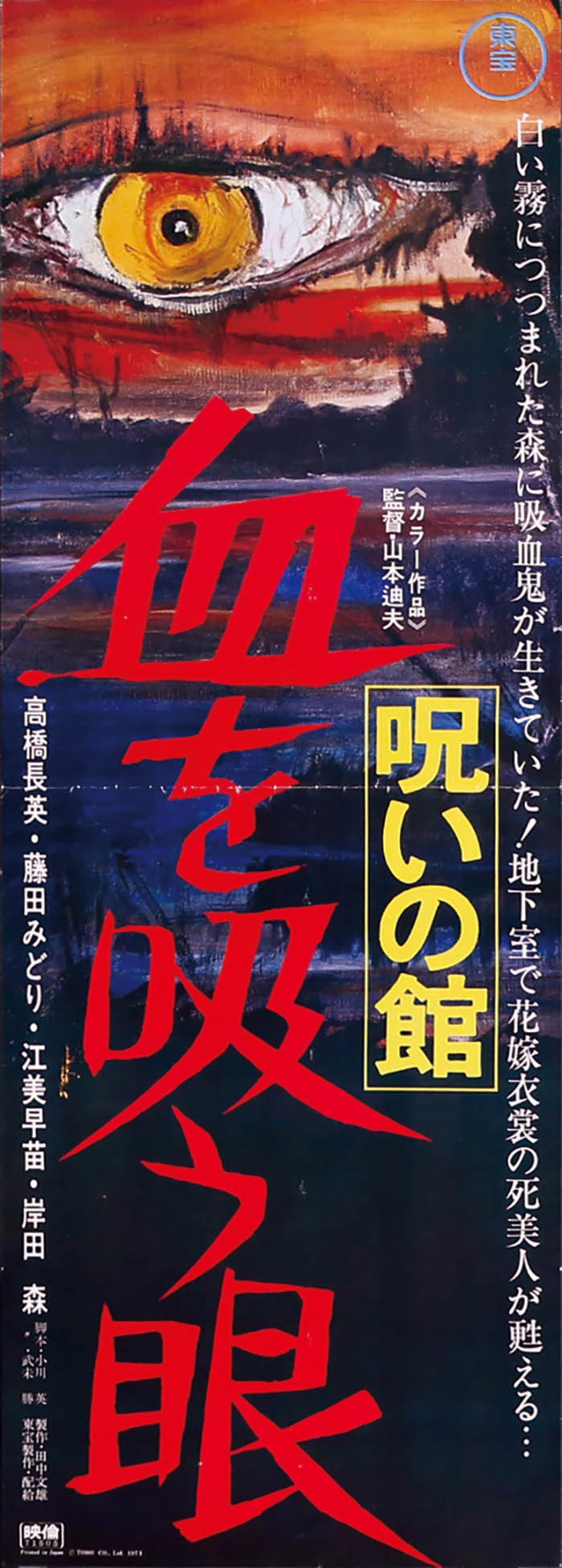
Lake of Dracula (呪いの館 血を吸う眼, Michio Yamamoto, 1971)

Lake of Dracula posterThe Vampire Doll, the first in a loose trilogy of films along vampiric themes released by Toho in the 1970s, had done its best to relocate Hammer-style horror to contemporary Japan. Adopting the best of the gothic from thundery skies to creepy mansions in the middle of nowhere, Vampire Doll successfully merged the Japanese longhaired grudge bearing ghost with the “romantic” bloodsucking tragedy of a young woman corrupted by illicit desires (though in this case for revenge). Returning to the theme a year later, Michio Yamamoto steps away from Japanese folklore altogether and positions his “foreign” Dracula as a “living” embodiment of repressed trauma, sucking the life out of his unwitting enemy until she finally learns to remember him, burning him away in the bright sunlight of his own eye.

Unlike Vampire Doll, Lake of Dracula (呪いの館 血を吸う眼, Noroi no Yakata: Chi wo Su Me) begins with a short prologue in which some children play on a rocky outcrop underneath a strangely ominous pink sky. When little Akiko’s pet dog Leo uncharacteristically runs off, she follows him and he leads her straight into the path of danger. Finding herself in a creepy mansion complete with stained glass windows and a dead body posed at a piano, the last thing that Akiko remembers is the pale face of a strange man with golden eyes and blood staining his chin.

Flashforward 20 years and Akiko (Midori Fujita) is a school teacher still living with her younger sister Natsuko (Sanae Emi) in their childhood home. She is convinced her traumatic childhood incident must have been a dream though it continues to haunt her enough to be a frequent subject in her artwork including a striking canvas she has just completed featuring a frightening golden eye looming over a tiny girl and her dog. Akiko has nice boyfriend, Takashi (Choei Takahashi), who is a doctor in the city, and all things considered a pretty nice life. Sadly it is not to last.

The trouble begins when someone randomly delivers a coffin to the local boathouse. First Akiko’s dog goes missing, then her trusted uncle figure tries to attack her before running off never to be seen again. Meanwhile, at Takashi’s hospital, a young “runaway” has been brought in in a catatonic state though no one can find much wrong with her until Takashi spots two suspicious bite marks on her neck. In case you’d forgotten about Natsuko, she has also begun behaving strangely – offering snide comments to her sister, going out alone in the middle of the night, and most alarmingly she has begun to grow pale.

Like Vampire Doll, Lake of Dracula is also an experimental vampire movie hybrid – a B-movie stalker picture in which Dracula is the creepy guy who can’t seem to take no for an answer. Yamamoto films the “naturalistic” action in standard Toho fashion but shifts into a higher register for his conception of heightened vampiric romanticism as Akiko’s “dream” erupts under a blood red sky and eventually leads her to an artfully appointed gothic cottage in which even the dead bodies are tastefully arranged.

Yet what Dracula comes to represent is the soul sucking power of the repressed past. Akiko has largely been able to move past her traumatic childhood adventure, convincing herself it was nothing more than a dream, and seems to be living a pleasant enough life even if her paintings betray her continuing anxiety. As we later find out, it is not quite so much the episode itself as the refusal to accept it which has caused Akiko so many problems – not least a buried rift with her treasured sister resulting from unfortunate sibling rivalry never fully dealt with both because of the incident and the early death of their parents. Akiko, resentful of having a new sister who had “displaced” her in her parents’ affections, sought to win back her rightful place by being the ideal child – good and obedient. Hence when no one believed her about the creepy house and strange man, she backed down, let them tell her it was only a dream to avoid being thought argumentative. Now she wonders if Natsuko harboured ill will towards her too for “stealing” back her parents’ love through her crazy story and perhaps relegating her to second place when she had become used to first.

Familial love becomes an odd kind of theme as we discover Dracula had a father of his own – a descendent of non-Japanese immigrants who had purposefully built a creepy mansion in the middle of nowhere in order to limit the possibility of his “bad blood” wreaking havoc in the world. The bad blood apparently skips a generation here and there and so Dracula, the third generation, is the first to be affected by it. His father tried to sacrifice himself to control his son, but now the demon is loose and is after Akiko who, creepily enough, seems to have caught his eye all those years ago (when she was five!) and he is determined to make her his “wife”. Vampirising someone’s sister is probably not a good way to win their heart, but Dracula, oddly, has never been very good at conventional romance.

Dracula’s “foreign” origins are perhaps an uncomfortable nod back to the xenophobic nature of the vampire myth. Despite being 3/4 Japanese and born and raised in Japan, Dracula’s late in the game exposure as not properly “Japanese” enough unfortunately reinforces the idea that “mixed” blood is somehow “impure”, even dangerous, and that even those who’ve spent their lives in Japan are not the same as those who are descended from long lines fully recorded 100% Japanese ancestors. Thus the danger becomes a “foreign object” which must be expelled to restore the integrity of the whole.

Restoring integrity is Akiko’s quest as she, along with her doctor boyfriend, attempts to solve the mystery through revisiting her traumatic childhood incident and finally learns to put it behind her. Yamamoto’s direction shifts between standard B-movie naturalism and florid avant-garde compositions but perhaps fails to capitalise on their inherent theatricality. Picking up the pace for the final set piece, Yamamoto also allows himself to go grim in taking a leaf directly out of the Hammer book by lifting the final death scene from the Christopher Lee starring Hammer Horror from 1958 in his crumbling, melting vampire, not to mention the other decomposing corpse resting in the house whose skin slides sickeningly from his body. A strange, hybrid adventure, Lake of Dracula makes an early attempt to pair the vampire chiller with serial killer thriller and does so moderately successfully even if its psychology remains firmly within the realms of the B-movie.


Lake of Dracula is the second of three films included in Arrow’s Bloodthirsty Trilogy box set which also includes extensive liner notes by Jasper Sharp detailing the history of vampires and horror cinema in Japan.

Original trailer (no subtitles)

https://www.youtube.com/watch?v=b1V2hCpxMNU