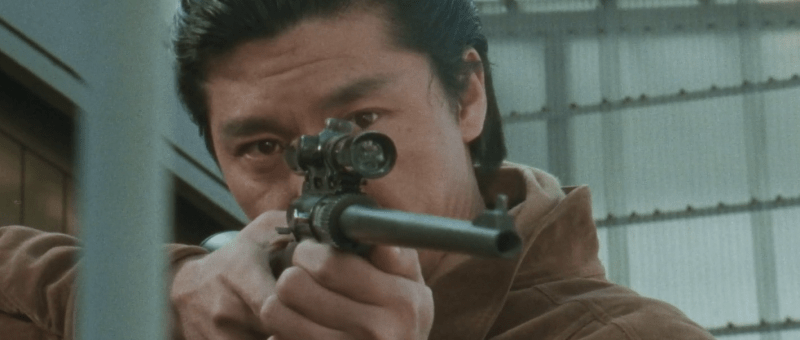
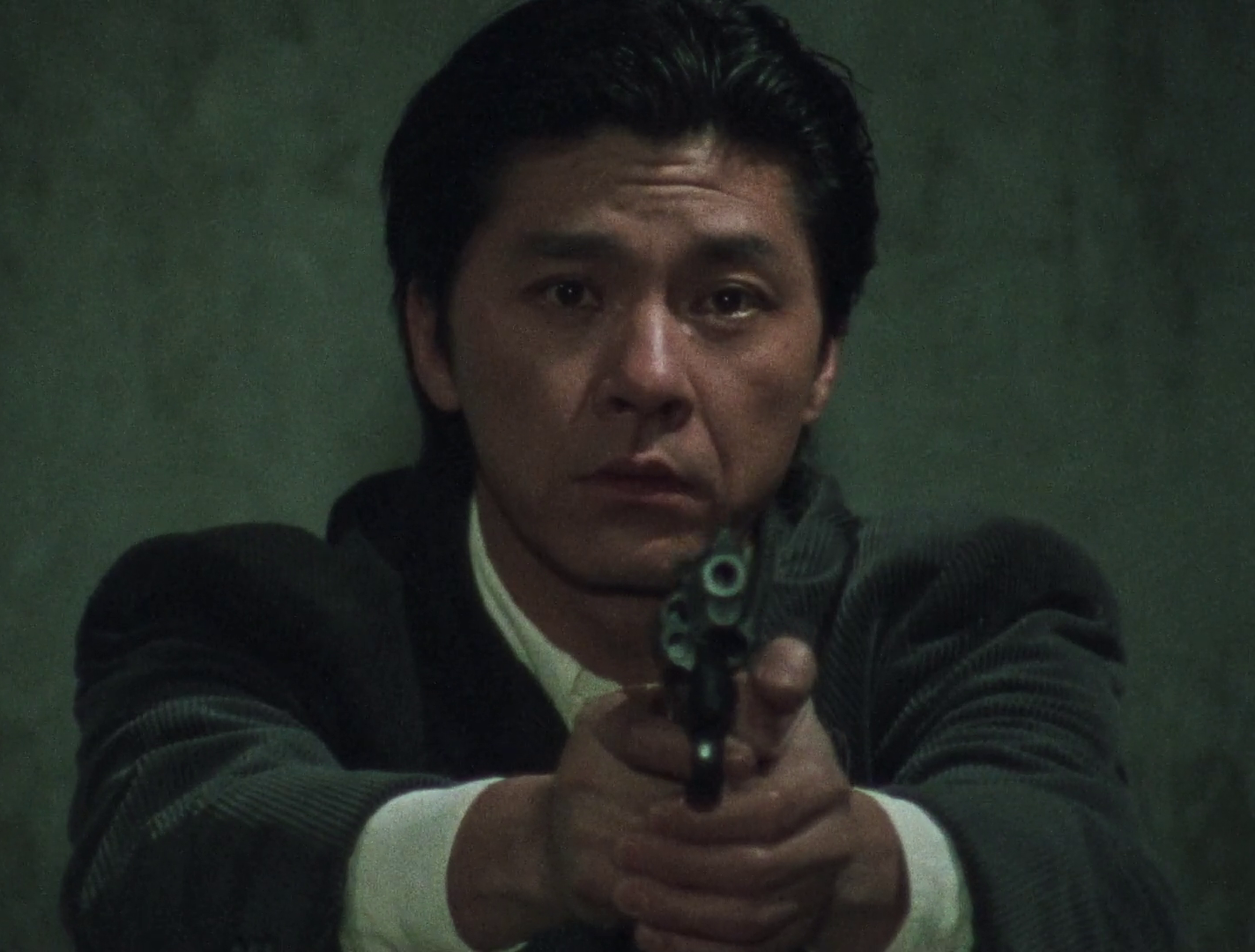
After his fiancée is killed during a yakuza shootout in a restaurant, a former spy in training plots revenge in Teruo Ishii’s Hitman: Blood Smells Like Roses (ザ・ヒットマン 血はバラの匂い, The Hitman: Chi wa Bara no Nioi). Ishii has been in retirement for 12 years before making the film but steps right into the zeitgeist with his bubble-era nightclub opening in which a yakuza goon pretends to be the son of a stockbroker to seduce a young woman he intends to press into prostitution, while looking back to classic noir and the borderless action past.
The young woman is rescued, though not soon enough to escape harm, by the titular hitman, Takanashi (Hideki Saijo), though he does not intervene to save her, only to take out the trio of yakuza who were one side of the gun battle in which his fiancée Reiko (Mikiko Ozawa) was killed. Reiko’s innocence is emphasised by her position as a teacher at a Christian school which is directly contrasted with the sleazy world of contemporary Shinjuku in which Takanashi becomes involved with a series of women. The Asia Town that he strays into is another international space with its samba bars and Filipina hostesses, while Takanashi is later sent to track a boat coming in from the Philippines which is thought to be smuggling guns.
That’s a tip off he receives from Nakatsuka (Kiyoshi Nakajo), an old mentor from the defence academy who now works for the Cabinet Intelligence and Research Office, the nation’s primary intelligence authority. Nakatsuka is also seen meeting with the police chief who tells him that the yakuza have been complaining that police are encouraging the gang war rather than trying to stop it. So much the better, Nakatsuka says, let them massacre each other then take them all out right before the election to manipulate public opinion. If the election goes their way, the police chief will have additional budget to hire more policemen. Thus Takanashi also becomes a kind of pawn in cynical political machinations conducted by Nakatsuka and CIRO who are helping him both out of friendship and sympathy and because it is useful for him to make use of Takanashi and his desire for revenge. Only veteran policeman Uchino (Tetsuro Tanba) smells a rat, but even he later lets Takanashi go after making a moral judgement that justice has been served and Takanashi hasn’t really done anything wrong.
And so Takanashi tries to avenge Reiko by setting the gangs against each other in a recreation of the original gang war. He’s first frustrated and then aided by Shinjuku party girl Rumi (Natsumi Nanase) who steals his briefcase and gives it to the yakuza, and also be her friend Hisako (Yuki Semba) whom he meets after ducking into a soapland to escape the police. Hisako’s apartment is well furnished with even the modern convenience of an exercise bike, while Rumi’s feels empty, like a hideout with its bare floors and sparse decor. The walls are decorated with posters for Casablanca and Bonnie and Clyde that bring home and older noir past that Takanashi is echoing in his quest to avenge Reiko’s death at the hands of a crime-ridden society. We’re told that he gave up his place at the defence academy and became a truck driver when his parents objected to their marriage, but now fulfils his destiny in tackling the yakuza threat head on.
Meanwhile, as a kind of counter to Rumi, Hisako, and Yasuda’s girlfriend, Kumasa’s woman Beniko (Kimiko Yo) who is very much involved in policy decisions and actively fights back in defence of Kumasa who is otherwise a bit useless. The film is sleazy from its opening rape sequence to the soapland escapade and inexplicable closing credits which consist of a number of raunchy gravure shots backed by a power ballad that otherwise have little to do with the rest of the film, but is perhaps less cynical that it appears or at least seems to edge away from nihilism towards something that appreciates that a more emotional, poetic kind of justice is possible and valid. Takanashi is allowed to complete his quest, though it incurs additional casualties, and then leave the scene having achieved a kind of closure and brought the cycle to an end leaving the rest to Nakatsuka and Uchino who now seems to have crossed over to Nakatsuka’s side if perhaps lamenting that he may be working far too hard to a achieve a justice that now seems surprisingly easy to enact.
 Windows on Worlds