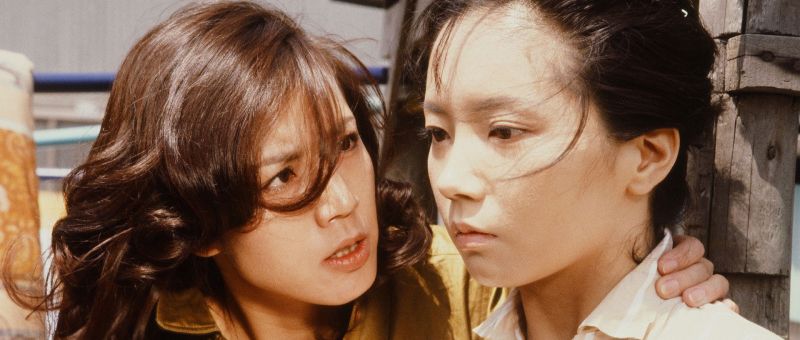

Angel Guts: Nami (天使のはらわた 名美, Noboru Tanaka, 1979)

Aspiring journalist Nami Tsuchiya (Eri Kanuma) works for a magazine called “The Woman,” but it soon becomes clear she’s their only female reporter and one of a handful of women in an office otherwise staffed by men. Her editor has her writing a series titled “Rape and its Consequences” in which she attempts to interview women who’ve experienced sexual assault in an attempt to root out the effect it’s had on their lives. At times Nami seems a little conflicted, puffing away on a cigarette with a pensive look on her face, but there’s no denying that she’s sold out other women for a chance to make it in a man’s world by exploiting a suffering she does not herself share.

Muraki (Takeo Chii), formerly a top magazine editor, reminds her that not everyone who reads her magazine is a woman, but there is something perverse about the idea of her article which is otherwise conceived from a perspective that seems very male. The female readership of this magazine would not need to be educated about the prevalence of rape nor its consequences. Nami’s article doesn’t seem to want to find success stories, but to revel in misery. She accosts one of the women she’s hoping to interview and tries to badger her into talking on the record. Yoshiko appears fed up and tells her that recounting what happened would be like being raped all over again, but still Nami doesn’t relent. She tries to guilt her into speaking by suggesting that her testimony would stop other women being assaulted, which is backwards logic seeing as it isn’t the women who are responsible and even if she were advancing a victim blaming narrative that it’s on women to protect themselves, Yoshiko had not done anything that could be seen to be “wrong” nor is there any way she could have prevented what happened to her.

Through her articles, Nami has become complicit in this culture and is effectively an agent of rape herself in her desire to tear into the lives these women have tried to build for themselves and extract even more salacious detail. She describes Yoshiko as “happily married,” but she’s living in a rundown house on the margins of the city. It seems her husband maybe ill and therefore unable to work. Yoshiko may have married him out of a lack of other options and it’s not clear if her husband knows about her past or how he would react if he learned of it now. The fact that Nami’s attempt to interview others about Yoshiko fails bears out the social stigma that can surround those who’ve experienced sexual assault and suggests that Yoshiko has now become an outcast. The photos that they publish only black out Yoshiko’s eyes making it easy for those in her community to identify her which could certainly make her life much more difficult and lead to a loss of employment or social further exclusion.

It’s clear that Nami hasn’t really thought any of this through and is only focussed on impressing her male editors to be given better assignments. This may in part be what she means when she says that she’s been assaulted in her office by the people she works with on gaining more of an insight into the consequences of her writing. Though he threatens to rape her himself, Muraki seems to be a representative of a more compassionate masculinity but at the same time has been emasculated, rendered impotent after his own wife was raped by an intruder and then left him because he couldn’t satisfy her sexually. He connects Nami with a mentally disturbed nurse who was assaulted by a doctor with an autopsy fetish, though the incident was covered up by the hospital. None of these men, except Muraki, is held responsible for their actions. Nami, however, becomes all of these women, envisioning herself abandoned at the scene half-naked and clothes torn, discarded on the rubbish tip of the modern society. At the beginning of the film, a woman smashes the lens of the camera as a man moves towards her, as if she meant to rebuke us for watching, while even Nami finds herself becoming dangerously aroused by watching other women being assaulted or listening to their stories before she too cracks and begins to see herself as nothing more than an anonymous object at the mercy of male society.


Angel Guts: Nami is available as part of The Angel Guts Collection released on blu-ray 23rd February courtesy of Third Window Films.
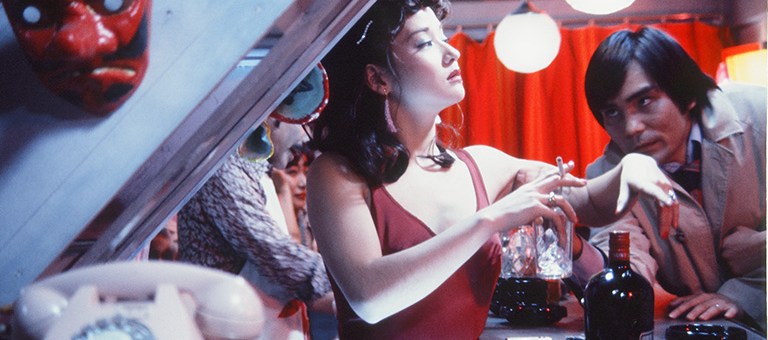
Angel Guts: Red Classroom (天使のはらわた 赤い教室, Chusei Sone, 1979)

Chusei Sone’s Angel Guts: Red Classroom (天使のはらわた 赤い教室, Tenshi no Harawata: Akai Kyoshitsu) opens with grainy 8mm footage of a woman being gang raped, but this turns out to be a film being watched by the protagonist, Muraki (Keizo Kanie), rather than the one we’re actually watching. Nevertheless, in presenting the footage in this way, the film has made us somewhat complicit in witnessing this woman’s exploitation for the purposes of entertainment. A producer of pornographic magazines, Muraki is captivated by the woman’s ruined innocence and becomes obsessed with the idea of finding her.

Though he says he doesn’t think she belongs in this world, Muraki does not so much want to save Nami (Yuki Mizuhara) as get her to work for his magazine. He declares that years of this kind of work have left him numbed and desensitised. Watching her video was the first time he’s felt moved in years. However, it turns out that this may be because the video wasn’t a movie in which the actress had consented to appear, but raw footage of an actual gang rape committed against a trainee teacher. The implication is that this traumatic incident has numbed Nami in the same way Muraki has been numbed by his exposure to pornography, leaving her with a permanently vacant, inscrutable expression and reducing her to nothing but a sexual object. Though the 8mm “blue movie” is an illegal form of pornography that can be watched only in underground clubs, she claims to have run into several men like Muraki who recognise her and has concluded that the only way to get rid of them is to satisfy their desire by sleeping with them. She says she won’t feel anything anyway, but has scars on her wrist and seems to have turned to potentially dangerous sex with random men as a means of self-harm.

Muraki refuses to sleep with her, but in Nami he seems to be looking for his own buried innocence and masking the shame he feels towards his line of work. His parents think he publishes books for children, he tells Nami, but rants to another woman that his magazines are all the same and he doesn’t know how to make them better. He can’t take the kind of pictures he wants to, because he wouldn’t be able to publish them under the increasingly strict censorship laws. Repeated references are made to the need to avoid showing any pubic hair which is considered obscene under Japanese law, though they’re otherwise free to depict scenes of sexual violence and degradation. Ironically, Muraki is unable to meet Nami at their rendezvous because he’s been arrested for breaking the Protection of Minors Act after having photographed a 15-year-old girl, though Muraki claims he was just trying to help her. He says she told him she was 19, recently arrived from Aomori and had been reduced to shoplifting, so he gave her a job out of the kindness of his heart.

It’s things like this that might have Muraki desperate to prove he’s not “scum” but a good man and an artist rather than a purveyor of pornography and exploiter of women. The film has its cake and eats it too, critiquing female exploitation but simultaneously trading on it, if doing its best to make the viewer feel at least conflicted. Three years later, Muraki is in a relationship with a woman he once exploited who couldn’t let him go and has fathered a child, but the papers are full of news about suicides and domesticity does not seem to him provide much of a refuge. He continues to search for Nami in order to reclaim his innocence, but discovers that she has become a vacant sex worker, ironically working at a bar called “blue” and the plaything of a man in a James Dean-style red jacked who has broken dreams of his own. Unlike Muraki, she has only fallen further, and he is ultimately forced to watch what his business has reduced her to as a group of men set on a captive high school girl like a pack of wolves, ironically echoing the opening sequence. Yet in the end, it’s Nami who frees him by literally showing Muraki the way out of this place as he urges her to leave though she seems to say it’s already too late. Looking at her own distorted image in a puddle, she no longer knows who she is and has no identity that is not forced upon her by a violent male gaze.


Angel Guts: Red Classroom is available as part of The Angel Guts Collection released on blu-ray 23rd February courtesy of Third Window Films.