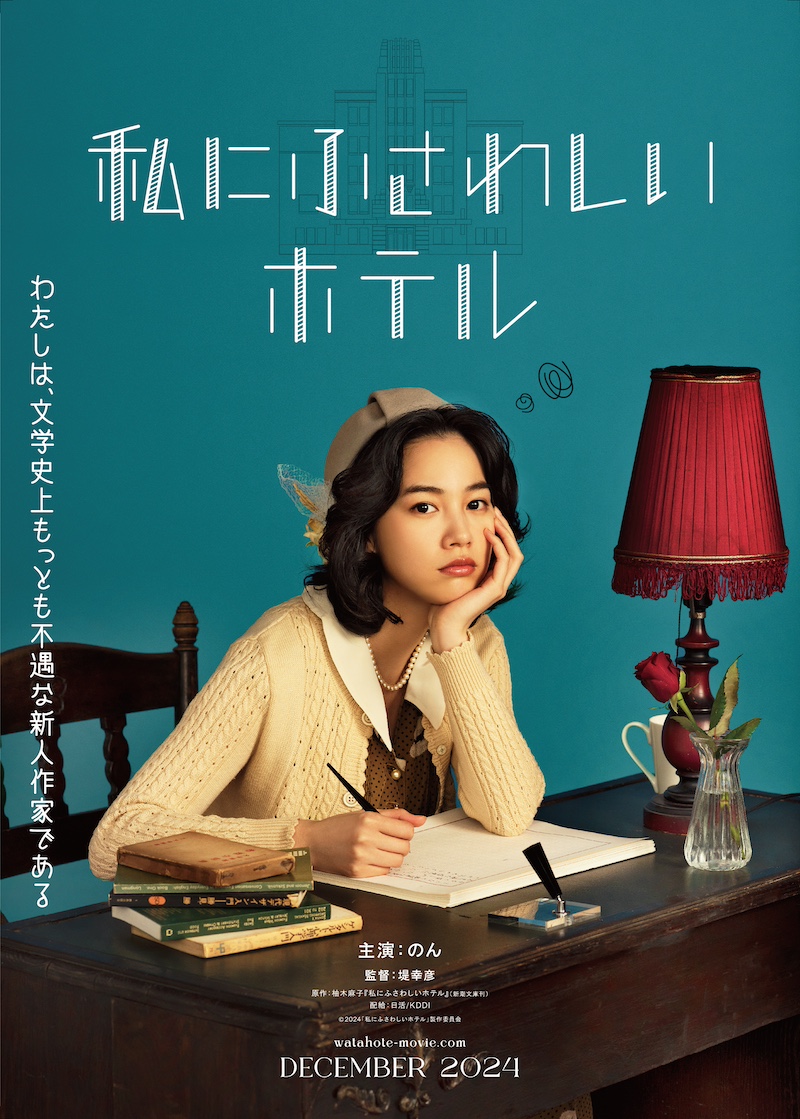
The Hotel of my Dream (私にふさわしいホテル, Yukihiko Tsutsumi, 2024)

What does a girl have to do to get her book published in this town? Adapted from the novel by Asako Yuzuki, Yukihiko Tsutsumi’s The Hotel of My Dream (私にふさわしいホテル, Watashi ni Fusawashi Hotel) follows its eccentric heroine through a literary feud with an established master in an attempt to defeat a misogynistic, hierarchal and exploitative publishing industry and finally publish a full-length novel. In part a meditation on identity, the trades on its heroine’s charms and the comedic prowess of leading lady Non.

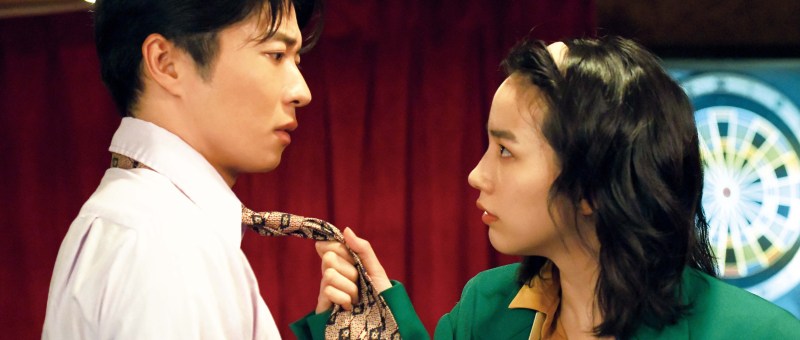
Set in 1984, the film begins and ends at the Hilltop Hotel popular with writers through the ages thanks to its proximity to book town Jinbocho and the offices of big time publishers. Using the pen name Taiju Aida, Kayoko (Non) is an aspiring author who won her publisher’s newcomer prize a few years previously for a short form essay but has been unable to write anything of substance since after being stung by a harsh review from literary master Higashijujo (Kenichi Takito). After learning from her editor Endo (Kei Tanaka) that Higashijujo is in the room upstairs and is on a tight deadline to complete a story for an upcoming anniversary anthology, Kayoko decides to impersonate a hotel maid so he’ll stay up all night and not make it, forcing Endo to use her story instead.

The irony is that Kayoko’s story is popular with readers and she has real talent as a writer that’s being suppressed by the publishing industry at large in the form of her former publisher, Endo, and Higashijujo. Higashijujo is a representative of a particular kind of older writer and is effectively acting as a gatekeeper by suggesting that young women like Kayoko have no place in the literary scene. Even so, he’s captivated by the story she tells him that’s the same as the essay she later has published which cleverly weaves in some of his own personal details. She plays on his vanity and lasciviousness in telling him she’s a big fan and is romantically naive as if dangling herself as bait. Higashijujo realises that Kayoko is Taiju Aida and kicks off a kind of literary feud in which he disrupts her career and she puts on various different personas to upset or embarrass him. 

Nevertheless, his rivalry with her does seem to stimulate his own latent artistic mojo and have him writing manically once again if partly out of resentment, while Kayoko is forced to change her name again before winning a note literary prize as “Junri Arimori” and writing with a completely different style. On realising that they may both be being manipulated by Endo who is setting them against each other in order to stimulate their writing, they team up against him by attempting to disabuse his daughters of the notion that Santa’s not real only they already know. They were just going along with the ruse because that’s a child’s job in much the same as Higashijujo suggests a writer’s is to conjure a pleasant fantasy for the reader and Kayoko creates a series of false personas further her own literary dreams. 

Yet as Kayoko says she’s not given the kind of support that other writers get and even after getting a book published has to go round to stores on her own to encourage them to stock and promote it. She only rises to prominence by charming a bookseller after catching a notorious book thief who didn’t even steal hers because he only takes “popular” books. Kayoko is indeed a total crazy lady, but perhaps you need to be in order to survive in this environment that’s still dominated by men like Higashijujo writing borderline sleazy novels and hanging out with hostesses in upscale Ginza bars. Resented by his daughter, he stays out in hotels for days at a time, leaving his wife alone and neglecting his family. Kayoko has to fight tooth and nail for her place in this space and to prove herself worthy of a room at the Hilltop Hotel while Higashijujo’s ride was must less fraught with difficulty even if it may not have been easy. The final message seems to be, however, that art is created best in opposition and success isn’t always good for an artist as Kayoko finds herself frustrated, feeling as if she hasn’t achieved all of her revenge but has no left to take it against while perhaps still manipulated by Endo who provides a source of authority for her to kick back against as literary queen trying to hang on to her throne.


The Hotel of my Dream screens as part of this year’s Japan Foundation Touring Film Programme.

Trailer (English subtitles)

Images: © 2012 Asako Yuzuki_Shinchosha © 2024 “The Hotel of my Dream” Film Partners

Will I Be Single Forever? (ずっと独身でいるつもり?, Momoko Fukuda, 2021)

If you can achieve financial independence in the contemporary society, then what is or should be the primary purpose of and motivation for marriage, what does it mean, should you want it at all or is it merely an outdated institution designed to keep women in their place by making them dependent on men? Adapted from the manga by Mari Okazaki, Momoko Fukuda’s Will I Be Single Forever? (ずっと独身でいるつもり?, Zutto Dokushin de Iru Tsumori?) finds a series of young women asking just these questions wondering why it is everyone themselves included is still intent on viewing marriage and motherhood as the only markers of success as if none of their other achievements really matter if they’re going to write spinster of this parish on their headstone. 

10 years previously the now 36-year-old Mami (Jun Hashizume) shot to stardom penning a best-selling book about how it isn’t a sin to be single and the worst thing isn’t to be alone but to settle for less solely to escape loneliness. These days, however, she’s beginning to wonder, growing fearful of what it might mean to spend the rest of her life alone and worrying she’s about to miss the marriage boat witnessing it pass by passively without making a concrete decision of her own. Expressing her views on a talk show where “the troubled women of today are slapped with harsh reality”, Mami disappoints some of her longtime fans who found validation in her book reassured that there was nothing wrong in their desire to live independently rather than get married right after college and become regular housewives. Yet they are also ageing and facing the same dilemma, wondering if their life choices are really OK or if they’re missing out on a family life by refusing to settle for Mr. Almost-Right. 

The film’s English-language title flips the Japanese as if the question is self-directed, the women asking themselves when Mr. Right’s going to come along or worrying about the consequences if he never shows up, while the Japanese is more like the dreaded question every young woman is asked by an invasive female relative at a family gathering reminding her she’s not getting any younger and will end up alone if she’s not careful. Meanwhile, Mami is reminded that women who’ve bought their own apartments seldom marry, men aren’t interested in women who can be financially independent and don’t need to rely on them for economic support as Yukino’s (Miwako Ichikawa) longterm boyfriend explains breaking up with her immediately before moving in together as it turns out right next to Mami though she doesn’t know it as she takes out her frustrations online through an embittered anonymous Twitter account. 

For her, the point of marriage is supposed be escaping loneliness yet as her school friend Ayaka (Eri Tokunaga) will testify marriage can be the loneliest thing of all. Her husband is happy to play with the baby but hands it back every time it cries or needs changing unwilling to engage with the less fun sides of marriage or parenthood. Husbands are emotionally absent and rarely help at home, Ayaka’s trying to be helpful by taking the baby to the park so that she can focus on her chores both leaving her out of their fun and reinforcing the idea the home is all her responsibility and none his. “Don’t end up like me” Mami’s mother (Mariko Tsutsui) advises instantly seeing that her decision to marry casual boyfriend Kohei (Yu Inaba) just because he asked is doomed to end in failure, warning her that you have to “be ready to live alone” even if you marry, “no good comes of being a slave to a husband” she adds uttering the unthinkable in trying to warn her daughter of the realities of a patriarchal marriage. 

And as it turns out though five years younger vacuous rich kid Kohei is a patriarchal man whose friends all praise him for being brave and understanding in marrying an older woman while he pats himself on the back for being progressive in granting her permission to continue using her maiden name professionally after they marry. When they go to meet his conservative parents he criticises her outfit for making her look “old” while he’s worn shorts to a fancy restaurant and then orders a ridiculous green soda drink, forcing Mami to go along with his mother’s prodding that she’ll give up work when they marry to devote herself to childrearing though he’d also refused to attend a fertility/genetic screening session Mami had recommended on the grounds that it’s unnecessary because he’s a man as if childbirth is only a female concern and only women can have fertility issues or potential problems in their medical history. The more she tries to voice her worries the more he overrules her, the final straw coming as he refuses to listen to her anxiety about getting behind the wheel of a car, generally unnecessary in Tokyo, having previously been involved in an accident. She begins to wonder why it’s so important to follow the “correct path” even if it brings you no happiness solely in order to avoid people asking you with barely suppressed pity if you’re going to be single forever. 

The question comes from an older era in which it was it was near impossible for a woman to survive without a husband, but now that she can why should she put up with poor treatment and restrictions on her freedom if she is perfectly capable of supporting herself? Much younger than the others, sugar baby / professional socialite Miho (Sayuri Matsumura) meanwhile has gone the other way in trying live off men without the constraints of marriage only to find herself hamstrung by patriarchal expectations once again in having failed to realise that her lifestyle has an expiration date while she’s painted herself into a corner with no qualifications or work experience at the age of 26. The bulk of her business model is already rooted in the selling of other younger, prettier women as party guests for wealthy men and the consequences of continuing down that path are largely unpalatable to her. 

Touched by a further TV update from Mami, each of the women has a kind of epiphany that allows them to move forward into happier lives reassuring them that it’s alright to ask for more and they don’t have to hold any part of themselves back to meet the outdated expectations of traditional femininity, even Miho finding another way of harnessing the skills she does have to achieve true independence. The answer is not a total rejection of marriage or committed relationships but a reacknowledgment that to marry or not should be their own choice based on their own happiness rather than something you have to get over with to avoid the social stigma of becoming an old maid. A relatable exploration of the lives of young women in the contemporary society Fukuda’s empathetic drama eventually advances that in the end the best cure for loneliness is female solidarity in the face of a still overwhelmingly patriarchal society. 


Will I Be Single Forever? streams in the US until March 27 as part of the 14th season of Asian Pop-up Cinema

International trailer (English subtitles)