
I Will Buy You (あなた買います, Masaki Kobayashi, 1956)

20140731_762129In I will Buy You (あなた買います, Anata Kaimasu, a provocative title if there ever was one), Kobayashi may have moved away from directly referencing the war but he’s still far from happy with the state of his nation. Taking what should be a light hearted topic of a much loved sport which is assumed to bring joy and happiness to a hard working nation, I Will Buy You exposes the veniality not only of the baseball industry but by implication the society as a whole.

Kishimoto works as a scout for a popular Tokyo baseball team. His job is to find the promising young players and charm them into accepting a contract before any of the other teams get to them. His first assignment doesn’t go well when he arrives at an ace pitcher’s home only to be told the subject in question is recovering from having lost a finger in a workplace accident. No major league career for him – Kishimoto heads home without even introducing himself. The next prospect is very exciting – a semi-well known college ball player who might be persuaded to turn pro. However, the student, Kurita, is “managed” by a benefactor, Kyuki (whose name literally means “ball spirit” in Japanese) who seems to be a difficult man to deal with. Nevertheless, Kishimoto is young, ambitious and determined to get Kurita on side by any means possible.

It’s just baseball, one might think but it’s almost as if we’re playing for souls. Everyone is lying, everyone is double crossing everybody else and everyone has their own interests at heart all the while swearing they only want the best for Kurita. Kurita has become a trophy, no one has even thought to ask him if he actually wants to keep playing baseball. He’s no no longer a person for them so much as a flag to be captured. This might actually work out quite well for Kurita himself who, it turns out, is far from the country bumpkin everyone has him pegged as. Though surrounded by carping relatives who are also all intent on exploiting his talent, the possibility of Kurita suddenly discovering the power to make his own decisions is a threat to everyone that they haven’t even considered yet.

Kyuki himself is the bad guy we’ve all been set up to be suspicious of but may actually turn out to be the most decent hustler in the picture. They say he spied for the Chinese during the war but is it a rumour you can really believe or just the jealous slurs of his various rivals? He himself says he taught Chinese girls to use the bayonet and carries an air of aloofness that makes him seem untrustworthy. He’s bankrolled Kurita’s education and taken on the position of a father to him over the last four years but how much of that is genuine feeling and how much financial investment? Kyuki is a married father with a family out of town but is sort of living with the older sister of Kurita’s girlfriend which is an awkward situation in itself. He also claims to have a serious gallstone problem which requires an operation though others claim he’s putting it on. Who is Kyuki, with his suspiciously apt name and hard nosed attitude can we trust him, or not?

I Will Buy You is a characteristically angry and cynical effort from Kobayashi and though it’s still a fairly early work carries some of his later technical prowess. Stripping the mask away from what is assumed to be a gentle pastime, the film lays bare the money hungry desperation of post-war Japan. Money ruins everything, even something as innocent as baseball. The Kurita from the end of the film is not the idealistic young student who came to Tokyo but a canny self-interested individual. Whether or not this transformation, and the accompanying transformation of Kishimoto whose eyes have been well and truly opened, is for the better or not maybe a matter of personal perspective but it’s not hard to guess where Kobayashi stands.


I Will Buy You is the second of four early films from Masaki Kobayashi available in Criterion’s Eclipse Series 38: Masaki Kobayashi Against the System DVD boxset.
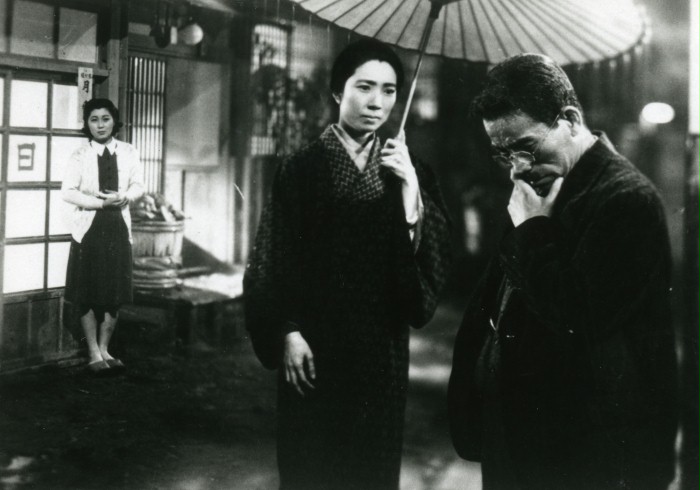
 

Jubilation Street 歓呼の町 (Keisuke Kinoshita, 1944)

20138117_1_IMG_FIX_700x700The third entry in Criterion’s Kinoshita and World War II box set takes a decidedly darker turn than either of its predecessors. Made a little later in 1944, Jubilation Street is surprising addition, not least because for the majority of its running time it’s hard to see how it could have ever have fulfilled the propaganda requirements of the time. Its title is almost ironic, there’s nothing here but an inevitable sadness and eternal partings both between people and between eras. It’s not until the closing moments of the film that anything even remotely “inspirational” occurs, and even then it’s all a little bit tacked on and feels like a token epilogue to please the censors. With far less obvious comedy moments Jubilation Street is taking us somewhere significantly darker, but is not without Kinoshita’s characteristic sympathy.

Jubilation Street is an old-fashioned row of modest housing home to a small community of families who’ve each lived there for many years. Now they’re all being “relocated” because the government wants the land for the war effort. Some are ready to leave, others are not – either because they feel too old to start again somewhere else or simply because they don’t want to be split up from the people they’ve shared their lives with. The family who own the printer’s shop want to finish their last few orders and wait until their baby is born, the crotchety old man who runs the bath house just doesn’t want to go anywhere and Mrs. Furukawa is afraid to leave in case the husband who walked out on her and their son ten years previously finally comes home. Shingo, Mrs. Furukawa’s son, is a test pilot in the air force and wants to marry childhood sweetheart Takako, though her parents are against it given his family circumstances and dangerous work. Just in the knick of time, Mr. Furukawa makes a shocking reappearance, unbeknownst to his wife and son but will his ten years away with nary a word damage his chances of a happy reunion? With the evacuation date drawing nearer, important decisions will have to be made, and made in a hurry.

There may have been hope and happiness in this little street once, but now there’s just waiting and desperation. Towards the beginning of the film, the war still feels something far off – the relocation programme might as well be for a new dam or a modern housing development as much as being down to a war. Shingo is the only person directly involved with anything military and though his work is dangerous in one sense he gets to live at home with his mother and nothing seems very different than before. Towards the end, however, a traumatic event will drop the devastation of war right into the middle of this little community with as much force as any bomb. Doomed romance, shattered dreams, a lifetime’s work going for nothing – there’s nothing to celebrate here. Having undergone a tragedy and forced out of their homes, the community each vow they’re going to honour the sacrifices made by each doing their best for the war effort, but it comes dangerously close to being insulting. “So you’ve lost people, you might have lost your home or your business or a child but that just means you have to work even harder to make your loss mean something”. A fairly bleak message, if understandable given the circumstances, but it’s debatable that it’s one a worried populace would have wanted to receive in the normally escapist realms of the cinema.

It’s remarkably ambiguous for a film of its time. Perhaps because, again, he kept the war effort in the background, Kinoshita was able to get away with showing a less “jubilant” group of people each facing their various difficulties with an enviable degree of stoicism (coupled with their determined resolutions at the end). There’s no way you could read Jubilation Street as a “pro-war” film. Though it stops short of any kind of direct criticism, war (and even in one case the whole idea of Manchuria) has ruined each of these people’s lives, destroyed their community and cast them adrift in an uncertain world. What sort of glorious nation is this, and was it worth all this sacrifice?

Jubilation Street is not as well preserved as either Port of Flowers or The Living Magoroku, though the actual film is fine for the most part the soundtrack is very badly damaged with strong hiss and distortion throughout. However, it doesn’t detract from the experience too much and given that it’s a minor miracle it survives at all you can’t complain. Kinoshita has once again tried to put the lives of ordinary people up on screen with all the warmth, empathy and truth that was permitted to him at the time. The last days of Jubilation Street were not altogether happy ones, but as a metaphor for a place and time it’s about as close as you’d be allowed to explore.

Port of Flowers 花咲く港 (Keisuke Kinoshita, 1943)

film_syosai_img_01_04-thumb-730x480-1642Keisuke Kinoshita is far better known in his native Japan than outside it despite his long and prolific career in filmmaking. Equally adept at comedy and tragedy and tackling all genres from musicals to crime dramas, Kinoshita began his career in the relatively turbulent war years where every last detail was at the censor’s mercy.  Port of Flowers is his very first foray into the director’s chair and began a long association with the comedy genre. Though, yes, it has it’s obligatory moments of bare faced propaganda, the film is refreshingly light on heavy handed political statements and prefers to focus on a humorous take on small town life.

Life in a sleepy little port town is about to get significantly more exciting after the local inn has received two rare telegrams purporting to be from the same man but sent from different locations one day apart. The man in question claims to be the son of a businessman who lived in the town some years previously but has since died and the bereaved child has a hankering to see the little shipping village that the father apparently loved so much. After picking up their new guest at the station the mini delegation of inn keepers and officials are shocked to discover another disgruntled customer also claiming to be the sender of the letter. Sufficed to say neither of the two in question is what he claims to be but has come to town with the intention of fleecing some gullible country bumpkins out of grandma’s silver. The two decide to work together but eventually the goodnatured enthusiasm of the villagers (and the rising war effort) begin to make them rethink their nefarious ways!

Given the time period and strict censorship, it would be ridiculous not to expect some degree of pro-war sentiment in the film but Kinoshita has managed to more or less leave the conflict as merely a background setting. Life in this little fishing village seems fairly tranquil and the war has barely encroached on its idyllic settings. There are youngish men about, the people aren’t rich but they aren’t afraid and the only mention of turbulence seems to be a young woman who’s recently returned from Manchuria not entirely at her own volition. There are some fairly excited mentions of various victories but these are fairly minor events, almost like something happening far away to other people to whom you feel connected but not quite involved with. The most important thing is the building of the ship – not only is it a source of pride for the villagers, a way of fulfilling the dream of a respected visitor they all remember fondly but it will also be for their country. Everyone must contribute as they can because it’s for the entire community of citizens, not just the village but for everyone in the country and it’s important. Their sacrifice and hard work will matter because it will be for the greater good.

Here endeth the lesson, for the most part. What of our two bumbling crooks? It’s never really explained how they came to know so much about this poor, unsuspecting community and simultaneously hatched on the same scheme at the same time but they must have been pretty well out of options to think these poor villagers were going to be worth this much effort. They came to commit a fraud but ended up having to actually do the impossible and make their improbable scheme work solely because the villagers’ kindness was too much to bear. The addendum to the lesson being that pure hearts can shame the devil and innocence becomes infectious after a while (in the best possible way).

Very much of its time and with an air of disposability, Port of Flowers is an enjoyable, surprisingly warm film but not without its faults. Eschewing heavy handed propaganda for a subtle enforcement of traditional, communal values it reflects Kinoshita’s subsequent humanistic concerns and even manages to do so without giving in to the censor’s red pen. A nice take on an old story, Kinoshita once again proves that nothing matters so much as people and goodness will always win through in the end.