Unlock Your Heart (ひらいて, Rin Shuto, 2021)

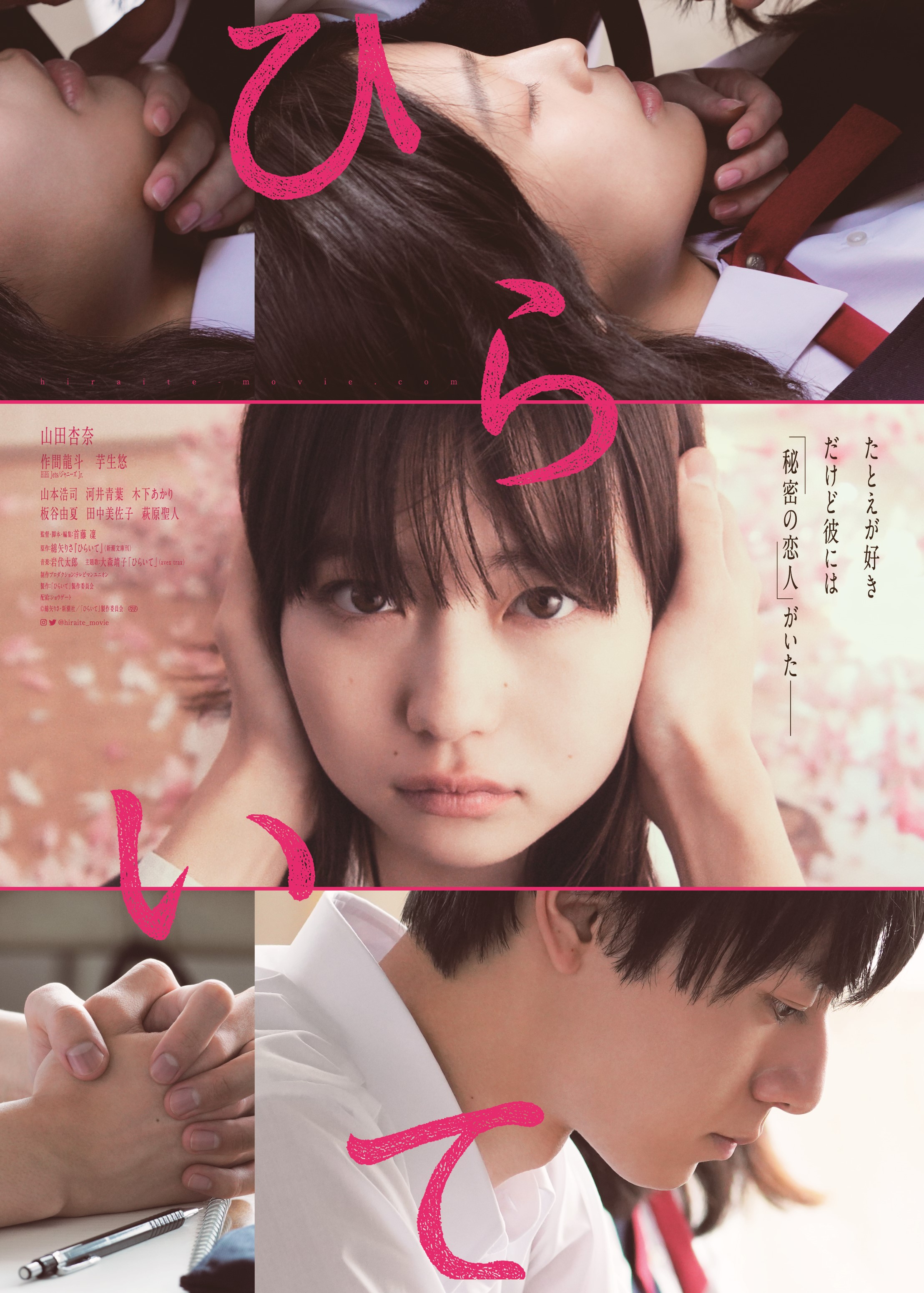
A straight-A student and popular girl enters a self-destructive tailspin on discovering her longterm crush has a secret girlfriend in Rin Shuto’s adaptation of the novel by Risa Wataya, Unlock Your Heart (ひらいて, Hirate). Wataya also penned the source material for Akiko Ohku’s Tremble All You Want and Hold Me Back, and while Shuto may shift away from Ohku’s quirky style she maintains and intensifies an underlying sense of unease in what has the potential to develop into an incredibly messy situation. 

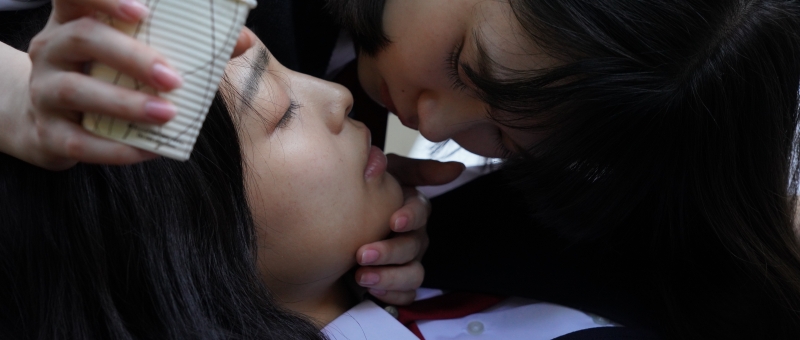
As the film opens, popular girl Ai (Anna Yamada) walks away from a dance rehearsal and discovers fellow student Miyuki (Haruka Imo) collapsed by a tree next to a pouch containing her insulin. Barely conscious, Miyuki asks her for something sweet and Ai soon returns with some sugary juice. Unable to find to an efficient way of getting her to drink it, Ai passes the liquid from her own mouth in a literal kiss of life that seems have an unexpected effect on her. Meanwhile, after sneaking into the school late at night with some friends halfheartedly joking about stealing the exam papers, Ai raids the locker of her crush, Tatoe (Ryuto Sakuma), and discovers a series of love letters which turn out to be from Miyuki. 

For some reason this revelation turns Ai’s life upside-down even though she later reveals that she had been enduring the silent crush on Tatoe for some years without ever acting on it. It may partly be that Ai is popular and attractive and so the idea that someone may not find her desirable is destabilising, cutting to the quick of her teenage insecurity while pulling the rug out from under her if she had indeed thought of Tatoe as a kind of comfortable backstop or easy plan B. Enraged, she befriends Miyuki yet for unclear reasons, perhaps hoping to get some insider info on Tatoe, find out what it is Miyuki has and she doesn’t, or somehow break them up, but finally settles on seduction unexpectedly kissing her again in an echo of their awkward meet cute.  

At heart, Ai does not understand herself and is operating with no real plan. Each escalation seems to come as a surprise even to herself leaving her with moments of internal conflict gazing into a mirror wondering what it is she’s doing. On separate occasions, both Miyuki and Tatoe accuse her of lying and indeed she is, most particularly to herself in a wholesale denial of her own desires which fuels her impulsive and self-destructive behaviour. Others accuse her of being selfish and self-absorbed, unable to look beyond herself and indifferent to the feelings of others which is also in its way a reflection of the degree to which she is consumed by internal confusion, driven slowly out of her mind while taking out her frustration on those around her not least in her increasingly dark manipulation of Miyuki and Tatoe. In the end, as Tatoe points out, she’s little different from his abusive father in her need to possess and control but it’s the extreme control that she’s trying to exercise over herself and the desires she can not accept that is causing her self-destructive behaviour. 

Only Miyuki seems to be able to see through her, at least to an extent, yet it’s not entirely clear at first if she responds to Ai’s advances willingly or simply goes along with them because she has no other friends and is afraid Ai will reject her if she refuses. Ostracised by the students because of her diabetes which is of course a very visible condition in that it requires her to inject herself while at school, Miyuki is shy and lonely while required to keep her relationship with Tatoe a secret because of his abusive father. But as Miyuki later puts it in her letter, Ai isn’t quite as aloof as she’d like to pretend and acts with an unexpected tenderness and consideration, even a kind of vulnerability, in moments of intimacy that betray the true self otherwise stifled by anxiety and internalised shame. With a persistent air of danger and unease spurred by Ai’s impulsive and chaotic nature, Shuto’s intense drama reaches its climax in its deliberately abrupt conclusion perfectly capturing the heroine’s moment of realisation imbued with all of her idiosyncratic messiness. 


Unlock Your Heart screened as part of this year’s Camera Japan.

International trailer (English subtitles)
Erica 38 (エリカ38, Yuichi Hibi, 2019)

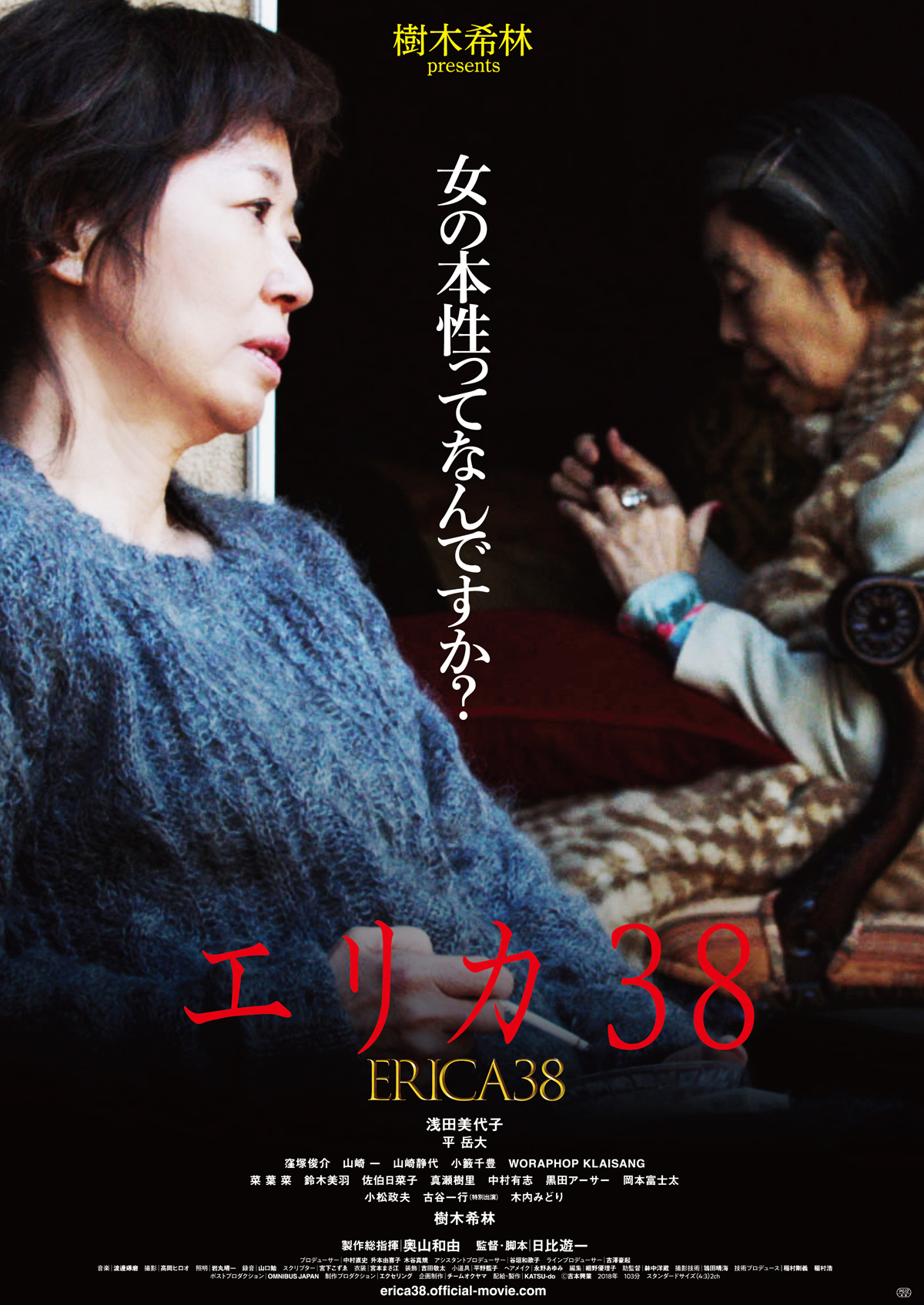
Erica 38 poster“Everybody’s life is in someway unfulfilling”, admits the philosophical victim of a con woman in ripped from the headlines tale Erica 38 (エリカ38). “It’s like a crutch” he adds, without a little fantasy you can’t go on. Like the “Erica” of the title, her victims are also looking for escape from an unsatisfying reality, and unfortunately for them already have what she feels would make her life more bearable – vast wealth. Returning to Japan after three decades abroad, director Yuichi Hibi does his best to humanise the figure of the coldhearted grifter, painting her as just another disappointed, lonely old woman desperately trying to recapture the sense of possibility so cruelly denied her in youth.

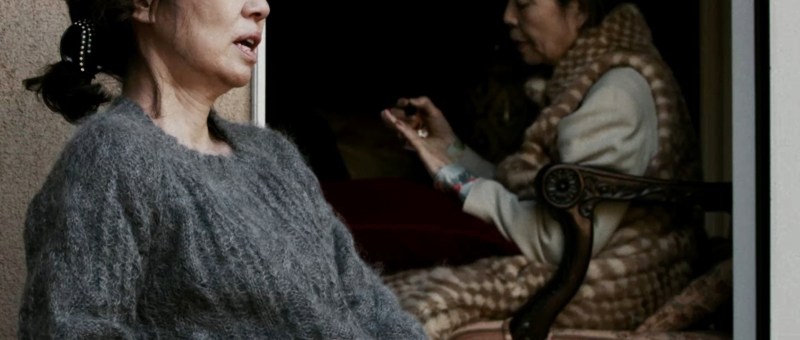
Later rebranding herself as “Erica”, a 38-year-old woman of means, our “heroine” is Satoko Watanabe (Miyoko Asada), an ageing bar hostess supplementing her income by peddling a dodgy multi-vitamin pyramid scheme to bored housewives eager to make a few extra bucks. Her sales pitch, however, gets her noticed by a refined old woman sitting close by in an upscale hotel during in one of her sessions. The woman, Mrs. Ito (Midori Kiuchi), introduces her to a “friend”, Hirasawa (Takehiro Hira), who cuts in with a sales pitch of his own in branding himself as a paid up member of the global elite who works with the Pentagon on important international matters. Hirasawa heavily implies his business is not quite on the level, but Satoko, captivated by his suave sophistication, fails to realise just how dodgy he really is. Before long, she’s joined him in his “consultation” business, selling fraudulent investment opportunities in the emerging market of Cambodia.

It is surprisingly easy to sympathise with the dejected Satoko as she falls under Hirasawa’s spell. Already well into her 50s when the film begins and clearly over 60 when she rebrands herself as the 38-year-old Erica, Satoko has led an unhappy life beginning with a traumatic childhood lived in the shadow of an abusive, adulterous father. The only memory of joy from her youth is when she and her mother (Kirin Kiki) giggled together after accidentally tipping rat poison into dad’s miso soup. Life since then, it seems, has been one disappointment after another spent in the hostess bars of Kabukicho. What all of that means, however, is that she’s become skilled in the art of selling fantasy. All that time invested in extracting cold hard cash from lonely men has set her in good stead for selling unrealistic investment opportunities to the already comfortably off.

Unrepentant, Satoko tells herself that she bears no responsibility towards those who lost money in her scams because they were chasing exactly the same thing she was – escape, and they both found it at least for a moment. Her victims made the decision themselves, she never forced anyone, and so it’s their own fault that they fell for her patter while she perhaps laments only that she’s been foolish and profligate in not planning better for the eventual implosion of all her schemes.

“There’s a thin line between real and fake”, she tells a party guest admiring one of her paintings, “if someone sees it as real then real it is”. Satoko’s cons are, in essence, an extension of the paradox of the hostess business. Anyone with an ounce of sense would have seen that the business isn’t legitimate, but like a salaryman in a hostess bar they invest in the semblance of connection while knowing in a sense that isn’t “real”. Ironically enough, Satoko is forced to realise that the first victim of her subterfuge is herself. Chasing a dream of love, she fell hard for Hirasawa without thinking him through. Hirasawa succeeds in his schemes because he’s scrupulously careful in maintaining his persona – he operates out of hotels, has no fixed address, and uses several cellphones. As Satoko later finds out, he is effectively running a harem, romancing several women all like herself bringing in the big bucks while he sits back relatively risk free. She has been used, once again.

The implosion of her dream of romantic escape is what sends her to Thailand where she ponders a reset, rebranding herself as the 38-year-old Erica of the title and beginning an affair with a young and handsome Thai man she rescued from gangsters with her ill-gotten gains. Porche (Woraphop Klaisang) later describes her as “My Angel”, of course realising that she was much older than she claimed but claiming not to care. It may be that he really did love her, but you can’t ignore the corruption of all that money and the power that it buys. In the end, money can’t buy you love, or a path out of loneliness, or a cure for disappointment.

Satoko was, like many, just another lonely, disappointed old lady trying to escape an unsatisfying present through a fantasy of returning to the past, rebooting herself as a successful business woman, loved and in love, as someone with a brighter future to look forward to. Her sales patter worked because it was “true”, the similarly dejected could sense in her the desperation for escape and as they wanted to escape too they let her take them with her. A melancholy tale of delusion and disillusionment, Erica 38 has immense sympathy for the scammer and the scammed painting them both as victims of an often unfair, conformist society in which freedom is the rarest commodity of them all.


Erica 38 screens in New York on July 25 as part of Japan Cuts 2019.

Original trailer (English subtitles)