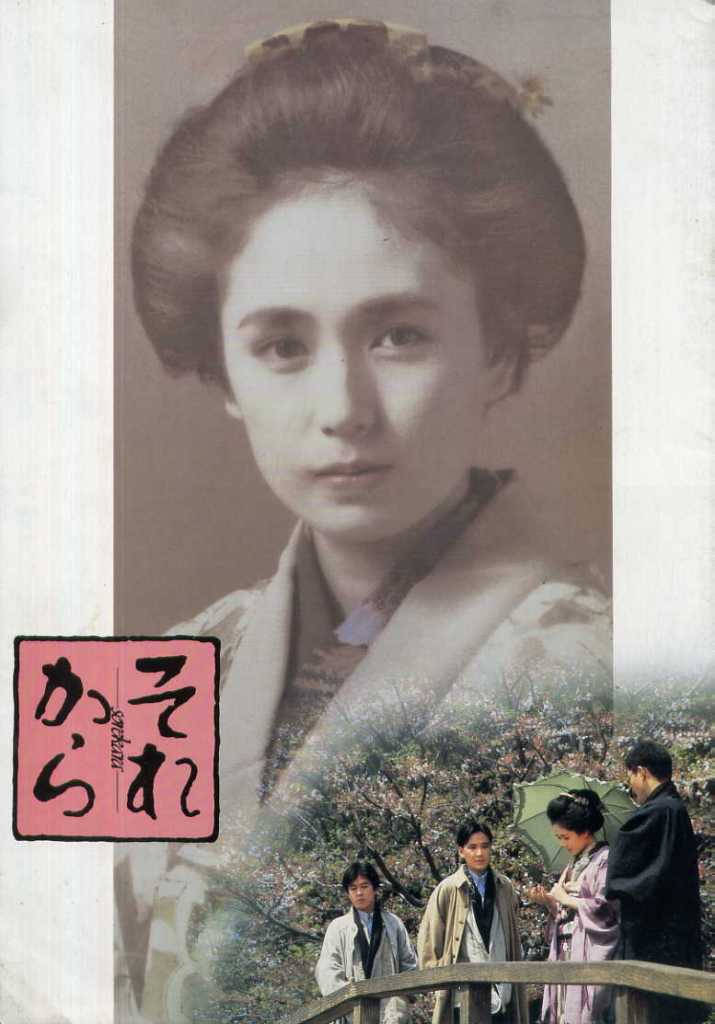
 Yoshimitsu Morita had a long and varied career (even if it was packed into a relatively short time) which encompassed throwaway teen idol dramas and award winning art house movies but even so tackling one of the great novels by one of Japan’s most highly regarded authors might be thought an unusual move. Like a lot of his work, Natsume Soseki’s Sorekara (And Then…) deals with the massive culture clash which reverberated through Japan during the late Meiji era and, once again, he uses the idea of frustrated romance to explore the way in which the past and future often work against each other.
Daisuke (Yusaku Matsuda) is a youngish man approaching early middle age. Thirty years old and a “gentleman” of leisure, he lives in a world of perpetual ennui where he even has to hold his hand to his chest to check that his heart is indeed still beating. His days might have gone on aimlessly had it not been for the unexpected return of an old friend from university, Hiraoka (Kaoru Kobayashi), who has been dismissed from his job following a series of problems with his superiors which has also landed him with a considerable debt to repay and no prospects of further employment. Adding to his sorrows, Hiraoka and his wife, Michiyo (Miwako Fujitani), have recently lost their infant child and have been told that due to Michiyo’s poor health they may not be able to have any more. Daisuke wants to help them, but he’s also facing a lot of pressure from his family to accept an arranged marriage which will further his father and brother’s prospects and is becoming conscious of the relative lack of freedom his life of dependent idleness entails.
Men of Daisuke’s era have perhaps had it hardest coming of age during a period of massive social change which is incomprehensible to the older generation. He’s a well educated man, an intellectual, who can speak several languages and is given to introspective contemplation, but he’s also inherited the worst of European classism as he’s come to believe that working for money is beneath his dignity as a gentleman. He’s completely unable to identify with his friend who needs to work to eat and enjoys none of the various safety nets which are provided by his own wealth and privilege. Nevertheless, he does want to try and help Hiraoka and is dismayed to discover just how little power he has do anything for him.
Hiraoka and Daisuke were part of a group of friends at university which also included another boy who, sadly, died of an illness and his sister – Michiyo, who eventually married Hiraoka. At the time, Daisuke himself had fallen in love with Michiyo but out of a misconceived idea of “chivalry” – another unnecessary adoption of European romanticism, he stepped aside in favour of his friend. This has proved to be a disaster all round and Michiyo and Hiraoka are trapped in an unhappy union which has made Michiyo physically weak and caused Hiraoka to spend the money he should be using to pay back his massive debts on drink and geisha so he can avoid going home. Daisuke’s adherence to a code of morality which is more affectation than anything else is shown up to be cowardice, another way of avoiding adulthood, as he uses his intellectual ideas to mask what is really a fear of rejection.
Daisuke later comes to believe what he did in not acknowledging his own feelings towards Michiyo was “a crime against nature”. He now finds himself at another crossroads as he faces the choice between conforming to the rigidity of his upperclass life in marrying the woman his father has chosen for him and continuing to be financially dependent, or embracing his individuality and striking out on his own to finally claim the woman he’s always loved (and, tragically, has always loved him). In choosing to make a life with Michiyo, Daisuke would be taking several transgressive actions – firstly acting against his own self image by entering the world of working men and secondly by stealing a married woman away from her husband which is no simple matter in the still relatively conservative Meiji era society.
Ultimately, the film is much more a story of Daisuke’s journey of self realisation than it is a melodrama with a love triangle at its centre though Sorekora certainly embraces these aspects too. Morita opts for a more classical tone here with a number of long, unbroken takes and static camera shots yet he also affects a strange, dreamlike tone in which the present and the past seem to co-exist, each drifting one into the other. He intercuts scenes which echo the film’s ending into the main body of the action as well as showing us the early days of Daisuke and Michiyo’s unresolved romantic connection which is poignantly brought out by an experimental technique in which the foreground appears almost like a freeze frame while the rain carries on falling behind them. At certain points there are also some surreal sequences in which Daisuke is travelling on a train but is surrounded by fellow passengers who suddenly each pull out a large sparkler or another where a gaggle of men all dressed just like him are crowded into the the other end of the train and looking at the moon through the open roof of the carriage.
A prestige picture, but one with a healthy dose of strangeness, Sorekara is an inexpressibly sad film full of the tragedy of wasted time and the regret that comes with not having acted in way which satisfies your authentic self. In order to live a life that’s true to himself Daisuke must finally learn to risk losing everything but the film’s ambiguous ending may ask whether the cost of following your heart may not be too heavy a one to pay.
Unsubtitled trailer:
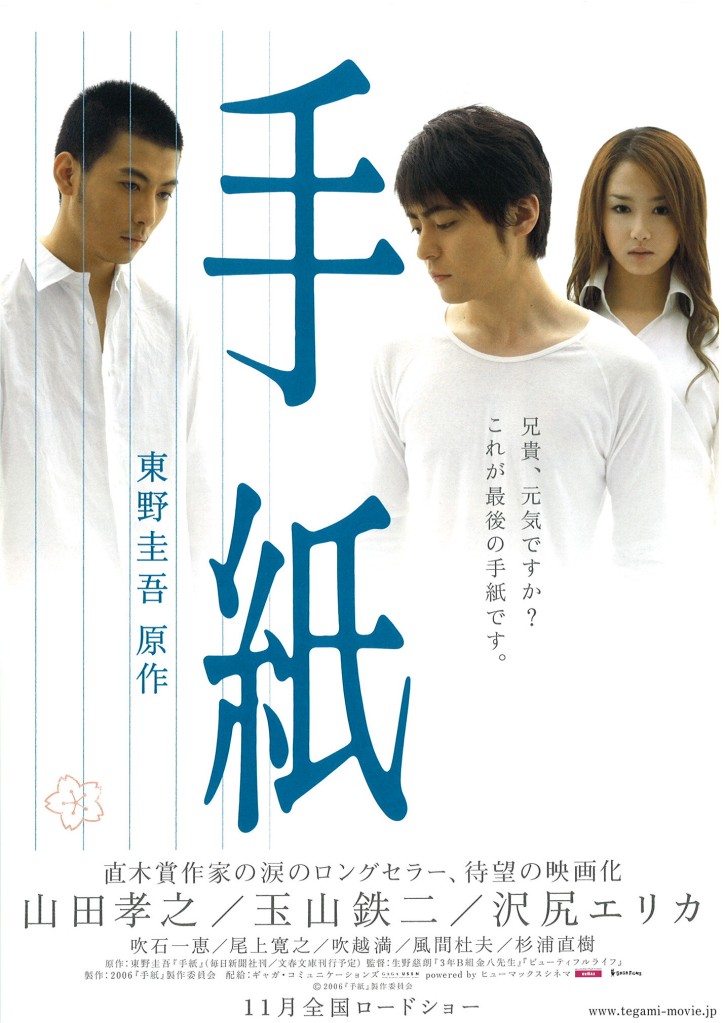 When it comes to cinematic adaptations of popular novelists, Keigo Higashino seems to have received more attention than most. Perhaps this is because he works in so many different genres from detective fiction (including his all powerful Galileo franchise) to family melodrama but it has to be said that his work manages to home in on the kind of films which have the potential to become a box office smash. The Letter (手紙, Tegami) finds him in the familiar territory of sentimental drama as its put upon protagonist battles unfairness and discrimination based on a set of rigid social codes.
 Windows on Worlds