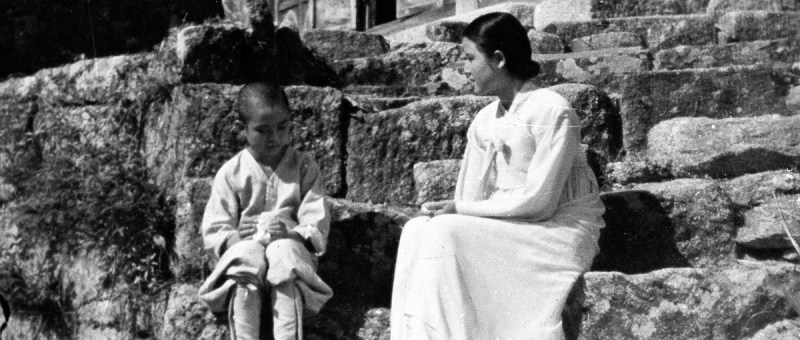

Should the “sins” of the mother be visited on the son? The ageing monk at the centre of A Hometown in Heart (마음의 고향, Maeum-ui Gohyang) seems to think so, punishing a young boy for his mother’s transgressions by treating him as a little man and insisting he reform himself by careful study of the sutras. A bereaved mother feels differently, certain that all he needs is maternal love, while the boy pines for the woman who abandoned him when he was so young that he is unable to remember her.
As the film opens, 12-year-old Do-seong (Yu Min) is an apprentice monk at a mountain temple where he is forced to do the chores typically assigned to novices such as ringing the bell and carrying water from the valley below despite his youth. Do-seong has no interest in Buddhism and does not want to become a monk though he has little choice. He looks on enviously as the other children laugh and sing while playing in the forest, but if they bump into each other he is mocked and bullied. The ringleader, hunter’s son Jin-su (Cha Geun-su), is fond of killing birds around the temple with his slingshot, which is not very Buddhist and often gets him in trouble with the head monk which is another reason why he dislikes Do-seong. Meanwhile, all Do-seong hopes for is that his mother, who left him at the temple when the was three, will one day return. Apparently, she was very beautiful and is now living in Seoul, the urban paradise on the other side of the mountains.
As we later learn, Do-seong’s mother was herself a relative of the head monk who took her in when she was orphaned and raised her as a nun, only she ran off with a hunter and gave birth to Do-seong perhaps not quite legitimately. All of that makes Do-seong almost like the head monk’s grandson, but he continues to hold his mother’s “betrayal” against him, insisting that he needs to be more virtuous than the other children in order to make up for his mother’s “sins” in running off with the hunter and abandoning her child. The monk claims that he could forgive her for the hunter, but not for leaving her son. Later we hear that the choice could not have been easy for her, she had two children and could not raise them both and so she left Do-seong somewhere he’d be safe. Do-seong has been pining for her all this time, little knowing she tried to visit him five years previously but the monk turned her away.
Meanwhile, the temple is all abuzz because they’re due to hold a 49th day ceremony for the wealthy Ahn family from the city. Sadly, the young son of the widowed daughter-in-law (Choi Eun-hee) has passed away from measles at only six years old. On hearing that the ceremony is for a boy from a wealthy family, Do-seong is confused, certain that a family of that kind would have taken great care him, in the way he perhaps longed to be taken care of by a loving mother. Diseases like measles, however, do not discriminate. The loss of the child is a double blow for the widow because he was her only son and as her husband died just before the baby was born, perhaps in the war, she will have no more children. That may be why she takes so strongly to little Do-seong even though he’s much older than her son was, immediately realising how lonely he must be and how much he must miss his mother even though he never knew her.
Growing close to the boy, the widow begins to wonder if she shouldn’t adopt him and take him away from this cold and austere temple life which he seems to so dislike. Her mother is against it, telling her to put the past behind her and attempt to marry again, but the widow is certain that she wants to raise Do-seong with maternal love in opposition to the head monk’s emotionless rigidity. The monk, however, is resistant, punishing Do-seong because of the grudge he bears his mother. Only when the boy’s mother turns up unexpectedly does he relent, preferring that Do-seong leave with the widow rather than with the woman who abandoned him. Do-seong’s mother wrestles with herself, longing to see her son but unsure she has the right, eventually meeting with the widow to ask her to reconsider which she of course does because she’s not someone who’d want to separate a mother and a child. But Do-seong is so excited about going to Seoul, getting a suit, and maybe going to college that his mother reconsiders and decides that perhaps it’s too late after all and Do-seong should go with the widow who can give him a much more comfortable life.
As if to prove the head monk right, however, karma catches up with Do-seong when it’s discovered that he too killed one of the birds hoping to make a fancy feather fan like the widow’s for his mother in case she ever came back. The widow’s mother is scandalised, not wanting to bring a killer into her home, while the head monk revokes his permission in certainty that Do-seong is “bad”, filled with the sins of his mother, and in need of further correction. The widow disagrees and points out that he must miss his mother very much to have done something like that for her and what he needs is a mother’s love, not the cold cruelty of the monk’s emotionless asceticism. As the servants point out however, “we can’t do anything about our fate, we all have to live and die according to our lot”. There’s not much the widow can do other than promise to try again later.
One of the other monks had tried to comfort the widow and her mother by reassuring them that it’s all because of karma, which seems like an inappropriate thing to say to a woman who’s lost a child no matter how sincerely it’s meant. The head monk also tells Do-seong that he’s bad because he’s got bad karma, but perhaps that’s not something he really needs to believe. Overhearing that his mother had returned and tried to see him but was prevented, he takes his fate into his own hands, striking out alone towards the city and an end to his loneliness in claiming his birthright as a beloved son in a world unburdened by moral austerity.
A Hometown in Heart is available on DVD from the Korean Film Archive in a set which also includes a bilingual booklet featuring essays by film critic Kim Jong-won and KOFA Film Conservation Center manager Jang Gwang-heon.
 Windows on Worlds