Omniscient Reader: The Prophecy (전지적 독자 시점, Kim Byung-woo, 2025)

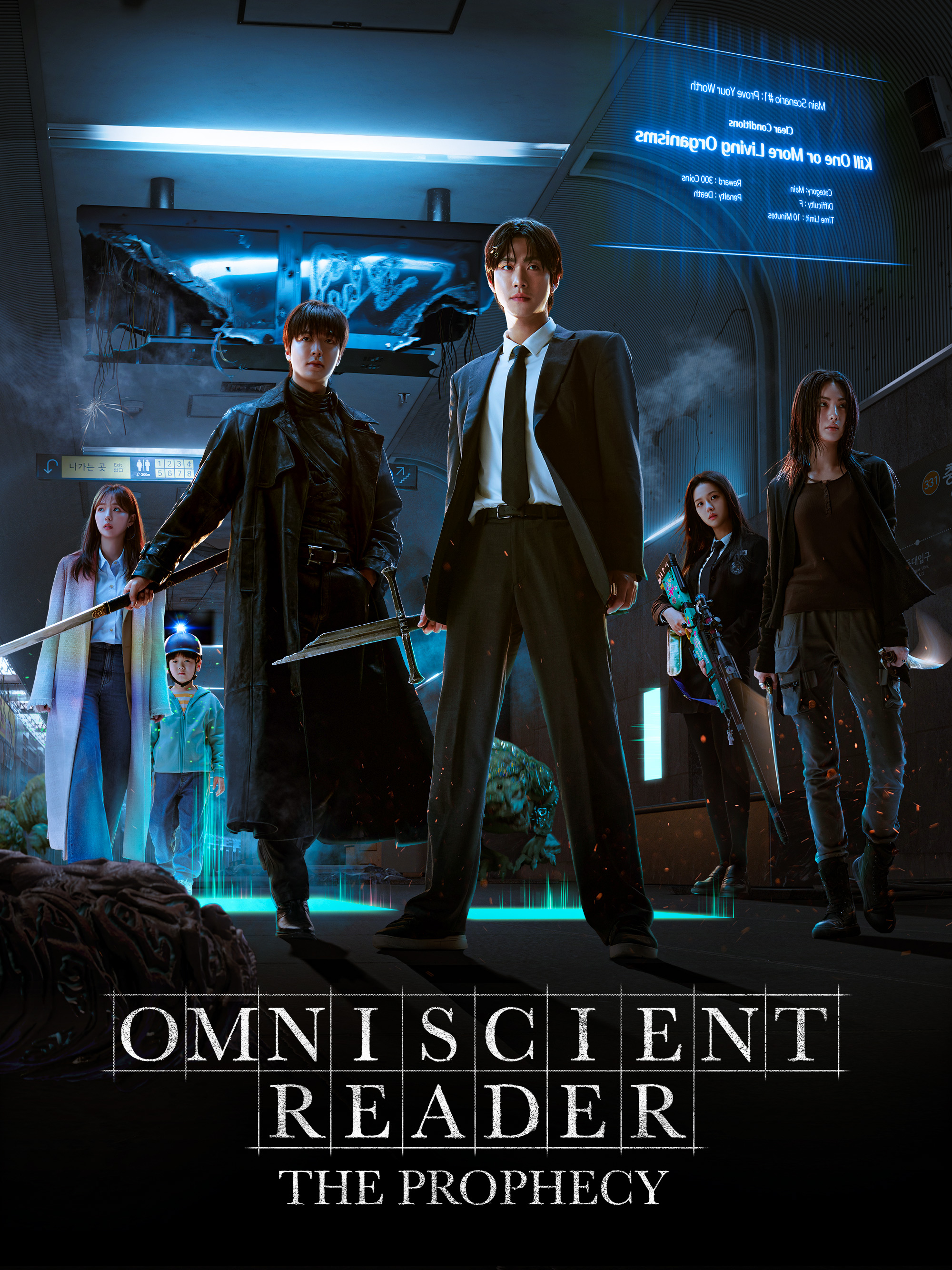
Fed up with the ending of a web novel he’s been reading since his teens, Dokja (Ahn Hyo-seop) sends the author a message. By this stage, he’s the only reader left, a kind of “lone survivor”, if you will. But he tells the author that the ending has disappointed him and that he can’t accept that the main theme was that it’s alright to sacrifice the lives of others so that you alone can live. Adapted from the popular webtoon, Kim Byung-woo’s Omniscient Reader: The Prophecy (전지적 독자 시점, Jeonjijeok Dokja Sijeom) is in part about the conflict between nihilistic pragmatism and selfishness, and a pure-hearted altruism that insists it’s possible for us all to survive and that surviving alone would be pointless anyway.

It only obliquely, however, touches on these themes in how they relate to the contemporary society in hinting at the destructive effects of capitalism. Dokja is the hero of this story, but he’s also a face in the crowd as a member of a constant stream of office workers on their way to work, not really so different from little ants squeezed between the fingers of powerful elites. Dokja at least feels himself to have lost out in this lottery, a contract worker let go by a conglomerate, while his sleazy boss Mr Han (Choi Young-joon) slobbers all over his female colleague, Sangha (Chae Soo-bin), who unlike him is no longer wedded to the corporate philosophy and is considering striking out on her own to do something that interests her personally. Perhaps the novel ending on the same day as his contract felt a little bit to much like the end of a world, which is what pushed him to write a message that in other ways seems uncharacteristically mean. 

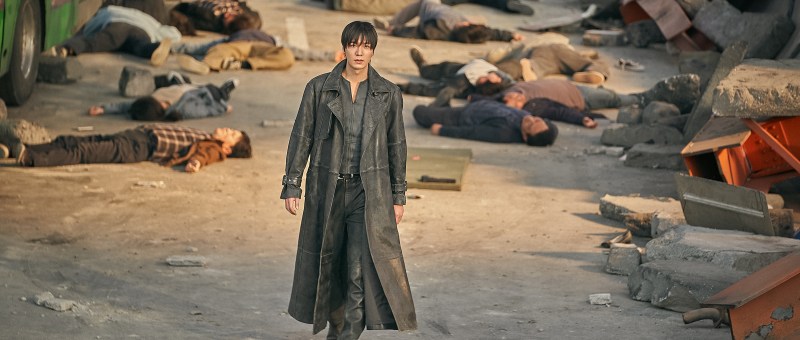
But then the author tells him that if he doesn’t like this ending he can write his own, perhaps obliquely reminding him that he is free to change his future if he wants. Nevertheless, Dokja is soon thrown into the world of the novel where he is faced with a series of scenarios where he must choose whether to sacrifice the lives of others in order to save his own for the entertainment of celestial beings who watch the whole thing via live streams and occasionally sponsor interesting players. Dokja has an advantage in that he already knows what’s going to happen, but is also aware that things don’t always go the way they should and his own actions change the course of the narrative. He’s convinced that he has to save the “hero”, Jung-hyeok (Lee Min-ho), or the fantasy world will end, killing everyone inside it, but never really considers that he too can be the protagonist of his own story. 

He remains committed, however, that the only way to survive is through mutual solidarity even if he scoffs at the quasi-communist mentality at the Geumho subway station correctly guessing that it’s all a scam being run by a corrupt politician which muddies the water somewhat when it comes to the film’s politics. In any case, Dokja seems to believe that he must save Jung-hyeok not just physically but spiritually in proving to him that his nihilistic viewpoint is mistaken and the only way for them to survive is to support each other by pooling their skills and resources. In dealing with his own trauma and guilt over having once sacrificed someone else to ensure his own survival, Dokja is able to write a new ending for himself surrounded by his companions rather than as a lone survivor roaming a ruined land with nothing to look forward to except death.

On the other hand, perhaps it’s true that he thinks he needs a hero to save him rather than realising that he is also the hero of this story, while the fantasy world too is driven by capitalistic mentality in which Dokja must amass coins to be able to level up or literally buy his survival. Occasionally he wavers, wondering if the others have a point when they tell him he’s being foolish and should learn to just save himself no matter what happens to anyone else, but otherwise remains committed to rejecting the premise of the original novel’s nihilistic ending in insisting that there’s a way for us all to survive if only we can learn to be less selfish, trust each other, and work for the good of all.


Omniscient Reader: The Prophecy is available in the UK on digital download from 15th December.

UK Trailer (English subtitles)
Confession (자백, Yoon Jong-seok, 2022)

An accused man and the woman sent to defend him battle over the elusive nature of objective truth in Yoon Jong-seok’s steely psychological thriller, Confession (자백, Jabaek). A remake of the Spanish film Contratiempo, Confession is nevertheless the latest in a longline of Korean films critical of expanding chaebol culture and the utter entitlement of the elite who assume they have the right to do whatever they want because their money, status, and connections protect them from any potential consequences of their actions. Then again as the lawyer tells her client, salvation is never painless. 

Min-ho (So Ji-sub) had something of a golden life. Married to the daughter of the chairman of a large corporation, he was a rising star of cybersecurity who had even been named IT businessman of the year but was about to throw it all away through a lengthy affair with a woman, Se-hee (Nana), whom he has now been accused of killing. You’d have to admit, he had a motive and the circumstantial evidence against him is convincing yet Min-ho claims that he didn’t do it and there was a third party involved in this otherwise locked room mystery. 

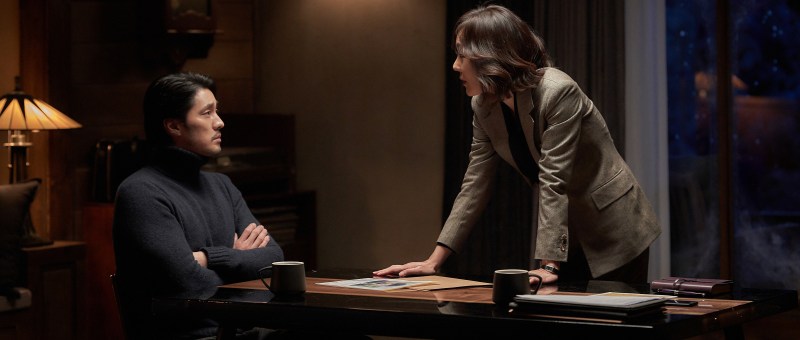
Much of the film takes place in a claustrophobic wooden cabin in the woods all but cut off by heavy snow in which Min-ho has chosen retreat after his chairman father-in-law managed to get his arrest warrant canceled. What emerges is a psychological battle between Ms. Yang (Kim Yunjin), the fancy lawyer hired by the chairman, and Min-ho who have somewhat opposing goals. Min-ho wants her to sign the documents confirming her as his legal counsel and therefore making anything he might have said subject to privilege while she presses him for the location of vital evidence while trying to expose the objective truth behind Min-ho’s selective testimony. 

Neither of them are reliable narrators, Ms. Yang coming up with potential scenarios and at times implying she has evidence that she does not in order to push Min-ho towards revealing the facts of the case. As she says, a lawyer can only help you if you’ve been rigorously honest because she in turn needs to construct a narrative that can undercut the prosecution’s case. The truth might in one sense be irrelevant, as she implies when advising that they frame Se-hee as the villain suggesting that she orchestrated a plot to blackmail Min-ho over their affair in a mix of vengeance and greed when he decided to end their relationship because he could no longer bear the guilt of cheating on his wife. 

Yet there are further transgressions in Min-ho’s past aside from his affair and it’s the attempt to cover them up more than the affair itself which has landed him in so much trouble. As he tells the lawyer, he doesn’t just want to avoid prison but is set on total exoneration unwilling to accept any kind of responsibility for what is currently happening to him. Because of his wealth and status he believes he is not subject to the same laws as everyone else and that even if he had killed Se-hee as his lawyer is beginning to suspect, he would still not be guilty of any crime. “What’s important is to survive” he tells the lawyer revealing his inner ruthlessness along with the complacent reckless streak which might hinder her attempts to defend him. 

There’s no denying that the film’s earliest twists are obvious and heavily foreshadowed but like a seasoned lawyer it is also laying a trap that leaves its final revelations extremely satisfying in implying a kind of justice at least is possible in this inherently corrupt society where dodgy lawyers and elite privilege go hand in hand to destroy the lives of ordinary people. Dark in its implications, the cat and mouse game between lawyer and client who each lie in an attempt to expose the truth hints at the malleability of what is considered to be “true” in the way in which we all construct the narrative of our lives to suit ourselves while denying the realities of others. There may be no such thing as objective truth, but guilt and complacency will still come for you in the end. Visually referencing Alfred Hitchcock’s Psycho, Yoon’s tense psychological drama is in its own way hopeful in its reeling conclusion even if as the lawyer says salvation is never painless. 


Confession screened as part of this year’s New York Asian Film Festival.

International trailer (English subtitles)