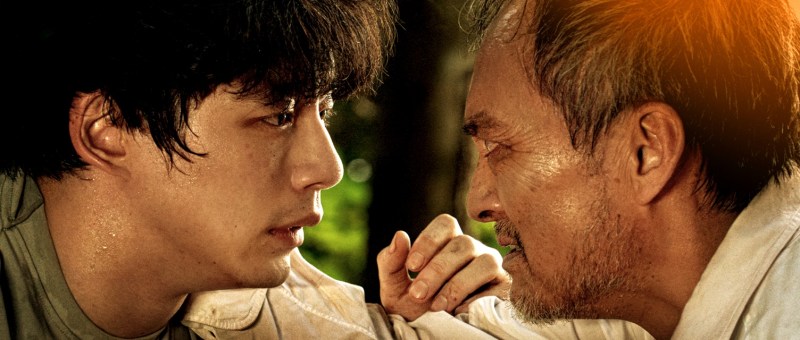
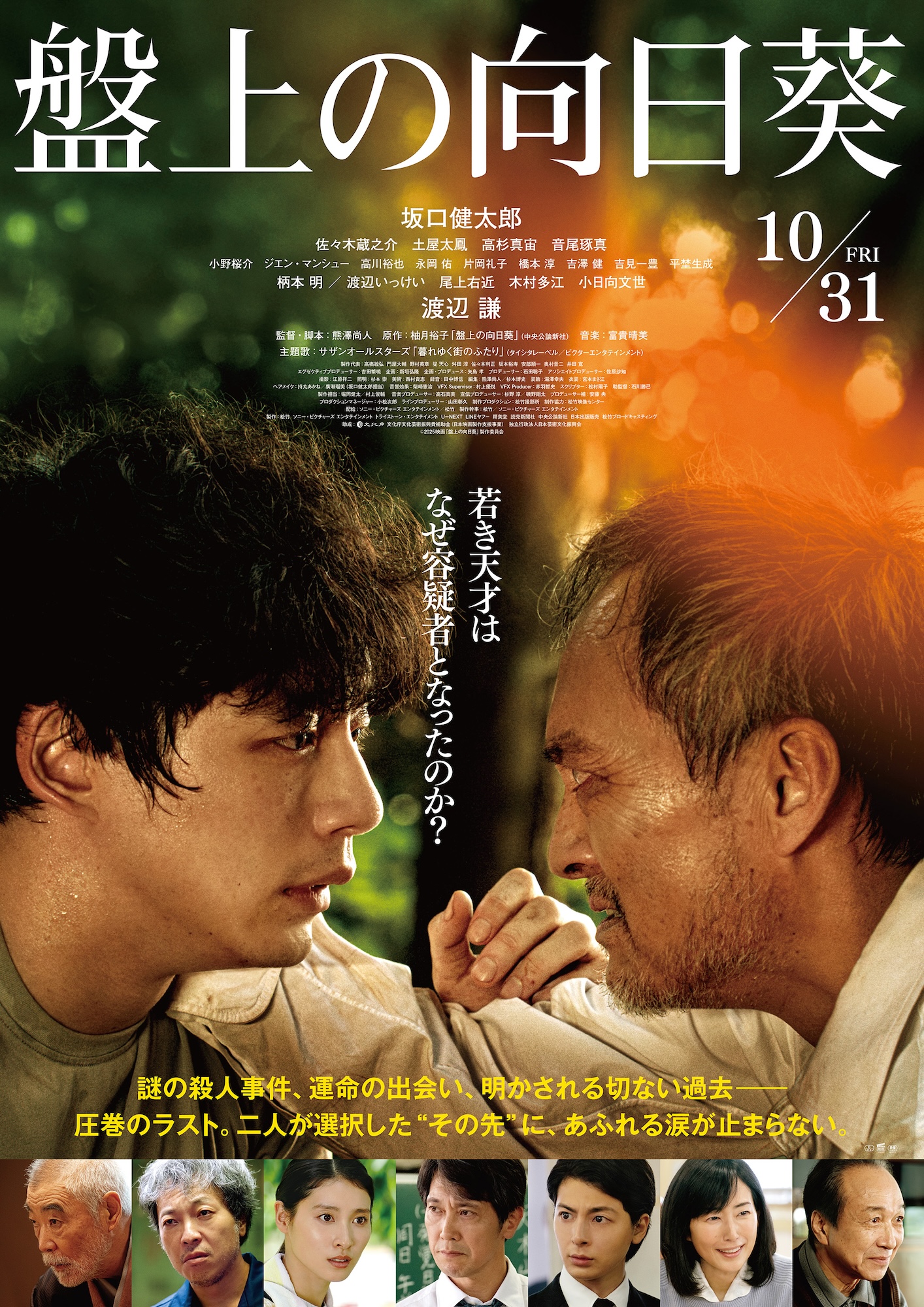
The Final Piece (盤上の向日葵, Naoto Kumazawa, 2025)

When a body is discovered buried with a priceless set of shogi tiles, it unearths old truths in life of an aspiring player in Naoto Kumazawa’s sprawling mystery, The Final Piece (盤上の向日葵, Banjo no Himawari). In Japanese films about shogi, the game is often a maddening obsession that is forever out of reach. Hopefuls begin learning as children, sometimes to the exclusion of everything else, but there’s age cut off to turn pro and if you don’t make the grade by 26, you’re permanently relegated to the ranks of the amateur. 

Junior policeman Sano (Mahiro Takasugi) was one such child and in some ways solving the crime is his final match. The thing is, he loves the game and admires Kamijo’s (Kentaro Sakaguchi) playing style along with the aspirational quality of his rise from nowhere not having trained at the shogi school and turning pro at the last minute to win a prestigious newcomer tournament. He’s hoping Kamijo will win his game against prodigious player Mibu (Ukon Onoe) with whom Kamijo’s fortunes are forever compared. Which is all to say, Sano really doesn’t want Kamijo to be the killer and is wary of accusing him prematurely knowing that to do so means he’ll be kicked out of professional shogi circles whether he turns out to be guilty or not.

Nevertheless, the more they dig into Kamijo’s past, a sad story begins to emerge that strongly contrasts with his present persona, a slightly cocky young man with a silly beard and smarmy manner. While Mibu seems to have been indulged and given every opportunity to hone his skills, Kamijo was a poor boy whose father had drink and gambling problems and was physically abusive towards him. His mother took her own life, leaving Kamijo to fend for himself with a paper round while his father occasionally threw coins at him and railed against anyone who questioned his parenting style. Good intentions can have negative consequences, the landlady at his father’s favourite bar remarks recalling how he went out and beat Kamijo for embarrassing him after another man told him he should be nicer to his son.

Toxic parental influence is the wall Kamijo’s trying to break in shogi. Aside from the man raising him, Kamijo finds another, more positive, paternal figure in a retired school teacher (Fumiyo Kohinata) who notices his interest in shogi and trains him in the game while he and his wife also give him clean clothes and a place to find refuge. But Kamijo can’t quite break free of his father’s hold much as he tries to force himself to be more like the school teacher. As an impoverished student he meets another man, the cool as ice yakuza-adjacent shogi gambler Tomyo (Ken Watanabe), who insists he’s going to show him the “real” shogi, but in reality is little different from his father if more supportive of his talent.

Kamijo finds himself torn between these three men in looking for his true self. Though he may tell himself he wants to be like the schoolteacher being good and helping people in need, he’s pulled towards the dark side by Tomyo and a desperate need for shogi which tries to suppress by living a nice, quiet life on a sunflower farm that reminds him of the happier parts of his childhood. There’s a cruel irony in the fact that the police case threatens to ruin to his shogi success at the moment of its fruition, even if it accompanies Kamijo’s own acceptance of his internal darkness and the way it interacts with his addiction to the game. 

Tomyo’s own obsession may have ruined his life as he looks back over the town where he spent his happiest months with a woman he presumably lost because of his gambling and need for shogi glory even though he never turned professional and remained a forever marginalised presence as a gambler in shogi society. Unlocking the secrets of his past seems to give Kamijo permission to accept Tomyo’s paternal influence and along with it the darker side of shogi, but there’s something a little uncomfortable in the implication that he was always doomed on account of his “bad blood” aside from the toxic influences of his some of his father figures from the man who raised him and exploits him for money well into adulthood, and the ice cool gangster who taught him all the best moves the devil has to play along with a newfound desire for life that may soon be snuffed out.


The Final Piece screens as part of this year’s Japan Foundation Touring Film Programme.

Yurigokoro (ユリゴコロ, Naoto Kumazawa, 2017)

Yurigokoro posterThose who cannot remember the past are doomed to repeat it, as they say, but is it better to acknowledge the dark parts of yourself as part of an inherited legacy or ignore a nagging sense of incompleteness in favour of a harmonious existence? The hero at the centre of Naoto Kumazawa’s Yurigokoro (ユリゴコロ), adapted from the mystery novel by Mahokaru Numata, is about to discover a side of himself he might not like just as storm clouds seem to gather over his previously idyllic childhood home.

For Ryosuke (Tori Matsuzaka), everything had been looking up. He’d set up his own business – a charming cafe and summer lodge, with the woman he intended to marry, Chie (Nana Seino). However, no sooner has he introduced his fiancée to his father than she disappears, gone without trace. Meanwhile, his father informs him that he has stage four pancreatic cancer. Suddenly everything is falling apart and the braver the face he tries to put on it, the worse he seems to feel. Perhaps that’s why he can’t resist opening up a mysterious old box hidden in a cupboard in his father’s study that almost calls out to him to be opened. Inside the box is an old exercise book with the title “Yurigokoro” pencilled on the front. Ryosuke only reads the first few pages but they’re enough to disturb and fascinate him. The book, written in the first person, recounts the dark history of a murderess (Yuriko Yoshitaka) from silent, disconnected child to vengeful spirit.

“Yurigokoro” as the diary’s protagonist later explains is a made-up word, one she childishly misheard from the mouth of a well meaning doctor (who probably meant “yoridokoro” which means something like grounding). It could, however, almost translate as a shaking heart – something the doctor seems to imply the child does not quite have which is why she feels disconnected from the world around her and unable, or unwilling, to speak. The girl in the book travels through life looking for something that makes her heart beat and originally finds it only in the strange pleasure of watching something die, at first by accident and later by design. She drifts into an intense relationship with a damaged young woman (Aimi Satsukawa) who, like her in a fashion at least, resorts to self harm in order to feel alive. She thinks she finds her home, but it slips away from her or perhaps changes in form as it succumbs to inevitable disappointment.

Yet, in the grownup crimes at least, there is a kind of love in amongst grudging resentment. Ryosuke reads the diary and declares he does not relate to it at all but something about it gets under his skin and he can’t let it rest. He hears from an older woman (Tae Kimura) that Chie may have a past he knew nothing about, largely because he failed to ask, and that she may be in danger. He begins to feel rage surfacing within him like the dark violence of the diary’s protagonist and it both frightens and enthrals him.

The owner of the diary likens her experience of existing in the world to being prickled by hundreds of tiny thorns. She seeks relief through bloodletting and violence, as if she could shake herself free of the tiny stings that remind her of nothing other than her sense of emptiness. Later she discovers that love too can shake the heart, but the old darkness remains and even the most positive of emotions may require an act of violence in order to sustain it. The diarist remains ambivalent, knowing that there is no salvation for her except death and that any attempt to stave off the darkness with light will eventually fail, but determined to cling on to her brief moment of wholeness however inauthentic for as long as it lasts.

Ryosuke, meanwhile, who’d apparently never sensed in himself the kind of gaping emptiness that the diary’s owner describes, is forced to wonder if the diary is legacy and destiny, if he too is destined to commit random acts of inescapable violence as someone unfit for living as a human being among other human beings. Love might not have “cured” the darkness inside the diarist, but it did change it in quite a fundamental way, a way that eventually provided him with the means of his “salvation” perhaps at the cost of her own if only he is willing to accept it. Ryosuke might wish he’d never opened that particular box, but in doing so he discovers not only the path towards a fully integrated self but that his own darkness can be tempered precisely because of the sacrifice that was made on his behalf.


Yurigokoro was screened as part of the 2019 Japan Foundation Touring Film Programme.

Original trailer (no subtitles)