Asia is One (アジアはひとつ, NDU, 1973)

“They came to beat us into a splendid Japanese future, to conquer us” according to an interview in a small Taiwanese mountain village towards the end of the Nihon Documentarist Union’s Asia is One (アジアはひとつ, Asia wa Hitotsu). Having documented Okinawa on the brink of its reversion to Japanese sovereignty, the collective return to examine more widely its legacies of oppression and exploitation under Japanese imperialism venturing first to its smaller islands and then all the way out to Taiwan from which many migrant workers had come to work in harsh conditions in Okinawan mines during the colonial era. 

One man describes himself as having been tricked in coming to the Marusan mine in 1933 in the mistaken belief he could work there for six months and then return home. “I thought it would be better to die than live there” he goes on, originally too afraid to attempt escape having seen others rounded up and punished but later managing to get away by blowing up a boat. A Japanese man who worked at the Noda mine in Iriomote, meanwhile, reveals that they were refused days off and sick workers were often cast out. Many simply died because they could not afford to pay for medical attention. Workers were paid in company script which could be spent only on the compound, the mine owners fearing workers would abscond if they were paid in cash. By his reckoning, however, the Taiwanese workers had it better because they were working on a contract basis and could get a better rate of pay. A third man, Masuda, meanwhile describes long days and early mornings, being unable to eat if they didn’t have money for the canteen, and the watchmen locking their bedroom doors at night to prevent them escaping. The conditions were so bad that one man took his own life by blowing himself up with dynamite tied around his waist. 

Even so, the second man then living in a nursing home, does not blame the mine owner, Mr. Noda, describing him simply as a “capitalist” and remarking that he was often kind and generous giving workers money for medical treatment etc, blaming instead the foreman. “It’s the people working under the capitalists who are bad” he explains, bearing out the extent to which oppressed people will often oppress others like them in order to feel less oppressed but also letting the system off the hook in failing to acknowledge that if Mr Noda had really been good and kind he could have improved conditions in the mine while still remaining “a capitalist”. Hsieh King-Fu, known as Dr. Seh, whose father worked as a doctor at the mines recalls a mass outbreak of malaria among the Taiwanese migrant workers leading to a shortage of morphine. Having bought supplies from a local pharmacy himself a rumour later circulated he was injecting them deliberately to get them addicted so he could drag them away so endemic had the sense of betrayal and exploitation become. 

Meanwhile since the reversion the islands have been fostering deeper connections with Taiwan which is after all geographically closer than the Japanese mainland. An older man explains that he’s instilling Taiwanese agricultural techniques in the local population and has successfully been cultivating pineapples on the island for the last 40 years. Fishermen too remark on how much easier it is to trade with Taiwan rather than the mainland because it’s simply closer meaning they can also trade live fish with a longer shelf life. Meanwhile an official details a potential agreement between the Ryukyu government and Taiwan to recruit workers developing new ties independently from those of mainland Japan. 

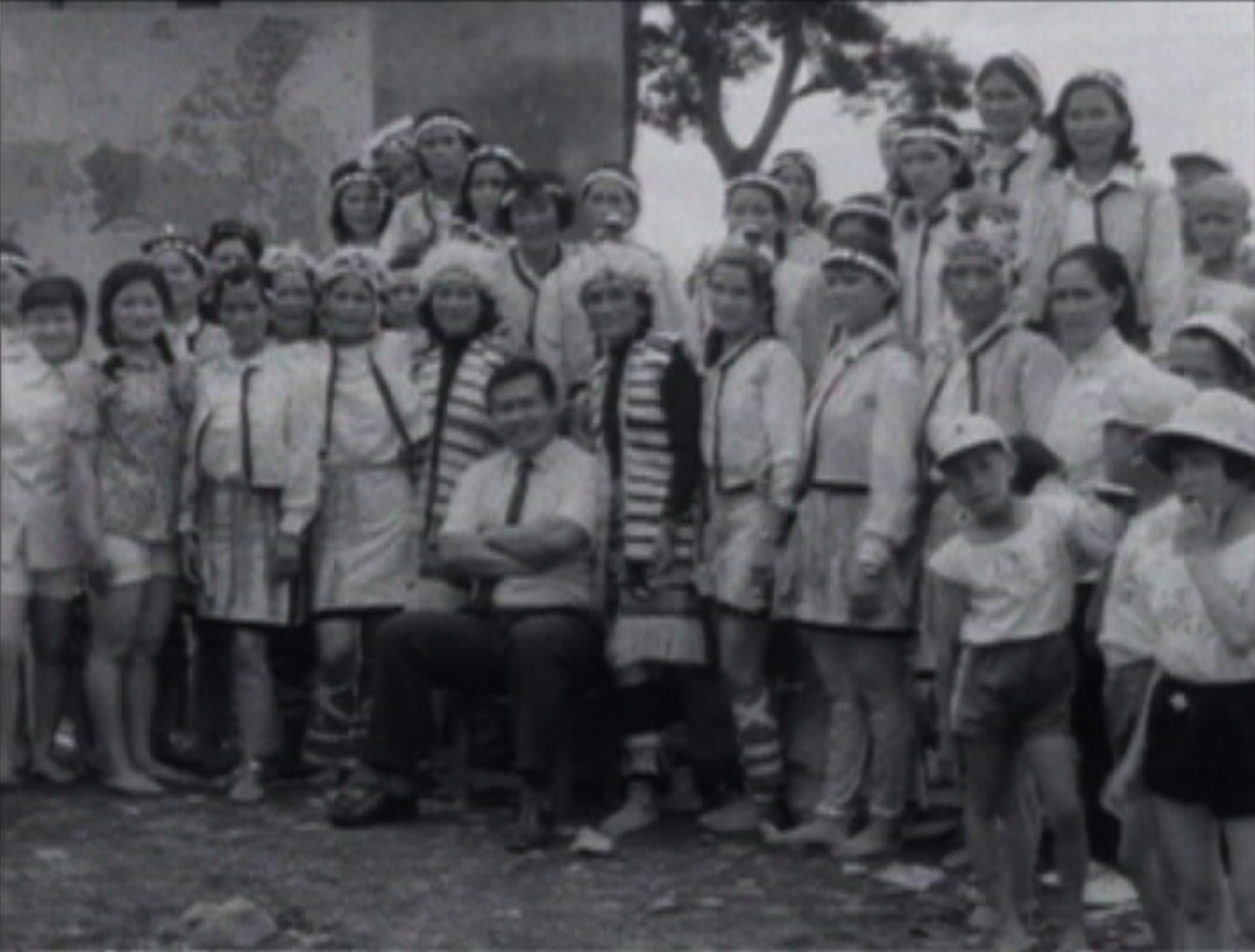
Yet in travelling to Taiwan itself, the documentary collective encounter surprising reactions to the legacy of Japanese colonialism in a small village inhabited by the indigenous Atayal community who still play the Japanese national anthem every day at noon. Many of them can still speak fluent Japanese having been forced to learn it during the colonial era and have almost a fondness for Japanese rule. “We owe everything to Japan” one woman states, uncomfortably grateful for her “civilisation” and thankful that the Japanese educated them out of some of their more “barbaric” customs such as the admittedly oppressive practice of beheading. Like the Korean man who obtained three names during his travels through the Japanese empire, many of the villagers have names in their indigenous language, names in Mandarin, and names in Japanese. “I’m still terrified of imperialism and oppression” one man admits though adding “I guess imperialism is different now” in lamenting that the emperor has never visited him but observing that he looked “free” on his last tour to Taiwan before going on to talk about a seal he received from the emperor after executing prisoners, by beheading, as a conscript soldier during the war. Asia may indeed be one if ironically, united in the destructive legacy of Japanese imperialism, but perhaps also finding new ways to repair itself which take less account of concepts such as sovereignty, diplomatic recognition, or man-made borders. 


Asia is One streams worldwide (excl. Taiwan and Japan) until June 3 as part of Japan Society New York’s Visions of Okinawa: Cinematic Reflections.

Motoshinkakarannu (沖縄エロス外伝 モトシンカカランヌー, NDU, 1971)

Active between 1968 and 1973, the Nihon Documentarist Union or NDU was a collective of documentary filmmakers emerging from the then declining student movement and “Zenkyoto” struggle committees whose members were often university drop outs disillusioned with the system. The group’s 1971 documentary Motoshinkakarannu (沖縄エロス外伝 モトシンカカランヌー, Okinawa Eros Gaiden: Motoshinkakarannu), shot in black and white and using asynchronous sound, takes its name from a word in the Okinawan language used to describe a business which can be started without seed money, effectively an ironic euphemism for sex work. Visiting the islands immediately prior to their return to Japan, the collective examines among other things a legacy of exploitation along with the effects of economic dependency on one or another colonising force. 

“How come Okinawa changes so much?” a street singer asks playing a sanshin while reflecting on the islands’ complicated history. An old lady born in 1889, the tail end of the Meiji era, reflects on cultural change when speaking of the tattoos on her hands which she’d so wanted as a child believing not to have them was not to be accepted as a woman and therefore unable to marry. But tattoos are taboo in Japan and the practice was eventually banned by the police leaving her stigmatised in her own community and forced to wear gloves in order to hide the markings of her culture. “Now in the contemporary society you can’t get married if you have a tattoo. Things can change 180 like that” she adds reflecting on the rapid changes which have taken place within her lifetime in which even ancient traditions can be abruptly ended by outside forces. 

Meanwhile, another woman prepares to adjust her currency exchange business once Okinawa reverts to Japan and the American presence decreases. While some are in favour of the reversion more because they want the Americans to leave than actively desire to return to Japanese sovreignity, others wonder what the effect will be on the local economy given that workers are already being laid off from jobs on American bases. The documentary captures several labour protests held outside military facilities by anxious workers. “Okinawa is sacrificed again under military control” one leader insists while another later adds “for 20 years Okinawa was denied normal employment opportunities due to its militaristic colonisation” each emphasising the unanswered questions in the reversion agreement of what is supposed to happen to these now redundant workers, where will new jobs be coming from and what are they supposed to do until they arrive? Many of the protestors are extensively masked appearing somewhat like the invisible man with their heads wrapped in fabric and sunglasses covering their eyes presumably because they fear negative consequences from their employers if they’re caught at the demonstration.

The documentary team muddy the waters a little by challenging one man that as he’s a cook he could easily find new work, but as he points out it’s not just about him and he believes the labour movement will be beneficial to the islands’ future. Many feel betrayed that the local Okinawan police force continues to protect the interests of the Americans in attempting to suppress their protests, but conversely there is also anxiety regarding new industrial investment from Japan with the CEO of Toyo Oil, directly labeled a war criminal in the embedded subtitles, trying to argue that he is an environmentalist and would not go ahead with the plant if it were to produce pollution. Such worries are perhaps at the forefront of the minds of ordinary Okinawans given the numerous mainland scandals of the postwar era such as the Minamata disease and Yokkaichi asthma among many others, while an old man’s hand-painted sign also protests that the oil refinery is to exist on land stolen from local farmers. The anxiety seems to be as the camera pans ominously across a new industrial zone that Okinawa will become a dumping ground for problematic industries the mainland isn’t willing to place on its own soil, the people of Okinawa once again sacrificed for Japan’s gain. 

Then again others are worrying about a collapse in the local sex industry which they suggest caters almost entirely to American personnel. The documentary collective spend some time with a collection of American servicemen who discuss with them the US civil rights movement, but also appear to have a more regressive view of the sex industry than many in Okinawa making what seems to be a moral judgement as one flat out refuses to believe the women have no choice but to pursue sex work claiming they’ve chosen an “easy” solution to their problems rather than taking a more nuanced view of the economic realities of the islands and the complex networks of exploitation which support them. Then again as Akemi, the sex worker with whom the documentary opened, hints perhaps the filmmakers are no different. “They’re filming me because they want to show “Motoshinkakarannu”. They don’t know what it is, but they want to use the title.”


Motoshinkakarannu streams worldwide (excl. Taiwan and Japan) until June 3 as part of Japan Society New York’s Visions of Okinawa: Cinematic Reflections.