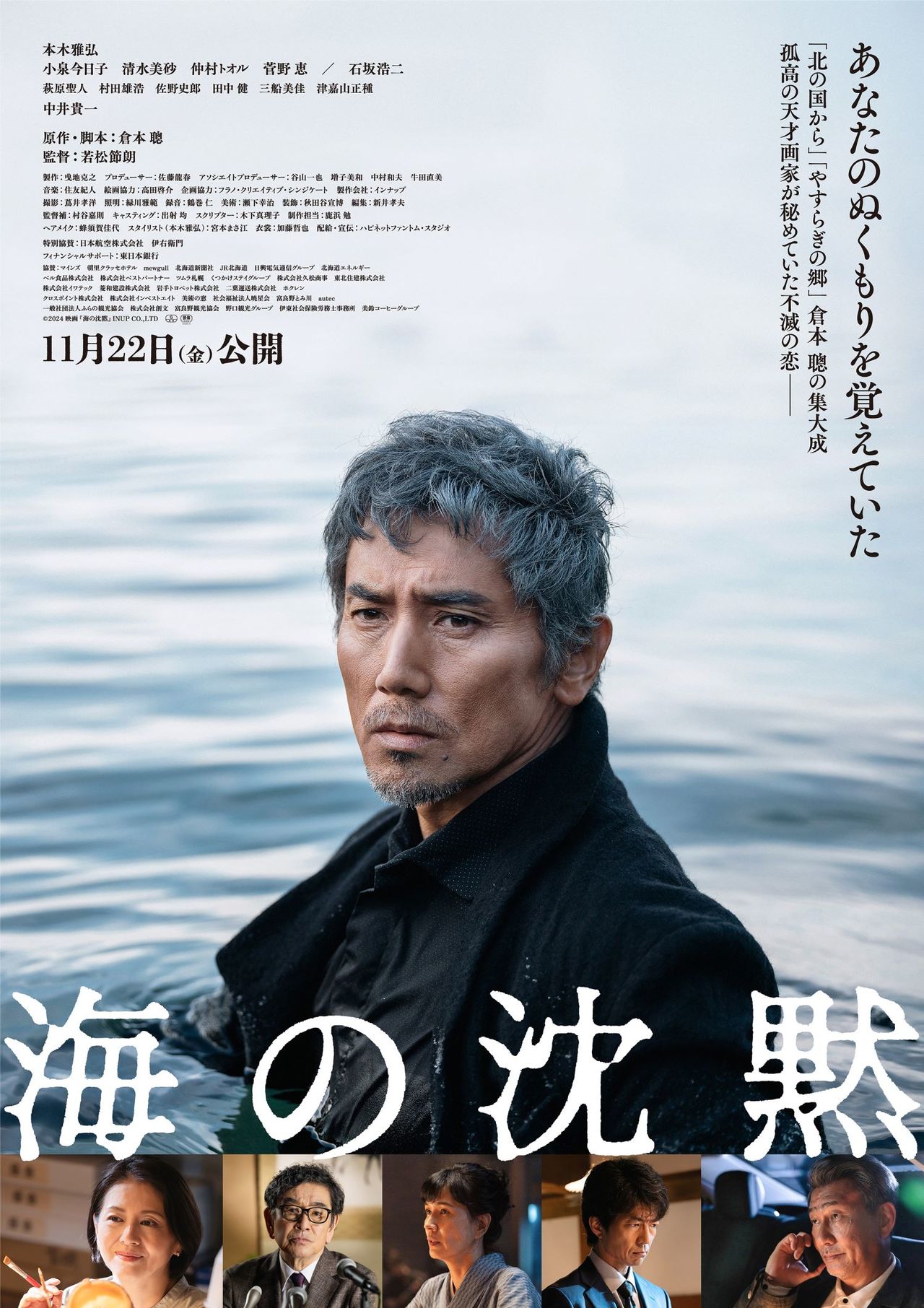
Silence of the Sea (海の沈黙, Setsuro Wakamatsu, 2024)

Can there be any greater humiliation than having your work plagiarised and the other person’s being better? Renowned artist Tamura (Koji Ishizaka) feels he has to say something on seeing an old painting at an exhibition honouring his late mentor and realising it’s not the one he painted. He doesn’t think he ever had the ability to paint something with this kind of power even when he was young, and he didn’t even use the materials which appear to have given this version a emotional depth that the original never had.

In some ways, this is Tamura’s past literally coming to the surface to show him that his life has been a series of mistaken choices and whatever success he may have achieved it’s come at the cost of his artistic soul. The first part of Setsuro Wakamatsu’s Silence of the Sea (海の沈黙,, Chinmoku no Umi) ponders why Tamura might be so keen to confess this work isn’t his when he admits that it’s objectively “better”, but even if that might be true, he has to concede it isn’t him and therefore shouldn’t have his name on it. Though he appears to have become greedy and vain, trading on his connections and more of a celebrity artist than someone with real and urgent ideas to express, he is apparently willing to burn all his bridges on the altar of authenticity while simultaneously refusing to divorce his wife, the daughter of his late mentor, despite living with another woman and their child on the other side of the country.

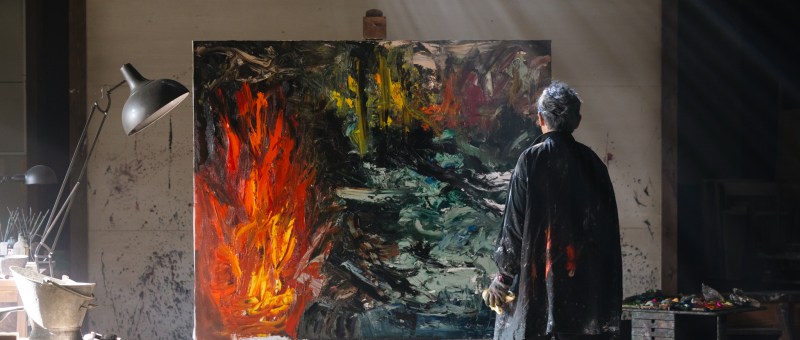
But as someone else says, does it matter whose name is on the painting when it is beautiful in itself? Then again, this beauty is intended both to cover something up and to expose it. In his youth, Tamura apparently threw another artist, Lyuji (Masahiro Motoki), under the bus. 40 years later, Lyuji is a master forger living a life in the shadows tattooing young women with his fevered artistic visions. It’s true enough that he seems to see them only as “canvases” and otherwise rejects personal connection while still carrying a torch for Tamura’s now wife Anna (Kyoko Koizumi). He seems to be stuck in the past, forever meditating on a particular pairing, The Silence of the Sea, which reflected his own moment of trauma when his parents both drowned when he was a child. 

The film seems to pain Tamura and Lyuji as two sides of the same coin. The more Tamura’s star rose, the sicker and more humble Lyuji became as if he were literally bleeding him dry. In the words of his assistant, Lyuji had an imperative to depict beauty, but art seems to deplete him. He literally vomits blood on the canvas while struggling to recreate his lost painting and thereby return to the source of his trauma. The sea for him seems to represent life and death along with life’s beauty and terror, while for Tamura it is perhaps merely picturesque even if for both of them the sun is always setting.

One man has almost painted over the other, stolen a life that might have been meant for him though his talent may lie more in an ability to play the game than in art itself. But at the same time, Lyuji has destroyed himself through his selfishness and single-minded obsession with his art along with the internal traumas it turns out he cannot simply paint over. His life is like the candle that Anna makes in his image, slowly melting away and producing only a single tear from a lonely soul. His eventual conviction is that beautiful things need only exist in our hearts and minds as memory rather than as material things. As he says, measuring art in money is mere foolishness, which paints his career of forgery as an ironic revenge against the art world which values only what’s popular and has become a game for the rich to play to enhance their status little caring for the nature of the art itself. Yet this covering up and later revealing of a truth has led to several deaths, among them a man who lived for art and a woman who yearned for love only to end up a scorned muse of an emotionally distant man. The sea took them all, but for Lyuji at least it may finally have fallen silent in the final perfection of his art.


Silence of the Sea screens as part of this year’s Japan Foundation Touring Film Programme.

Trailer (English subtitles)

Images: © 2024 Eiga Umi no Chinmoku INUP Co.,Ltd

Tonight, at the Movies (今夜、ロマンス劇場で, Hideki Takeuchi, 2018)

Tonight, at the Movies posterThe romance of the silver screen is one that never fades. Cinema has long been in love with itself, wilfully trapped inside the nostalgia of its own origins and youthful glory days. Nevertheless, we love it too and it’s a rare film fan who can resist the allure of the golden age backlot. With Tonight, at the Movies (今夜、ロマンス劇場で, Konya, Romansu Gekijo de, AKA Color Me True) Hideki Takeuchi becomes the latest in a long line of directors including Koki Mitani and Yoji Yamada to pay homage to world of classic Japanese cinema only this time he opts for a double rainbow as his eternal dreamer hero laments the loss of ‘30s glamour in the declining movie world of 1960 while his older self looks back on the bygone pleasures of his youth.

In 1960, Kenji (Kentaro Sakaguchi) is an assistant director at Kyoei film studios. Well, AD is what it says on his payslip, but Kenji is a mild mannered sort who mostly ends up doing odd jobs like ferrying props around and painting backdrops, mostly because he’s too much of a soft touch to push for anything else. The shy and beautiful daughter of the studio chief, Toko Naruse (Tsubasa Honda) – note the name, has fallen for him, but Kenji only has eyes for the silver screen. He spends his evenings at the local rep cinema “Romance Theatre” where he watches the daily programme and then bribes the owner (Akira Emoto) to make use of the projection booth after hours to watch his favourite forgotten classic, “The Tomboy Princess and the Jolly Beasts”. After a freak lightning strike and power outage, Kenji is shocked to discover that Miyuki (Haruka Ayase), the Tomboy Princess herself, has escaped from the silver screen and ventured into the Technicolor world.

After opening within the world of the film within the film, Takeuchi hops us forward to the contemporary era of cellphones and an ageing society as a kindly nurse laments that no one ever seems to come and see her favourite patient, Mr. Makino (Go Kato), except his granddaughter who everyone agrees is unnecessarily cold towards him. Makino is something of a key name in Japanese movie history having belonged to Shozo Makino who is often regarded as the father of Japanese cinema, and to his son Masahiro who was best known for his jidaigeki but also for his love of song and dance as seen in such cheerful hits as Singing Lovebirds which seems to have in part inspired the brief musical number in The Tomboy Princess sung by her Jolly Beasts in true ‘30s style. As we assume, Mr. Makino is Kenji 50 years later though we quickly realise that he was not able to live up to the promise of his name and never became the top film director of his dreams.

This is (partly) because we meet Kenji at what is really the beginning of an end. By 1960, the golden age was drawing to a close and studios were beginning to feel the heat from the growing popularity of television. In 10 years time, Kenji’s studio will no longer exist and the industry will have undergone a series of seismic shifts that will forever change the cinematic landscape. Yet even now Kenji is looking back rather than forwards – he worships the world of twenty years previously with its cheerful if nonsensical musical adventures and most particularly that of the Tomboy Princess who dares to rebel against her destiny by leaving her life of comfort behind to seek adventure in a foreign land, ours.

As the voice over from the melancholy rep cinema manager reminds us, film is fleeting but even forgotten films have the magical power to bring colour to someone’s heart. Both Kenji and the cinema manager have a deep seated reverence for movie making and feel almost sorry for the myriad films lying dormant in rusty cans waiting for someone to find them. The heroine of just such a film, Miyuki in turn is a lonely cinema ghost whose era has long since passed.

In Kenji she has finally found an adoring audience though the pair remain separated by an invisible screen even as their fated romance proceeds along the expected lines. Taken as metaphor, Kenji’s all encompassing obsession with a character from an old movie is not especially healthy and later leads him to reject the possibility of a full and conventional romance with a woman who loves him as well as give up on his dreams of movie making. He has, in a sense, decided to marry “cinema” with all the questionable aspects of that decision. In this case, however, “cinema” has taken real physical form even if that form is not available to him physically. Kenji and Miyuki remain on two sides of an invisible screen, but it is clear that the love flows both ways and, perhaps crucially, causes them both pain in their inability to exist fully within the same physical space. 

Filled with a wealth of references to cinema classics from Japan and beyond, Tonight, at the Movies is a beautiful fairytale romance well worthy of its cinematic pedigree. Cinema is a theoretical paradox where permanence and impermanence meet thanks to the magic of the movies. Nostalgia may be a trap, but it’s a beautiful one to fall into.


Tonight, at the Movies was screened as part of the 2019 Japan Foundation Touring Film Programme.

Original trailer (no subtitles)