The Guest (301호 모텔 살인사건, Yeon Je-gwang, 2023)

We’re under surveillance all the time, so when we really need someone why is that no one seems to be watching? Yeon Je-gwang’s slasher drama The Guest (301호 모텔 살인사건) takes place in a world of high anxiety fuelled by the very real life plague of illicit photography predominantly targeting young women with hidden cameras in places such as public bathrooms and hotels. We’re told the CCTV networks are there for our safety, but they necessarily impinge on our privacy and cannot be relied upon when we most need them.

A case in point, two young men working in a love hotel and running a sideline in illicit photography at the behest of a gangster to pay off their debts are conflicted when they spot what looks like a violent attack and attempted murder going on in one of the rooms. One of them, Min-cheol, wants to intervene but the other is against it. If they call the police, their spy cam scam may get exposed and they need money to pay off their debts to the gangster and restart their lives. Min-cheol in particular has been resentful of their line of work and wanted to quit but also has an ageing mother and needs the money to pay for an operation for her.

The backstory goes someway to giving Min-cheol justification for his complicity while it’s clear he disapproves and is not directly violating these women for his own gratification or direct financial gain. He does not, however, do all that much to resist beyond telling gangster Deuk-cheol that he won’t participate any further. It’s clear that environment around him is extremely misogynistic, and the anxiety enveloping Eun-soo all too real as a previous spy cam victim now left paranoid, checking all around her for anything that looks out of place. A sign outside a bathroom at a petrol station states that it’s a “safe” space because they regularly sweep for cams which somehow doesn’t seem very reassuring. In any case, the attendant is busy watching videos of girls dancing on Tiktok while another guest at the love hotel badgers Min-cheol to call him a “coffee girl”. The killer himself is also an embodiment of this pervasive misogyny, silently stalking his prey and slashing anyone who gets in his way.

Yet masculinity is consistently weak. Neither of the boys is willing to help nor can they fight back effectively against the killer who is himself an ineffectual coward slashing around at random while failing to achieve his own goals of destroying the spy cam footage which of course also exposes his crime and and perversity. When the police eventually arrive, they can’t help much either and quickly fall victim to the killer’s plot somehow not suspecting him and taking his excuses at face value. 

Min-cheol tries to wield the technology for his own advantage, trying to blind the killer with camera flashes all of which hints at the double-edged nature of the technology itself. We’re told it exists for our safety but it also invades out privacy and is open to abuse. A later news report suggests there has been a spate of incidents in which hackers take over the intercom in various apartment buildings suggesting that not even the domestic space is safe. To Eun-soo, Min-cheol is therefore another disappointing nice guy otherwise complicit in spy photography and exploitation of women. Both the boys pay heavy prices for their moral failings, but you can’t really blame Eun-soo for being unwilling to help them given her victimisation at the hands of a misogynistic society. These men will not protect her, and so she has only the option of protecting herself. 

Remaining largely within the grim confines of the rundown love hotel, Yeon conjures an atmosphere of malice and anxiety in which a crazed killer wanders the corridors with an axe while relentlessly stalking his prey but it’s really just a manifestation of the fear and anxiety Eun-soo faces every day of her life as a young woman constantly threatened by oppressive patriarchy and fragile masculinity while eternally watched by those less concerned with her safety than their own gratification. 


The Guest screens July 22 as part of this year’s New York Asian Film Festival.

Original trailer (no subtitles)
#Alive (#살아있다, Cho Il-hyung, 2020)

Is solidarity really the answer to alienation? The latest in a short line of zombie-related crisis movies, Cho Il-hyung’s oddly prescient #Alive (#살아있다, #Saraitda) presses directly into what it means to live in a time of isolation as its already introverted hero discovers the existential dread of true aloneness, orphaned by his society and quite literally surrounded by cannibalistic threat only to rediscover the desire for life in the company of others vowing to survive not out of obligation but individual will. 

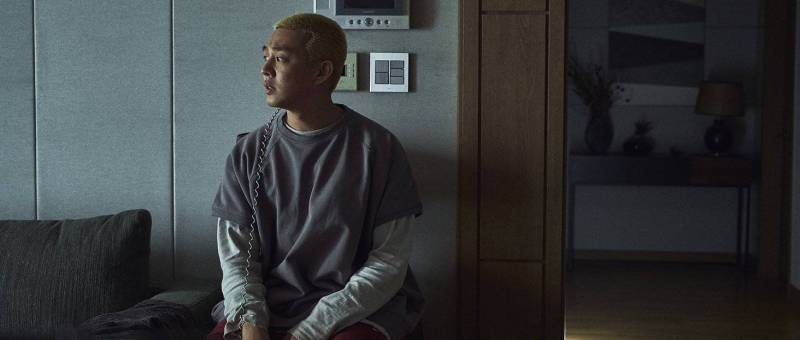
A young man in his 20s, Jun-u (Yoo Ah-in) lives at home with his parents and seems to be a virtual shut-in not quite supporting himself as a pro-gamer/vlogger. He ought to be in his element when he turns on his television one day to discover that a violent riot has apparently erupted all over the city, apparently spreading like a virus which causes aggressive behaviour and cannibalistic frenzy. Unfortunately, Jun-u’s parents left early that morning and didn’t have time to prepare food, leaving him money to go out for groceries but obviously it’s too late for that now and it looks like they won’t be coming home. Jun-u is entirely alone, and all the more so when his usual lines of communication are cut. 

Like the thematically similar EXIT, with which #Alive shares its faith in mountaineering, #Alive concerns itself less with the zombie threat than with youthful alienation and a sense of hopeless despair. Jun-u ought to be in his element, but finds himself ill-equipped for surviving the apocalypse given that he lacks basic adult life skills and those he does possess are now ironically unhelpful. Resourceful as he is, he remembers a smartphone app that would help him communicate via FM radio and all he’d need would be a standard earphone jack only all his earphones are wireless. Making the most of his unstable connection he uploads a single photo of himself holding his address written on the side of a cardboard box with the hashtag #I_MUST_SURVIVE to his Instagram in the hope that someone will see him but becomes increasingly despondent as his food and resources dwindle and he receives a disturbing voicemail which suggests his family may not have escaped the disaster. 

Hitting rock bottom he considers taking his own life but is saved by a literal light in the darkness, a laser shone from an opposing apartment signalling another presence he had previously missed. Believing he was alone in the world, Jun-u lost the will to live and faced with the prospect of waiting to starve to death or venturing out among the zombie hoards chose the only agency available to him in deciding the time and manner of his death. Realising he is not alone restores his desire for life, yet Yu-bin (Park Shin-hye), though much more well prepared, is also dealing with her own trauma in the face of crisis in the memory of a climbing fall that leaves her additionally anxious and fearful of physical risk. Where Jun-u flounders, lamenting as so many of us has in recent years, that no one seems to know what’s going on, the news continually flashing the same info screen while telling viewers only to stay home, Yu-bin has constructed a mini fort complete with a series of booby traps perhaps content in her independence having resolved to live and glad to have discovered she is not entirely alone. 

In contrast to disaster movie tropes, the pair instantly bond in their shared bounce back from despair, developing unconventional means of communication while Yu-bin willingly shares her food stash which in turn gives Jun-u the courage to venture outside for supplies. Eventually reuniting they do their best to withstand the zombie hoards, standing in as they are for the various anxieties which otherwise surround and oppress them, only to find themselves betrayed, worried that perhaps they have after all been abandoned and that no one is there looking out for them. Their salvation lies in their connection, the derided social media proving a lifeline that both affirms their existence and restores a sense of community that returns their safety, airlifting them from the locus of despair finally #Alive and returned to the world secure in the knowledge that they are not alone.


Netflix trailer (English subtitles)

Family Ties (가족의 탄생, Kim Tae-yong, 2006)

What is it that binds a “family”, bonds or blood, and do you really have a choice when it comes to being in one? Those are all questions which might have greater import in societies in which the concept of family is clearly defined and deeply entrenched, but even so the answers may be in a state of flux in the face of rapid social change which perhaps dangles the possibilities of greater personal freedom while in other ways remaining rigidly conservative. 

More literally translated as the birth of a family, Kim Tae-yong’s Family Ties (가족의 탄생, Gajokeui tansaeng) explores these changing connections through three interconnected stories, the first two occurring roughly contemporaneously and the third around a decade later. The heroine of the opening chapter, Mira (Moon So-ri), is a reserved young woman running a small cafe mostly catering to noisy teens. Originally excited to receive a phone call from her younger brother Hyung-chul (Uhm Tae-woong) whom she hasn’t seen for five years letting her know he’ll be coming home for a visit, Mira’s enthusiasm for the reunion dwindles when he turns up with a new wife, Mu-shin (Go Doo-shim), who appears to be much older than him. Mira is understandably put out. Firstly, he obviously didn’t invite her to his wedding, in fact he didn’t even bother to share the news he’d got married, and secondly it’s quite inconsiderate not to have warned her there would be an extra guest in tow especially as they’ve not met before. 

On the other hand, perhaps seeing him again merely reminds her of all the reasons they haven’t stayed in touch. In a quiet moment, Hyung-chul reveals he wants to open a shop selling traditional hanbok nearby, which is a surprise, but Mira instantly realises he’s probably come for money and repeatedly tells him she doesn’t have any. When everyone’s asleep, she makes a point of putting her bank book in a locked box inside the safe just to be sure he won’t abscond with it in the night. With Hyung-chul picking a fight with her fiancé and a random child turning up who turns out to be Mu-shin’s unwanted stepdaughter from several relationships ago, Mira’s patience begins to come to an end. She suggests that perhaps they’ve outstayed their welcome, but then evidently thinks better of it only to be let down once again by her irresponsible brother who claims he can take care of everyone, but predictably does not follow through. 

Family becomes a burden left to women to bear while acting as a safety net for men who view their role as protector yet largely can’t look after themselves. Sun-kyung (Gong Hyo-jin), the slightly younger protagonist of the second story, is frustrated by this same self sacrificing quality in her mother who has been continually deceived by useless lovers all her life including the most recent, a married man who won’t leave his wife and children. She also resents the presence of her much younger brother, still an elementary student doted on by the mother from whom she feels increasingly disconnected. Having run away from home to become a singer, Sun-kyung now has her sights set only on escaping abroad and is currently working as a guide for Japanese tourists only to end up bumping into her ex-boyfriend on a day out with his new partner. For her family is little more than a trap, her boyfriend apparently breaking up with her for being too selfish while she eventually pays a visit to the home of her mother’s lover to confront him and ask if “love” is really worth the price of sneaking around living a lie. Yet bonding with her brother and discovering what was in the mysterious suitcase her mother insisted on leaving at her apartment perhaps reconnects her with her childhood self and a more positive take on family bonds, even if that means in a sense regaining one dream only to abandon another. 

In any case, the anxieties of the first two sequences are visited in the third through the story of a young couple we first meet sitting next to each other on a train. So familiar with each other are they that we assume they are already involved, but they are in fact strangers meeting for the first time. Flashing forward a little, however, we can see their relationship is strained. Kyung-seok (Bong Tae-gyu), the young man, has inherited a sense of male insecurity, flying into jealous rages ostensibly because his girlfriend Chae-hyeon (Jung Yu-mi), is simply too nice or more to the point she’s nice to everyone and not just to him. He is frustrated by her because he feels she allows herself to be taken advantage of, often lending money to people who won’t see the need to pay her back because she’s too “nice” to bring it up. The last straw comes when he feels she’s embarrassed him by not showing up for a family dinner because she got involved in the search for a missing child. 

“When I’m with you I’m dying of loneliness” he somewhat dramatically announces as part of a breakup speech, annoyed that Chae-hyeon does not devote herself entirely to him as perhaps he expects a woman to do, but defiantly carries on being indiscriminately nice to everyone. He describes his mother as “pathetic” for having been overly attached to unreliable men, only to be corrected by his sister who reminds him that she merely had a big heart, something he’s perhaps lacking in his broody neediness. Yet through meeting Chae-hyeon’s family we get a sense of something different and new in which two women have raised a child unrelated to them by blood who came into their lives by chance as the result of a man’s irresponsible behaviour, an unnecessary throwaway reference to separate bedrooms perhaps undermining the boldly progressive introduction of Chae-hyeon’s two mothers to the extremely confused Kyung-seok. Nevertheless what we see in this last family, born as it was through a series of accidental meetings, is the first instance of a warm and loving home built on mutual support and affection rather than simply on blood or obligation. Having reclaimed the nature of family for themselves perhaps gives the women the courage and conviction to firmly close the door on those who might seek to misuse or corrupt it with their own sense of selfish entitlement, blood relation or not. 


Family Ties streamed as part of this year’s London Korean Film Festival.