

“They were just ordinary people” the heroine of Um Tae-hwa’s Concrete Utopia (콘크리트 유토피아) replies when asked about those who once lived in her apartment block. Considering what happened there, her words have a chilling quality hinting at the ways society breaks down and doesn’t in the wake of disaster and fear brings out our worst instincts. Yet on the other hand, perhaps it’s not so far from where we are now as Um’s housing crisis satire makes plain in a patriarchal and status-obsessed society.
“There’s no high and now low now. Everyone is equal,” according to Keum-ai (Kim Sun-young), head of the women’s association at the Hwang Gung apartment block, but of course that’s not true. An opening sequence featuring stock footage hints at the aspirational nature of post-war high rises that as one woman said were designed to give regular people a chance at homeownership though what most people enjoy is the convenience. The irony is that this is quite literally hierarchal living, though there are hierarchies even within hierarchies. When disaster strikes the city, Hwang Gung is inexplicably the only apartment complex left standing in what was previously a forest of concrete. Refugees from other other apartment blocks have made their way into the building, but some want to evict them and not least because they come from “Dream Palace” a more expensive and snooty complex across the way the residents of Hwang Gun believed looked down on them.
With all these “outsiders” in the building, tensions begin to bubble. One couple wants to evict the non-residents because it took them 23 years to buy an apartment so they’re incredibly resentful that someone might usurp their privilege. Chaired by Keum-ai, a debate develops as what to what residency means with some firmly believing only home ownership is good enough, questioning the rights of civil servant Min-sung (Park Seo-joon) because he is still repaying his mortgage and therefore isn’t technically the owner of this home. In any case, most are unwilling to share despite knowing that many of the non-residents will die if left out in the post-disaster sub-zero temperatures.
It’s also telling that when pressed to elect a leader, someone says that it has to be a man. Within the new system that emerges, the residents are divided along strict gender lines with the men serving in a kind of militia under the increasingly authoritarian rule of “Delegate” Young-tak (Lee Byung-hun) and women remaining in the building doing stereotypical female tasks. The rules state that the apartments are for residents only, while rations are awarded in proportion the perceived contribution to the community and it is forbidden to go outside. The residents develop a sense of themselves as chosen people, but are also feared by those around them for their cruelty with the rumour that their raiding parties are practicing cannibalism.
The moral centre of the film, Min-sung’s wife Myeong-hwa (Park Bo-young) was against evicting the non-residents but largely goes along with the status quo until noticing the ways in which Young-tak’s authoritarianism is changing her husband, destroying his humanity and turning him into an obsequious lackey too afraid to resist. Then again, Min-sung was already a little more selfish and conservative than she may have been, secretly wanting to evict the non-residents in the hope of holding on to his property while unwilling to share the spoils with them. It’s this fear, their fear of displacement on losing the social status that comes with homeownership, that drives some towards cruelty even though in a world like this things like property values and job titles are obviously no longer relevant.
This is may also explain Young-tak’s short term thinking, sending raiding parties out to find more food in the ruins and rubble rather than exploring options for growing new crops or securing water supplies. Flashbacks to conversations with his family reveal that this may have been a longterm problem for him with his wife criticising that he “never solved anything”. Her criticism undermines his sense of manhood in his inability to protect his family, not only unable to provide financial stability but even to keep a roof over their heads having apparently been swindled out of a house purchase. Male failure and insecurity by turns fuel his need for authoritarian power while the men under him, like Min-sung, mistakenly look to him as a leader and seek to emulate his code of masculinity in the desire to claim their own role as patriarchs protecting their families.
As another member of the apartment block points out, no matter how bad the situation is there are things you should do and things you shouldn’t. Myeong-hwa does her best to maintain her humanity and is perhaps rewarded for it on encountering another group of good people much like herself while others find only more violence and misery. If they had only agreed to share in the beginning, come together and thought seriously about solutions for a better future all this could have been avoided but in the end traditional social values prove hard to abandon with homeownership still afforded special status amid the ruins of society even as Young-tak institutes a mini authoritarian fiefdom complete with secret police and public self-criticism sessions. Darkly comic in its satirical absurdity, Um’s drama is keen to point out what a crisis can do to “ordinary people” but also offers a ray of hope that there will in the end always be those less inclined to selfish cruelty than to an altruistic desire to find solutions that work for everyone.
Concrete Utopia screened as part of this year’s London East Asia Film Festival.
International trailer (English subtitles)
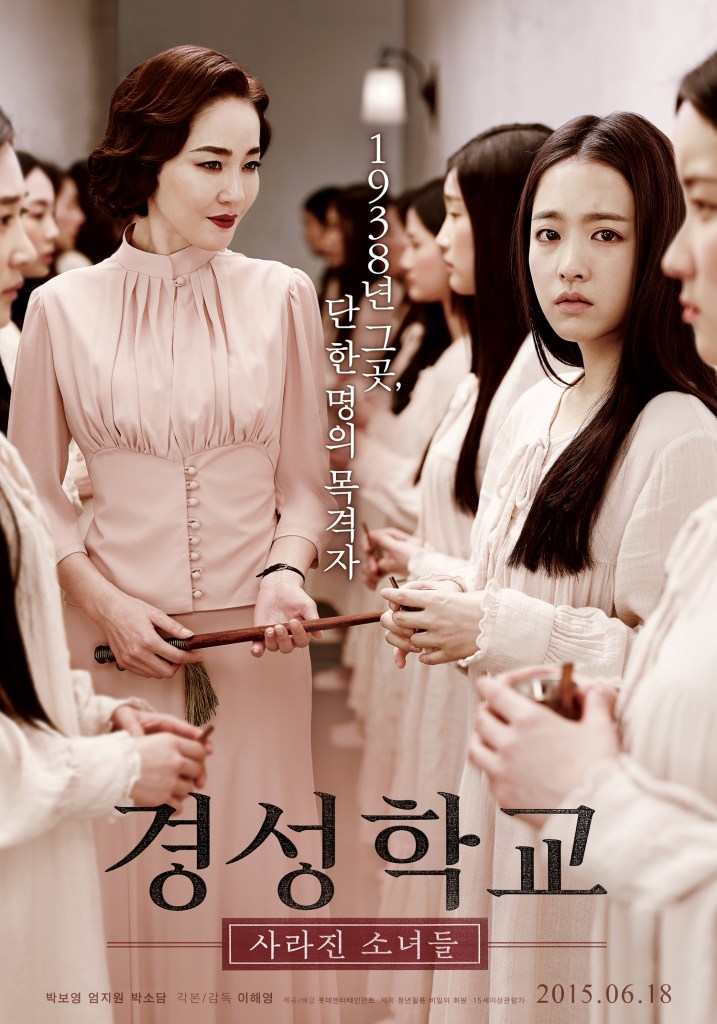 The Silenced (경성학교: 사라진 소녀들, Gyeongseonghakyoo: Sarajin Sonyeodeul) has all the classic genre aspects of the boarding school horror story familiar to fans of gothic literature everywhere, but this is no Victorian tale of repressed sexuality and hallucinatory psychosis. What The Silence does is take all of these essential elements and remix them as a metaphor for the horror of colonialism. Surrounded by quislings and forced into submission in order to survive, how does the essential soul of an oppressed people survive? The Silence would seem to argue that perhaps it can’t, but can evolve and learn to resist its colonisers even if it has to bend to do so.
 Windows on Worlds