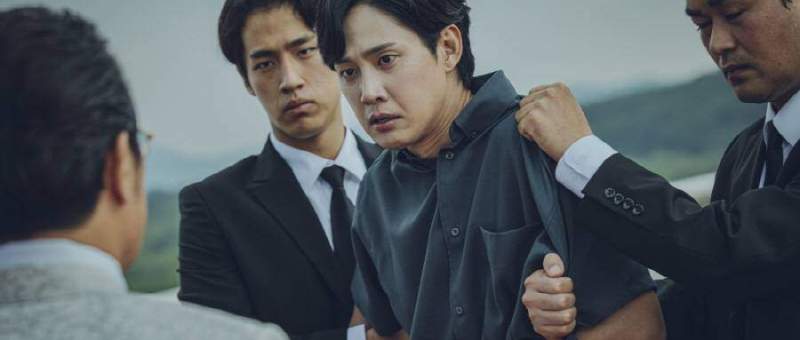
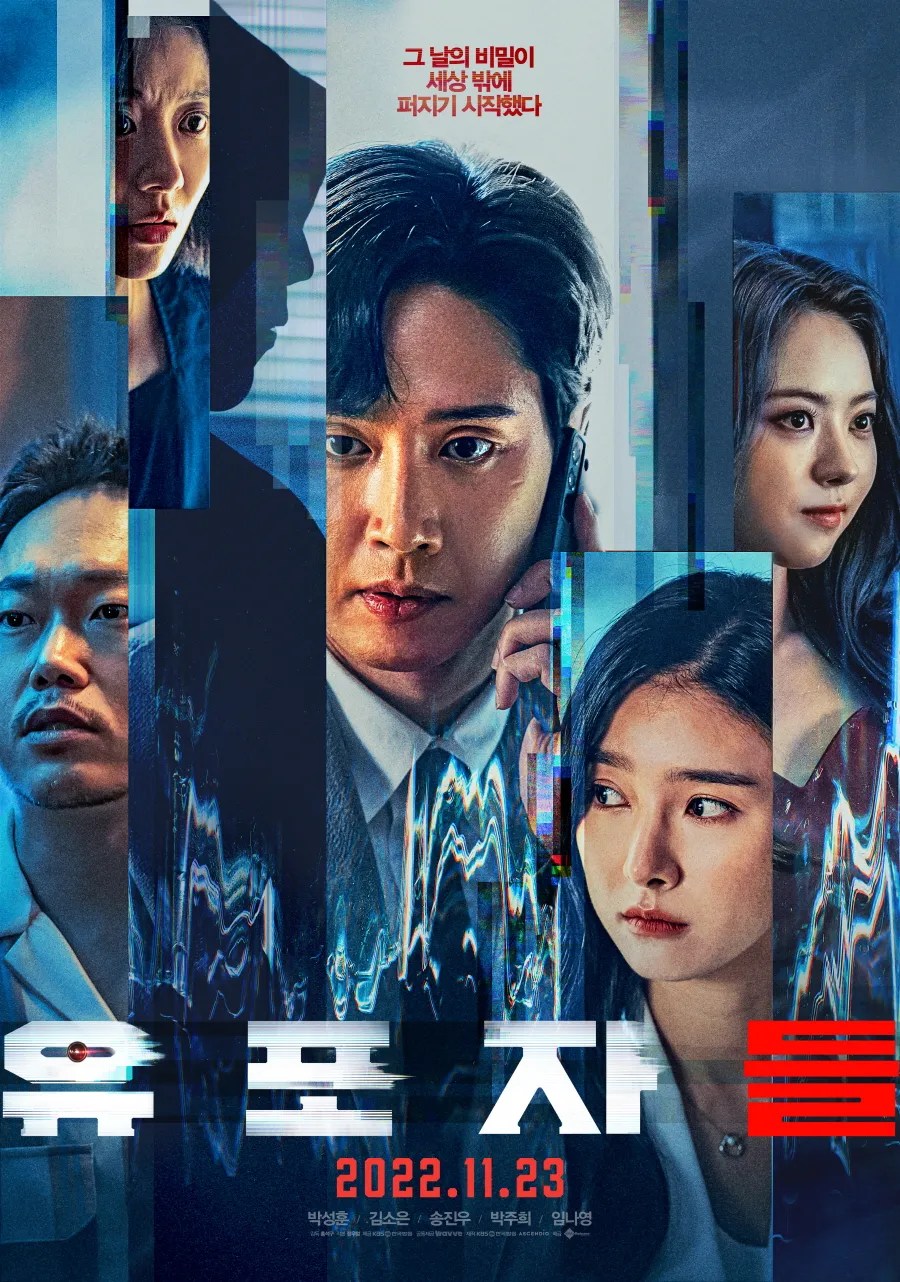
When Yu-bin (Park Sung-hoon) finds himself being blackmailed after being drugged in a club and videoed by an attractive young woman, he can’t help but feel hard done by. A teacher who once aspired to making films, he’s on the verge of marrying his fiancée Sun-ae (Kim So-eun) who is from an incredibly wealthy and very conservative pro-Japanese family, but if any of this gets out he can kiss his comfortable life goodbye. His focus is not, however, on how he shouldn’t have gone to his friend’s night club after promising Sun-ae he wouldn’t, but how he can cover all this up so she doesn’t find out he took two girls back to their flat when she was away on a business trip.
Hong Seok-ku’s The Distributors (유포자들, Yoopojadeul) never quite keys in to the fact that its hero’s a bit of a slimeball who nevertheless thinks he’s a good guy, and more often than not falls into his hard done by mindset. This might, however, echo the perspective of the average man in a society in which illicit photography has become a hot-button issue. As the film opens, Yu-bin is inflicting corporal punishment on two boys who’ve been caught taking inappropriate videos of women, which is perhaps not the best way to deal with this issue. Though he emphasises that they’ve done wrong, he’s also sort of on their side in that he agrees not to take this any further in case it damages their futures. Ji-ho, in particular, is on track to get into Seoul University and Yu-bin can’t really work out why he might have done something like this. The other boy Seong-min, happens to be his fiancée’s younger brother and predictably blames everything on Ji-ho.
It is then quite ironic that Yu-bin finds himself a victim of a video taken without his consent that shows him in a compromising position. Seven years earlier, he’d been accused of posting revenge porn after a former girlfriend broke up with him and had to pay her legal compensation. He claims that he didn’t intentionally leak it, but that his friend Sang-beom (Song Jin-woo) found it on his computer and uploaded it to the internet to make money on amateur porn sites. But again, his focus is more on how to make this go away rather than the harm he may have caused to Ga-young. She tells him that her life’s been ruined and that it’s pure hell to feel as if everyone’s looking at you wondering if they’ve seen the video. He, however, offers her money and suggests they settle this “like civilised people”, which is in itself not so different from blackmail while suggesting that she’s being unreasonable in not letting the matter drop.
Meanwhile, what Yu-bin might actually be worried about is that he’s made a tape of him and Sun-ae that she may not even know about or have consented to. In any case, his carelessness has meant that this video too might end up online ruining her life in the same way as Ga-young’s while the consequences for him are only mild humiliation and the breaking of his engagement. It’s not exactly clear how he and Sun-ae ended up meeting, but there’s a mild implication that he’s only really with her for the luxury lifestyle she provides while her father, who objects to the marriage because Yu-bin is not of their social class, also offers him career advancement in sponsoring a film department at the school.
The blackmailer, Yu-bin, and his friend Sang-beom all make ironic references to this being like a Hitchcock movie, though Yu-bin is not really a “wrong man” so much as one running away from his own cowardice and imperfections. In his film class, he shows the children Kim Ki-young’s The Housemaid, which is certainly an ironic choice given that it ends with a direct message warning men of the dangers of adultery and to always remember their duties to their family as husbands and fathers. Even Yu-bin’s sadly looking out through a rainy window echoes Kim’s cinematography, though Yu-bin is still in the mindset of feeling sorry for himself rather than coming to the realisation that even if it’s not Ga-young who is punishing him, he has never really faced his role in what happened to her or accepted responsibility for his failure to safeguard her privacy. Only now, when it’s him, does he begin to understand not only that he’s been selfish but that he’s failed in his role as a teacher by not figuring out what was going on with the boys and the videos while focussing on protecting their futures rather than those of the young women around them who deserve safety and respect but are provided little of either by a male-dominated society.
Trailer (English subtitles)
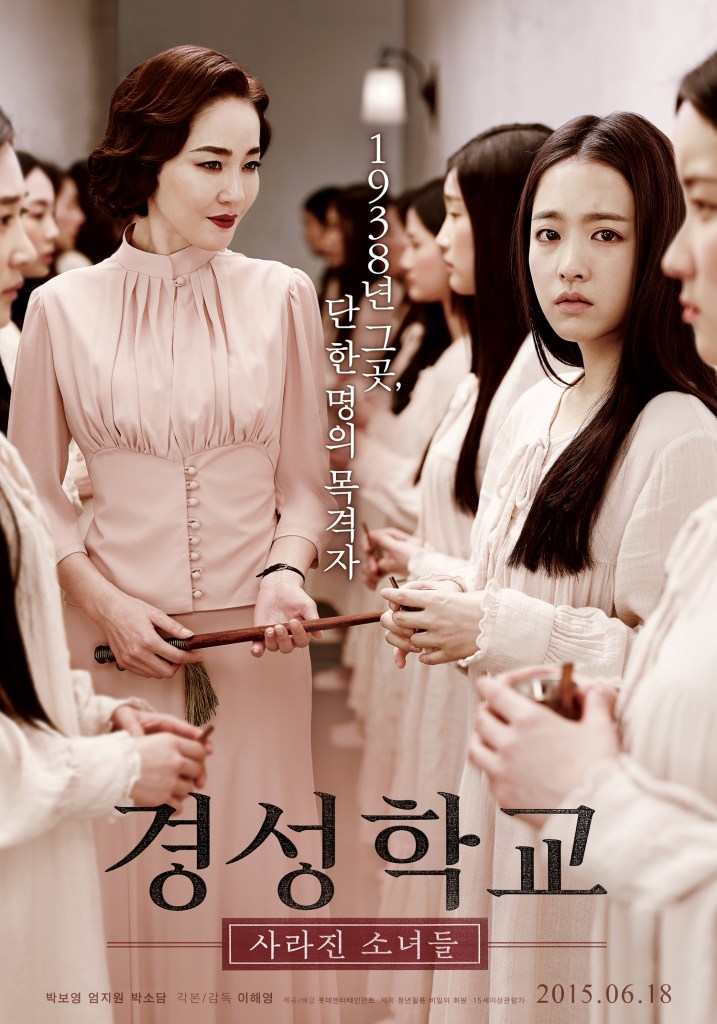 The Silenced (경성학교: 사라진 소녀들, Gyeongseonghakyoo: Sarajin Sonyeodeul) has all the classic genre aspects of the boarding school horror story familiar to fans of gothic literature everywhere, but this is no Victorian tale of repressed sexuality and hallucinatory psychosis. What The Silence does is take all of these essential elements and remix them as a metaphor for the horror of colonialism. Surrounded by quislings and forced into submission in order to survive, how does the essential soul of an oppressed people survive? The Silence would seem to argue that perhaps it can’t, but can evolve and learn to resist its colonisers even if it has to bend to do so.
