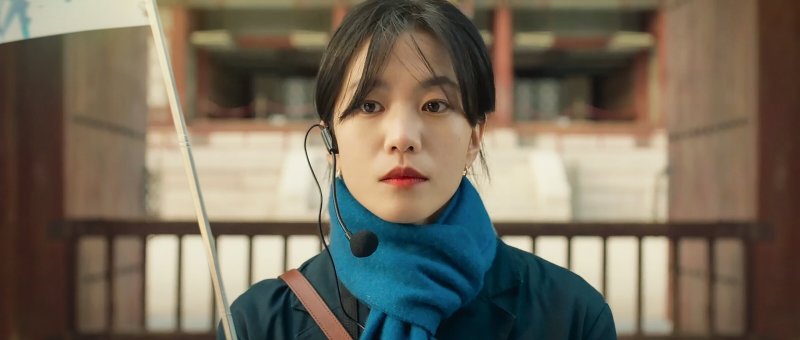

“We look the same, but they treat us less than foreigners.” Han-young’s (Lee Seol) friend Jung-mi (Oh Kyung-hwa) laments, explaining that she’s decided to move abroad for a better life rather than scrape by in a country that is not always welcoming. Kwak Eun-mi’s A Tour Guide (믿을 수 있는 사람, Mid-eul su issneun salam) explores the position of North Koreans in South Korean society, but also the difficulties of assimilating into a new culture that is not primed to accept you, the isolation of being of this place and not, and the heroine’s complex cultural background that leaves her feeling torn between competing ideas of homeland.
Having lived in China for a while after escaping North Korea, Han-young worked hard to harness her Mandarin-speaking skills to earn a license to work as a tour guide and interpreter. Even so, she struggles to find employment as many companies are unwilling to hire those from the North whom they view with suspicion. When she eventually is hired, it’s a for a zero hours contract freelance job in which her pay is dependent on the amount of souvenirs her wealthy Chinese holidaymakers purchase. The ironies could not be starker. While Han-young struggles to get by, the residents of the formerly communist turned hyper capitalist society have more money than they know what to do with and often aren’t really interested in the information she has to give them about Korean historical sites but are eager to get to the duty free.
In her interview, Han-young had said she wanted to share Korean culture with visitors to the country but it also seems like this wasn’t really what she worked so hard to get her license for. She also said she wanted to earn a lot of money and have a nice life, which is more honest, but the job doesn’t really allow her to do that. She was told that she shouldn’t force people to buy goods, but it’s clear that this is essentially what the company’s hired her for. Under increasing pressure, she finds herself bending the rules and her own integrity. Copying a less earnest colleague, she begins embellishing her speeches with made-up information to appeal to the Chinese tourists, while later colluding with the saleswoman to put on a snake oil-style act selling Korean cosmetics in the hope of getting her ranking up and being kept on while the company experiences a period of financial difficulty. MERS and declining political relations between China and South Korea see a huge drop off in tourism and a fair amount of economic damage.
Her brother (Jeon Bong-seok) too has witnessed the implosion of his South Korean dream having failed to get into university. Manual labour at the docks wasn’t what he had in mind, which might be one reason he drops out of contact with Han-young who tries to look for him but continues to hit a brick wall. She eventually discovers that he thought about going back to the North despite knowing what might happen to him if he did. In some ways it may not be all that surprising that some people find themselves unable to adapt and prefer the brutal certainty of their old lives, but it’s equally true that the siblings encounter only futility. Viewed with suspicion, they are constantly monitored by a “protection officer” who is supposed to be helping them adapt to life in the South and prevent them being exploited or harassed, though Jang-mi thinks it’s more like “surveillance” than “protection” and the focus is really on whether they present a danger rather than are presented with it. Nevertheless, her aunt decided to extend her protection period voluntarily because she said it was easier that way.
One by one, each of Han-young’s lifelines disappears, from her friend who decides to try her luck abroad, to her brother, and then protection officer. Asked why she doesn’t go abroad too, Han-young replies that if she stays closely, her family call live together again as if hinting at a desire for reunification even as she desperately tries to get the money together to bring her mother to the South while prejudiced bosses tell her she should just work in a factory, or a cafe, or a convince store, which is to say casual labour jobs they look down on and consider unworthy for South Koreans because someone like Han-young isn’t really entitled to become a tour guide. Eventually she’s joined by a friend from China whom she has to disabuse, reminding her you’re poor here too if you can’t find work and it’s not exactly the kind of utopian paradise she might have thought it to be. Nevertheless, it seems as Han-young is leading herself towards her own liberation and a future less constrained by loneliness and petty prejudice.
Trailer (English subtitles)




 Windows on Worlds