Concrete Utopia (콘크리트 유토피아, Um Tae-hwa, 2023)

“They were just ordinary people” the heroine of Um Tae-hwa’s Concrete Utopia (콘크리트 유토피아) replies when asked about those who once lived in her apartment block. Considering what happened there, her words have a chilling quality hinting at the ways society breaks down and doesn’t in the wake of disaster and fear brings out our worst instincts. Yet on the other hand, perhaps it’s not so far from where we are now as Um’s housing crisis satire makes plain in a patriarchal and status-obsessed society.

“There’s no high and now low now. Everyone is equal,” according to Keum-ai (Kim Sun-young), head of the women’s association at the Hwang Gung apartment block, but of course that’s not true. An opening sequence featuring stock footage hints at the aspirational nature of post-war high rises that as one woman said were designed to give regular people a chance at homeownership though what most people enjoy is the convenience. The irony is that this is quite literally hierarchal living, though there are hierarchies even within hierarchies. When disaster strikes the city, Hwang Gung is inexplicably the only apartment complex left standing in what was previously a forest of concrete. Refugees from other other apartment blocks have made their way into the building, but some want to evict them and not least because they come from “Dream Palace” a more expensive and snooty complex across the way the residents of Hwang Gun believed looked down on them. 

With all these “outsiders” in the building, tensions begin to bubble. One couple wants to evict the non-residents because it took them 23 years to buy an apartment so they’re incredibly resentful that someone might usurp their privilege. Chaired by Keum-ai, a debate develops as what to what residency means with some firmly believing only home ownership is good enough, questioning the rights of civil servant Min-sung (Park Seo-joon) because he is still repaying his mortgage and therefore isn’t technically the owner of this home. In any case, most are unwilling to share despite knowing that many of the non-residents will die if left out in the post-disaster sub-zero temperatures. 

It’s also telling that when pressed to elect a leader, someone says that it has to be a man. Within the new system that emerges, the residents are divided along strict gender lines with the men serving in a kind of militia under the increasingly authoritarian rule of “Delegate” Young-tak (Lee Byung-hun) and women remaining in the building doing stereotypical female tasks. The rules state that the apartments are for residents only, while rations are awarded in proportion the perceived contribution to the community and it is forbidden to go outside. The residents develop a sense of themselves as chosen people, but are also feared by those around them for their cruelty with the rumour that their raiding parties are practicing cannibalism. 

The moral centre of the film, Min-sung’s wife Myeong-hwa (Park Bo-young) was against evicting the non-residents but largely goes along with the status quo until noticing the ways in which Young-tak’s authoritarianism is changing her husband, destroying his humanity and turning him into an obsequious lackey too afraid to resist. Then again, Min-sung was already a little more selfish and conservative than she may have been, secretly wanting to evict the non-residents in the hope of holding on to his property while unwilling to share the spoils with them. It’s this fear, their fear of displacement on losing the social status that comes with homeownership, that drives some towards cruelty even though in a world like this things like property values and job titles are obviously no longer relevant. 

This is may also explain Young-tak’s short term thinking, sending raiding parties out to find more food in the ruins and rubble rather than exploring options for growing new crops or securing water supplies. Flashbacks to conversations with his family reveal that this may have been a longterm problem for him with his wife criticising that he “never solved anything”. Her criticism undermines his sense of manhood in his inability to protect his family, not only unable to provide financial stability but even to keep a roof over their heads having apparently been swindled out of a house purchase. Male failure and insecurity by turns fuel his need for authoritarian power while the men under him, like Min-sung, mistakenly look to him as a leader and seek to emulate his code of masculinity in the desire to claim their own role as patriarchs protecting their families. 

As another member of the apartment block points out, no matter how bad the situation is there are things you should do and things you shouldn’t. Myeong-hwa does her best to maintain her humanity and is perhaps rewarded for it on encountering another group of good people much like herself while others find only more violence and misery. If they had only agreed to share in the beginning, come together and thought seriously about solutions for a better future all this could have been avoided but in the end traditional social values prove hard to abandon with homeownership still afforded special status amid the ruins of society even as Young-tak institutes a mini authoritarian fiefdom complete with secret police and public self-criticism sessions. Darkly comic in its satirical absurdity, Um’s drama is keen to point out what a crisis can do to “ordinary people” but also offers a ray of hope that there will in the end always be those less inclined to selfish cruelty than to an altruistic desire to find solutions that work for everyone.


Concrete Utopia screened as part of this year’s London East Asia Film Festival.

International trailer (English subtitles)
Dream (드림, Lee Byeong-heon, 2023)

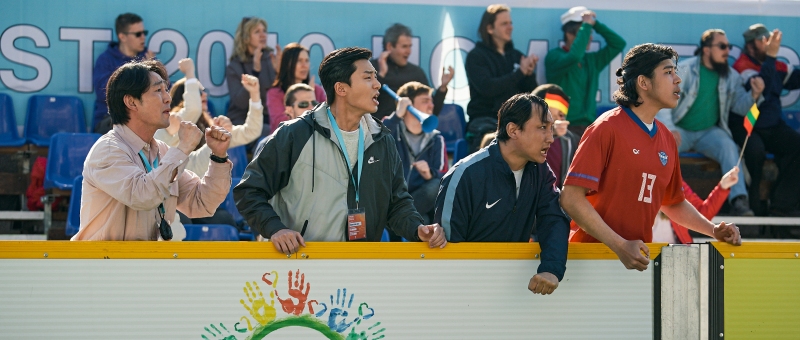
A disgraced football player gets a shot at redemption after agreeing to coach a team hoping to take part in the Homeless Olympics in Lee Byeong-heon’s sporting drama, Dream (드림). The Homeless Olympics was founded in order to advocate for the end of homelessness while combatting discrimination and stigma and takes place annually with teams of homeless people from all over the world taking part. Set in 2010 and inspired by the first Korean delegation to participate, the film is essentially an underdog sports drama in which the act of scoring a single goal is the same as an overall victory.

It is also, meanwhile, heavily critical of celebrity and sensationalist media each of which have a habit of latching onto popular causes in order to further their own careers. Hong-dae (Park Seo-jun) was a popular footballer insecure in his talents, but gained notoriety after poking an obnoxious reporter in the eyes when he repeatedly brought up the topic of his mother who happens to be a fugitive from justice. Deciding to retire from the game, Hong-dae is picked up by a talent agency who want to make him a star and is convinced to become the coach of the homeless football team in order to improve his personal brand while documentarian So-min (Lee Ji-eun) hopes to do something much the same by producing a semi-scripted reality show following the team’s fortunes.

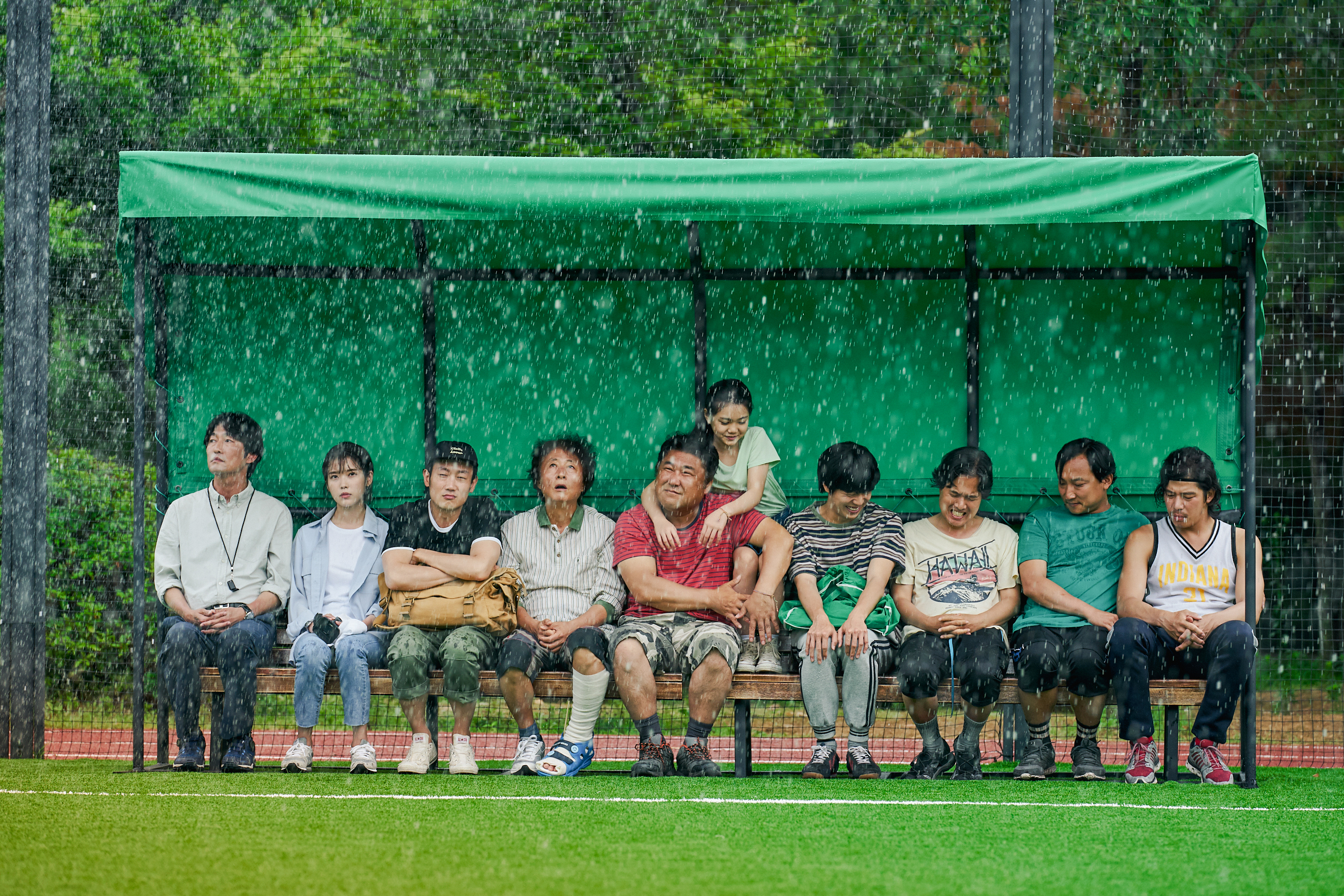
Accordingly, So-min instructs Hong-dae to let her “cast” the key players on the basis of their touching backstories rather than their sporting ability. She comes up with a selection of people who have each for various reasons ended up on the streets but are looking for a way to turn their lives around and repair fractured relationships with family members. One man turned to booze and women while riding high but found himself out of luck when the Asian Financial Crisis ruined his business, while another claims that he’s not really homeless just lying low for a while, and a third was scammed by a friend and saddened by the impending exit of his ex-wife and daughter who will shortly be moving to Australia with her new husband. The film strays into more interesting territory in exploring the story of 44-year-old Beom-su (Jung Seung-gil) who ended up on the streets after a workplace accident left him with a chronic illness he did not have the money to treat, but otherwise falls into the same trap as So-min’s documentary in taking a fairly superficial view of homelessness. By the end of the film many of the players have thankfully moved into stable accommodation but do so largely without explanation aside from having apparently managed to save up for a deposit. 

Positioning their battle for sporting success as a means of reclaiming their self-esteem might also uncomfortably suggest that the reason they’re on the streets is a matter of mental attitude while ignoring other systemic issues that led them there or prevented them from moving on (assuming that they wish to do so). Aligning their struggles with Hong-dae’s and to a lesser extent So-min’s might do something similar while they too are also battling cynicism and self-esteem issues, Hong-dae continuing to blame his mother for his problems complaining that he was born to be second place because she never put him first. As Hong-dae later points out, So-min is also to an extent exploiting the homeless in trying to create an inspirational narrative for her TV show before she like everyone else realises there are other ways to win besides the literal. 

The final message is more one of never giving up as the team finally travel to the Olympics and find themselves out of their depth before deciding to give it everything they have even if it’s very unlikely they will win. There had indeed been discrimination in Korea, a sponsor pulling out describing the homeless as “smelly and disgusting” and expressing a degree of squeamishness about involving them with their brand, but at the Olympics they become the most popular team despite their lack of skill purely because of their charismatic perseverance. One player’s late in the game announcement that he is gay but has now come to accept himself in the knowledge that the problem lies with the world that will not accept him also makes the case for a greater equality if perhaps clumsily conflating two different issues. Nevertheless, IU’s lively performance and the film’s warmhearted tone help to overcome any mild sense of discomfort in its otherwise genial tale of never giving up and regaining your self-esteem even if you feel as if the world has already abandoned you. 


Dream screens July 17 as part of this year’s New York Asian Film Festival.

International trailer (English subtitles)
Images: © 2023 PLUS M ENTERTAINMENT & OCTOBER CINEMA INC. ALL RIGHTS RESERVED.

Parasite (기생충, Bong Joon-ho, 2019)

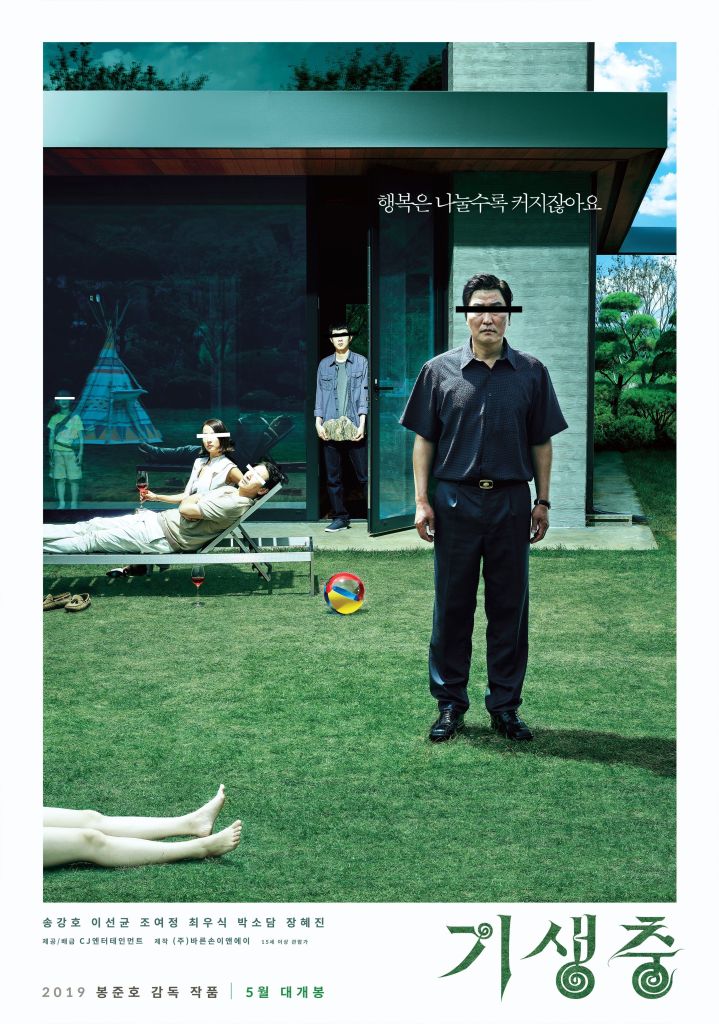
“So metaphorical!” the ambitious son at the centre of Bong Joon-ho’s class war melodrama Parasite (기생충, gisaengchung) is fond of saying, and he’s right – it really is. “Hell Joseon” rears its ugly head again, only it’s not just the young who can’t climb out but mum and dad too. Sticking together all the way, this enterprising family have realised that the only way they’re going to enjoy the fruits of the modern society is by becoming hangers on, feeding off someone else’s perhaps unfairly gotten success, and if that means stomping on a few others just like them to get there then so be it. There’s no room for love or fairness in a class war. 

The Kims – mum Chung-sook (Chang Hyae-jin), dad Ki-taek (Song Kang-ho), and grown up kids Ki-woo (Choi Woo-shik) and Ki-jung (Park So-dam), all live together in a tiny semi-basement apartment in a rundown slum. Unable to find steady jobs, the family make ends meet with casual jobs like folding pizza boxes while cadging wi-fi to look for better opportunities. Better opportunities only arise, however, thanks to Ki-woo’s upper middle-class college kid friend Min (Park Seo-joon) who brings them a special gift from his dad of a stone said to attract wealth, and a hookup for Ki-woo with a possible job coaching the pampered daughter of a superrich tech entrepreneur. After faking his credentials, Ki-woo gets the job, and wastes no time at all bringing in his sister as an “art tutor” for the couple’s apparently “troubled” young son. Together, they conspire to get the chauffeur fired so dad can take over, and then plot to do the same to the housekeeper so mum can come too, colonising the house and living alongside the wealthy Parks with a view to someday ousting them. 

The house, a fabulously modern take on the traditional designed by a famous architect who sold it to the Parks when he moved to France, is a kind of “host” in itself. We might not all admit it, but there are few of us who would not want to live in a house like this, especially if we feel it has been deliberately placed out of our reach. The Kims are envious, yes, but not perhaps malicious. They simply want a kinder life, one free of the anxiety of always having nothing and then getting that taken away from you too. In a running gag, a drunk keeps peeing right in front of the Kims’ window, and later they literally find themselves drowning in a river of shit when torrential rain causes the local sewer system to backup and flood their fetid, low-lying slum forcing everyone into a makeshift “evacuation” centre where insincere public servants try to make excuses about not being bothered enough to make sure those with no money don’t drown just because it rained. 

The Kims aren’t bad people, but their desperation means they can’t afford to be kind. The true “villains” of Parasite aren’t the Parks or the Kims themselves, but the system which forces one set of oppressed people to oppress another. The Kims know they’re responsible for displacing people just like them – getting the driver fired, going after the housekeeper, etc, but they can’t afford to think about it, pausing only to wonder if maybe they found other jobs once they themselves start to feel comfortable. “She’s rich but still nice” Ki-taek says of Mrs. Park (Cho Yeo-jeong), only for his wife to counter no, “she’s nice because she’s rich”. Mrs. Park can afford to be nice because she has plenty. She has no need to worry about taking things from others, and is secure enough not to have to worry about people taking things from her. That makes her easy pickings for a family like the Kims, but it also hints that “niceness” is the natural condition of being human, the way we’re supposed to behave to each other in an ideal world where none of us are hungry or afraid. 

Then again, the Parks are not wholly “nice” even if they are polite in a superficial, wholesome sort of way. Mr. Park (Lee Sun-kyun) in particular has a curiously feudal outlook in which he is perpetually preoccupied with the idea of his servants “crossing the line”, making it plain that there is a clearly defined border between those who rule and those who serve. The Parks’ young son is the first to notice that the Kims all smell the same even if he does so innocently, they all obviously use the same soap and detergent after all. Mr. Park, however, later takes it further, complaining about the way Ki-taek stinks up his car, resenting the smell of “poverty”, the mustiness born of living with damp and mould. To him, the Kims are not so much different from stink bugs, squatting in his home, members of “the great unwashed” unfit for his society. 

He does, however, need them. The Parks are as dependent on the Kims as the Kims are on the Parks, and they all need the house. Unfortunately, peaceful coexistence seems to be a distant possibility in a world of such fierce inequality as to encourage the most casual of cruelties. “All you have to do is walk up the stairs” Ki-woo later tells his father, but that’s easier said than done, especially when everything is telling you that you’ll always belong in the basement. 


Parasite is released in UK cinemas on 7th February.

UK release trailer (English subtitles)

The Divine Fury (사자, Kim Joo-hwan, 2019) [Fantasia 2019]

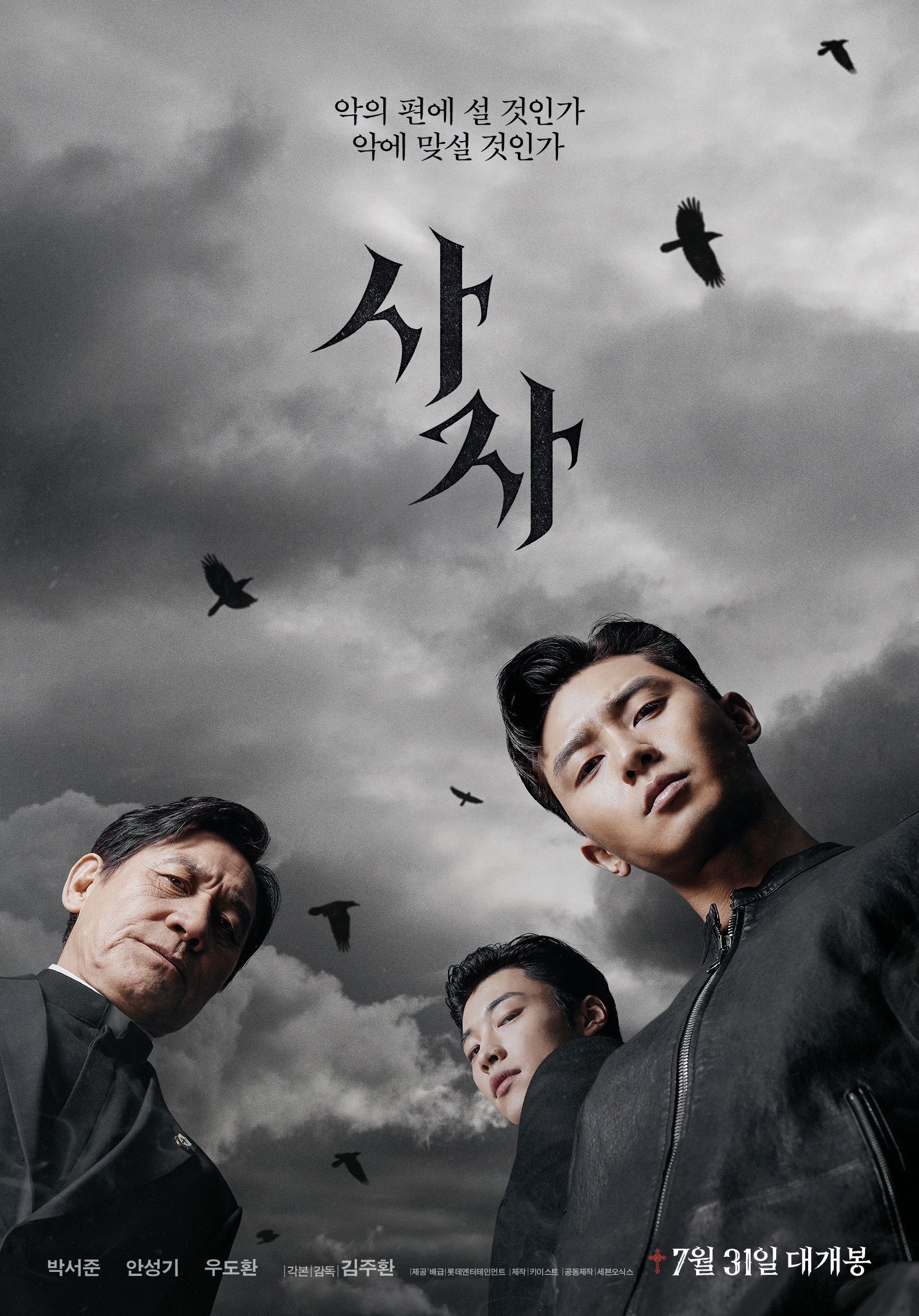
Divine fury poster 1“If you have faith you have nothing to fear” the veteran priest explains to his protege in Kim Joo-hwan’s The Divine Fury (사자 Saja). The hero is not quite so sure. A tale of grief and resentment, The Divine Fury revels in supernatural dread, but makes plain that the origins of evil lie in the human heart and that it’s a failure to forgive that invites the darkness in.

A brief prologue introduces us to the young Yong-hu whose mother passed away shortly after he was born. His doting dad leaves him at home alone at nights while he works as a regular beat cop. Unfortunately Yong-hu’s earnest father is killed one evening by a rogue driver, leaving the boy orphaned and alone. Though his dad had been careful to take him to church and explain to him about the power of prayer, Yong-hu feels distraught and betrayed by a god who refused to listen and took his dad anyway even though he prayed as hard as he could. Vowing never to set foot in a church again, Yong-hu refuses to believe in anything at all.

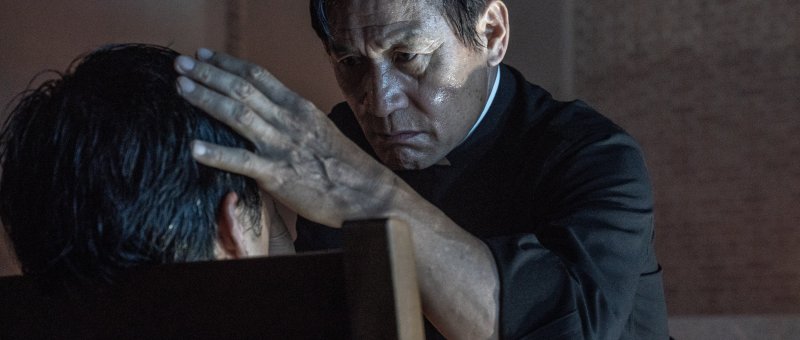
20 years later, he’s a world famous MMA star with vengeance on his mind. Plagued by voices telling him to go back and take revenge on the priest who told him everything would be OK, Yong-hu (Park Seo-joon) buries himself in violence and superficial pleasures. Everything changes on the flight back from an international bout when Yong-hu has a dream of his father in which he grabs a cross and wakes up with stigmata on his right hand. When doctors can’t explain his strange injury which refuses to heal, he turns to a shaman who tells him that he is rife with demonic energy and is only protected by the shining goodness of his father’s wedding ring which he still wears on a cord around his neck. Perhaps surprisingly, the shaman advises him to follow the cross and go to a church at a certain time where a man will help him. The man turns out to be father Ahn (Ahn Sung-ki) – a Vatican-based exorcist currently in the middle of a case so difficult it’s sent his assistant running for the hills in terror.

Anyone who knows anything about exorcism in the movies knows you need an old priest and a young priest. Ahn is more or less resigned to working alone, exorcism is no longer cool with the youngsters it seems, but nevertheless remains keen to court the enigmatic Yong-hu and his all powerful demon banishing hand. Yong-hu, however, remains reluctant. He doesn’t believe in God and resents the old priest as a symbol of all that’s betrayed him. Gradually he begins to warm to Ahn, seeing in him a kind of goodness as he selflessly battles the forces of evil and releases the tormented from their supernatural oppressors even if it might take longer to help them escape their darkness. Meanwhile he continues to hunt the “Dark Bishop” who feeds on fear and negativity in order to secure his own immortality.

Ahn is fond of saying that there’s a reason for every torment and that it’s all part of God’s grand plan. As far as the film goes, he may very well be correct at least in providing the mechanism for Yong-hu’s eventual path towards re-embracing his faith. Still missing his father and nurturing intense hurt and resentment, Yong-hu invited the darkness in, beginning to hate where he should have learned to forgive. As Ahn tells him, you can’t hate something you never loved which might explain why the darkness has never been able to fully consume him. Still battling his father’s absence, Yong-hu remains doubly conflicted, falling into an easy paternal rhythm with the older man yet also resenting him both as a potential father figure primed to betray and as a symbol of the Church in whom no he longer trusts.

Kim shifts away from the comedic banter which made Midnight Runners such an unexpected treat for something more melancholy as his heroes ponder the wages of grief and the demands of responsibility. Cynical, Yong-hu forgot his father’s ghostly instructions to him to grow up to be a good person who helps others and stands up to those who harm the weak (like demons) but eventually comes to reconnect with his dad’s essential goodness when realising that he’s been guided onto a unique path as an MMA star with a magic demon vanquishing fist. Having conquered the evil inside him and accepted his father’s legacy, Yong-hu is ready to take on the forces of darkness with a divine fury of his own while saving the souls of those in peril from threats both earthly and supernatural.


The Divine Fury was screened as part of the 2019 Fantasia International Film Festival. It will also be released in cinemas across the US and Canada courtesy of Well Go USA from Aug. 16.

International trailer (English subtitles)

Be with You (지금 만나러 갑니다, Lee Jang-hoon, 2018)

be with you Korean posterWhen Nobuhiro Doi’s Be With You was released in 2004, it followed the even more popular Crying Out Love in the Centre of the World as the second in a wave of “jun-ai” or “pure love” romantic dramas in which the heroes and heroines struggle to move past romantic tragedy. Where Be With You differed from the genre norm was on its focus on a love that was already successful – the couple were older, had married, and even had a son before their happiness was taken from them by a cruel illness. Lee Jang-hoon, adapting the source novel by Takuji Ichikawa, shifts the setting to Korea but more or less follows Doi’s blueprint with a number of notable exceptions.

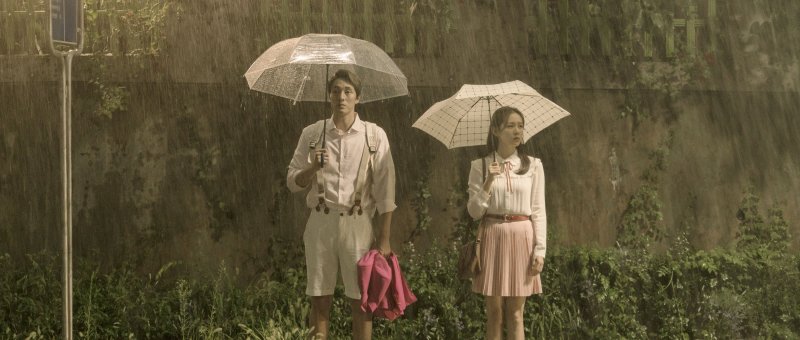
Rather than the framing sequence which kicks off the original, Lee opens with the beautifully illustrated picture book Soo-a (Son Ye-jin) made for her son shortly before she passed away. In the book a cute mummy penguin lives up above in Cloudland watching her baby through a crack in the clouds. When the rainy season arrives, the mummy penguin will be able to catch the Raindrop Train to come back to Earth, but before the summer ends she’ll have to return else she’ll lose her place among the clouds and won’t be able to watch over her son even from afar.

Little Ji-ho (Kim Ji-hwan) has taken the book to heart and really believes his mother will come back when the first rains fall. His father, Woo-jin (So Ji-sub), knows better but hasn’t the heart to tell his son that the book is just a story and that he will never see his mother again. Against the odds, Ji-ho and Woo-jin do indeed find a woman who looks exactly like Soo-a collapsed in an abandoned railway tunnel in the forest but she has no memory of her life as a wife and mother or of the family who’ve been patiently waiting for her return.

In contrast to her counterpart in Doi’s original, Son Ye-jin’s Soo-a is a much less passive presence, less inclined to simply go along with her new circumstances and keen to remind us that the decision to “work or lurk” is entirely her own. Likewise, Lee scales back on Woo-jin’s disability, rendering it far less visible than it had been in Doi’s adaptation. Bar some barbed comments from insensitive relatives at Soo-a’s funeral who question Woo-jin’s ability to raise his son alone, Woo-jin suffers little by the way of stigma regarding his medical condition though he does worry he might have embarrassed his son by pushing himself too hard at a school sports day and making himself ill in the process. Rather than the typical “jun-ai” selfish selflessness which caused the hero to breakup with his one true love out of a noble desire not to be a burden, Woo-jin’s decision is perhaps more out of pride and insecurity than it is out of misplaced consideration.

Nevertheless the timeless innocence of the couple’s early courtship (such as it was) retains its essential sweetness. As Soo-a can’t remember her romantic past, Woo-jin recounts his recollection of it to her in all its painful honesty, and in return later gets to hear her side of events thanks to the diary she left behind for him to read. Having met in high school, the pair entertained crushes on each other they assumed were unrequited, never quite working up the courage to declare themselves and squandering opportunities through nerves and awkwardness. Reliving their original romance the couple fall in love all over again only to be parted by a season’s end.

Yet it is familial love rather than the romantic which eventually takes centre stage as the love of Soo-a and Woo-jin envelops their son in something deeper and richer than your average tragic love story and becomes all the more poignant for it. Realising her time is short, Soo-a sets about teaching her husband and son how to live without her – showing Ji-ho how cook eggs, how to do the washing, how to keep the place tidy etc while giving them a few more happy memories to see them through and reminding them to take care of each other in her absence. Dreamlike and ethereal as Lee effortlessly blends one time period into another in a vast web of memory, Be With You is a heartbreaking drama in which a family must attempt to come to terms with irreparable loss through learning to treasure past happiness and living on in its memory.


Screened at the 20th Udine Far East Film Festival.

Also screened as the first in a series of teaser screenings for the upcoming London Korean Film Festival. The next screening in the series will be Memoir of a Murderer on 21st May, Regent Street Cinema.

International trailer (English subtitles)
Midnight Runners (청년경찰, Kim Joo-hwan, 2017)

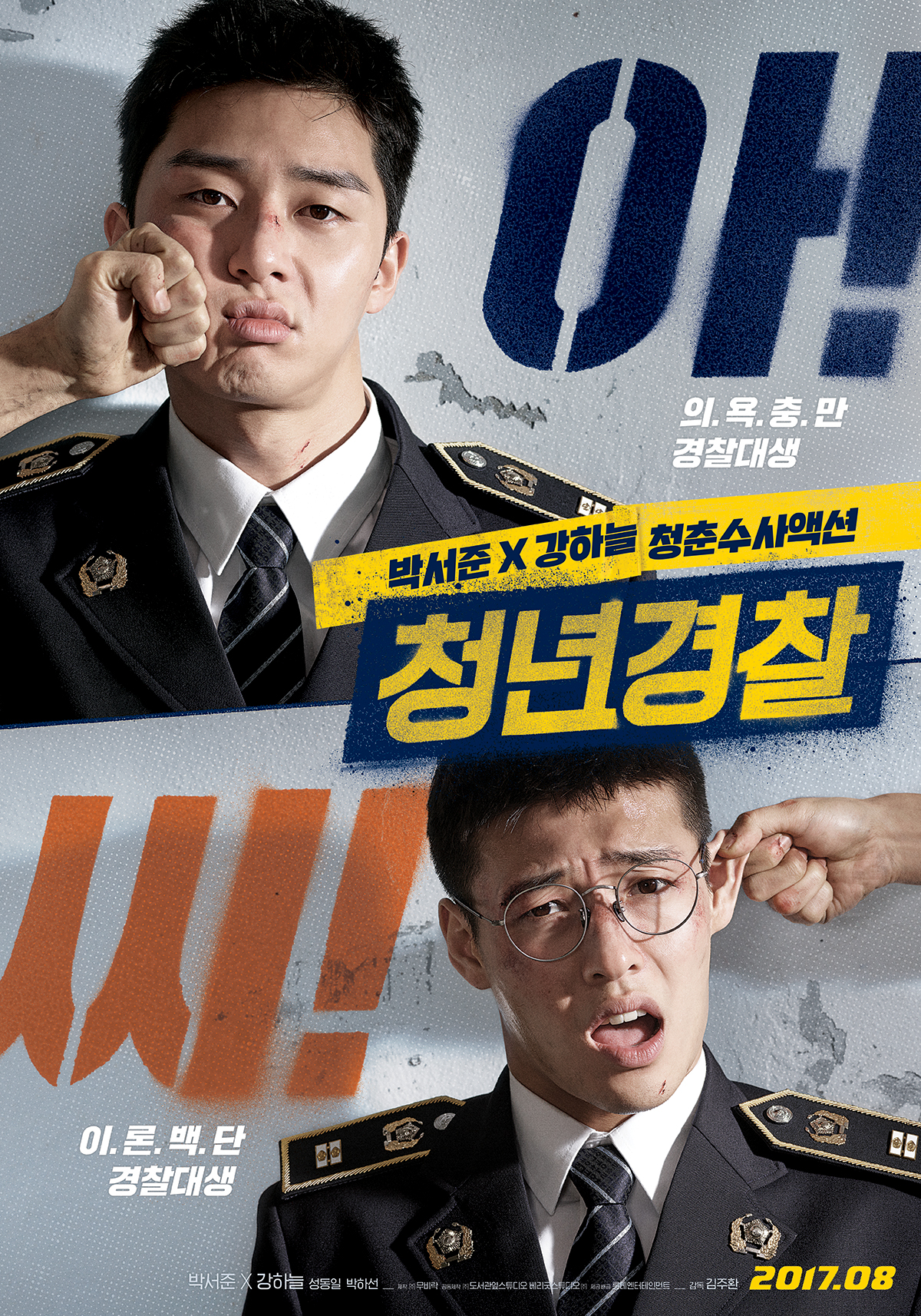
b861faaff73e4760fa673b9ca1b1468dffb7a334b9e43caee1065e675364da586d07306fe12f0a8d2f3556ef798dde699b6f2adc283c1ae8d9b53a8d85745de393ee015725bff3c47298edfb94e7f49fThere are many good reasons for applying to Police University, even if many people can’t see them. That aside, the heroes of Kim Joo-hwan’s Midnight Runners (청년경찰, Chungnyeongyungchal) have ended up there not through any particular love of honour and justice, but simply because it was cheap, on the one hand, and because it was different, on the other. An ‘80s-style buddy (not quite) cop comedy, Kim’s followup to the indie leaning Koala is the story of two young men finding their calling once their latent heroism is sparked by witnessing injustice first hand, but it’s also careful to temper its otherwise crowd pleasing narrative of two rookies taking on evil human trafficking gangsters with a dose of background realism.

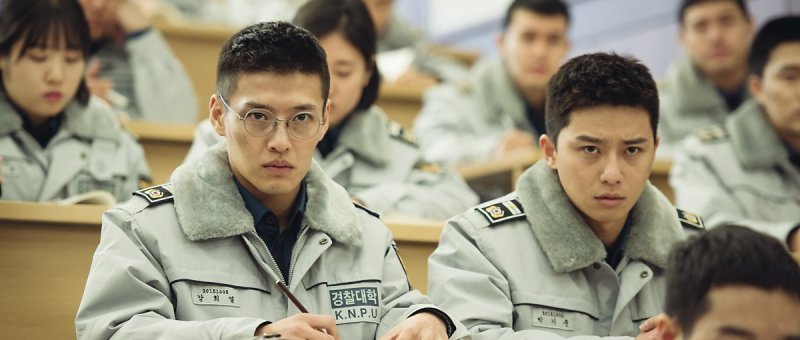
Rookie recruits to Seoul’s Police University, Gi-jun (Park Seo-joon) and Hee-yeol (Kang Ha-neul) could not be more different. Gi-jun is exasperated by his worried mother’s words of parting, but hugs her goodbye anyway. Hee-yeol’s dad looks on in envy at this touching scene, but asking if he should hug his son too gets a resounding “no” before Hee-yeol begins to walk away, turning back to remind his father to button his coat because it’s cold outside. Gi-jun doesn’t want to get his hair cut because he’s fashion conscious, whereas Hee-yeol doesn’t want his cut because they don’t sterilise the clippers and he doesn’t want to catch a bacterial skin infection. Nevertheless, the pair eventually bond first during lunch as Hee-yeol surrenders his “carcinogenic” sausages to the always hungry Gi-jun, and then when Hee-yeol sprains his ankle during the final endurance test and Gi-jun (eventually) agrees to carry him to the finish line. Not for the first time, Gi-jun’s “selfless” actions to help a person in need earn the pair a few words of praise from their commander who berates the others for running past an injured comrade and thinking only of themselves when the very point of a police officer is to help those in need.

A year a later the pair are firm friends and decide to take a night on the town to find themselves some girlfriends to spend Christmas with. Sadly, they do not find any but they do find crime when they spot a pretty girl in the street and then spend ages arguing about asking for her number only to see her being clubbed over the head and bundled into a black van. Slightly drunk, the boys panic, chase the van, and ring the police but are told to stay put and wait for a patrol car. They figure they can get to the police station faster than a car can get to them but once they do they realise the entire station is being pulled away on another high profile case and no one’s coming. They do what it is they’ve been trained to do, investigate – but what they discover is much darker than anything they’d imagined.

Police in Korean cinema often have a bad rap. It’s nigh on impossible to think of any examples of heroic police officers who both start and finish as unblemished upholders of justice. Midnight Runners, however, attempts to paint a rosier picture of the police force, prompting some to describe it almost as a propagandistic recruiting tool. It helps that Gi-jun and Hee-yeol are still students which means that the idealistic line they’re being fed goes mostly unchallenged (at least until the climactic events prompt them to think again), but there are certainly no beatings, no shady dealings with the underworld, or compromised loyalties in the boys’ innocent quest to rescue a damsel in distress.

The spectre of corruption hovers in the background but on a national, rather than personal, level as the news constantly reports on the kidnapping of a wealthy CEO’s child while a young woman from a troubled background has also gone missing but no one, not even the police who have devoted all their resources to the CEO’s case, is interested. Meanwhile, Gi-jun and Hee-yeol, having just escaped from certain death, attempt to get help from a nearby police box but the shocked jobsworth of a duty officer won’t help them because they don’t have their IDs. The boys’ outrage on being informed that despite all their efforts, the specialist team who handle cases like these won’t even be able to look at it for weeks is instantly understandable, but so is their professor’s kindly rationale that all lives are equal and the squad can’t be expected to dump their current caseload and swap one set of victims for another. The police, so it goes, are heroes caged by increasing bureaucracy which has made them forget the reasons they became policemen in the first place. 

Despite the grim turn the film takes after Gi-jun and Hee-yeol make a shocking discovery as a result of their investigation, Kim keeps things light thanks the boys’ easy, symbiotic relationship filled with private jokes and even a cute secret handshake. Jokey slapstick eventually gives way to hard-hitting action as the rookie officers finally get to try out some of their training and find it effective on entry level street punks, but less so on seasoned brawlers with mean looks in their eyes. Told to “leave things to the grown ups”, Gi-jun and Hee-yeol decide there are things which must be done even it is dangerous and irresponsible because no one else is going to do them (whether that be eating sausages or rescuing young women no one else seems to care about). A strange yet fitting place to make the case for a better, less selfish world, Midnight Runners is a buddy cop throwback which brings the best of the genre’s capacity for humour and action right back with it.


Currently on limited release in UK cinemas.

Original trailer (English subtitles – select from menu)

https://www.youtube.com/watch?v=yKnhYBlCJAA