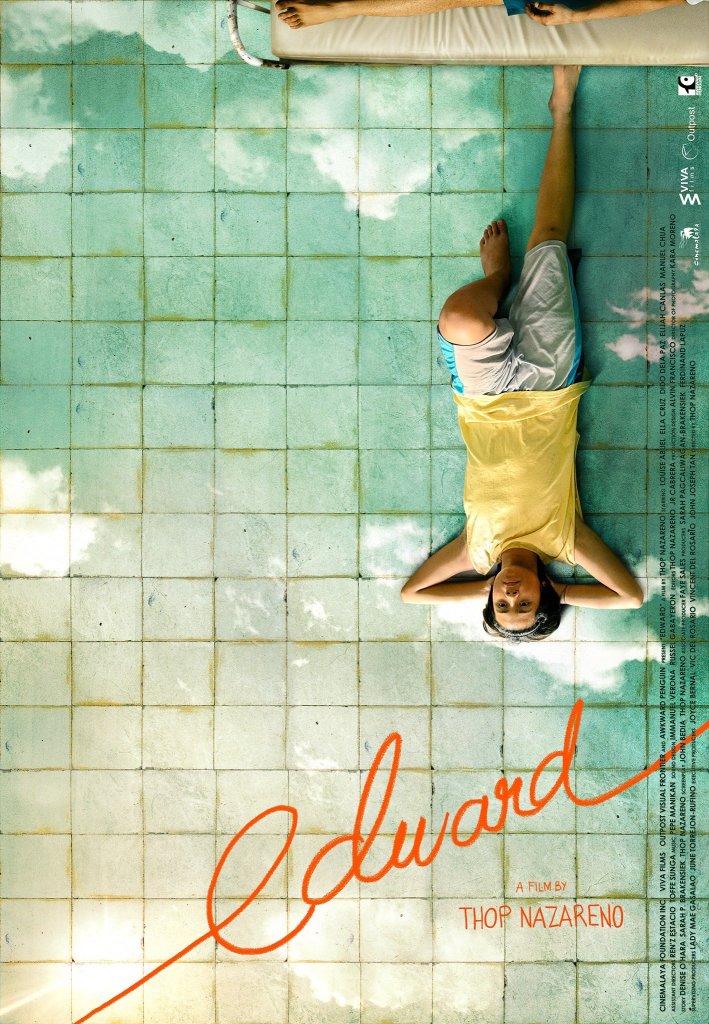
Maybe there’s no better place to learn about life and death than a hospital, but it’s a devastatingly cruel one in which to come of age in Thop Nazareno’s infinitely warm second feature Edward. A sharp condemnation of failing health policies with minor jabs to the political realities of the day, Edward finds its titular hero forced to grow up all too soon thanks to a confluence of personal tragedy, parental disappointment, and shattered dreams all of which are brought home to him as he begins to bond with his distant father while forced to care for him during his hospitalisation for an as yet undiagnosed respiratory complaint.
Just a teenager, Edward (Louise Abuel) should probably be in school but he’s left his rural home to be with his father Mario (Dido de la Paz) at a hospital in Manila where he sleeps on the floor under his bed and is expected to provide care such as making sure he’s washed, changing sheets, and generally watching over him to be able to update the doctors on his condition. Technically speaking, Edward shouldn’t be taking on this responsibility, but his older half-brother Renato has had to leave and there are no other relatives available so the hospital has made an exception. As you might expect, he’s not as diligent as one might hope, especially as his relationship with his father is already strained, spending most of his time goofing off with another boy, Renz (Elijah Canlas), who is giving him a few life lessons of his own in drinking and weed while they help out running errands for the hospital staff.
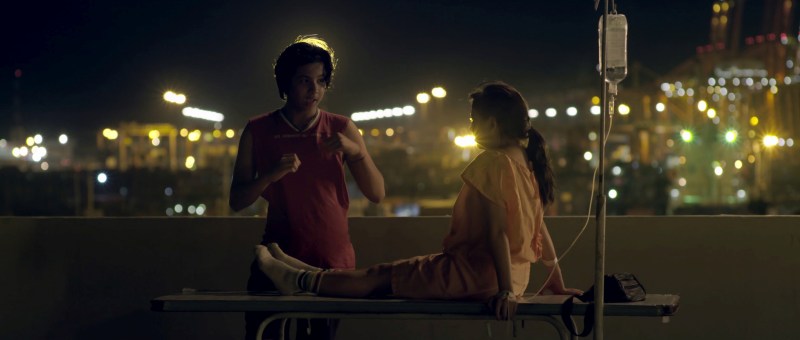
When we first meet the two boys they’re playing a grim game, taking bets on whether or not the emergency patients are going to make it. Nazareno opens with a long tracking shot following just one such casualty into the hospital, shifting chaotically from one bed to another while those in the crowded waiting area loudly call out for a doctor but are told only to wait their turn. Edward’s insensitivity bears out firstly how used he’s become to the liminal space of the hospital where death is never far away, but also his youth and impressionability, taken in as he is by Renz’ rather cool and cavalier approach to life. Later he bonds with a young woman, Agnes (Ella Cruz), herself an accident victim, who takes him to task for his callousness pointing out that she’s a real live human not the subject for a game, showing him it seems for the first time how inappropriate his behaviour has been.
Though he knows very little about her aside from her name and that she seems to be around the same age, Edward enjoys spending time with the refreshingly direct young woman and comes to see it as something of a respite from being forced to care for his dad whom he is technically neglecting. We realise that Mario is perhaps not an easy man and the family network seems to have broken down, Renato declaring himself at the end of his tether and no longer prepared to care for a father who abandoned his family for another woman only to expect filial deference on becoming ill. Like Agnes, Edward is all alone but actively avoids looking forward, little realising that his father’s condition may be far more serious than they’d assumed, preferring to lose himself in the small absurdities of hospital life as if he were on a strange kind of holiday.
Meanwhile, he discovers just how unequal and unfair the hospital system can be. During the chaotic opening we witness a congressman’s cook attempt to get bumped up the queue using his political clout while a boy bleeds out from gunshot wounds on a gurney behind reception. Mario’s original doctor leaves his position to move away, while the new one has his own private clinic and only works at the hospital on Tuesdays. Tests take three whole weeks to come back because they have to outsource and until then all they can do is guess and treat symptoms. While hanging out with Renz, Edward finds out about some decidedly dark and very untoward goings on at the hospital morgue which it perhaps doesn’t quite occur to him to feel disturbed by until much later.
For all that, Edward still hasn’t grasped that sometimes when they tell you you can go home, it’s not necessarily a good thing. Still, for the time that he’s there the hospital is a home. Mothered by overworked nurses and beginning to warm to his rather gruff father who only wants to talk to Renato (who doesn’t want to talk to him) while experiencing his first brush with romance, Edward comes of age staring death in the face. With its moody jazz score and wistful folk rock soundtrack, Thop Nazareno’s second feature doesn’t so much tug at the heart strings as play a merry tune with them, finding all the warmth there is in tragedy as Edward learns to navigate his hospital life towards its inevitable exit.
Edward streamed as part of this year’s Udine Far East Film Festival.
Festival trailer (English subtitles)

 Windows on Worlds