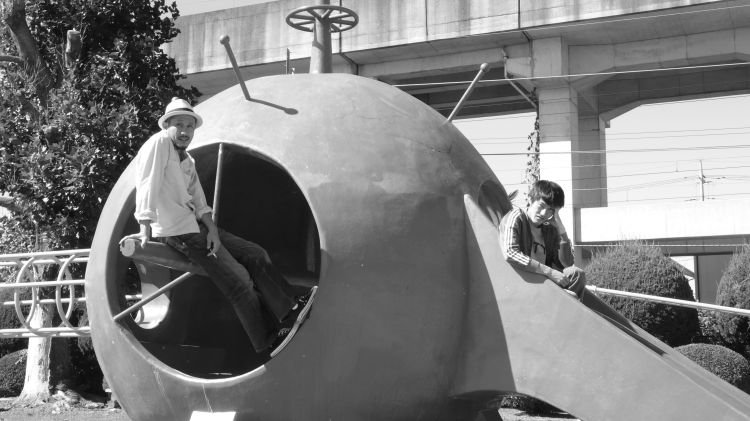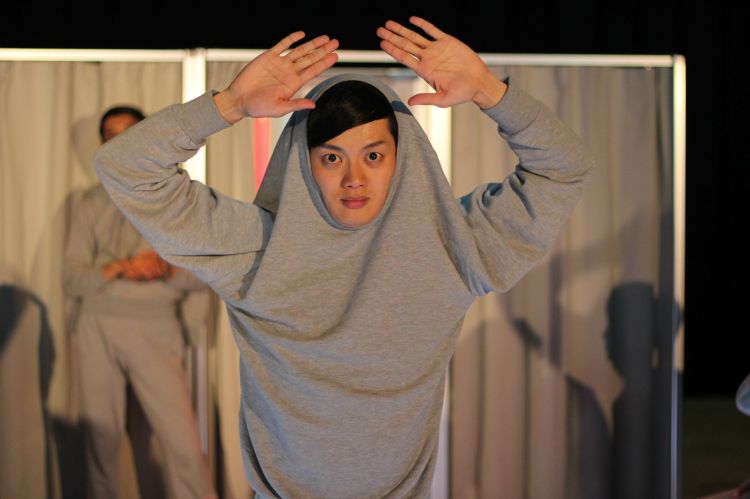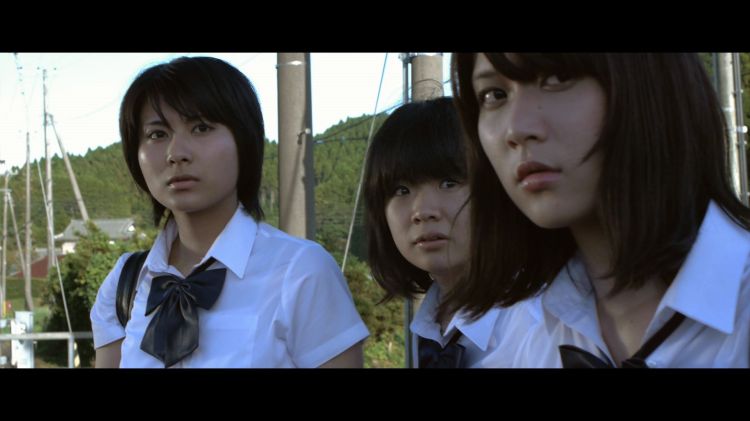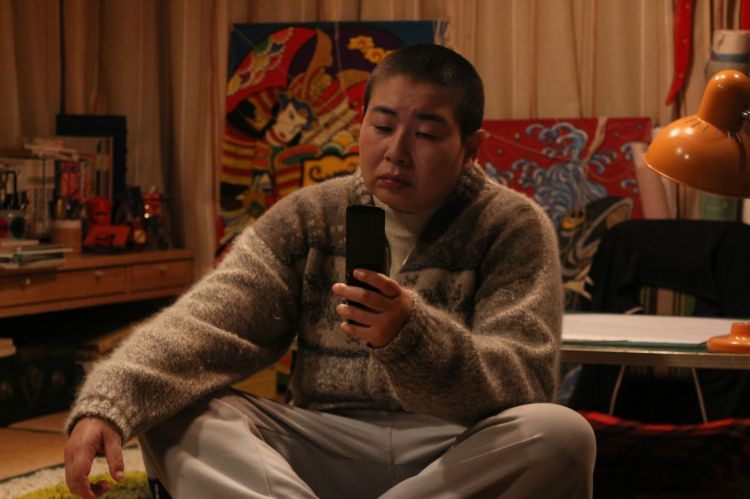
Rolling (ローリング, Masanori Tominaga, 2015)

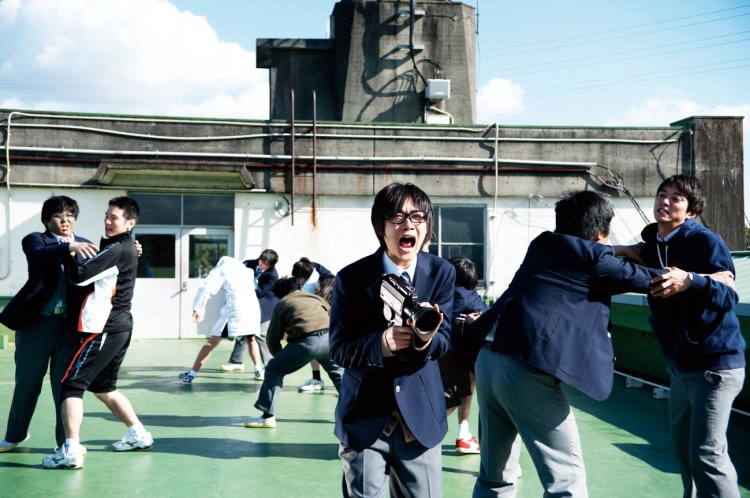
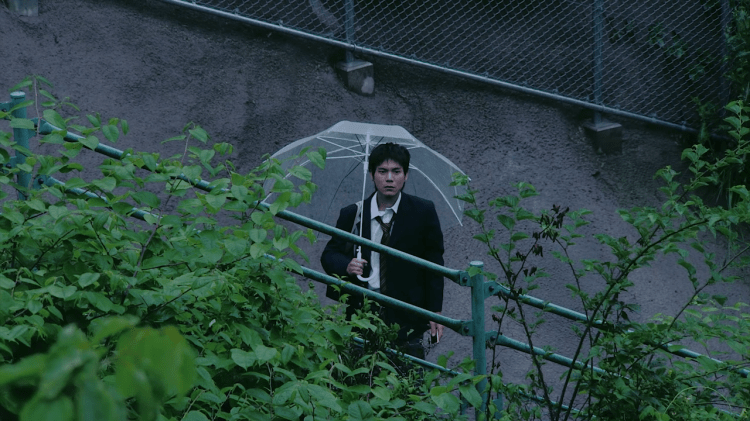
384f90_4054bb8ba5554cc186f2bce4c6beb853“Weird teacher” is almost becoming a genre now. Even so, the teacher at the center of Masanori Tominaga’s Rolling may give them all a run for their money (well, for about five yards before having somekind of bizarre accident, anyway). Gondo is a feckless middle aged man who was fired from his teaching position ten years previously after having been caught secretly filming the girls’ changing rooms. Now he’s back in his old stalking ground after having pulled off an improbable white knight routine by rescuing the young and pretty Mihara from a bad boyfriend in Tokyo. However, his former students have not forgotten him or his pervy ways! It’s not long before the entire town of twenty somethings are on Gondo’s case hoping for a little vengeance for their teenage betrayal.

However, Gondo’s fortunes improve slightly when it’s discovered that some of his secret recordings feature some rather salacious goings on starring a former classmate whose TV career is just about to kick off. Smelling money in the air, Gondo is suddenly everyone’s best friend again. Gondo is…still Gondo though so as you may expect this state of affairs will not last. He’s even lost Mihara to a former student of his, one he even quite likes too…

Despite his failings and protestations to the contrary, what Gondo ultimately remains is a teacher. Yes he’s made some mistakes (understatement of the century), and he’s actually quite unpleasant in a lot of ways but somehow he still wants to protect this ragtag bag of not quite young people that he previously harmed. Coming to the realisation that his actions not only resulted in revulsion and violation of trust but also had a disruptive effect on the educational progress of his students simply resulting from his abrupt dismissal, Gondo does at least want to make amends (in his own way).

However, Gondo’s just the kind of guy things never work out for. “All my students are idiots” he proclaims at one point and he’s not altogether wrong. Attempting to hatch a blackmail plot with a very strange group of a idol managers-cum-gangsters and an ex-policeman, the gang get themselves into a whole world of trouble which is only exacerbated when the almost famous subject of the video comes forward and makes a very surprising request of her old flame and Gondo’s kindly love rival Kanichi.

Darkly comic, Rolling has the air of a film noir B movie with its ever present voice over and thriller trappings including secret video taping, a blackmail plot and trio of business-like gangsters. It is though, also firmly grounded in the now despite its often surreal humour. Also branded an “erotic comedy” Rolling is fairly high on sexual content adding to its generally sleazy feeling. It may well go down as a cult hit simply for the phrase “I’m going to make a milkshake out of your filthy boob juice” which gives you some indication as to the tone.

Far from perfect but oddly touching if sometimes baffling too, Rolling is another strange and surreal adventure from Tominaga. Its slightly vulgar tone may put off some but by and large it gets away with it through sheer cheekiness and absurd humour. Gondo is a dreadful person almost all of the time, selfish and needy yet he also seems to have this yearning for redemption which makes him seem not so bad really, as does the fact that most of his former students have not turned out all that well – even the “hero” Kanichi has his problems. For those that can accept its oddly surreal tone and decidedly old fashioned gender politics, Rolling is a rewarding and delightfully absurd film that does also manage to pack in a decent (if subtle) amount of social commentary.


Reviewed at Raindance 2015.

Review of Masanori Tominaga’s Rolling (ローリング) – first published by UK Anime Network.

Obon Brothers (お盆の弟, Akira Osaki, 2015)

Obon BrothersReview of quirky comedy Obon Brothers (お盆の弟 Obon no Ototo) from this year’s Raindance up at UK Anime Network. I was also lucky enough to interview the director, Akira Osaki, while he was at Raindance to introduce the film which you can also read over at UK Anime Network.


Sometimes you think everything is going to be alright, but then several calamities arrive all at once. Down on his luck film director and stay at home dad Takashi has only been able to get one film made so far and it doesn’t look good for another any time soon. Right now he’s spending sometime apart from his wife and daughter as his elder brother Wataru is ill with colon cancer and as his brother never married, both their parents are dead and they have no other family Takashi has gone to look after him. However, Wataru is anything but grateful and proceeds to mope about the house repeatedly asking when Takashi plans to go home.

When he finally does go home, Takashi’s wife realises she liked it better when he wasn’t there and asks for a divorce. With nowhere else to go except back to Wataru’s, a confused and heartbroken Takashi goes home to Gunma where he reconnects with his screenwriting partner who’s finally met a girl through internet dating. Persuaded to come on a double date, Takashi strikes up a friendship with Ryoko despite still harbouring hopes for a reconciliation with his wife. No job, no home, no wife – what does the future hold for a mild mannered man like Takashi?

Like last year’s Raindance highlight And the Mudship sails away, Obon Brothers stars Kiyohiko Shibukawa though this “Takashi” is a little more sympathetic than the completely apathetic character from Watanabe’s film. With a sort of gentleness of spirit, Takashi is the sort of person who enjoys taking care of others like his ailing brother and cute little daughter and is just as happy keeping house as anything else. For his wife, his passivity becomes a major issue as she finds herself taking on a more independent role and comes to feel she needs someone with more drive at her side rather than the meek Takashi who’s content just muddling through.

Indeed, just muddling through ends up becoming an accidental theme of the film. Every morning, Takashi stops at the local shrine, throws a coin in the donation box and prays for everything to work out…and then goes home and waits for things to happen. However, things don’t just happen no matter how much you want and pray for them – at the end of the day you have to put the effort in which goes for all things in life from marriages to friendships and careers. If anybody gets anything at all out of Takashi’s religious practices, it’s ironically the older brother Wataru who thinks all this religious stuff is hokum – even going so far as to urinate into a sacred pond!

Also like Watanabe’s And the Mudship Sails Away, Obon Brothers is shot in black and white with a preference for long takes and static camera. Consequently it has an innately sophisticated indie comedy feeling which, coupled with its naturalistic tone, bring a kind of warmth and familiarity that it’s hard to resist. Though the film touches on some heavy themes – cancer, the breakdown of a marriage, it treats them all with a degree of matter of factness that never lets them overshadow the main narrative. After all, these things happen and life carries on while they do.

A loving tribute to the prefecture of Gunma from which many of the cast and crew originate including the director Akira Osaki, scriptwriter Shin Adachi and leading actor Kiyohiko Shibukawa, Obon Brothers has more than a little autobiographical content though it doesn’t reflect the actual circumstances of any of the creative team’s lives. It’s a gentle comedy, though one with shades of darkness creeping in around the edges, and moves at an equally gentle pace which gives you ample time to see into these characters and their lives. Osaki’s camera is unjudgemental, it gives equal sympathy and understanding to everyone and even the eventual end of Takashi’s marriage is accomplished with the utmost amicability. Whether or not Takashi has actually changed very much by the end of the film or has just gained a little more knowledge about who he is as a person, Obon Brothers gives you the feeling that it’s alright to start all over again – even if you’re just muddling though!


Obon Brothers is getting a UK release from Third Window Films next year(?) – highly recommended, especially if you like gentle, indie comedies!


Asleep (白河夜船, Shingo Wakagi, 2015)

asleep posterBased on the third of three short stories in Banana Yoshimoto’s novel of the same name, Asleep (白河夜船, Shirakawayofune) is an apt name for this tale of grief and listlessness. Starring actress of the moment Sakura Ando, the film proves that little has changed since the release of the book in 1989 when it comes to young lives disrupted by a traumatic event. Slow and meandering, Asleep’s gentle pace may frustrate some but its melancholic poetry is sure to leave its mark.

Terako (Sakura Ando) is a young woman who sleeps a lot. Almost all the time, in fact. The kept woman of a married man whose wife, oddly enough, is in a coma following a traffic accident, Terako has been in a kind of limbo since her former roommate and good friend committed suicide by taking an overdose of sleeping pills. Prior to her death, Shiori had taken up an unusual occupation – she lies next to lonely strangers who just want to know that someone is watching over them while they sleep and will be there when they awake. This also meant that she rarely had the opportunity to sleep herself as her occupation demanded keeping a watchful eye over her charges and falling asleep on the job seemed like a lapse of professionalism.

Mr. Iwanaga, Terako’s boyfriend, is an enabler of the first order. He prefers that Terako not work so that she’s available for him whenever he feels the need to call meaning that she’s always at home, sleeping. She sleeps and sleeps but finds no relief from her exhaustion. Even her dates with Iwanaga feel “like the shadow of a dream”. The constant flashbacks and meandering timelines perfectly reflect someone trying to think through the distorted reality of fractured sleep where the boundaries between dream and reality have become impossibly blurred.

There’s an odd sort of triumvirate of sleeping women here – Terako herself who does little but sleep but is still constantly exhausted, Shiori who denied herself sleep until ultimately deciding to take enough sleeping pills to go to sleep forever and Iwanaga’s wife who’s trapped in coma. At one point, in a conversation which either happened some time ago or not at all, Shiori remarks that Iwanaga has Terako “on pause” because he’s afraid to move on from his wife (the fact of his having an affair while his wife is lying in a hospital bed even has Terako labelling him a cold, unfeeling man but then she says she likes that kind of thing anyway). It’s as if she’s waiting for someone to hit the spacebar to wake her up again, though Iwanaga is “on pause” too – torn between the choice of abandoning his wife who will likely never wake up and being labeled heartless, or sacrificing the rest of his life in devotion to a memory.

Help does come, in a way, through the intervention of a either a dream or a kind of cosmic transference – an impossible conversation between two women equally in need of it. Shingo Wakagi’s adaptation is more interested in psychology and existential questioning than it is in hard realities or concrete solutions. A vignette of a moment in a young woman’s life, Asleep gives us little in the way of backstory or explanatory epiphanies, and finally ends in the characteristically ambiguous way many Japanese novellas often do though there is a hint at a possible shift in Terako’s life offered by the final images. A poetic meditation on dream, memory, grief and loneliness, Asleep is beautifully framed, if appropriately distant, look at modern life in limbo.


Reviewed at Raindance 2015

First Published on UK Anime Network in 2015.

Fires on the Plain (野火, Shinya Tsukamoto, 2015)

fires on the plain 2015 posterShinya Tsukamoto is back with another characteristically visceral look at the dark sides of human nature in his latest feature length effort, Fires on the Plain (野火, Nobi). Another take on the classic, autobiographically inspired novel of the same name by Shohei Ooka (previously adapted by Kon Ichikawa in 1959), Fires on the Plain is a disturbing, surreal examination of the effects of war both on and off the battlefield.

Late in the war when it’s almost lost though no one wants to admit it, Corporal Tamura (Shinya Tsukamoto) finds himself suffering with TB on the Philippine island of Leyte where supplies, and tethers, are running short. Shortly after being punched in the face by his commanding officer, he’s given five days’ worth of supplies and ordered to march to the field hospital for treatment as no one wants a sick man weighing down the unit. Only, when he finally arrives at the field hospital, they have their hands full (literally) with the battlefield wounded. Marching back to his unit again, Tamura is ordered back to the field hospital and told to use his grenade to ease the burden on his fellow soldiers if refused. So begins Tamura’s fevered, mostly solitary odyssey across the beautiful landscape of the Philippine jungle suddenly scarred with corpses, the starving and the mad.

Tsukamoto’s adaptation sticks closer to the original novel than Ichikawa’s 1959 version, though both eschew Ooka’s Christianity. Tamura is a man at odds with his fellow soldiers. Formerly a writer he’s “an intellectual” as one puts it, and a little on the old side for a corporal. Coughing and wheezing, he shuffles his way through just trying to survive. Unlike Ooka’s original novel in which the protagonist’s Catholicism makes suicide an unavailable option, it’s the memory of Tamura’s wife which stays his hand on the pin of his grenade. Tamura wants to go home, to escape this hellish island full of the walking dead, hostile locals and hidden clusters of enemy troops.

To get home, to survive, what will it cost? There was barely any food left to start with. The original five days’ worth of rations Tamura was given amounted to a handful of yams. On his second trip to the military hospital he was given nothing at all. There’s no wildlife, even if you manage to find some plant roots they’ll need cooking. Of course, there is one abundant source of food, except that it doesn’t bear thinking about. Tsukamoto’s version takes a less ambiguous approach to the idea of cannibalism than Ichikawa’s which removed Tamura’s moral dilemma by having his teeth fall out through malnutrition and rendering him unable to indulge in “monkey meat” even if he might have succumbed. Death feeds on death and there’s no humanity to be found here anymore where men prey on men like animals.

There’s no glory in dying like this. Half starved, half mad and baking to death in the heat of a foreign jungle abandoned by your country which cared so little for its men that it never thought to conserve them. When you make it home, if you make it home, you aren’t the same you that left. The things you had to do to get there stay with you for the rest of your life, and not just with you – with all of those around you too. Wars don’t end when treaties are signed, they survive in the eyes of the men who fought them.

A timely and a visceral look at the literal horror of war, Tsukamoto’s Fires on the Plain is a refreshingly frank, if stylised, examination of the battlefield. Limbs fly, heads explode, organs are exposed and brain fragments leak out of ruined corpses. At any other time, Leyte would be a paradise of lush vegetation, colourful flowers and beautiful blue skies but it’s corrupted now by the fruits of human cruelty. This is what it means to go to war. There’s nothing noble in this – just death, decay and eternal grief. Though the film often suffers from its low budget and some may be put off by the stark, hyperreal cinematography, Fires on the Plain is another typically troubling effort from the master of discomfort and comes as a warning bell to those who still think it is sweet and fitting to die for one’s country.


Reviewed at Raindance 2015.

Original trailer (English subtitles)

First published by UK Anime Network.

Raindance 2014 Interviews – Hirobumi Watanabe / Kosuke Takaya (Via UK Anime Network)

Forgot to link to the other two interviews I conducted at Raindance last year for UK Anime Network.

nOOWOtL - Imgur
And the Mud Ship Sails Away

Hirobumi Watanabe – Director of And the Mudship Sails Away

BUY BLING GET ONE FREE - Imgur
Buy Bling Get One Free

Kosuke Takaya – Director of Buy Bling Get One Free.

Both of these films are available in Third Window Films’ New Directors From Japan box set alongside Nagisa Isogai’s The Lust of Angels whom I also interviewed at the festival.

CnIJg5w - Imgur
The Lust of Angels

Um, maybe don’t read them all though or you’ll figure out that I mostly just asked everyone the same questions without quite realising at the time….

I’d like to think I’m getting better at this but perhaps not, judge for yourselves!


Interview with Hoshi Ishida

vlcsnap-2014-10-04-22h46m14s119Totally forgot to post this at the time but here’s an interview I conducted with rising star Hoshi Ishida at Raindance 2014 on behalf of UK Anime Network.


Hoshi Ishida has had quite a long and varied career despite still being relatively young. As his latest short film, Touching the Skin of Eeriness, makes its UK premiere at Raindance (playing back to back with the upcoming Third Window Films release Lust of Angels) we sat down with him for a chat about the film as well as his career to date.

Is this your first time in London, how do you like it?

Hoshi Ishida: Yes – it’s great. Though at the moment I’m studying near Bristol for the next six months or so.

You started acting at quite a young age, and one of your first roles was in the 2002 movie Returner, directed by Takashi Yamazaki who recently directed your Touching the Skin of Eeriness co-star Shota Sometani in the upcoming Parasyte movies and The Eternal Zero. So I just wondered if you could talk a bit about your early experiences and how you got into the entertainment industry?

Hoshi Ishida: I didn’t really like acting in the beginning but then I met a director who I really liked and that gave me more of a desire to go on being an actor.

Which director was that?

Hoshi Ishida: Akihiko Shioda (Canary).

Was that why you left your original management company in 2006 and decided to study overseas? What were you doing during the two years between leaving your original company and joining the new one?

Hoshi Ishida: There were some extremely complicated circumstances. The reason I left the company was that it was up for renewal anyway – I decided to go to Australia because I wanted to learn some English not just for work but to make friends with English speaking people.

You said that when you met the director of Canary it rekindled your interest in acting and you’ve built up quite an interesting career so far with quite a few somewhat controversial or indie films. Is that something you’ve done deliberately or is it just by accident?

Hoshi Ishida: I haven’t made any kind of decision. I don’t really have any preferences about what I’m doing. It’s kind of like a coincidence that I was lucky enough to have some really good movies, but I’m always just given a script and I just go for it.

You also played the young boy Seita, the hero of Grave of the Fireflies, in the live-action film – were you nervous about taking on such a well known and well loved character? 

Hoshi Ishida: There was so much pressure! But if you let the pressure get to you can’t be a good actor so I had to put the pressure to one side just get on with acting as best as I could. The actress who played Secchan, [Setsuko, Seita’s younger sister] Mao Sasaki, really helped me so much and without her I probably couldn’t have done it.

To go back to Canary, it was obviously quite a controversial subject where you played a young boy who’d been raised in a revolutionary cult which later committed a terrorist act, which obviously has parallels with real events in Japan. Were you worried about a potential backlash from tackling such a taboo subject?

Hoshi Ishida: Once I’ve finished the role I don’t hold on to anything within me, it’s sort of irrelevant, but Canary is the reason I’m here now and still working, acting. So there’s something really substantial in me so I can only speak highly of Canary.

To bring things more up to date I believe you worked with the director of Touching the Skin of Eeriness, Ryosuke Hamaguchi, before on his previous film, The Depths? Was that how you became involved in this project? 

Hoshi Ishida: Yes, Hamaguchi saw me in Canary as well so everything really does come from that. He really liked my acting and asked me to be in his new film – The Depths, we took it from there and then he offered me another role in his next film so I just took it.

The Depths could be read as quite controversial as well as it deals with some fairly taboo subjects like homosexuality and yakuza prostitution rings etc. Did you worry about taking on what might be quite a difficult role?

Hoshi Ishida: Well, I’m always looking for something new to do so… it was challenging and I sort of hesitated when they offered me this role, but when Hamaguchi suggested I be in his film I thought if I didn’t do it now when would I? So I had to take the chance – I’m glad I did, I learned a lot from it.

The Depths was also a co-production with South Korea, did that have any effect on the shooting? 

Hoshi Ishida: The shooting ended on the first of April, which is the day before my birthday. In Japan the age of majority is 20, not 21, so I was 19 when we were shooting but I turned 20 right after we finished. So that was a really special moment for me. Apart from that it was the first time I’d worked on a co-production and it was a very new experience so yes – I enjoyed it. Also, the people who are into films, it really doesn’t matter where they come from – I watched them in South Korea being passionate about their filmmaking the same as Japan, which is good to know.

Did you enjoy working with Hamaguchi again on Touching the Skin of Eeriness?

Hoshi Ishida: I am so grateful he’s always asking me! This is really embarrassing but I didn’t know how well-known Hamaguchi is when I started doing his movies. Now I know, but when I first starting acting in his films everybody was saying “you don’t know how big he is” and then I kind of realised slowly but surely the amazing person I was working with, so I’m really grateful but I didn’t know then.

How detailed was the script for Touching the Skin of Eeriness – was it completely scripted? The scene in the cafe where you’re having the conversation about the thing you’re a afraid to touch felt like it might be improvised? 

Hoshi Ishida: The scene in the cafe with Shota Sometani where we’re sitting together and talking about the thing that scares you is 100% improvised, but apart from that everything was scripted. We didn’t really deviate anywhere, it was all on the line.

There’s also quite a lot of dance and physical acting – did you have a choreographer for that? 

Hoshi Ishida: The guy playing our teacher in the film was actually the choreographer. He’s a really famous guy called Osamu Jareo. He’s kind of a well known choreographer, he did everything.

Do you have a dance background or have you studied physical acting? 

Hoshi Ishida: I have done a little dancing but I can’t say ‘yes’ really.

Is that something you’d like to develop further in the future?

Hoshi Ishida: Well, I’m not sure…

Touching the Skin of Eeriness is a prequel to an upcoming film called The Floods – do you know a lot about that, do you expect your character to recur? 

Hoshi Ishida: I know of the concept – what’s going to happen in the new feature but the actual script hasn’t even been started yet.

So you don’t know anytime even when it’s likely to happen? 

Hoshi Ishida: I’m hassling Mr Hamaguchi to shoot it right now but he’s saying no. So I don’t know yet.

I know you had a film released just recently, Marching: Ashita He, but do you have anything else lined up at the moment? What are you working on now?

Hoshi Ishida: The next thing is a TBS drama – Shinya Shokudou and there’s another indie movie called Illuminations which I’ve already filmed and is due for release soon.

Do you prefer doing independent film or TV or do you have any aspirations to do theatre?

Hoshi Ishida: Movies!

Do you have any directors you haven’t worked with before that you’d like to work with in the future?

Hoshi Ishida: Mr Hamaguchi! Sion Sono – his films are really challenging so I’d really love to work with him one day!

Well I think that about wraps it up, Thank you so much for answering my questions and best of luck with the film.

Many thanks to Third Window Films for arranging this interview and to Sayaka Smith for the excellent translation.


Fuku-chan of FukuFuku Flats (福福荘の福ちゃん, Yosuke Fujita, 2014)

cbTezoQReview of Fuku-chan of FukuFuku Flats up at Uk-anime.net! Screening in London as part of the 2014 Raindance Film Festival on 30th September / 1st October. Tickets still available and the director will be in attendance!


It’s been quite a while since Yosuke Fujita released his first feature length film – the charming comedy Fine, Totally Fine in which two childhood friends who haven’t quite grown up fall in love with the same kind of strange girl, but now he’s finally back with another feature following his short film Cheer Girls which formed part of the Quirky Guys and Gals anthology film. Like those two previous efforts, Fuku-chan of FukuFuku Flats is another warm and funny tale of the strange lives of ordinary people.

The titular Fuku-chan (played by actress Miyuki Oshima) is a painter and decorator and something of a parental figure at the small block of modest apartments at which he lives, Fukufuku Flats. As well as defusing work place disputes including one character breaking wind in the face of another to try and wake him up after lunch, and ones at home such as two neighbours disagreeing about the ownership of an exotic pet, Fuku-chan lives a fairly quiet, solitary life. On the other side of the story, a once high-flying executive, Chiho, has quit her lucrative and steady job to pursue a career in photography only to discover her idol and mentor is interested less in her artistic attributes than her physical ones. As you might expect, the path of these two characters is destined to cross – however an unlikely pair they may seem. In fact as it turns out, they share connection that for one of the them has become a long buried memory but for the other is an unforgettable scar that has coloured the rest of their life.

The more observant among you may wonder if there’s a mistake in the above paragraph. The titular Fuku-chan is indeed a male but the character is being played by the popular Japanese comedienne Miyuki Oshima. Though this is by no means the first time that an actress has portrayed a male character on screen – Linda Hunt even won an oscar for playing a male photographer in The Year of Living Dangerously, some viewers may initially be thrown by the decision. Fuku-chan’s shyness, caring nature and reluctance when it comes to dating women might, after all, be explained if ‘he’ were in reality a ‘she’. However, that is not where our story takes us and a joke about the size of Fuku-chan’s ‘maleness’ is perhaps designed to reassure us about his true nature.

As with Fine, Totally Fine Fujita’s world is packed out with eccentric characters and instances of everyday surrealism. From the the completely crazy ‘avant-garde’ photographer with his strange dress sense and giant camera wrapped up in some kind of alien-like yellow suit to the owner of an Indian restaurant who’s philosophically opposed to the idea of drinking water whilst ‘enjoying’ a spicy curry, these are some very strange people but crucially the sort of strange you might just come across in your everyday life – they never feel contrived or deliberately bizarre, just people that are little abstracted from the norm. Also to the film’s credit is that the characters’ individual quirks are just those – amusing, as character traits, but not ‘jokes’ in and of themselves.

There is, however, a slightly dark undertone to the film. The traumatic incident that binds the two central characters together is of a fairly ordinary variety, a typical sort of thoughtless teenage prank that happens everywhere, everyday (in fact, something similar happened to the author of this review in the dim and distant days of youth). Its ubiquity doesn’t make it any less cruel and even if it wasn’t exactly malicious in its intention, the effects of such humiliation can have an enormous effect on the rest of someone’s life. It’s not hard to see how such an experience could make someone bitter, withdrawn and misanthropic and it’s testament to Fuku-chan’s innately warm nature that his ability to help others remains undimmed even if he keeps himself in protective isolation. Conversely, you have to accept that some people’s problems are in need of more specialist care than even the kindest of hearts can provide, no matter how much you may want to help them.

Fuku-chan of FukuFuku Flats is another excellent entry in the ‘human comedy’ genre. Warm, genuinely funny and in the end even a little moving, it’s impossible not to be charmed by the film’s whimsical, absurd world. Though darkness sometimes creeps in around the edges, it only makes the light seem brighter and actually adds a little real world turmoil to Fuku-chan’s otherwise innocent world. An unconventional (not quite) romantic comedy, Fuku-chan of FukuFuku Flats is nevertheless a masterclass in the genre and genuinely one of the most fun films to come out of Japan (or anywhere else for that matter) for quite some time.


The Kirishima Thing (UK-anime.net review)

thekirishimathingThis is from a million years ago but it was caught up in the queue at UK-anime.net and has only just been liberated! Also I wrote this when I was deathly ill (festival fever is a real thing!) so I’m not entirely sure it’s completely coherent. Anyway, have at it – The Kirishima Thing reviewed at Uk-anime.net


What’s up with that girl, why is everyone crying?

Must be the Kirishima thing again, right? It’s got everyone all riled up.

Hey, what exactly happened with that? Where is Kirishima?

You didn’t hear?! Kirishima quit the volleyball team! And nobody’s heard from him since, doesn’t answer calls, doesn’t answer texts – he’s in the wind….

Damn, man, that’s cold! Wonder what happened….

What happened with Kirishima, why he’s upped and quit the volleyball team quite suddenly right after having been made captain and with the team on course to win a big championship actually turns to out be almost totally irrelevant. We may speculate on why someone might just do that but we can never really know. What is important is that Kirishima’s unpredictable action causes a seismic wave to rip through the social structure of his class. With Kirishima gone, everyone else starts to question their own place in the social hierarchy – are they really where they want to be, where they ‘belong’ within the all important high school pecking order? Some threaten to move up and others down but will anything be the same ever again?

The ‘cool’ kids are in the ‘going home’ club or possibly ‘in a sports team but blowing off practice’, the next level are ‘kind of in a club because it’ll look good on my application forms (it’s not like I like it or anything)’ and then at the bottom we have the geeky guys and girls who are really into their club activities – exemplified here by the downtrodden film club. When Kirishima just quits and effectively demotes himself from the A crowd by quitting the volleyball team nobody’s really certain of anything anymore – what’s cool, what’s not, what do I care? The volleyball team feel betrayed by their captain’s absence, the cool boys are puzzled and uncertain without their leader to look to, the popular girls doubt their status now the alpha guy isn’t around and the film club….carry on as normal and try to ignore all the silly drama going around the school.

However, there are those in the higher echelons who maybe feel they don’t belong there. One of the cool girls has a secret liking for ‘geeky’ films but is frightened of becoming ‘one of them’ and losing her ‘popular’ status. Another girl, nominally one of the cool girls both hates and admires her friends for their vacuity and refusal to see whats going on around them. She is the only who really sees what’s going on everywhere, but even she too is afraid of losing her position. The most troubled and changed though is Hiroki, Kirishima’s ‘best friend’ who nevertheless didn’t know anything about his friend’s decision. Half in half out of the baseball team, he’s trapped between the cool world of the going home club and the slightly less cool one of being able to do something very well. The only people who aren’t really affected are the film club who are, to some extent, too invested in their own sense of inferiority to really notice what’s going on everywhere else.

The film club  are in some ways the heart of the film as they both refuse to see and ultimately document the social fracturing that’s going on within the school. They seem to think themselves very hard done by -‘they’re always winning’ complains one boy after they find a location they want to use already occupied and later ‘I won’t cast them when I’m a director’ about the annoying popular clique who’ve just been laughing at them loud enough for them to hear before they’ve even gone past. However, they are the key to the film’s climactic roof top confrontation scene as the film club’s high school zombie invasion movie is rudely interrupted by the popular kids’ desperate search for Kirishima. This leads to a day of the dead style zombie fantasy sequence as the film club zombies devour the unwitting volleyball stars and popular girls which is the highlight of the film. The intermingling of the two groups which would never normally have anything to do with one another finally forces the ramifications of the Kirishima thing to come to a head. In some senses it clears the air; the tensions have boiled over and worked themselves out. However, for some the outcome is far from clear and they remain trapped between levels of high school cool.

The Kirishima Thing is certainly not for for those who like a lot of action, zombies aside, or something with a heavier plot element, but as an ensemble character study it excels. As an allegory for the wider problem of conformity/social norms vs individuality and self recognition in the adult world it’s certainly a very apt parable but all of the characters concerned are very well drawn and each afforded a degree of sympathy and understanding. The Kirishima thing strikes a more realistic tone than the director’s previous films (Funuke: Show some love you losers!, Perfect Nobara) which took place in a world of heightened reality but still has a strongly comic tone. An extremely nuanced and layered tale, The Kirishima Thing may require multiple viewings to completely appreciate but it’s certainly well worth the investment in time.


Also look out for fellow queue inmates Kumiko the Treasure Hunter and Tale of Iya which, I am assured, will shortly become eligible for parole.

Updates! (or Lack Of)

I guess I haven’t been updating this blog as much as I should; I’m going to be trying to rectify but that but part of the reason is that I’ve been writing for UK-anime.net reviewing Live Action Asian cinema for about a year now so a lot of things that might have been here have been there! I’m going to try to remember to link them all here (as long as the good folks at uk-anime don’t mind) but here are a few recent ones:

Blu Ray:

Tetsuo: The Iron Man / Tetsuo 2: Body Hammer

Lady Snowblood

Festival Coverage:

Zipangu Fest 2012:

Raindance 2012:

Hopefully I’ll be able to keep this a bit more current! Anyway, in the meantime, here’s a trailer for Third Window Films’ Tetsuo release which (as you can see from my review) is pretty much essential viewing!