Luck-key (럭키, Lee Gye-Byeok, 2016)

luck-keyWhen it comes to intelligent farce, Kenji Uchida is Japan’s undisputed master so remaking his 2012 tale of love, crime, and mistaken identity Key of Life was always going to be a tall order. Thankfully it’s one Lee Gye-byeok largely manages to meet as he skilfully relocates the tale to South Korea and swaps Uchida’s complicated farce for a more lateral double sided comedy. While not as accomplished as Uchida’s hilariously intricate original, Luck-key (럭키) manages to charm with its thoroughly romantic, comically absurd, approach.

On one side of town, hitman Hyung-wook (Yu Hae-jin) finishes off his latest assignment and disappears into the night, while on another out of work actor Jae-sung (Lee Joon) contemplates suicide only to be interrupted by his landlady’s exasperated pleas for the back rent. In a fairly hopeless state, Jae-Sung heads out to the local bath house, intending to bid the world goodbye in a more dignified state. Hyung-wook also ends up at the same destination to wash the blood off his hands, only to embarrassingly slip on an errant piece of soap and knock himself out cold. Remembering admiring Hyung-wook’s expensive watch on the way in, Jae-sung makes a split second decision and switches locker keys with the unconscious rich guy.

Jae-sung decides to put his affairs in order by using Hyung-wook’s money to pay off old debts as well as experience one day as wealthy man before doing himself in. When Jae-sung discovers Hyung-wook has lost his memory and assumed Jae-sung’s identity, he decides against giving back Hyung-wook’s belongings in favour of trying on life in the fast stream. Jae-sung has also grown attached to a young woman who inexplicably appears on Hyung-wook’s TV, though he does wonder why Hyung-wook has all of these weapons and telephones, not to mention a big board of investigation material, stored away in a hidden room…

Each man begins to live a different life thanks to assuming the contents of the wrong locker. Hyung-wook has the rawer deal as he can’t remember anything about himself and ends up at Jae-sung’s apartment to find it covered in old food cartons and beer cans with his hangman’s noose still lying in the middle of the floor. With only two bucks in his wallet and no cards, he even has to ask the paramedic who brought him in, Lina (Jo Yoon-hee), to lend him the medical fees. Somewhat improbably Jae-sung’s identity card tells him that he is 32 years old (coincidentally the same as Lina) which can only make one think that he must have had a very hard life. Nevertheless, Lina decides to help him by taking him home and getting him a job in her mother’s restaurant.

Even though he can’t remember who he was before, Hyung-wook gradually reveals a different side to himself as Jae-sung, enjoying being a part of Lina’s busy family life. Jae-sung, by contrast, moves further towards the shadows as he becomes increasingly determined to protected the woman on Hyung-wook’s TV screen who turns out to be a whistleblower in a high profile fraud case. Eun-ju (Lim Ji-yeon) is a woman afraid for her life who leaves her apartment as little as possible, but eventually Jae-sung tracks her down and begins to woo her in impressively romantic ways, only to discover he’s made everything worse by misunderstanding the nature of the situation she finds herself in.

Experiencing a different sort of life highlights for each of the men what was making them so unhappy – Hyung-wook realises the value of a warm and supportive family life whilst Jae-sung finds purpose and drive in his desire to protect Eun-ju. Both men had, in a sense been “acting” as a part of their daily lives, living a kind of half life which frustrated their attempts to move forward. Through living in someone else’s world, these hidden parts of themselves – Hyung-wook’s softer, more feminine side, and Jae-sung’s masculine desire to charge of his life, become “unlocked” and allow them to become the people they always meant to be all along.

Dispensing with Uchida’s farce structure, Lee Gye-byeok more or less eliminates the third major character from the original script in order to more neatly split the action between the two guys who then mirror each other as they each begin to move more towards the centre whilst also making tentative moves towards romance. Filled with gentle, often absurd humour and taking pot shots at everything from gangster clichés to diva TV stars, Luck-key makes all the right moves in its relocation to Korea, bringing both amusing comedy and genuine romantic warmth with it.


Original trailer (no subtitles)

https://www.youtube.com/watch?v=OGhEyQhwxkw

My Best Friend’s Wedding (我最好朋友的婚礼, Chen Feihong, 2016)

My Best Friend's WeddingChinese cinema screens are no stranger to the event movie, and so a Chinese remake of the much loved 1997 Hollywood rom-com My Best Friend’s Wedding (我最好朋友的婚礼, Wǒ Zuì Hǎo Péngyǒu de Hūnlǐ) arrives right on time for Chinese Valentine’s Day. Purely by coincidence of course! However, those familiar with the 1997 Julia Roberts starring movie may recall that My Best Friend’s Wedding is a classic example of the subverted romance which doesn’t end with the classic happy ever after, but acts as a tonic to the sickly sweet love stories Hollywood is known for by embracing the more realistic philosophy that sometimes it just really is too late and you have to accept that you let the moment get away from you, painful as that may be.
This time the story focuses on Gu Jia (Shu Qi), recently made editor-in-chief of a Chinese fashion magazine her career is riding high but there’s something nagging at Gu Jia’s happiness that she’s been content to keep on the back burner. On an important work assignment in Milan she begins remembering a wonderful holiday she had there with her childhood friend Lin Ran (Feng Shaofeng). Lin Ran is a football reporter who has been working in London with the BBC so he and Gu Jia have not seen each other for a while. Just as she’s going into her first fashion show, Gu Jia receives an unexpected phone call from Lin Ran who has some surprising news – he’s getting married. The following weekend. Suddenly Gu Jia’s world crumbles.

Jumping on the next plane to London, Gu Jia makes a fool of herself as a crying mess but meets a very nice, sympathetic guy who does a good job of pretending not to mind very much when she chucks champaign all over him during a drunken “conversation” with her mental Lin Ran. On arrival she’s thrilled to see the real Lin Ran but much less so to meet his wife to be – Xuan Xuan (Victoria Song), a very young, bubbly, and slightly silly girl from an extremely wealthy family. Gu Jia is even more determined than ever to derail Lin Ran’s wedding and win him back for herself.

There was undoubtedly something very 1990s about My Best Friend’s Wedding and its daring acknowledgement that sometimes the happy ending lies in learning to accept there are things you will always regret, but you just have to learn to live with them. Somehow it’s difficult to imagine a romantic comedy making a success of a “realistic” ending rather the dash to the airport final confessions and reconciliations the genre is known for in these more troubled times. It’s surprising that in switching the action to China the ages of the leads have increased – Julia Roberts’ character was 28 in the original film (the idea being to get married before 28) but Shu Qi and Feng Shaofeng are playing characters in their ‘30s who have already established themselves in extremely successful, international careers.

The majority of the film takes place in London and is filled with picturesque, touristy images of the various famous landmarks, sunshine filled green parks, and of course big red buses. This is the London inhabited by the elite super rich who flit between upscale boutiques and live in spacious Kensington townhouses with flashy convertibles parked in the paved driveway which is enclosed inside a large metal gate (at one point Gu Jia and Lin Ran take a ride on a double-decker as an “experience” because he hasn’t been on one in years). It’s all very “aspirational” in one sense, but also a little unpleasant as rich people hang out with other rich people because they’re all rich together and all anyone’s interested in is how much money everyone else has.

This becomes the film’s central problem as it indulges in some the least subtle product placement to ever grace the cinema screen. On arrival in Milan, Gu Jia heads into the Bulgari hotel which has adverts for Bulgari watches on the TV screens (as the real hotel undoubtedly does) with the brand then turning up on shopping bags and even prominently on the lid of a wedding ring box. The film also makes a show of everything from whiskies to airlines and fashion houses including an actual cameo from designer Christian Louboutin.

The one thing it doesn’t showcase is any kind of emotional connection with the material. Shu Qi does what she can with an extremely underwritten part which provides her with no real way to explain just why it is she finds it impossible to reveal her true feelings to Lin Ran, but there’s little chemistry between any of the co-stars and the various connections between them never ring true.  Unlike the original film, Gu Jia’s “boyfriend” stooge (a Mandarin speaking British Chinese guy, Nick, played by Rhydian Vaughn) is not gay though he does briefly pretend to be to open a path for Lin Ran to choose Gu Jia over his wife-to-be.

A big budget, prestige picture moving from upscale Chinese high rise cities to biscuit tin London and elegant, neo-classical Milan, My Best Friend’s Wedding is a shallow affair which attempts to cover up for its lack of soul with high production values. Shu Qi does her best and turns in another characteristically charming performance with good support from her co-stars but they can’t make up for the lack of any real connection throughout the overly glossy proceedings. A mild misfire despite its starry cast, My Best Friend’s Wedding fails on both the comedic and romantic fronts yet does offer some very pretty shots of various picturesque European locales.


Original trailer (English subtitles)

Monsterz (2014)

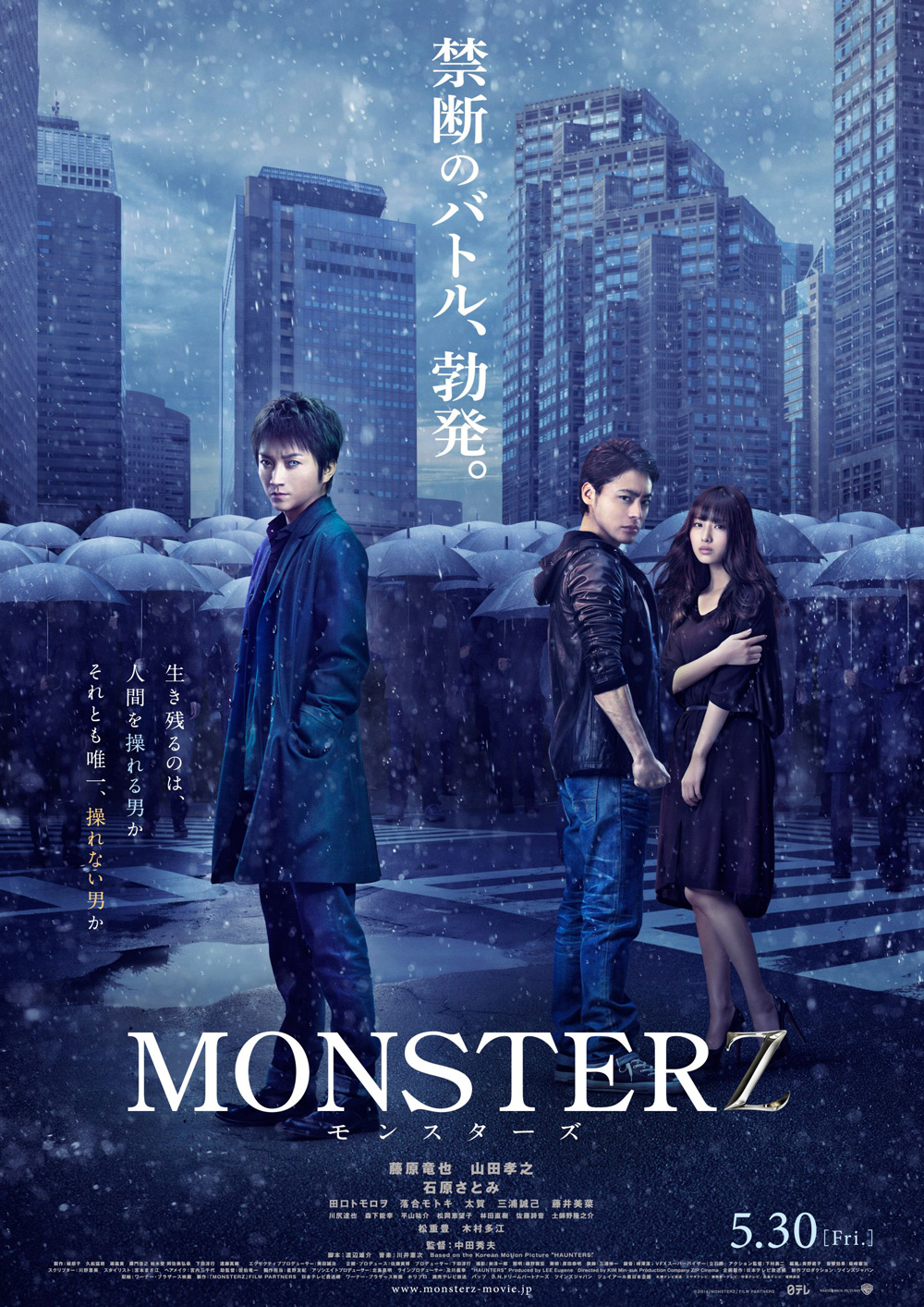
Monsterz_2014Hideo Nakata is best remembered as one of the driving forces of the J-Horror boom of the late ’90s thanks to his hugely influential Ring movies. However, despite a few notable hits including Dark Water, his career has seen something of a slump following a foray into American filmmaking with The Ring 2 – a sequel to the remake of his own Ring (though entirely different from his Japanese language Ring 2 completed in 1999). Monsterz sees him helming a remake of another foreign property – this time the Korean sci-fi thriller Haunters.

The film begins from the POV of Monster no. 1 (played by Tatsuya Fujiwara), who narrates much of the story and refers to himself solely as “monster”. Blindfolded, a small boy is dragged home by his mother only to be discovered by his abusive father who beats him and berates his mother whilst insisting “the monster” needs to die. At this point the blindfold comes off and the boy controls his fathers actions eventually persuading him to snap his own neck. Beginning to also control his mother, the boy stops short of giving her the same treatment and wanders off into the rain. Fast forward 20 years and the monster is now a criminal mastermind who uses his time freezing and mind control capabilities to make a living as a bank robber. However, one day he discovers someone who seems to be immune to his powers (Takayuki Yamada) and his whole world is shaken. The monster sets about removing this threat to his supremacy but it appears his opponent is also “a monster” – a man with super healing properties who cannot die! It takes a “monster” to fight a monster but which one will come out on top?

Yes, lots of predictably comic book style action adventures begin as the two guys with opposing super powers face off against each other. The most interesting aspect of the film is that it’s mainly told from the point of view of the otherwise unnamed “monster” though Nakata’s attempts to make him a sympathetic anti-hero never quite work out despite Fujiwara’s committed performance. The film’s ending is also unconventionally unresolved (though also very true to its American comic book roots) with a pleasing note of tolerance and inclusivity thrown in. However, that is in part facilitated by the lack of tension in the central dynamic – the two opposing forces are at a perpetual stalemate which only ends up feeling, well, stale – in a word. The monster’s freezing and mind control powers are impressive but the action sequences are much of a muchness and just get bigger rather than more interesting.

Having said that the action sequences aren’t unexciting, there are some impressive moments (bar the odd use of dodgy CGI and green screen). The main problem with the film is a slight mismatch in tones between Nakata’s portentous doom laden fatalism and the playful lightness of its comic book inspiration. The conventional hero, Shuichi, takes second lead here with his gang of sidekicks – otaku Akira and flaming queen Jun offering odd moments of comic relief. Though actually the role of Jun is another interesting inclusion as, despite offering a stereotypically “gay” character camping things up spectacularly, Jun is also presented fairly normally as a valued friend and comrade of the hero. His sexuality is merely a character trait, never a joke in itself which is a refreshing element particularly in a Japanese film. In the end, Monsterz aims to offer a message of tolerance and inclusiveness – that, oddly, there are no monsters and would be no villains if we could all just learn to accept each other’s differences and live together in harmony. However, the message is a little hamfisted and clumsily delivered and, some might feel, out of place in an action orientated film such as this.

Very typical of the comic book movie genre (though perhaps more Fantastic 4 than Dark Knight), Monsterz is middling mainstream fare which, while mildly diverting, fails to offer anything particularly memorable. A fine way to spend 90 minutes, Monsterz never outstays its welcome and offers generally high production values plus Nakata’s trademark visual flair but is unlikely to satisfy more genre savvy fans.