My Father’s Tracks (僕と彼女とラリーと, Renpei Tsukamoto, 2021)

A struggling Tokyo actor begins to re-appreciate small-town wholesomeness after returning home for the first time in many years on learning of his semi-estranged father’s death in Renpei Tsukamoto’s heartwarming drama My Father’s Tracks (僕と彼女とラリーと, Boku to Kanojo to Rally to). As much a celebration of the idyllic countryside villages around the city of Toyota in Aichi, obviously closely associated with the automobile industry, Tsukamoto’s gentle coming-of-age tale sees its hero find his purpose in returning to his roots while gaining a new perspective on his parents’ relationship and the father he’d always resented who became a local hero but was never around when his family needed him. 

At 29 Taiga (Win Morisaki) is still trying to make his mark as an actor in Tokyo, his dejected manager complaining his trouble is that though he’s quick and clever he’s essentially soulless which is why he’s failing to captivate the audition panel. He repeatedly ignores calls from his semi-estranged father Toshio (Masahiko Nishimura) and then answers one on the urging of a friend only to utter some very unkind words before unceremoniously hanging up. The next time he answers his phone, however, the call is from an old friend and neighbour, Miho (Mai Fukagawa), letting him know that his father has passed away suddenly of a heart attack. Though they had not been on good terms, Taiga cannot help feeling guilty that his final words to his father were so harsh especially as he’d called to invite him to visit the following November. 

Though everyone in the town seems to have held Toshio in high regard, he was a frequent fixture on the local TV channel for which Miho works, both Taiga and his older brother Hiroyuki (Ryuta Sato) who has become a cynical and heartless businessman feel only contempt for him for having selfishly neglected his family while travelling all around the world as a mechanic with a champion rally team not even making it home in time to see their mother before she passed away of a longterm illness. Taiga can’t forgive him for leaving his mother lonely, but later comes to reflect that perhaps he wasn’t best placed to fully understand the relationship between his parents and may have misinterpreted something which as he later puts it only a husband and wife can know. Meanwhile, it seems his father had also been a supportive force in the community having given jobs to those who might not ordinarily find them in a mechanic with a criminal record, an old man past retirement age, and a young woman so shy she is largely unable to speak. Taiga can see how important his father was to these people and worries what will happen to them now whereas his coldhearted brother is deaf to their pleas planning to close the business and have it and the family home bulldozed as soon as possible to settle the estate without undue delay. 

Hurt even more deeply that Taiga, Hiroyuki has become cruel and cynical often running his brother down rolling his eyes that no one makes a living from a “hobby” while insisting this isn’t one of his “namby-pamby” plays. He claims that he needs the money to protect his family, something that he feels his father failed to do in spending all his time on a “hobby” of his own even shutting down his own small son’s curiosity and desire to join in with the other kids’ fun. Even so after repeatedly telling him to “man up” and get a real job, Hiroyuki is less than impressed by Taiga’s desire to take over the family business which he admittedly knows nothing about having acquired a driving license solely for a role, only relenting when threatened by a flamboyant human rights lawyer with the name of a legendary samurai (Riki Takeuchi).  

Nevertheless, marshalling the skills he picked up in Tokyo and working alongside the locals Taiga begins to rediscover the sense of purpose he’d been missing while gaining a new understanding of his father and greater sense of future possibility. Despite complaining that there is “nothing here” in comparison to Tokyo only for Miho to remind him of all the things Tokyo doesn’t have or that are freely given in Toyota but need to be paid for in the city, he quickly settles back in to small town rhythms and begins to accept his father’s legacy finally finding his sense of direction and taking his place in the driving seat of his own life. A heartwarming tale of familial reconnection and the power of community, not to mention a celebration of rural small-town Toyota, My Father’s Tracks insists life is a rally, all about the going there and coming back, walking on blazing a trail and never giving up no matter the sharp corners and unexpected turns a life may take. 


My Father’s Tracks streams in the US until March 27 as part of the 14th season of Asian Pop-up Cinema

Original trailer (English subtitles)
Bento Harassment (今日も嫌がらせ弁当, Renpei Tsukamoto, 2019)

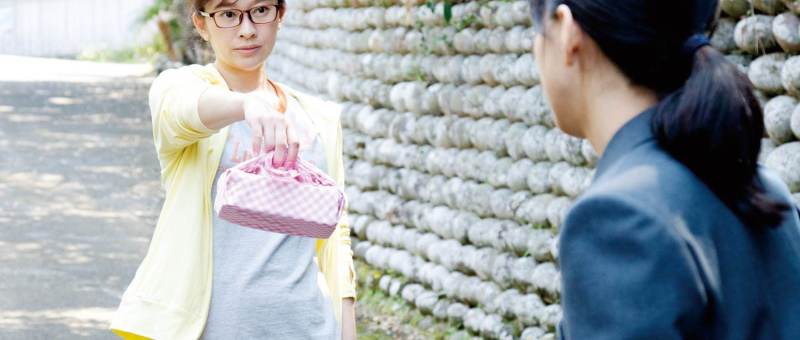
Bento harrassment posterChildhood’s a funny thing. Obviously lacking life experience and used to being the centre of someone’s universe, children can be curiously self-centred, little knowing the hard work their parents put in to try and make them happy until they suddenly realise years later that their mothers must have toiled through the night just to finish that costume for fancy dress that they didn’t really want to wear. Fed up with her teenage daughter’s sullen indifference, the heroine of Bento Harassment (今日も嫌がらせ弁当, Kyo mo Iyagarase Bento) comes up with an ingenious solution – increasingly elaborate lunchboxes designed to vent her frustration in a way that’s impossible for her daughter to ignore.

12 years previously Kaori (Ryoko Shinohara) was blissfully happy with her two little daughters, Wakaba (Rena Matsui) and Futaba (Kyoko Yoshine), but then her husband was killed in an accident and her life was turned upside down. Now she lives alone with her youngest daughter Futaba who has entered something of a rebellious phase, never directly talking to her mother but communicating through pithy, passive aggressive texts. In a bid to get her attention, Kaori decides to play her at her own game – by becoming so annoying that she’s impossible to ignore. From the day that Futaba enters high school she commits herself to making one “annoying” bento every day, eventually adding a message or two into the mix. Much to Futaba’s chagrin, her mother’s bento becomes a cause of daily excitement among her school friends who can’t wait to see how her mother has chosen to troll her on this particular day.

Perhaps tellingly, Kaori and her daughters live on a small island, Hachijojima, which is technically classed as “Tokyo” though in another sense almost as far from the bustling metropolis as it’s possible to get. There are no trains, or shopping malls, or convenience stores, just cows and wholesome wisdom. Caught between one thing and another, Futaba quits her after school athletics club to sit in a field and write angsty poetry about how she’s all alone in the universe. She doesn’t understand why her mum’s so extra and is confused by her attraction to a childhood friend (Kanta Sato) who has now become buff after developing an obsession with taiko drumming. Beginning to figure out why her daughter’s so moody lately, Kaori doubles down on the annoying bento plan but tries to put a little guidance in there too to push the indecisive Futaba towards making concrete decisions about her future.

Unlike the typically self-sacrificing mothers of “hahamono”, Kaori has her spiky side and never particularly looks for thanks or recognition from her daughters only basic civility. She works two jobs (one in a bento shop and another in a pub) and still makes time to devote herself to the petty art of annoying bento which she also posts online on a blog which becomes an instant hit with similarly stressed out parents looking for a little innocent revenge. Through the blog she finds herself bonding with Shunsuke (Ryuta Sato), a widowed father of a five-year-old boy who is struggling to perfect the art of bento though his aim is less revenge than trying to bond with his son who obviously misses his mum. Yet even “annoying” bento comes from a fundamental place of love – after all, you don’t spend all night cooking to send a passive aggressive message to someone you don’t like. Rising to the challenge, Futaba refuses to admit defeat and makes a point of eating all of the annoying bento without a word of complaint, allowing a kind of communication to arise between herself and her extremely patient mother.

Seeing all her dreams crushed on one extremely bad day, however, makes Futaba lose faith in her mother’s gentle wisdom. Kaori tries to convince her that nothing’s ever really “wasted” because even when things don’t work out the way you hoped they still teach you something else but that’s a hard lesson to learn when you’re young and unused to disappointment. Nevertheless, thanks to her mother’s relentless trolling and some careful words from her sister, she comes to realise just how much her mother has sacrificed on her behalf and understand her mother’s love. A warmhearted tale of mother daughter bonding and an ode to persevering through life’s various difficulties, Bento Harassment is a wholesome treat and inspirational tribute to living life without regrets.


Bento Harassment screens in Chicago on Sept. 27 as part of the ninth season of Asian Pop-Up Cinema.

Original trailer (English subtitles)

700 Days of Battle: Us vs. the Police (ぼくたちと駐在さんの700日戦争, Renpei Tsukamoto, 2008)

700days-of-battleThose golden last few summers of high school have provided ample material for countless nostalgia filled Japanese comedies and 700 Days of Battle: Us vs. the Police (ぼくたちと駐在さんの700日戦争, Bokutachi to Chuzai-san no 700 Nichi Senso) is no exception. Set in a small rural town in 1979, this is an innocent story of bored teenagers letting off steam in an age before mass communications ruined everyone’s fun.

In the summer of 1979, a group of teenage high school students get their kicks pulling pranks around the neighbourhood. They finally meet their match when a new policeman, Chuzai (Kuranosuke Sasaki), arrives in town intent on actually enforcing the law. When one of the boys is fined for speeding after coming down a steep hill on his bicycle, the guys decide to make Chuzai their new enemy, virtually daring him to arrest them with their constant trolling.

However, things take a turn when the boys move their prank planning meetings to a local cafe and discover the beautiful waitress working there, Kanako (Kumiko Aso). Instantly smitten the boys step up their romance game (donning some fancy outfits in the process) and semi-forget about their mission. Unfortunately Kanako is a married woman and worse than that she’s married to Chuzai! This whole thing just got real.

Chuzai, for all his uptight authoritarianism is onto the boys and their generally innocent mischief. Finding it all very irritating rather than actually dangerous, Chuzai gradually starts playing them at their own game by attempting to prank them back such as in one notable incident where he makes them attend a public behaviour seminar but gives the entire lecture through a ventriloquist’s dummy called Taru-kun. As a slightly older man, Chuzai can see the boys are just hopelessly bored in their backwater town. Breaking with his hitherto austere persona, Chuzai drops the authoritarian line to offer some fatherly advice to the effect that these summers are precious times,  soon the boys’ high school lives will be over and they’ll most likely leave their pleasant small town for the bustling metropolis of Tokyo so they’d better make the most of these aimless days while they can.

Idyllic as it is, the nature of the boys’ mission changes in the second half as the war against Chuzai takes on a slightly more affectionate quality. At this point they decide to use their pranking powers for good to help a little girl who’s stuck in the hospital finally enjoy the summer fireworks she’s been longing for even though the doctors won’t let her out to go to the festival. With the fireworks heist hovering in the background the guys get into various romanctic difficulties while enjoying archetypal teenage summer adventures.

Infused with period detail, 700 Days of Battle: Us vs. the Police has an authentically ‘70s soundtrack with some of the biggest hits of the era running in the background. Frequent cultural references such as a brief appearance from Ultraman add to the atmosphere which has a kind of retro, nostalgic innocence behind it as these kids live in a golden era of friendship and bike riding when the sun is always shining and graduation is still a long way off.

Director Tsukamoto keeps things simple though the production values are high and visual gags are spot on. Somewhat episodic in nature, the tale is split up into various chapters by means of title cards which helps to break up the seemingly endless summer as the boys attempt to fill their otherwise empty days. Apparently this was only the beginning of the “war” against the police, occupying only 108 days of a “conflict” which would finally run to 700. Presumably the guys have finished up their high school days by that point but at least they’ve succeeded in making some amusing memories of their elaborate and sometimes fiendishly clever schemes to take revenge on the surprisingly patient Chuzai-san. Filled with innocent, witty and whimsical comedy 700 Days of Battle: Us vs. the Police offers no great leap forward even within the realm of quirky teen comedies but still manages to provide some old fashioned, wholesome summer themed fun.


Original trailer (English subtitles)