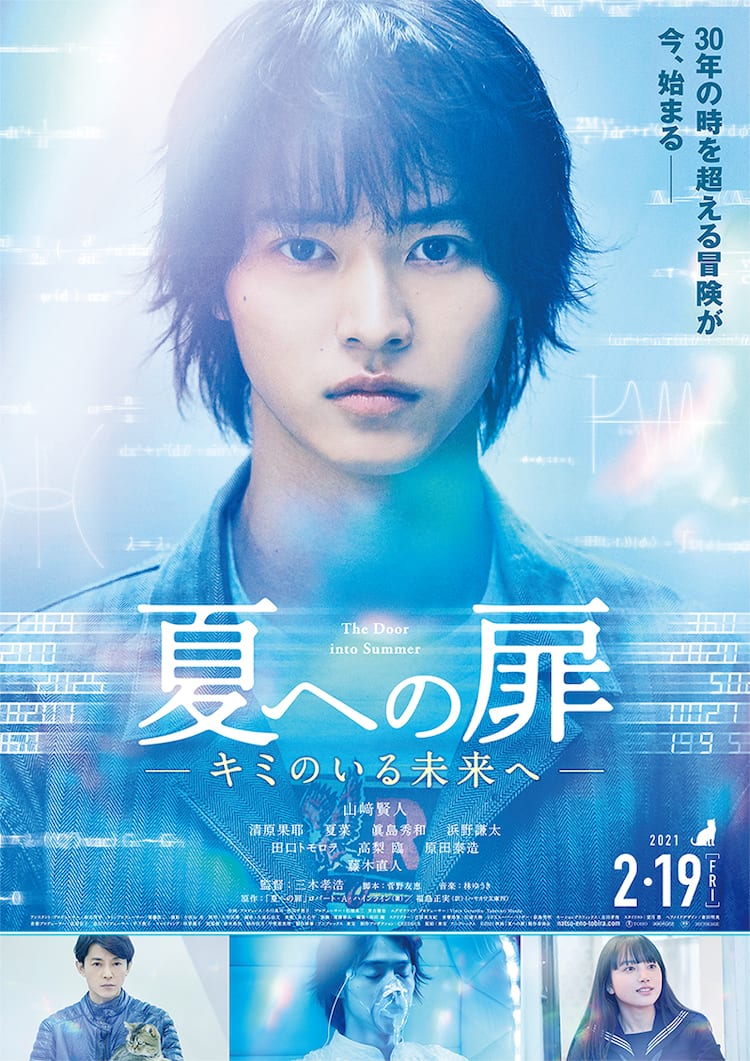
The Door into Summer (夏への扉 ―キミのいる未来へ―, Takahiro Miki, 2021)

Takahiro Miki has made something of a name for himself with a particular brand of bittersweet youthful romance often featuring a fantastical element such in Girl in the Sunny Place, or My Tomorrow, Your Yesterday. Adapted from a novel by Robert A. Heinlein, The Door Into Summer (夏への扉 ―キミのいる未来へ―, Natsu e no Tobira: Kimi on iru Mirai e) is in many ways more of the same, repurposing a sci-fi-inflected, slightly uncomfortable love story as an inspirational tale of never giving up and learning to overcome personal trauma in order to seek true happiness. 

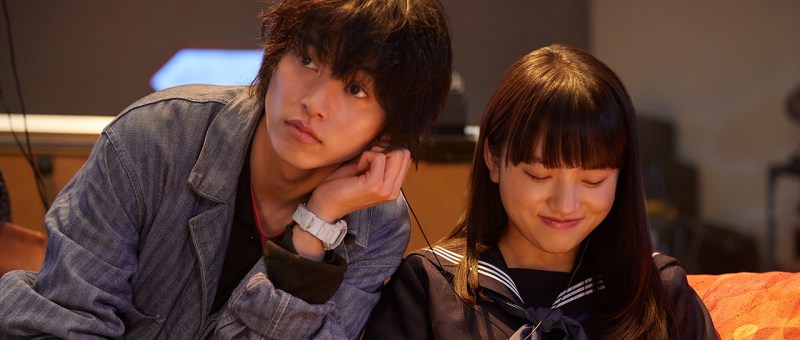
In 1995, 27-year-old Soichiro (Kento Yamazaki) has experienced a lot of loss in his life. His mother passed away soon after he was born, followed by his father when he was 17. He was then taken in by a family friend and became a big brother to then 7-year-old Riko (Kaya Kiyohara), but his adoptive parents then died in a plane crash. While Riko went to live with her uncle Kazuto, Soichiro became a robotics prodigy with an internalised sense of despair that prevents him making lasting connections, believing that his fate is always to lose everything he loves. His prophecy is in a sense fulfilled when he’s duped into signing away some of his shares in the robotics company founded by his adoptive father by an unscrupulous colleague. Filled with despair, he decides to enter a cryostasis programme for 30 years intending to transfer his remaining stocks to Riko, in part avoiding the inappropriate crush she has on him and hoping to escape from reality along with his best friend/cat Pete to start again in another time when the programme promises his investments will have matured leaving him with a good quality of life. Before he can do that, however, an attempt to confront his wrongdoers backfires when he’s placed into their proprietary cryosleep programme to ensure he’s out of the way for the next three decades. 

To that extent, you’d have to wonder why they’d bother rather than just getting rid of him for good. In any case, when he wakes up he realises that the shady company that housed him, Mannix, went bust years ago leaving him with no savings and also no cat because his enemy didn’t give much thought to poor Pete. In the future, however, he gets a fancy new rogue robot companion, also called PETE, who supports him as he tries to adjust to the digital world his inventions helped create before realising that he must have at some point time travelled back to 1995 to put things “right” (to a certain extent) so that could happen and starting in on that. This accidental paradox is never really addressed, Soichiro travelling to the past because he knows he already has, but not giving himself very much time to complete the magic plasma battery that powers the future while remaining in hiding until ready to disrupt his tormentors’ dastardly plan, rescue his beloved cat Pete, save Riko, and return to the future to make sure that nothing else changes in the new 2025. 

It is indeed Pete that inspires the film’s title in his revulsion of winter weather, always insisting on checking all the internal doorways in the hope that one magically leads to summer which is a roundabout metaphor for film’s secondary message in the insistence on perseverance, never giving up or losing hope in a brighter future even it seems impossible. Nevertheless, it can’t be denied that there’s something slightly uncomfortable in the relationship between 27-year-old Soichiro and his 17-year-old adoptive sister Riko even as he repeatedly reminds her she’s still a child and should live her life with people her own age, especially given the implications of the romantic resolution which attempts to smooth over this awkwardness by placing them on a more equal footing if somewhat artificially. In the end, however, the most important tool for saving the future turns out to be companionship and unconditional support of the kind that Pete offered the orphaned Soichiro, a quality he later programs in to his over-curious robot “son”, PETE. Miki doesn’t do much with the hard sci-fi trappings of the original novel, but does in his best tradition craft an innocent romance as the hero learns to look for his eternal summer in the present rather than the past while overcoming his internalised despair in his cursed fate to embrace love and happiness. 


Trailer (no subtitles)
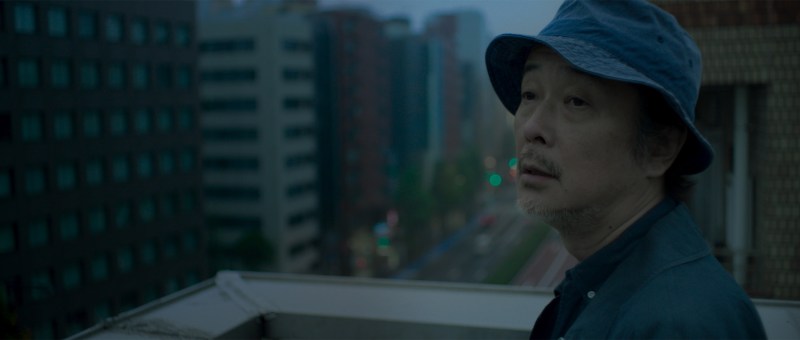
Cottontail (コットンテール, Patrick Dickinson, 2023)

A recently bereaved widower travelling to Lake Windermere to scatter his wife’s ashes begins to reclaim an image of family in Patrick Dickinson’s melancholy character study, Cottontail (コットンテール). Having travelled to the Lake District in her childhood to visit her father who was working in the UK at the time, Akiko (Tae Kimura) recalled fondly a sense of familial connection symbolised by a photo she believes to have been taken on the lake’s shores and continued to wear a Peter Rabbit necklace right to her dying day.

In a poignant note to her husband Kenzaburo Lily Franky) written before her dementia worsened and left with a Buddhist priest until the time of her death, Akiko expresses regret that they were never able to go there again as a family while she was alive but would like him to scatter her ashes on Lake Windermere in the company of their Son, Toshi (Ryo Nishikido), who now has a wife and daughter of his own.

As we can see from the opening scenes, Kenzaburo is a man living at odds with the world around him. Emotionally distant, he finds it difficult to relate to his son and often quite literally shuts him out leaving Toshi hurt and resentful. To begin with, Kenzaburo insists he will go to Lake Windermere on his own and only later agrees to allow Toshi and his family to accompany him, making all the travel arrangements. Once there, however, he becomes impatient and after a minor argument over the itinerary takes off alone only to get on the wrong train and end up on the opposite side of the country as he’s kindly informed by a raucous hen party on their way to York. Forced to rely on the kindness of strangers, he’s taken in by a farmer (Ciarán Hinds) and his daughter (Aoife Hinds) who have suffered a bereavement themselves and attempt to help him process his loss while encouraging him to reconcile with his son. Presenting a kind of mirror he may bounce off while mediating these complex emotions in a second language allows Kenzaburo the opportunity to confront himself and his grief along with his feelings of inadequacy as a husband and father.

We can sense his own regret in a flashback to a meeting in a cafe shortly after Akiko was diagnosed with dementia in which she looks to Kenzaburo for reassurance but he remains in denial. She tells him that she’s afraid and can’t bear the idea of losing her family or becoming a burden to them but he simply tells her that it won’t come to that as if he were closing himself off to the reality but also from her in leaving Akiko alone to deal with her fear and loneliness in refusal to confront anything that is emotionally difficult or unpleasant. Yet Kenzaburo refuses to relinquish her memory, stubbornly carrying her ashes in a tea tin and at times holding it up as if he were showing her around and attempting to share this trip with her in a more literal way.

What threatens to devolve into a more conventional road trip drama in which Kenzaburo is helped on his way by a series of improbably kind and sagacious strangers develops into something deeper as he trudges his way through the English countryside which as it turns out is not all that aesthetically different from that of Japan and largely free of the often claustrophobic hedgerows that literally separate us from the surrounding scenery. The landscape further recalls scenes from Kenzaburo’s life as he begins to reflect on his time with Akiko and confront the reality of her loss along with his new life without her.

In effect, he’s journeying towards a recreation of Akiko’s photograph and its capture of a brief moment of familial unity in a gradual process of reconciling with Toshi and his own position as a father. Quiet and unassuming, Dickinson’s film is less a slow voyage through grief and learning to let go as it is one of gaining courage to open a door that had long been closed, Kenzaburo no longer the melancholy octopus hiding deep in the ocean but a bobbing rabbit eager to experience more of the world around him before it’s too late.


Cottontail opens in UK cinemas 14th February courtesy of Day for Night.

UK trailer (English subtitles)

It All Began When I Met You (すべては君に逢えたから, Katsuhide Motoki, 2013)

It All Began When I Met You posterChristmas, in Japan, is an occasion for romance. Strangely, the Christmas date movie has never quite taken off though there are a fair few examples of this oft maligned genre even if they don’t generally help to ameliorate the contempt in which it is held. Truth be told, It All Began When I Met You (すべては君に逢えたから, Subete wa Kimi ni Aeta kara) won’t help to do that either but then it isn’t really intended to so much as provide a little warmth combat the to Christmas cold whilst celebrating the centenary of Tokyo Station (a destination surely as romantic as meeting under the clock at Waterloo).

Spinning out from Tokyo Station, the film splits into six interconnected stories of love ranging from dealing with long distance romance to an orphaned little girl who has projected her need to believe in the existence of her parents onto a faith in Santa Claus. Counting down to Christmas Day, the protagonists each progress towards some kind of crisis point which will allow them to deal with their various problems whilst getting into the holiday spirit.

Couple one are a pair of youngsters, one a fashion designer, Setsuna (Fumino Kimura), and the other an engineer, Takumi (Masahiro Higashide), who are separated because of differing work commitments. She’s in Tokyo, he’s up North, but they chat on the phone all the time and seem close despite the distance between them. The truth is revealed when Takumi comes to Tokyo and is supposed to meet up with Setsuna but stays out all night drinking with a (female) colleague instead.

Meanwhile, a college student (Tsubasa Honda) is invited to a karaoke party but isn’t sure whether to go because her crush is going and she can’t pluck up the courage to confess to him. Her boss at the pastry shop (Chieko Baisho) where she works tells her to go get him rather than allow her true love to slip away as, we later find out, happened to her when her boyfriend failed to appear at Tokyo Station 49 years earlier when they had arranged to elope. One of their regular customers, a Shinkansen driver (Saburo Tokito), has just retired early and, it turns out, may not have long to live but wants to make the most of his last Christmas with his son (Ryutaro Yamasaki) who is preoccupied about a “half-coming of age” ceremony they’re having at school.

Across down, the train driver’s brother-in-law, an arrogant CEO (Hiroshi Tamaki), runs into an aspiring actress (Rin Takanashi) who is currently in rehearsals for a play she puts on every year at a local orphanage. This year might be her last, however, because she’s begun to accept that her acting career will never take off and it’s time to go home. One of the little girls at the orphanage, Akane (Emiri Kai), is particularly looking forward to the festivities because she’s invested in the unseen figure of Santa as a substitute for believing in the unseen figures of the parents she never knew.

Each of the stories is intended to capture something of the complicated business of modern city living – a long distance relationship is, perhaps, something that many will be familiar with, relating to the pain and confusion of being not quite sure where each party currently is in terms of commitment. The pace of contemporary life frustrates romance, but the station is there to connect people and bring them back together. The conclusion is perhaps a little optimistic in its sudden cementing of a romantic bond but broadly in keeping with the Christmas theme.

The CEO and the actress, by contrast, are a much more conventional rom-com couple. Serendipitously meeting each other at various upscale joints, the CEO immediately tags the actress as a gold digger after she (accidentally) catches him flashing his premium credit card. Offended she spins him a yarn about a dead boyfriend as payback but finds it backfiring when he is unexpectedly moved and tries to make it up to her. Warmer in tone, this strand sets the station up as a symbol of the interconnectedness of city life where such mini miracles are indeed possible even if the perfectly rational reason for all the coincidental meetings is later explained to us.

However, where there’s joy there’s also heartbreak. The train driver’s tale seems out of place here, but plays into other themes of coming to terms with reality and committing to enjoying the now rather than worrying about the past or future. Similarly, the little girl begins to work out her faith in Santa maybe misplaced because the letter he’s written her is in Japanese, which is weird because isn’t Santa Swedish? Learning to accept that not having parents is not due to a lack of faith and that she has good people looking after her helps Akane move past her loneliness while the baker gets a surprise visitor who helps fill in a few details about her failed romance which in turn helps her offer advice to her young assistant faced with her own typically adolescent love worries.

Miracles really do take place at Tokyo Station, which, it has to be said, is quite picturesque. Saccharin and superficial, It All Began When I Met You is nevertheless a heartwarming tribute to the strange serendipity of city life, throwing in a good amount of Christmas cheer with hope for the future and presumably a happy new year.


Original trailer (no subtitles)

Like Someone in Love (UK Anime Network Review)

Like_someone_in_love_quad_v5_HRFirst published on UK Anime Network in June 2013.


Like Someone In Love is only Iranian director Abbas Kiarostami’s second international venture after 2010’s Certified Copy but this time sees his familiar preoccupations with ambiguities and poetic imagery transported to modern day Tokyo. Although in this case all the characters are quite clearly drawn and presented somewhat unambiguously, the reasoning behind the decisions they make and the way they behave, however, remains oblique. The title implies someone is acting ‘like someone in love’ if not exactly ‘in love’ themselves but who is it, who or what are they (‘almost’?) in love with, and what exactly would that mean – these are all the gentle ambiguities that Kiarostami wishes us to think about in this perfectly excised cross section of modern life.

As the film opens we are placed statically looking onto a scene which appears to be some sort of bar, a woman’s voice can be heard speaking to someone – not us, this clearly isn’t a voice over, there is obviously someone else involved in this dialogue that we cannot hear. We search the screen for the owner of the voice and even though we can see that nobody else is speaking somehow the thought that the woman is off camera hasn’t quite occurred to us. Eventually we find a young woman has been talking on the phone, presumably to her boyfriend – ‘I’m not lying’ she says, though we know she is. The boyfriend suspects her and makes her go to the bathroom to count the number of tiles so he can come there later and compare to see if she’s telling the truth.

Shortly afterwards, an older man (Denden) starts talking to her and encourages her to break up with said jealous boyfriend ‘not just for business reasons’ but as fatherly advice. He wants her to visit ‘a very important man’, she doesn’t want to because she’s tired after cramming all night for an exam and anyway her grandmother is in town and she’d like to see her. The man makes it very clear he isn’t forcing her, but he leaves her no room to refuse and she goes anyway even though she doesn’t want to. He puts her in a taxi for an hour’s drive across the city – on the way she gets a message from her grandmother that she’ll be waiting outside the station until her train so Akiko (Rin Takanashi) asks the driver to pass the station twice just so she can catch a glimpse of her.

Fast asleep in the car she arrives at a rather nondescript little address behind a ramen shop where a retired sociology professor (now sometime translator), Watanabe (Tadashi Okuno), lives. As soon as they enter the phone rings and Akiko takes the opportunity to poke around – she finds some pictures of an older and a younger woman – a wife and daughter perhaps? Strangely they look a little like her, as does the woman trying to teach a parrot to speak in the famous print on one wall.  ‘I always thought the parrot was teaching the woman’ Akiko says and the professor laughs. Still tired she makes straight for the bedroom, undresses and gets into the bed. This wasn’t what the old man had in mind though – he’s cooked a full dinner and bought wine, soft music ‘Like Someone in Love’ is playing in the background. After trying to convince her to eat and failing the professor gives up and turns the light out to let her sleep.

The next morning he drives her to school only to witness an altercation with the jealous boyfriend, Noriaki (Ryo Kase) who’s been lurking in wait after not being able to get through on Akiko’s phone. It’s clear he’s angry, he grabs at her then sulks after she goes inside before trying to talk to the professor, mistakenly thinking he’s her grandfather. He of course keeps up the pretense simply by not (directly) correcting the mistake. It’s clear though that something is coming to head and the meeting of these three people is going to produce a fundamental change in one or all of their lives.

Like Someone in Love might be one of those films where the reaction to it says much more about the viewer than it does about the film. It’s so much more about what isn’t said, the things that one infers from brief snippets of possible backstory than it is about what is actually seen on the screen. We don’t know exactly why Akiko got into this line of work or why she does it or even how she really feels about it. It’s plain in the first scene that she doesn’t want to go, at least tonight, and that she’s refused to go before but when she arrives at Watabe’s house she’s anything but coy and seems every inch the seasoned pro ready to get down to business. She’s a cipher, the clearest thing you can say about her is that she’s defined by her own passivity. She says she won’t go and then bows to pressure and goes, she obviously wants to break up with her awful boyfriend but doesn’t, she wants to see her grandmother but obeys her pimp(?) instead. She seems to spend her entire life bowing to the whims of other people rather than making any sort of decision for herself.

The two men by contrast appear as virtual mirror images of each other. The elderly scholar Watanabe, contemplative and introspective and the violent, obsessively jealous high school dropout garage owning Noriaki. What is Watanabe’s interest in Akiko? Is this something he’s done often? it seems maybe not, perhaps this is a gift from his former student now Akiko’s ‘boss’. At any rate it seems he’s after some kind of romantic evening rather than a torrid few moments in bed with a girl young enough to be his granddaughter. He’s arranged things for her comfort – cooking her local dish, lighting candles, setting the dinner table etc just as someone in love might do. Perhaps he’s just lonely (though his phone is always ringing and he never answers it) and wants to relive fondly remembered memories of his wife. Noriaki by contrast seems much more territorial – he wants to own Akiko, he’s decided she’s useless on her own and needs his protection but he’s obviously terrified someone’s going to steal her out from under him. He’s also hugely over sensitive about the phone box card which looks like Akiko (because we know it is) maybe because he’s got a Madonna-whore conception of women to begin with.

The film ends as abruptly as it started which is inevitably going to be a problem for many viewers. This is not the end, but it is an end – perhaps the beginning of something new rather than the end of something old. An internal world is penetrated – like the intrusion of falling in love into an otherwise dull life, old securities prove inadequate and perhaps it’s harder to protect the things that are precious to you than you might hope (especially if you are old and your aggressor is not). In many ways we are like the old curtain twitcher whose sole entertainment is her window onto Watanabe’s doorstep – we can’t know what happened before our one and only window was opened, nor can we know what will happen once it’s closed but still we can’t help but wonder.


Available now in the UK from New Wave Films.