About Us But Not About Us (Jun Robles Lana, 2022)

A lunchtime conversation between two men provokes a series of confrontations in Jun Robles Lana’s pressing psychological drama About Us But Not About Us. There is indeed more going on than it seems, prompting a number of questions about who it is that’s really in control along with the subjective quality of memory and personal myth making. After all as the younger of the men later says, nothing compares to our fictional counterparts both those we create for ourselves and those born of the projections of of others. 

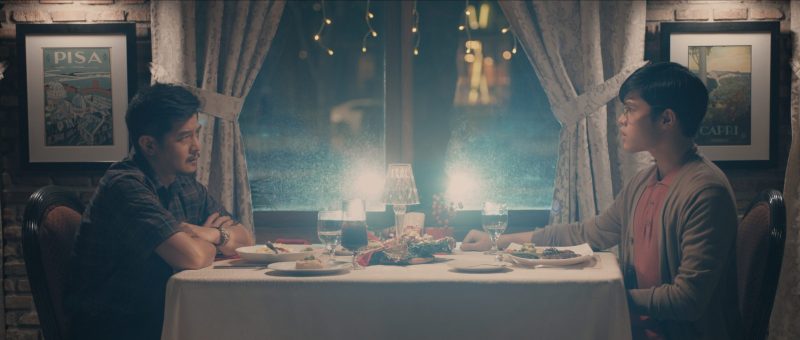
40-year-old professor Eric (Romnick Sarmenta) takes a look at the bags under his eyes in the mirror of his classic Beetle as he arrives at a restaurant for a lunch meeting with a student and gently applies moisturiser to his eyes before heading inside. It’s a small moment that hints at his insecurity about his age and also that he may have more interest in the student, Lance (Elijah Canlas), than he later claims. Lance is already waiting, perky and preppy in his neutral beige outfit and non-threatening haircut. The purpose of the meeting seems to be so that Lance can return the keys to Eric’s spare flat where he had being staying to escape an abusive stepfather. Lance no longer feels comfortable being there, in part because he’s afraid false rumours that there may be something inappropriate going on between them could cause problems for them both at the university, but also because he worries that his presence may have contributed to the suicide of Eric’s late partner Marcus, a leading light of English-language literature in the Philippines. 

Marcus had known about Eric’s interest in Lance but warned him about becoming too involved seeing as he is a teacher and Lance his student not to mention that he is also 20 years older and even if he’s done nothing wrong others may read his well-meaning attempts to help as “inappropriate”. But then we start to wonder, is Lance really as helpless as he claims to be? It seems strange that a 22-year-old man would need this kind of rescuing, perhaps as some have suggested he’s constructed an image of himself as vulnerable so that Eric will feel compelled to help him. Despite his seeming meekness, Lance does appear to be ambitious yet insecure smarting from an offhand comment of Marcus’ that he may in the end lack the necessary talent to be accounted a writer. 

In a theatrical conceit, Lana realises the projected images each has of the other to segue into recreations of previous meetings in which either Eric or Lance plays the role of the absent Marcus whose views are recounted only in the book he had written shortly before he died, his first in Filipino, or filtered through the memories and intentions of the other two men who of course may not be entirely honest in their recollections. Eric insists the problems that may or may not have existed between himself and Marcus were not not really “about” Lance. He claims to have been unhappy and emotionally neglected for years if also still in love, while later conceding that the book is both about and not about them in its retelling of a “trashy” love triangle as an intensely literary potboiler. 

That the book is in Filipino rather than English may hint at a further desire for “authenticity”, as may Lance’s desire to transfer from the English department to that in his native language. Yet neither man is really being “authentic”, not entirely able to reclaim themselves from the image projected onto them by others. The battle for control shifts uneasily between them, Eric assuming he has the upper hand by virtue of his age and position all while Lance may be cynically manipulating him, playing on his latent desire while fluffing his ego in appearing as a lost young man in need of help and guidance. Even so, a possibly imagined conversation with Marcus later suggests that Eric enjoys the subversion and is at heart a masochist who actively seeks to be controlled, perhaps he knows what the game is after all. Lana ends on a note of ambiguity in which it seems there is a choice to be made between sustaining a fiction and rejecting it but then again “sometimes feelings are more important than the truth.”


About Us But Not About Us screened as part of this year’s Queer East .

Original trailer (English subtitles)

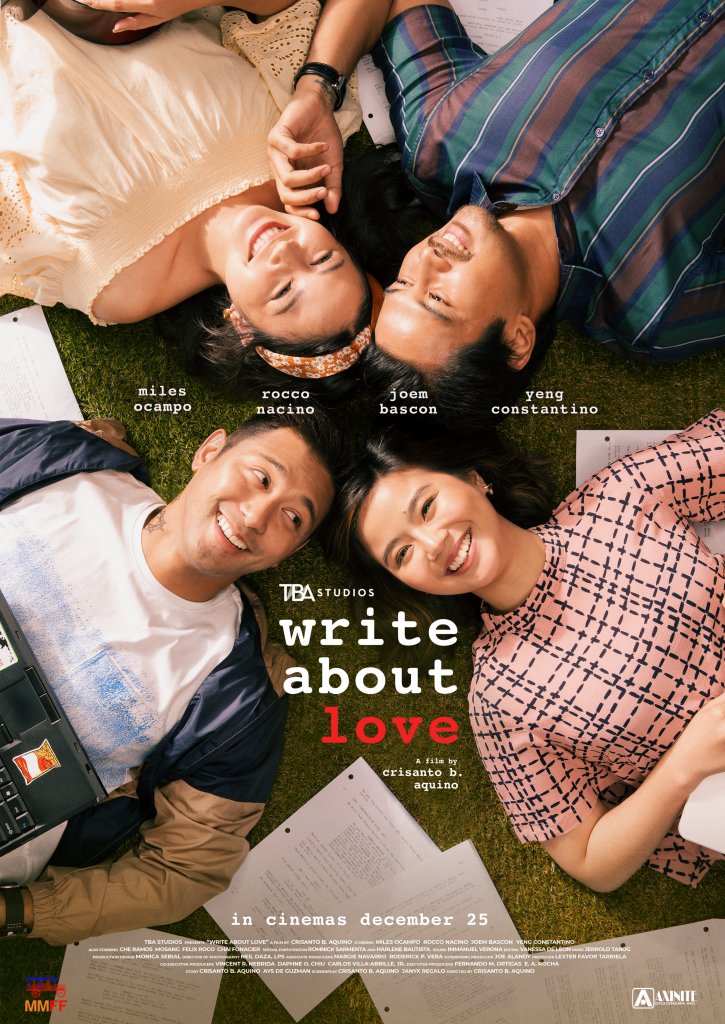
Write About Love (Crisanto Aquino, 2019)

Write what you know, the old adage goes, but can you really write about love if you’ve never been in it? The debut feature from Crisanto Aquino, Write About Love concerns itself not only with romance but with love in a wider sense as mediated through the act of creativity. Two writers are forced into an awkward collaboration working in some senses at cross purposes but eventually find common ground as their shared endeavour pushes them towards acts of self interrogation as they attempt to write a sincere romance with an ending that satisfies all. 

Credited only as “female writer” (Miles Ocampo), a young woman obsessed with rom-coms successfully pitches one of her own titled “Just Us” to a major studio. Though they like her ideas, the suits call her back in a few days later and express concern that her scenario is too similar to an upcoming movie from a rival studio. Rather than a traditional meet-cute rom-com, they want her to focus on what came next, not the story of how they got together but a serious relationship drama about all the boring bits of being in love. To help her out, they’ve decided to team her up with an experienced “indie” screenwriter (Rocco Nacino), and have given the pair one month to thrash out a first draft. 

Of course, things get off to a bumpy start. She’s very “mainstream”, He’s quite cynical, which might make for an interesting dynamic if they weren’t constantly clashing on a personal level. He pushes his experience, She pushes her earnestness. Still, they begin to become closer writing the story of Joyce (Yeng Constantino) and Marco (Joem Bascon), an aspiring musician and a company man who meet and fall in love but find that life gets in the way of their grand romance. The pair decide to structure their drama around various anniversaries – 100 days, 200 days, a year etc, during which Joyce and Marco grow apart, discover that they have different priorities, and eventually break up after an intense argument that lays bare Marco’s insecurity and ongoing abandonment issues which lead him to put his foot down over Joyce’s career ambitions in Korea. 

Meanwhile, the real lives of the writers begin to influence the drama as they hover on the sidelines observing their fictional romantics and plotting out where they might go next. Despite their intention not to write a “mainstream” romance, they are perfectly happy to play with standard melodrama plot devices like job offers from overseas and terminal illnesses as they try to tell the story of Joyce and Marco, but, it seems, those “plot devices” also come from their lives. He had a longterm relationship end because his lover went abroad and met someone else, while she is romantically naive and still hung up on the failure of her parents’ relationship. In fact, her parents’ meet cute inspired the one in Just Us though she hoped to rewrite their story with a happier ending where her dad didn’t eventually leave them to go back to an old girlfriend. 

He asks her if she’s never been in love because she’s afraid of getting hurt, She tells him she’s just not interested, but is eventually forced to deal with her sense of insecurity through accepting the fact that her family is never getting back together. He actually doesn’t tell her much of anything, but is later forced to accept that love is a choice he may have failed to make. We expect that the writers will eventually fall in love while writing the saga of Joyce and Marco, but first they have to discover a few things about themselves, about love, and about suffering. Questioning her mother, She finds out that love is great motivator, prompting you to make decisions good and bad, while He realises that just as in real life you can’t manipulate your characters to force them to do what you want because feelings must be earned to be sincere. Love and pain are inextricable, but love is also an energy which cannot be created or destroyed and endures even after death, according to Her, coming to the conclusion that you need two for a love story and creation is a collaborative effort. Maybe you can’t write yourself out of heartbreak, or give yourself a better ending than life saw fit to give you, but if you’re going to write about love you have to be honest and honest is never easy. 


 Write About Love was screened as part of this year’s Osaka Asian Film Festival.

Original trailer (English subtitles)