Portrait of Hell (地獄変, Shiro Toyoda, 1969)

Asked to paint a vision of heaven, an artist replies that he cannot because he sees it nowhere in this present society. “Over my body and my life, you have absolute authority. But you can never command my artist’s soul,” he spits back at his corrupt lord, but in many ways the lord can command his soul as an artist for he creates the world he reflects for all that he attempts to manipulate him as a man and one he assumes to be far inferior to himself. 

Shiro Toyoda’s adaptation of the classic horror story by Ryunosuke Akutagawa, Portrait of Hell (地獄変, Jigokuhen) opens with a brief voiceover narration that explains that this story takes place almost 1000 years ago in the Heian era when the Fujiwara clan was at the height of its power. But after so long at the top of the tree, the Fujiwara have become both restless and indifferent in their complacency. “The common people live lives of hopeless despair,” the narrator explains outlining the Fujiwara’s inability to govern as even minor natural disasters give rise to famines and corpses litter the streets. Even nobles now live “lives of perpetual dread” having gained a sense of their own impermanence. 

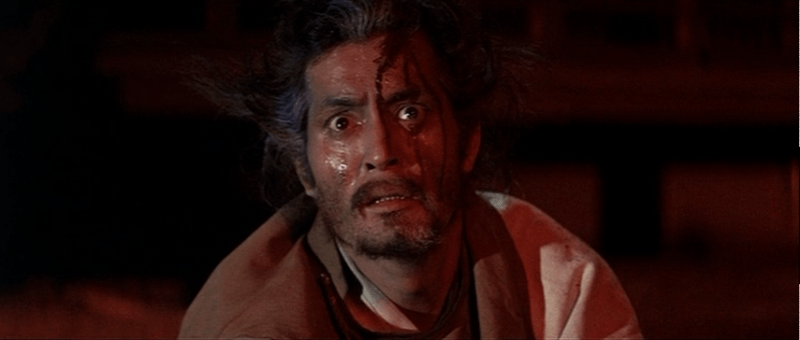
Lord Horikawa (Yorozuya Kinnosuke) is however seemingly oblivious to the suffering of his people. Yoshihide (Tatsuya Nakadai), a Korean painter, tells him that his problem is everyone tells him what he wants to hear (because they fear for their lives) rather than what is actually happening. During the opening sequence, Horikawa had abruptly decided to leave a public celebration. An old man appeals to some of the guards for money, but they roughly beat him and he is later trampled to death by Horikawa’s frightened bull which had become loose during a storm. The old man dies cursing him, exclaiming that “he has treated us like slaves. I have become no better than an animal.” Horikawa had been told that the man used his last dying breath to remark on what an honour it was to be trampled by the lord’s bull. Yoshihide paints a picture that drives a court lady out of her mind featuring the corpse of the old man under a cherry tree that seems so vivid to her that it emanates a stench of death. Horikawa doesn’t like it much either, and its uncanny realism unsettles his mind. He thinks he sees the ghost lying in wait for him in his own bed and orders Yoshihide to dismantle the painting as if that would make the ghost disappear. 

Horikawa believes the “ghost” is a manifestation of Yoshihide’s rage rather than his own guilt or incompetence. Yoshihide certainly does not like the world the lord has made, replying that he has seen hell everywhere in the cities and the villages while there is no heaven to be had which is why he cannot paint it. Yet Yoshihide and the lord are almost perfect mirrors of each other. Yoshihide is also rigid and superior. He prides himself on being Korean, pointing out that the foundations of the court and of modern learning were all brought over by Korean scholars even if Horikawa claims to have “improved” upon them. Yet some of his fellow painters worry that the style their Korean ancestors worked so hard to perfect has been eclipsed by Japanese influence while secretly considering returning to Korea which has now become prosperous unlike the conditions in Japan. 

Horikawa later slips and calls Yoshihide a stupid “foreigner” making plain his contempt despite describing him as the greatest artist of his generation which is why he’s commissioned this piece of art in the first place even though he had described all of his previous pieces “ugly” while objecting to their attempt to show him how rotten his kingdom has become. Yet Horikawa is correct when he says that it’s Yoshihide’s “infernal arrogance” that has provoked his downfall. Having caught his daughter Yoshika (Yoko Naito) with one of his pupils, he locked her in a shed and exclaimed that no other man would have her. If he had not done so, she may never have come to the attentions of the lord and suffered her eventual degradation at his hand, nor would Yoshihide have been so easily manipulated into a obsessive desire to effectively depict the depths of hell. 

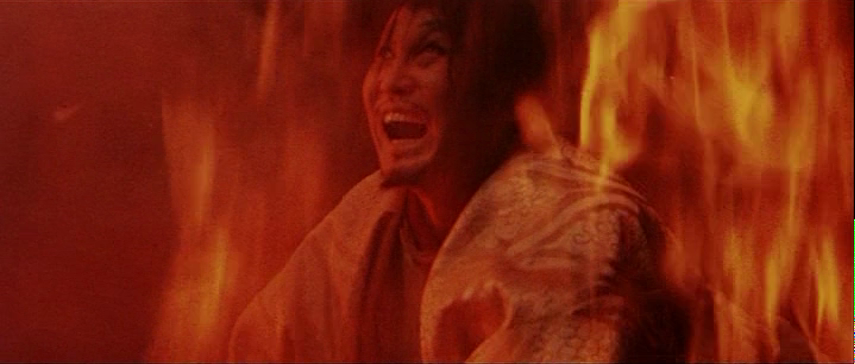
Yoshihide is some kind of method artist who insists he can only paint what he sees. Thus he goes to great lengths to observe hellish cruelty, tying up an apprentice boy in chains and torturing him with snakes, his eyes burning with a fiery intensity. His tragedy is that he comes to realise that the painting reflects not the world but himself. He is hell, hell is here. While his daughter burns, he looks on impassively only to be outdone by her pet monkey who in a gesture of selfless love leaps into the flames. Even so, Horikawa praises the finished painting as a masterpiece, “an impressive depiction of the hell that is our life,” commenting somewhat ironically on the current conditions within his fiefdom. Only latterly does he notice his own role within it, suddenly consumed by his hellishness as if dragged own into the flames despite himself. 

Toyoda shoots in the manner of a classic ghost story, making fantastic use of ghostly effects as Horikawa finds himself haunted by the spirits of those he’s wronged. At times, the screen fills with red light as if soaked in blood or baked in the hellish glow of slow burning flames. He flips between the icy blues of Horikawa’s estate, and the stifling ochre that seems to surround Yoshihide who does after all feed off all this strife rather than seeking to cure it. The two men end up in an impossible game of brinksmanship from which neither can back down, two “arrogant” rivals blindly creating a hell for those around them through their selfishness and vanity. “Life is more hellish than hell itself” runs a final quote from Akutagawa, laying bare the tale’s essential irony in our inability to recognise the hell we create for ourselves and others through our own arrogance and fear.
The Possessed (妖婆, Tadashi Imai, 1976)

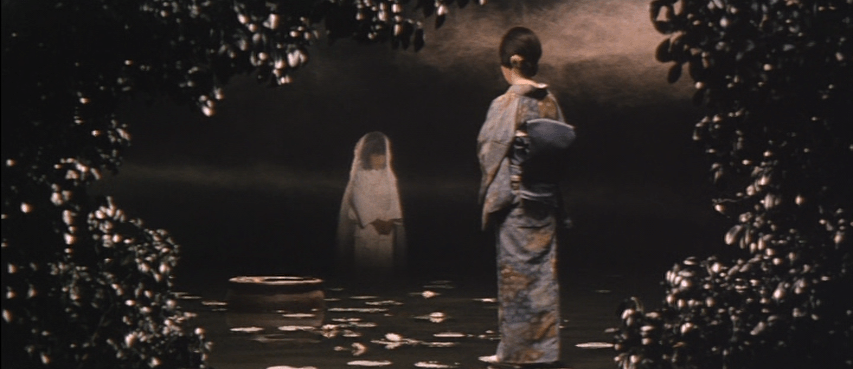
Shinto priests, black magic, and demonic possession. As the opening voiceover of Tadashi Imai’s The Possessed (妖婆, Yoba) remarks, you can hardly believe that such things could happen in the modern world alongside cars, trains, and telephones yet the tale we’re about to be told begins in 1919. Based on a story by Akutagawa, the film is however less a contemplation of ancient superstition amid rising modernity than the destructive patterns of class and patriarchy which conspire against the lives of two women who had once been good friends. 

In 1919, Shima (Machiko Kyo) marries Shinzo (Shinjiro Ehara) who has taken her name and become the presumptive heir of her family. Everyone at the wedding remarks on what a good catch he is, adding almost as an after thought that Shima seems happy about it too. The problem is that Shinzo is repeatedly unable to consummate the marriage. Part of this seems to be down to his wounded masculinity in having married into the family. He resents being under the thumb of his father-in-law along with the rumours that he only married Shima for her money even though this appears to be exactly what he has done. Perhaps further humiliated by his inability to perform, Shinzo tells Shima that it’s her fault because there is something wrong with her body that prevents him from becoming sufficiently aroused. Being a sheltered woman of the Taisho era, Shima wonders if her husband has a point and visits a doctor to find out but as expected he tells her there’s nothing at all wrong with her and it’s most likely Shinzo’s performance anxiety that is to blame. 

However, when her cousin Sawa’s (Kazuko Ineno) comb is found inside Shinzo’s kimono sleeve, the family begin to realise that the problem is he prefers her. He later admits as much and reveals that he’s planning to move closer to the family’s goldmine in Hokkaido and install Sawa in a house there as his common law wife with Shima left behind as a spouse of symbolic value. Shima has already felt herself haunted, but it’s at this point that the family brings in a Shinto priest who explains that Shinzo is possessed by an evil spirit though also giving the more rational advice that she should probably divorce him. Shima is forced to endure a strange ritual including purification by waterfall, but is also sexually assaulted by the randy priest though it it’s not completely clear that she fully realises what has happened to her. 

The implication is that the family treated Sawa as a kind of poor relation they trotted out to keep Shima company because she was an only child. Having grown resentful of Shima’s class privilege, Sawa’s jealousy manifested as covetousness that made her intent on taking whatever Shima had. She too later resorts to shamanistic black magic, fearful that Shima bears her a grudge for ruining her life and hoping to neuter any dark energy that she might be emanating in order to protect her teenage daughter Toshi (Miki Jinbo) who, ironically, has been betrothed to the son of a kimono shop named Shinzo (Taro Shigaki). 

Sawa never married and bore her child out of wedlock. She implies that she depended on men for financial support but never elaborates further. Shima, meanwhile, has been able to build an independent life for herself as a well-respected tailor. “It’s not normal for someone to suffer this much” a shamanically-inclined midwife later tells her when she too becomes pregnant out of wedlock but loses both the child and the man. The boot is perhaps on the other foot, Shima envies the life Sawa has with the one thing that will always be denied her, a child of her own. The midwife had once again told her that she was possessed, this time by the vengeful spirit of her lover’s daughter with his legal wife she fears may have been drowned deliberately by her mother out of jealousy. 

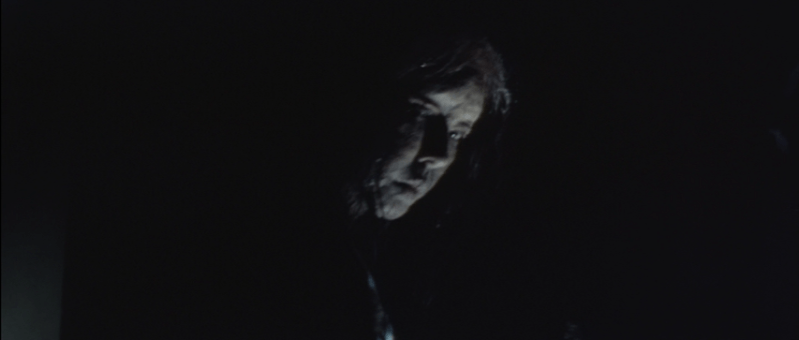
Shima is given a talisman of beads from the goddess of mercy, Kanon, and told that she can have what she wants if she prays hard enough, but Sawa is told the same thing and ends up going too far with the help of a shamaness praying to Basara Okami who later affirms that Sawa’s request comes with a price for the god wants Shima as a human sacrifice which is not really what Sawa had in mind. There is perhaps something symbolic in Shima’s gradual wasting away, becoming old before her time in her loneliness and sorrow (she is only supposed to be 33 at the film’s conclusion, actress Machiko Kyo was 52 at the time) even if she were not having the life force sucked out of her by a supernatural entity, though both women eventually pay a heavy price for their jealousy set against each other by a fiercely patriarchal and classist society which forces them to compete for husbands and standing. 

Imai’s photography is noticeably eerie if occasionally surreal as in the frequent and increasing sight of frogs, usually sign of good fortune or fertility but here ominous harbingers of supernatural dread in league with dark shamanistic forces. As the voiceover admits, it’s difficult to believe that these primitive ideas can exist side by side with the motor car but then again jealousy is as old as time itself and unlikely to disappear from the human psyche anytime soon even if in this case it could have been avoided if only the world were a little more equal. The film’s conclusion suggests it may now be, in a way, with a love match in the younger generation bringing the cycle of envy and resentment to a close even if the vengeful ghost of Shima may still be lurking somewhere in the shadows. 


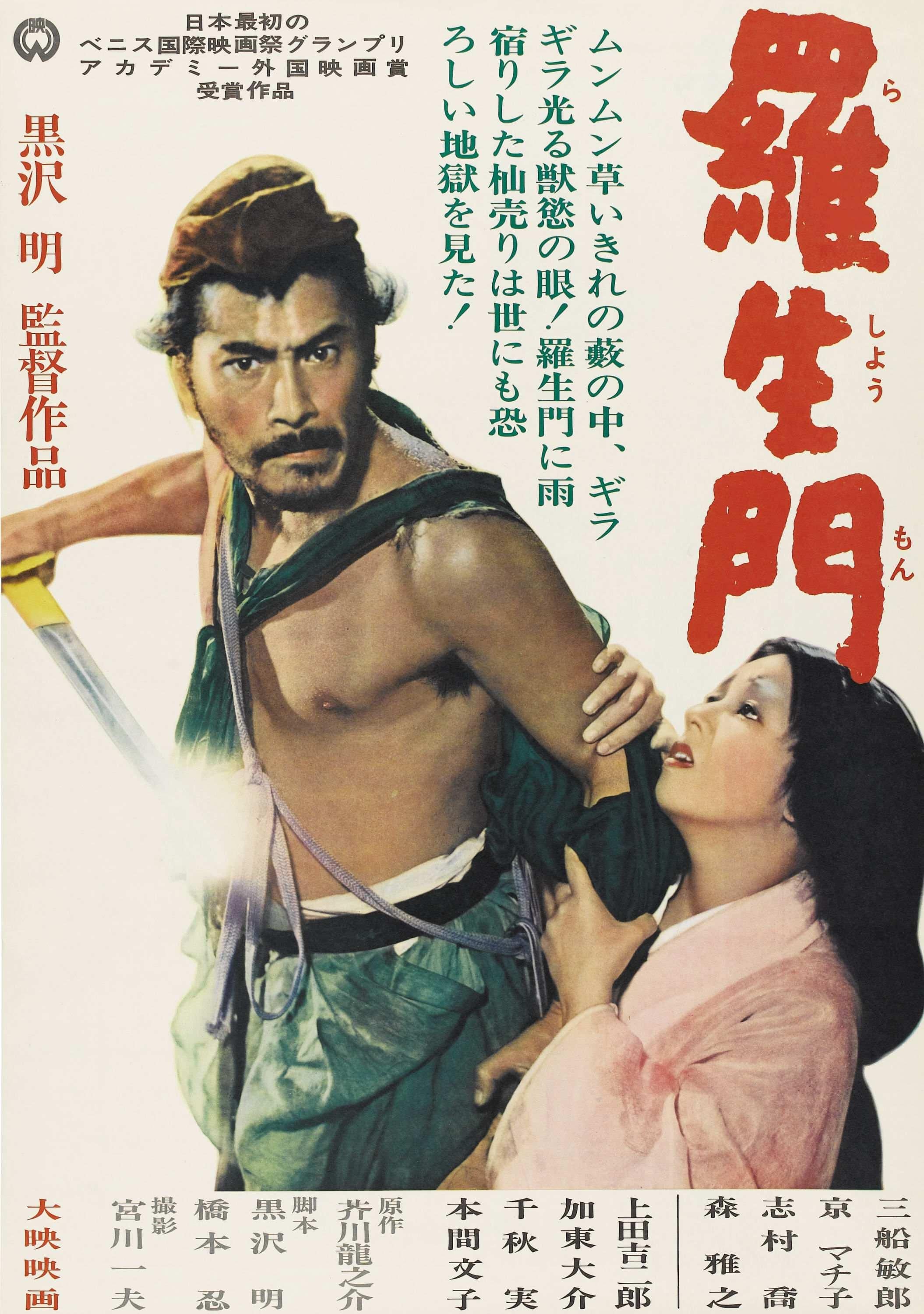
Rashomon (羅生門, Akira Kurosawa, 1950)

Is there such a thing as objective truth, or only an agreed upon “reality”? Like many of his early films, Akira Kurosawa’s adaptation of a pair of short stories by Ryunosuke Akutagawa is concerned with the idea of authenticity, or the difference between the truth and a lie, but is also acutely aware that the lines between the two aren’t as clear as we’d like them to be largely because we lie to ourselves and come to believe our own perceptions as “truth” assuming that it is others who are mistaken or duplicitous. 

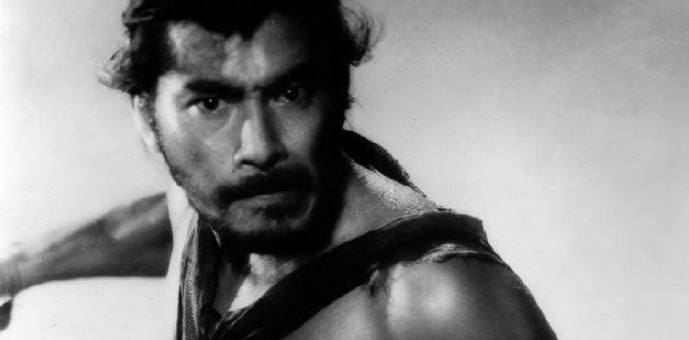
After all, the film opens with the words “I don’t understand”, as the woodsman (Takashi Shimura), who later tells us unprompted that he does not lie, tries to reconcile the conflicting testimonies of a series of witnesses at the trial of the bandit Tajomaru (Toshiro Mifune) who is accused of raping a noble woman (Machiko Kyo) in the forest and killing her husband (Masayuki Mori). At the end of the film it becomes clear that most of his confusion is born of the fact that he witnessed more than he claimed, later presenting a more objective version of the events while justifying his decision not reveal it earlier by saying he didn’t want to get involved. Not wanting to get involved might be understandable, he has six children and presumably won’t be paid for his time nor will he want to risk being accused of something himself. Then again as the cynical peasant (Kichijiro Ueda) sheltering with him at the already ruined Rashomon Gate seems to have figured out, it might equally be that he took the precious dagger repeatedly mentioned in the trial before running off to find the police. He has six children to feed after all. 

The woodsman is simply confused if also guilty, but the Buddhist monk (Minoru Chiaki) who saw the couple on the road some days previously has been thrown into existential despair and is on the brink of losing his faith in humanity. He can’t bear to live in a world in which everyone is selfish and dishonest. Yet “dishonest” is not quite the right word to describe the testimony, for there’s reason to believe that the witnesses may believe what they say when saying it or have at least deluded themselves into believing a subjective version of the truth that shows them in a better light than the “objective” might have. At least, none of the suspects are lying in order to escape justice as each confesses to the crime though for varying reasons. 

The bandit flatters himself by assuming dominance over the situation, baldly stating that he killed the samurai to rape the wife only she took a liking to him and he killed the husband in a fair fight even remarking on his skill as a swordsman. As we later see Kurosawa frames these fights in a more naturalistic fashion than your average chambara. They are often clumsy and desperate, won more by chance than by skill. Tajomaru also describes the wife as “fierce” in an unwomanly fashion though she is meek and cheerful on the stand and later states that she fainted after her husband rejected her for her “faithlessness” and woke up to find her dagger in his chest, while his beyond the grave testimony delivered via spirit medium claims that he killed himself unable to bear the humiliation of his wife’s betrayal in agreeing to leave with Tajomaru. 

As the peasant points out, Tajomaru lies because he is insecure and so tells a story that makes him seem more “heroic” than he actually is, while the wife lies to overcome her shame, and the samurai to reclaim agency over his death and escape the twin humiliations of having been unable to protect his wife and being murdered by a petty bandit. As the three men sheltering under the Rashomon Gate concede, we don’t know our own souls and often resort to narrative to tell ourselves who we are. As usual, the truth is a little of everything, all the tales are partly true and less “lies” than wilful self-delusion to help the witness accept an unpalatable “reality”. Kurosawa perhaps hints at this in his use of extreme closeup while otherwise forcing the viewer into the roles alternately of witness and judge as if we were like the woodman watching from the bushes or hearing testimony from the dais while the action proceeds to the maddening rhythms of a bolero. Despite the hopeless of the situation, the reality that everyone lies and the world is a duplicitous place, the monk’s faith is eventually restored in the acknowledgment that there are truths other than the literal as he witnesses the woodsman’s compassion and humanity, the skies ahead of them beginning to clear as they leave the shelter of the ruined gate for a world which seems no less uncertain but perhaps not so cynical as it had before.


Rashomon is re-released in UK cinemas on 6th January courtesy of BFI.

Re-release trailer (English subtitles)