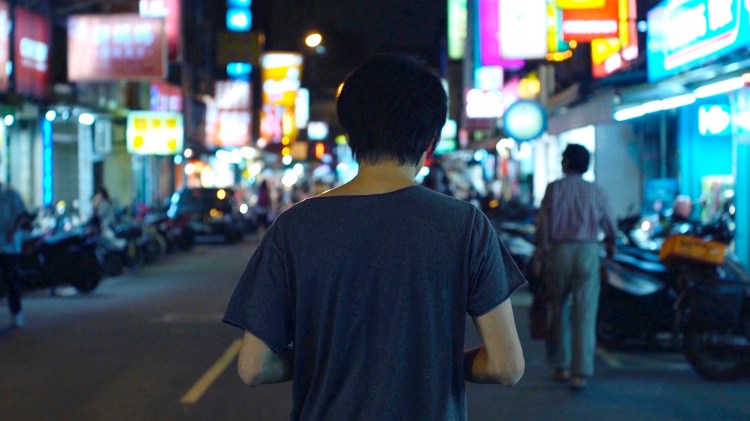
Inch Forward (走れない人の走り方, Su Yu-Chun, 2023)

Why does everything always go wrong just when it was about to go right? Everything has fallen into place for director Kiriko’s upcoming indie film but suddenly she finds herself experiencing a series of crises that are perhaps a bit of a wakeup call teaching her a few things about herself as well as the process of filmmaking. The latest film to tackle the perils of the independent movie scene, Inch Forward (走れない人の走り方, Hashirenai hito no Hashiri-kata) never shies away from the difficulties involved but does suggest they can be overcome with humility and a willingness to get creative.

Part of the problem is Kiriko’s difficulty in making decisions and lack of clarity over her role as a director. Her producer, Takimoto, tries to keep her grounded by pointing out places where the script will be difficult to film and dealing with the actors, but also tells her that she should have a better idea of the message she intends her film to carry and be prepared to answer questions about the script from her cast members. But Kiriko says she doesn’t really intend the film to have a message and thinks creating a character is an actor’s job not a director’s. Whenever Takimoto asks her to reconsider something, Kiriko childishly answers that she’ll think about it probably without really intending to.

But her irresponsible behaviour causes problems for others, particularly when she messes up the company car during a bit of unauthorised location hunting, or fails to shut the front door properly allowing her pregnant roommate’s pet cat to escape and thereby sending her into an early labour. It’s only after these series of crises that Kiriko begins to understand that she needs to make amends and be more considerate in future if she wants to continue receiving help and support from those around her. After all, you can’t make a film all on your own.

Ironically enough she describes her film as like a road movie but on foot about people going to the same place over and over again. Even one of her crew members asks her why it is indie filmmakers like to end at the sea hinting at her screenplay being slightly cliché even as she tries to think her way out of the problem. At a particularly low point, she has a vision of the film being taken away from her as her (all male) crew members and Takimoto remark on how useless she is and vow to take over their section from her. She also has an obsession with her horoscope which is usually a little negative further deepening her lack of confidence and general sense of despair. 

“Don’t worry, just believe in yourself and move forward’” one of her horoscope ads advises and it might indeed by good advice for an indie filmmaker. Learning to be a little more considerate of those around her, she begins to benefit from their help and advice rather than rejecting it in her own insecurity. Despite all of the constraints her friend tells her that she should make something authentic, what she actually wants to do rather than cynically doing what seems the most advantageous, but what’s really important is a sense of balance. As Takimoto told her, she needs to learn to prioritise rather than expect to get everything she wants and be realistic about what’s achievable while still aiming for the film she wants to make. 

Then again in the cinema scenes which bookend the film Su implies that the audience weren’t particularly impressed or perhaps confused by her road movie that doesn’t go anywhere. One audience member was so deeply asleep they had to be woken by an usher. Nevertheless, to overcome her problems Kiriko has to take the lead in more ways than one asserting control over her project but also prepared to work with others, listen to their suggestions, and make firm decisions as they inch forward towards their goal. Warm and quirky, Su’s lighthearted dramedy never shies away from the difficulties of indie filmmaking but finally resolves that it is possible to overcome them with a little mutual respect and solidarity between those on the other side of the screen.


Inch Forward screened as part of this year’s Osaka Asian Film Festival.

Original trailer (no subtitles)

You’re Not Normal, Either! (まともじゃないのは君も一緒, Koji Maeda, 2021)

What’s so great about being “normal” anyway? As the title of Koji Maeda’s quirky screwball comedy You’re Not Normal, Either! (まともじゃないのは君も一緒, Matomo Janai no wa Kimi mo Issho) suggests neither of its heroes is quite in tune with the world around them but then again, is there really such a thing as “normal” or is it more that most people are making themselves unhappy by settling for less simply because they think that’s just how things are and resistance only makes you seem awkward? 

Nerdy cram school maths teacher Yasuomi (Ryo Narita) thought he was OK with being a little different, but just recently he’s begun to feel lonely and fears the possibility of being alone for the rest of his life. Perhaps inappropriately, he looks to one of his students, forthright high schooler Kasumi (Kaya Kiyohara), for romantic and life advice hoping that she will teach him how to be, or at least present as, more “normal”. Unbeknownst to him, however, Kasumi is not quite “normal” herself and is in fact obsessed with a tech entrepreneur, Isao (Kotaro Koizumi), who is all about a new and freer future in which humanity is freed from the burden of labour. Finding out that her crush is already engaged to Minako (Rika Izumi) the daughter of a hotel magnate, Kasumi hatches a plan to break them up while training Yasuomi in the art of seduction. 

Kasumi’s insecurities seem to be down to her failure in her middle school exams, attracted to Isao’s philosophies because they offer a possibility of freedom outside the rigid demands of academic success in Japan. She tells Isao in a not quite by chance meeting that she wants to become a teacher in order to expand children’s minds rather than force them into a fixed perspective as the rather authoritarian, rote learning system of education often does. Yet she also feels out of place among her peers whom she sees as vacuous always gossiping about part-time jobs and boys. She frowns at Yasuomi when he accidentally cuts the conversation dead with an awkward comment while attempting to chat up a pair of bubbly office workers in a bar, but often does the same thing herself while sitting with her high school girl friends who fall silent and then change the subject after she injects a little realism into their mindless chatter. 

Yasuomi had viewed himself as “normal” and never understood why others didn’t, noticing that people often stopped associating with him but not knowing the reason why. Obsessed with pure mathematics, over literal, and overstimulated by the complications of life he takes refuge in the forest and the sensory overload of its nocturnal creatures speaking quite eloquently about the beauty of numbers and actually fairly emotionally intelligent in his understanding of the two women. Resolutely failing at Kasumi’s Cyrano act, he comes into himself only when speaking more honesty much to Kasumi’s annoyance actually hitting it off with Minako who is herself just as lonely and alienated but perhaps wilfully trapped. 

Predictably enough, Isao isn’t exactly “normal” either or perhaps he is but only in the most depressing of ways, his rosy vision of the future delivered with more than a little snake oil and just as much sleaze. Minako may know what sort of man Isao is, that her marriage is largely a dynastic affair set up by her overbearing, authoritarian father, but she too may think this is “normal” and might have preferred not to have to confront her sense of existential disappointment while attempting to fulfil the role of a “normal” woman content with creating a comfortable space in which her husband can thrive.  

Romantically naive, Kasumi wonders how people come to fall in love informed by two relatively mature classmates that for them at least falling in love is a gradual process of increasing intimacy generated through casual conversation. This turns out to be pretty much true for Kasumi too, though in ways she didn’t quite expect watching as Yasuomi opens up to Minako and finding herself unexpectedly jealous while reluctant to let go of the idealised vision she had of Isao as some kind of messiah for a better Japan. There is something a little uncomfortable in the potentially inappropriate relationship between a student and her teacher even as the roles are, on one level at least, reversed but there’s also a kind of innocence in their childish friendship and later determination to start small and let things grow while abandoning the idea of the “normal” altogether to embrace their true selves in a freer future of their own creation. 


You’re Not Normal, Either! screens in Chicago on Oct. 7 as part of the 13th season of Asian Pop-Up Cinema 

Original trailer (English subtitles)

Out There (Takehiro Ito, 2016)

out-thereWe don’t move forward in this dance, comments the lady currently being waltzed by a charming lost soul. Don’t worry, he says, that’s not a bad thing. Indeed, Out There, the first independent feature film from director Takehiro Ito exists in a fixed yet liminal space, here and not there as its protagonist finds himself without the proper place to be. Conceived as a way of salvaging some of the material collated for a documentary on the late Taiwanese director Edward Yang, Out There takes more of its cues from Tsai Ming-liang or even Lav Diaz in its preoccupation with the intersection between time, existence, and place. If that all sounds to weighty, there’s a little whimsy in here too, but the intent is a serious one as nationhood (or the lack of it), drifting cultures, love and history all conspire to confuse and distract the course of a young man in search of an identity which is entirely his own.

Beginning with an interview or perhaps an audition, the onscreen director questions the man who will be our star, Ma, about his motivations for applying – only, characteristically, he doesn’t quite know. From what he tells us, it seems his interests are largely introspective, unable to find a place to exist, perhaps he can carve one out for himself inside the fictional world of a film. Ito returns to this interview (or series of interviews?) throughout the action as Ma shows an apt desire to dissect himself on camera. The director is a minor player as Ma takes over, but like Ito he is trying to recover something from the ashes of a lost project, his producer sitting to the side, neatly picking apart the director’s somewhat thin proposal for a film about a cross cultural couple in which “everything happens by chance”.

The historical relationship between Tokyo and Taipei is perhaps a complicated one (though significantly less complicated than with many of its other neighbours), but there is a third party in this difficult romance in the spectre of America. Returning to Taiwan in the second segment, notably titled Land of Shadows, Ma talks to his parents about their views on global culture as Green Card holding Taiwanese who never made the move. In his original interview, Ma explained that one of the reasons he came to Japan was that he always felt like an outsider in Taiwan, unable to express himself fully. Having spent some time in the US as a child, Ma has a feeling America is “not for him”, but has also found that Japan is probably not the place he’s supposed to be either, and unlike his family he does not feel as if he can simply live out his days in his native Taiwan.

In a final discussion with Ayako – the actress in the film which never quite happens (in a sense, outside of the way it’s happening for us), Ma talks about the importance of memory which prompts Ayako to remark that it’s as if everything is already in the past for him. As if to symbolise Ma’s lack of forward progress, everything which happens in Tokyo bar a single flash of colour at the end of the interview sequence is cast in sharp black and white. Taiwan, by contrast, is shot in verdant colour though allowing for 16mm and 4:3 framing adding to the sense of nostalgia and homesickness which seem to invade Ma’s mind. This Taiwan is a place of backstreets and ruins, faded grandeur and unseen histories. Empty cinemas and abandoned film eventually give up their ghosts, but it’s Ma himself who seems to join them as he fades into the frame, here and not here as he repeatedly doubts the matter of his own existence.

There’s a slight irony in the way America has been idealised as a place of possibility given its (until extremely recently) severing of diplomatic ties with the island nation of Taiwan. Seeking a home in a place which refuses to acknowledge the land in which you were born exists may make one feel like a ghost, but Ma’s sense of existential dislocation runs deeper. A kind of hiraeth, a longing for a home which doesn’t quite exist, becomes a force which propels and halts in equal measure. Skating around Tokyo on his roller blades, Ma has no particular destination in mind except perhaps to escape himself. He takes photos of places because he doesn’t want to point his camera at people, refusing human connections which will have to be broken in his ongoing quest for a sense of belonging. As the director puts it, there are many endings but as long as he remains fixed on the concept of “there”, Ma risks losing the idea of “here” which remains in a state of perpetual future past, outside of this liminal space in which nothing moves or changes.

Ito’s drifting, experimental approach moving between documentary, narrative and fantasy with the borders between each as unclear as the hero’s sense of identity is one which defies categorisation, as much about the idea of place as the characterisation of the two cities at hand and the ever unseen spectre of the hovering America. Poetic, wistful, and imbued with a sense of loss, Out There is a poignant exploration of cultural dysphoria and existential confusion in an ever widening world in which past, present and future become indistinct in an endless journey onward to place or no place at all.


Currently available to stream worldwide via Festival Scope in connection with the International Film Festival Rotterdam.

Short scene from the end of the film: