

Seven years on from the hit TV series, the guys find themselves dealing with the problems of early middle age along with increasing internationalisation as members of the so-called Yutori generation in Nobuo Mizuta’s We’re Millennials Got a Problem? (ゆとりですがなにか インターナショナル, Yutori desu ga, naninka Internationa). Now they’re in a different place and increasingly confused by the youth of the day while reconsidering their own life choices and facing a series of impromptu crises.
Among them would be that both the yakiniku restaurant where the guys worked in the TV series and the company that used to distribute the sake produced by Masakazu’s (Masaki Okada) family brewery have been taken over by Korean conglomerates. To make matters worse, the company tells Masakazu at an online meeting he’s embarrassingly turned up to in person because no one thought to tell him it was remote that they’re shifting production entirely to makgeolli because no one drinks sake anymore and his takings are about to fall off a cliff. The only way he can keep the contract is by agreeing to introduce a new product, either makgeolli or alcohol free sake.
Meanwhile, his friend Maribu (Yuya Yagira) has returned after seven years in China with a Chinese wife and three children but apparently no job prospects. Masakazu offers him a job at the brewery, forgetting that it’s a bit awkward because he used to date his sister, Yutori (Haruka Shimazaki), who has quit her corporate job to start a business selling nordic knickknacks. It’s Maribu’s live streaming of the moribund brewery that unwittingly exposes the cracks in Masakazu’s marriage when Chinese netizens starts sending aphrodisiacs through the post to help him overcome the problems of his sexless life with wife Akane (Sakura Ando) who is herself struggling with the demands of looking after two small children and taking care of all the domestic chores with no help.
Later Akane tells mutual friend Yamaji (Tori Matsuzaka) that she’s worried she has post-natal depression and is fed up with her home life. We see can how stressful it is in the opening sequence in which Masakazu (ironically) tries to become a YouTube sake star but is repeatedly heckled by offscreen calls from Akane asking him to bathe the children and otherwise help out before she finally has no choice but to bring the kids to him. When they go to city hall to apply for a place in childcare they’re immediately dismissed, Akane somehow told that she doesn’t have as many “points” as her husband even though they’re both self-employed and there are many more needy candidates before the (probably well-meaning) civil servant not so subtly checks their daughter’s arm for signs of abuse or neglect. It’s not that surprising therefore that when the aphrodisiacs start piling up at home she wonders if Masakzau’s having an affair placing further strain on the relationship.
Shin-hye (Haruka Kinami), the Korean-Japanese-American CEO of the company that bought out their old distributor (for whom Akane was once a regional manager) also a expresses a similar anxiety about the place of women in the workplace on the one hand coming from Korean corporate culture and finding that Japan might not as be “as bad” at least in its every increasing list of harassment which at least admit there’s problem with workplace bullying, sexist culture, and unwanted sexual advances from men in positions of power. Yamaji, meanwhile, finds his well-meaning attempts to foster diversity in the classroom floundering when the kids declare themselves unable to understand the intricacies of LGTBQ issues explaining that at their age “dating” just means hanging out though they’re unexpectedly accepting of the Thai transfer student with an inexplicable crush on the incredibly obnoxious American boy who transferred in the same time as him.
In other ways, however, Yamaji is the same as ever. On his first appearance he’s on an awkward date with a woman from a dating app which he largely spends talking to his mentor on an iPad and making sexist remarks. They are all struggling with the demands of a more concrete adulthood in which much is already decided while their settled lives are undermined by unexpected crisis from the fallout from the conravirus pandemic and ongoing economic malaise to marital discord, the demands of caring for small children, and a friend a they had no idea was a top star live-streaming star in China. A recurring gag sees people undertake zoom meetings dressed in a suit jacked with sweatpants underneath. Yutori eventually exclaims that there’s no point even having dream while her family have a lot of sensible questions about her new business like where all the stock is whether it was worth the risk leaving her stable job that was presumably subject to all the harassment and otherwise oppressive corporate culture of contemporary Japan. Nevertheless, the millennials eventually come to a kind to acceptance and understanding of where they are in their lives along with a re-appreciation of everything they already have.
We’re Millennials. Got a Problem? International screened as part of this year’s Nippon Connection
Original trailer (English subtitles)
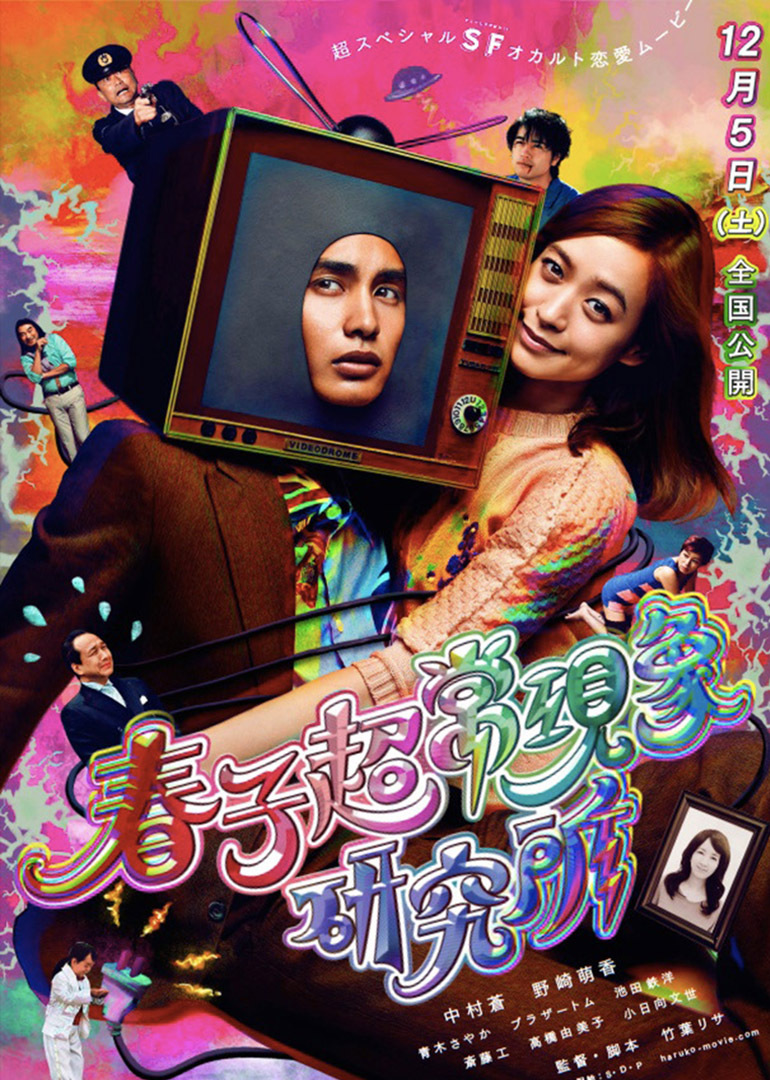 In the brave new Netflix era, perhaps it’s not unusual to hear someone exclaim that their most significant relationship is with their television, but most people do not mean it as literally as Haruko, the heroine of the self titled Haruko’s Paranormal Laboratory (春子超常現象研究所, Haruko Chojogensho Kenkyujo). Lisa Takeba returns with her second film which proves to be just as strange and quirky as the first and all the better for it. Haruko’s world is a surreal one in which a TV coming to life is perfectly natural, as is the widespread plague of “artistic” behaviour which involves robbing the local 100 yen store for loose change and randomly setting fire to things. Yet Haruko’s problems are the normal ones at heart – namely, loneliness and disconnection. Takeba’s setting may be a strange fever dream filled with fiendishly clever, zany humour but the fear and anxiety are all too real.
 Windows on Worlds