Hotspring SharkAttack (温泉シャーク, Morihito Inoue, 2024)

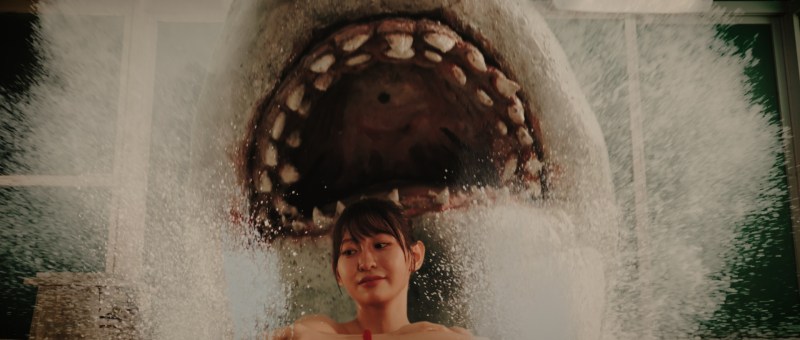
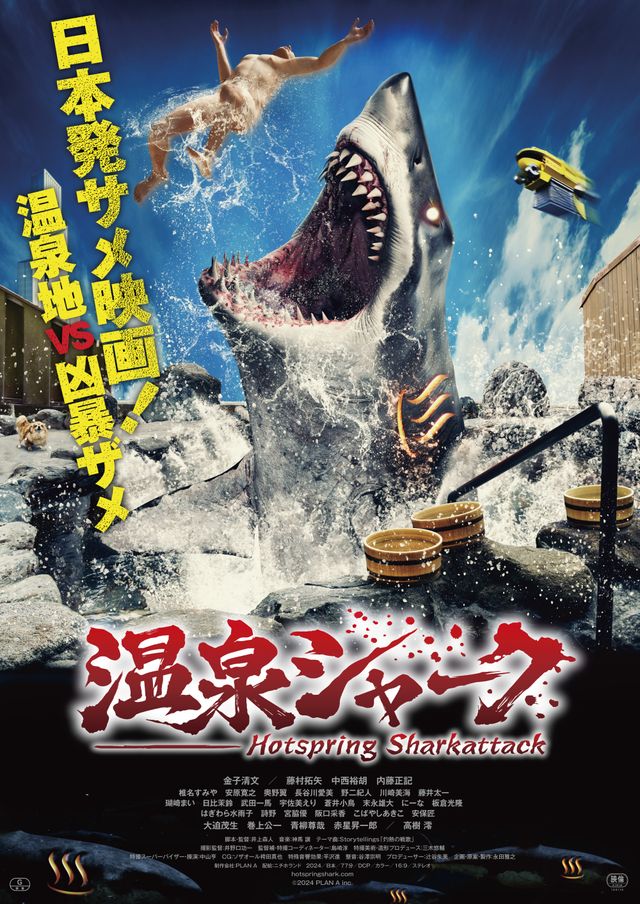
Just when you thought it was safe to go back to the onsen, prehistoric sharks decide it’s time to strike back against unsuspecting bathers. Is it really so wrong to want to relax in some nice, warm water or are we actually invading the sharks’ territory? In any case, Morihito Inoue’s creature feature Hotspring SharkAttack (温泉シャーク, Onsen Shark) is as much about the ravages of capitalism as it is about aquatic terror as the social media-obsessed mayor fixes his sights on saving the town through a massive onsen complex.

Tellingly, many of the local people are against the plan, which will have profound effects on their livelihood, while many of the local politicians are reluctant to close the onsen despite knowing about the shark issue in much the same way the mayor in Jaws refuses to lose the beach because they don’t want to risk damaging the tourist industry. When they do eventually close them, little children cry to their mothers about not being allowed into the baths, which just shows how important hot springs culture is to this area. 

But then it is quite weird, sharks suddenly snatching people from the baths and somehow dragging them back to sea. Modern science has an answer, thanks to top sharkologist Mayumi (Yu Nakanishi), but it’ll take a bit longer to find a way to stop them getting in while Mayumi agonises about her role in the proceedings as a lover of sharks yet essentially responsible for their destruction. A part of her still wants to find a way to coexist peacefully even as the sharks wreak havoc on the town and continue to pose a serious risk to life. Even so, the area ironically becomes a tourist hotspot after all as a swarm of live streamers arrive to try to experience the shark-infested waters for themselves despite the danger. 

Meanwhile, the sharks’ gills light up like the onsen symbol on maps while the mayor is haunted by the spirits of his ancestors and also wears a tie with little onsens on it. He later thinks better of his sleazy capitalist ways and comes to the realisation that it’s his responsibility to save the town even if that means torpedoing his landmark new resort and acknowledging the harm it would do to the local area. It seems that these prehistoric, super squishy sharks only got woken up because of global warming which is why they’re drawn to warmer waters and able to terrorise innocent onsen-goers. 

The same might be said of Maccho, a very buff guardian of onsen culture who can’t remember who he is or why he was born but is committed to defending protecting hot springs everywhere. Everyone in the town is keen to protect them too, and not just because they drive the local economy. The police chief’s about to retire with a vague idea about becoming a novelist but is still determined to clear up the shark problem, while his assistant later fights off a bunch of sharks single-handed to give the others time to do their thing. 

Unable to use guns because these sharks are also full of methane, this particular issue requires a less conventional solution, though the irony is that it lies at the heart of the problem. The weird disease the sharks starts spreading can only be cured by an antidote found within their own fins. The government might be content to simply destroy the town first, hinting at the indifference of the Tokyo elite to small-town disaster, but the local community won’t let that happen and nor will the hot springs guardian. Inoue adds in a fair degree of absurdity in order to make his central conceit work including a series of weird gags about eating a sub on a sub while harnessing the reality of his low budget to add a note of surreality to the town. The sharks themselves have a pleasingly retro design while the practical effects add to the sense of absurdity right down to the cute little submarine the team eventually constructs using the 3D printer that was designed to build the soulless onsen complex with its rooftop pool and ill-advised bungee jumping facilities. If there’s one thing that Hotspring SharkAttack has, it’s genuine heart along with small-town pride and a sense of fun that actively revels in the ridiculousness of its premise.

Hotspring SharkAttack screens 31st May as part of this year’s Nippon Connection.

Trailer (no subtitles)
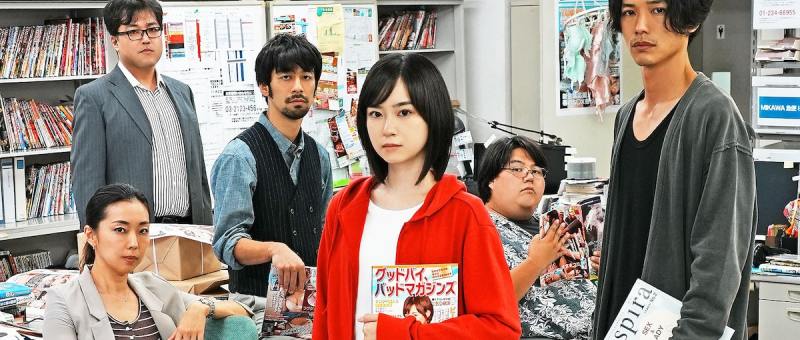
Goodbye, Bad Magazines (グッドバイ、バッドマガジンズ, Shoichi Yokoyama, 2022)

With the 2020 Olympics on the horizon, Japan began looking for ways to tidy up its image expecting an influx of foreign visitors which for obvious reasons never actually materialised. As part of this campaign, leading chains of convenience stores announced that they would stop selling pornographic magazines in order to create a more wholesome environment for children and families along with tourists who might be surprised to see such material openly displayed in an ordinary shop. Then again, given the ease of access to pornography online sales had fast been falling and the Olympics was perhaps merely a convenient excuse and effective PR opportunity to cut a product line that was no longer selling. 

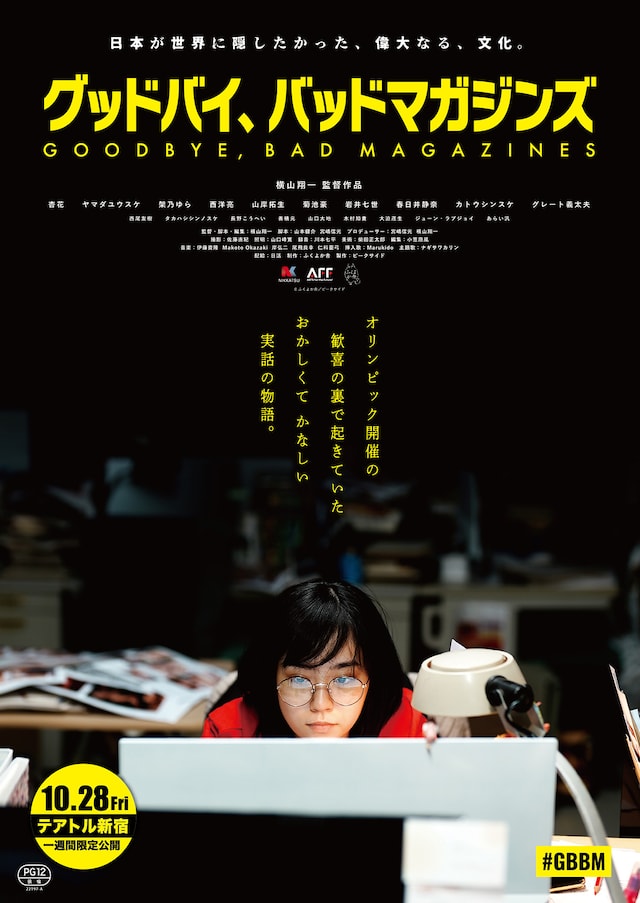
Based on actual events, Shoichi Yokoyama’s Goodbye, Bad Magazines (グッドバイ、バッドマガジンズ) explores the print industry crisis from the inside perspective of the adult magazine division at a major publisher which has just announced the closure of a long running and well respected cultural magazine, Garu. Firstly told they don’t hire right out of college, recent graduate Shiori (Kyoka Shibata) who had dreamed of working in cultural criticism is offered a job working on adult erotica and ends up taking it partly in defiance and encouraged by female editor Sawaki (Seina Kasugai) who tells that if she can make a porn mag she can make anything and be on her way to working on something more suited to her interests with a little experience under her belt. 

Her first job, however, consists entirely of shredding voided pages filled with pictures of nude women which is slightly better than the veteran middle-aged man who joined with her after being transferred from Garu who is responsible for adding mosaics to the porn DVDs they give away with the magazines to ensure they conform to Japan’s strict obscenity laws. Later a mistake is made and mosaics are omitted placing the publishing company bosses at risk of arrest and the magazine closure. Aside from being one of two women in an office full of sleazy men and sex toys, Shiori’s main problem is that she struggles to get a handle on the nature of the erotic at least of the kind that has been commodified before eventually falling into a kind of automatic rhythm. “It’s easy when it does’t mean anything” she explains to sex columnist and former porn star Haru (Yura Kano) who is much franker in her expression but perhaps no more certain than Shiori when it comes to the question asked in her column, why people have sex. 

Shiori asks her sympathetic colleague Mukai (Yusuke Yamada) for advice and he tells her that what’s erotic to him is relationships, but it seems his work has placed a strain on his marriage while his wife wants a baby and he has trouble separating the simple act of meaningless sex with that which has an explicit purpose such as an expression love or conceiving a child. According to Shiori’s editor Isezaki (Shinsuke Kato), the future of erotica will come from women with their boss finally agreeing to an old idea of Sawaki’s to create an adult magazine aimed at a female audience in the hope of opening a new market while handing a progressive opportunity to Sawaki and Shiori to explore female desire, but at the same time magazines are folding one after the other with major retailers canceling their orders and leaving them to ring elderly customers who’ve been subscribing for 30 years but don’t have the internet to let them know the paper edition is going out of circulation. 

The editorial team have an ambivalent attitude to their work, at once proud of what they’ve achieved and viewing it as meaningless and a little embarrassing. Not much more than a few months after working there, Shiori has become a seasoned pro training a new recruit who’s just as nervous and confused as she was but offering little more guidance was than she was given while becoming ever more jaded. When handed evidence that her boss has been embezzling money, she just ignores it though perhaps realising that when he’s found out it means the end for all of them too. Like everyone else, he’d wanted to start his own publishing company but the editor who left to do just that ended up taking his own life when the business failed. Yet, on visiting a small independent family-run convince store near the sea, Shiori hears of an old man who visits specifically to buy the magazines she once published because he can’t get them anywhere else while they have steady trade from fishermen who need paper copies to takes out to sea. The message seems to be there’s a desire and a demand for print media yet, even if it’s not quite enough to satisfy the bottom line. A sympathetic and sometimes humorous take on grim tale of industrial decline, Goodbye, Bad Magazines sees its steely heroine travel from naive idealist to jaded cynic but simultaneously grants her the full freedom of her artistic expression along with solidarity with her similarly burdened colleagues.  


Goodbye, Bad Magazines streamed as part of the 2022 Yubari International Fantastic Film Festival.

Teaser trailer (English subtitles)