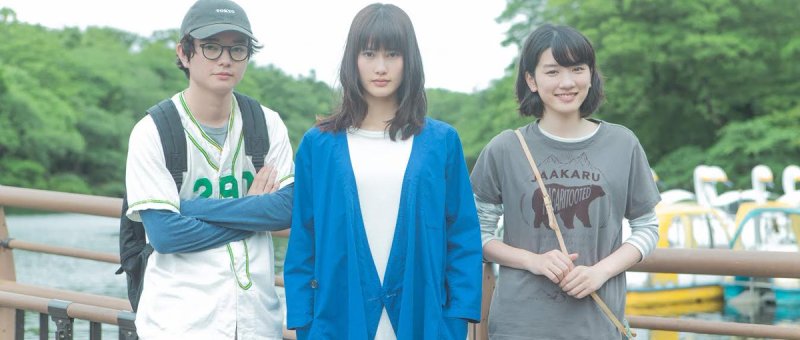
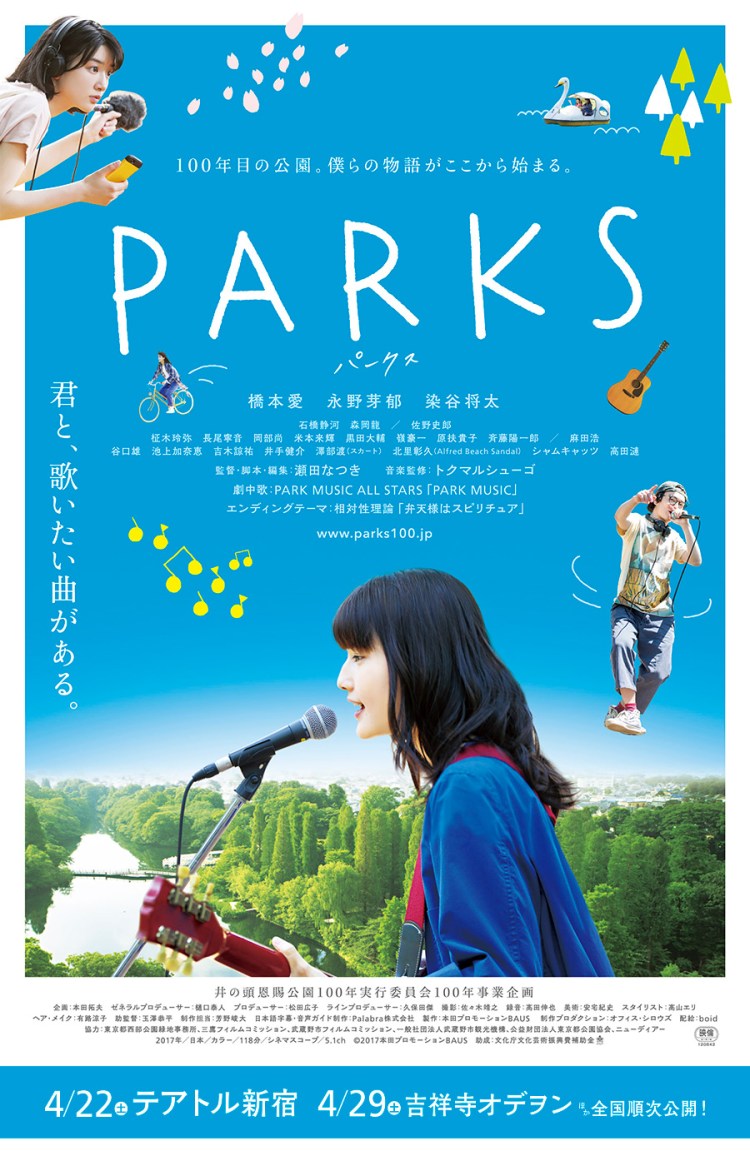
 Parks are a common feature of modern city life – a stretch of green among the grey, but it’s important to remember that there has not always been such beautiful shared space set aside for public use. Natsuki Seta’s light and breezy youth comedy, Parks (PARKS パークス), was commissioned in celebration of the centenary of the Tokyo park where the majority of the action takes place, Inokashira. Mixing early Godardian whimsy with new wave voice over and the kind of innocent adventure not seen since the Kadokawa idol days, Parks is a sometimes melancholy, wistful tribute to a place where chance meetings can define lifetimes as well as to brief yet memorable summers spent with gone but not forgotten friends doing something which seems important but which in retrospect may be trivial.
Student Jun (Ai Hashimoto) begins the story with a meta voiceover declaring her intention to begin among the cherry blossoms – letting us know right away that this will be an ephemeral sort of tale. She’s young, in love, and carefree – too carefree, actually, she’s already got a job lined up for after uni but has forgotten to do any of the work needed to graduate. Then, disaster strikes. Dumped by her boyfriend, Jun finds a letter from the university reminding her that she’s way behind and in a lot of trouble (the letter is dated six months previously).
On top of all of this, she bumps into the strange and dreamlike Haru (Mei Nagano) who barges into her apartment which apparently was once home to the lost love of her late father in the 1960s (he was evidently quite an aged dad). Chasing the leads they find in a collection of love letters and photographs the girls track down some of the pair’s old friends and eventually the grandson of the woman in question, Tokio (Shota Sometani), who discovers a reel-to-reel tape among his late grandmother’s effects which contains the remnants of the love song Haru’s father and Tokio’s grandmother were creating together. Seeing as the tape is damaged the trio decide to finish the song which will also form a part of the thesis Jun is supposed to be writing to graduate university.
Light, bright, and breezy like a spring day in a beautiful park, Parks is necessarily slight but filled with all the whimsical nostalgia of the no longer young. Celebrating the park’s 100th birthday, Seta apparently wanted create something which tied the various ages together – hence the 1960s focus, though her 1960s is much more French New Wave and postmodern silliness than it is student protests or economic anxiety. Romance is in the air as lovers meet in the park vowing never to part, only they do for reasons which Haru is desperate to know even if no one else particularly cares about the background to their ongoing project.
The interplay between the three accidental friends is the heart of the drama as they find themselves pulled in various different directions. Shota Sometani’s oddly spirited Tokio with his city boy accent and nerdy attempt at cool wants more Twitter followers and has his eyes set on musical fame where as poor Jun just wants to be left alone to finish Uni while Haru is swept up in the romantic love story of her much missed father.
Or is she? Seta throws in a few meta gags leaving us unsure of who or what Haru really is or if any of this is real. Taking a decidedly Lynchian detour with strange and surreal scenes focussing on a mysterious door, she lends this world an odd sort of charm through, like her New Wave inspiration, often refuses to follow the trail to its conclusion. Flitting between past and future, allowing the two to mingle and overlap and Haru to become a friend of her father as a young man, Parks is a sweet summer daydream filled with gentle music and warm air fit to blow away on the breeze.
The song itself, a characteristically whimsical composition by Tokumaru Shugo (who also has a brief cameo in the film), is a beautifully innocent ‘60s folktune which is then corrupted by the conflicting modern dreams of the easily swayed realists Tokio and Jun while the idealistically romantic Haru listens in horror before Jun finally remembers what all of this was about and tries to fix things before they get any more broken. Some songs are intended to float away on the breeze, like summer adventures and casual friendships and Parks is such a one, though a pleasant way to dream away a warm afternoon.
Parks was screened at the 17th Nippon Connection Japanese Film Festival.
Original trailer (English subtitles available by clicking subtitle button)
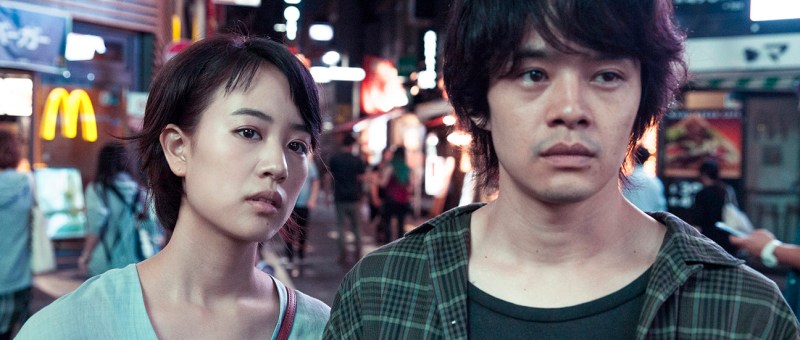
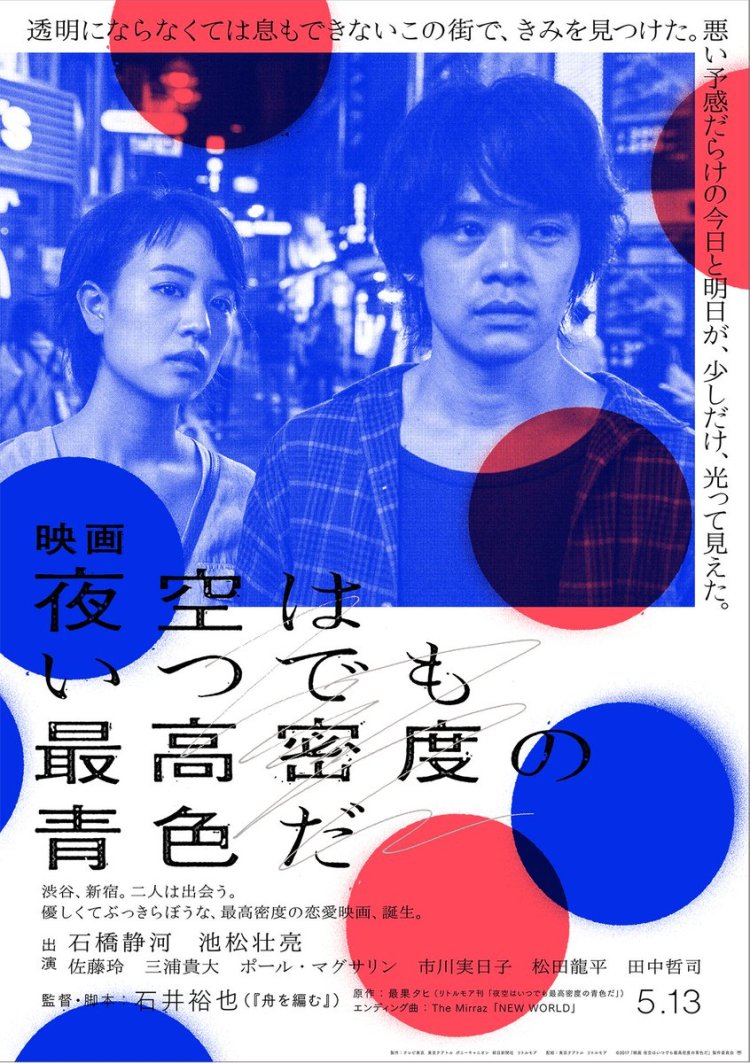 Learning to love Tokyo is a kind of suicide, according to the heroine of Yuya Ishii’s love/hate letter to the Japanese capital, The Tokyo Night Sky is Always the Densest Shade of Blue (夜空はいつでも最高密度の青色だ, Yozora wa Itsudemo Saiko Mitsudo no Aoiro da). This city is a mess of contradictions, a huge sprawling metropolis filled with the anonymous masses and at the same time so tiny you can find yourself running into the same people over and over again. Inspired by the poems of Tahi Saihate, The Tokyo Night Sky is at once a meditative contemplation of city life and an awkward love story between two lost souls who somehow find each other in its crowded backstreets.
 Windows on Worlds