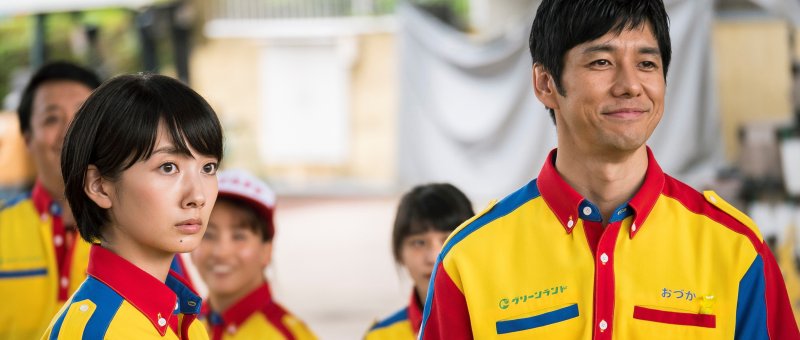
OZLAND (オズランド 笑顔の魔法おしえます。, Takafumi Hatano, 2018)

A snooty elitist gains a new perspective after being unexpectedly transferred to an old school rural theme park in Takafumi Hatano’s heartwarming workplace dramedy Ozland (オズランド 笑顔の魔法おしえます。, Ozland: Egao no Mahou Oshiemasu). Echoing The Wizard of Oz’ Dorothy, Kurumi (Haru) suddenly discovers that she’s not in her familiar Tokyo anymore and is originally resentful, sullen, and aloof refusing to engage with her new coworkers while dismissive of their work but gradually comes to see that there was method in the madness realising the ways she herself has been petty and small-minded while all anyone wanted to do was make people happy. 

Kurumi’s problem is that she’s a hometown girl. She loved her city, her family, her friends, and most particularly her boyfriend Toshi (Tomoya Nakamura) even going so far as to get a job at the company where he works so they can be together all the time. Tragedy strikes when she’s abruptly transferred to a theme park in provincial Kumamoto, Toshio suggesting she go and make the most of the experience of living alone for the first time while they do long distance. Coming from straight-laced Tokyo she experiences a kind of culture shock especially as her eccentric supervisor, Mr. Ozuka (Hidetoshi Nishijima), chooses to haze her with a pretend bomb scare immediately on her arrival. Aside from that, it seems the boss (Akira Emoto) misread her name on her résumé (as it turns out, the main reason he hired her) so no matter how often she corrects them everyone keeps calling her “Namihei” rather “Namihira”, suggesting that it might be easier if she changed her name because they’ve already had it printed on all her things. 

In a way, the name dilemma hints at Kurumi’s sense of superiority over her new coworkers in that she refuses to simply let it go out of politeness, as well she might in refusing to allow them to get away with calling her by a name that’s easier for them without bothering to learn her own, but equally using it as more evidence of their lack of sophistication rather than deciding to see the funny side. Though she’s been hired as part of the planning department, Ozuka assigns her mostly menial tasks further fuelling her sense of resentment. She might have a point when she says she didn’t go to uni to pick up trash for a living, but obviously looks down on her coworkers while the young man who joined at the same time as her, Yoshimura (Amane Okayama), simply gets on with the job without complaint. Kurumi went to a good university which adds to her snooty sense of elitism but later discovers that Yoshimura went to an even better one yet obviously doesn’t feel the same sense of belittlement in being asked to perform manual labour. 

What she later realises is that all of the “pointless” menial tasks had a point but she missed it because she tried to cheat, hoping to get in Ozuka’s good books in the hopes of being transferred back to Tokyo or allowed to do actual planning work. Not until she’s begun to settle in and accepted that she’s been unfair to her coworkers does Kurumi begin to look at herself realising that her snobbishness has only made her unhappy while the relaxed atmosphere and gentle camaraderie at the park is what has kept her new colleagues so cheerful. The extent of her personal growth is thrown into sharp relief when Toshio visits from Tokyo and immediately begins running the park down, describing her colleagues as “nosey”, and finally exclaiming that he preferred the old snooty Kurumi and wants her to come back to elitist Tokyo with him before she turns into a happy provincial. So changed is she that she can’t quite believe he’d be so snobbish and no longer knows what she saw in him realising that she’s much happier now she’s less judgemental and more engaged with those around her. 

In essence, she’s a Dorothy who decided to stay in Oz discovering a new home and a new family in a rundown theme park in Kumamoto that might quite literally be a dreamland making families happy all year round. Filmed at the real life Mitsui Greenland amusement park, Ozland might come from the sponsored by the tourist board school of Japanese cinema (local mascot Kumamon makes several guest appearances) but undoubtedly has a lot of heart not to mention surreal whimsy in its frequent Oz references and insistence on the importance of magic in everyday life. 


OZLAND streams until 27th February in several territories as part of Japanese Film Festival Online 2022.

Original trailer (English subtitles)

Library Wars: The Last Mission (図書館戦争-THE LAST MISSION-, Shinsuke Sato, 2015)

library-wars-last-missionWhen Library Wars, the original live action adaptation of Hiro Arikawa’s light novel series, hit cinema screens back in 2013 it did so with a degree of commercial, rather than critical, success. Though critics were quick to point out the great gaping plot holes in the franchise’s world building and a slight imbalance in its split romantic comedy/sci-fi political thriller genre mix, the film was in many ways a finely crafted mainstream blockbuster supported by committed performances from its cast and impressive cinematography from its creative team. Library Wars: The Last Mission (図書館戦争-THE LAST MISSION-, Toshokan Senso -The Last Mission-) is the sequel that those who enjoyed the first film have been waiting for given the very obvious plot developments left unresolved at the previous instalment’s conclusion.

18 months later, Kasahara (Nana Eikura) is a fully fledged member of the Library Defence Force, but still hasn’t found the courage to confess her love to her long term crush and embittered commanding officer, Dojo (Junichi Okada). As in the first film, The Media Betterment Force maintains a strict censorship system intended to prevent “harmful” literature reaching “vulnerable” people through burning all suspect books before they can cause any damage. Luckily, the libraries system is there to rescue books before they meet such an unfortunate fate and operates the LDF to defend the right to read, by force if necessary.

Kasahara is an idealist, fully committed to the defence of literature. It is, therefore, a surprise when she is accused of being an accomplice to a spate of book burning within the library in which books criticising the libraries system are destroyed. Needless to say, Kasahara has been framed as part of a villainous plan orchestrated by fellow LDF officer Tezuka’s (Sota Fukushi) rogue older brother, Satoshi (Tori Matsuzaka). There is a conspiracy at foot, but it’s not quite the one everyone had assumed it to be.

In comparison with the first film, The Last Mission is much more action orientated with military matters taking up the vast majority of the run time. A large scale battle in which the LDF is tasked with guarding an extremely important book containing their own charter (i.e. a symbol of everything they stand for) but quickly discovers the Media Betterment Force is not going to pass up this opportunity to humiliate their rival, forms the action packed centrepiece of the film.

The theme this time round leans less towards combating censorship in itself, but stops to ask whether it’s worth continuing to fight even if you feel little progress is being made. The traitorous officer who helps to frame Kasahara does so because he’s disillusioned with the LDF and its constant water treading. The LDF is doing what it can, but it’s fighting to protect books – not change the system. This is a weakness Satoshi Tezuka is often able to exploit as the constant warfare and tit for tat exchanges have begun to wear heavy on many LDF officers who are half way to giving up and switching sides. Even a zealot like Kasahara is thrown into a moment of existential despair when prodded by Satoshi’s convincing arguments about her own obsolescence.

Satoshi rails against a world filled with evil words, but as the head of the LDF points out in quoting Heinrich Heine, the society that burns books will one day burn men. The LDF may not be able to break the system, but in providing access to information it can spread enlightenment and create a thirst for knowledge among the young which will one day produce the kind of social change that will lead to a better, fairer world.

As in Library Wars all of these ideas are background rather than the focus of the film which is, in essence, the ongoing non-romance between Kasahara and Dojo. Remaining firmly within the innocent shojo realm, the romantic resolution may seem overly subtle to some given the extended build up over both films but is ultimately satisfying in its cuteness. Library Wars: The Last Mission masks its absurd premise with a degree of silliness, always entirely self aware, but gets away with it through sincerity and good humour. Shinsuke Sato once again proves himself among the best directors of mainstream blockbusters in Japan improving on some of the faults of the first film whilst bringing the franchise to a suitably just conclusion.


Original trailer (No subtitles)

https://youtu.be/8Bqgn4icG5M