As Long As We Both Shall Live (わたしの幸せな結婚, Ayuko Tsukahara, 2023) [Fantasia 2023]

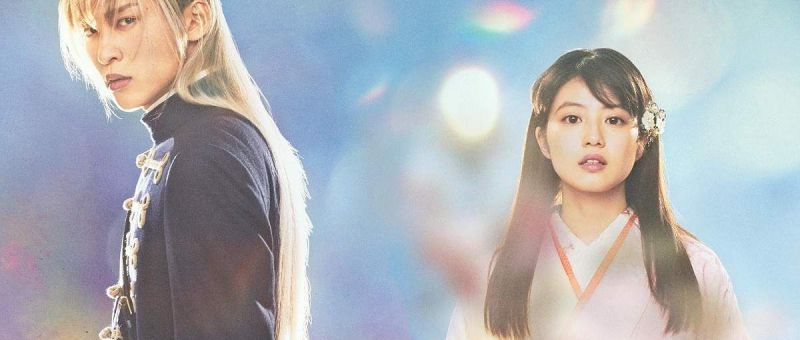
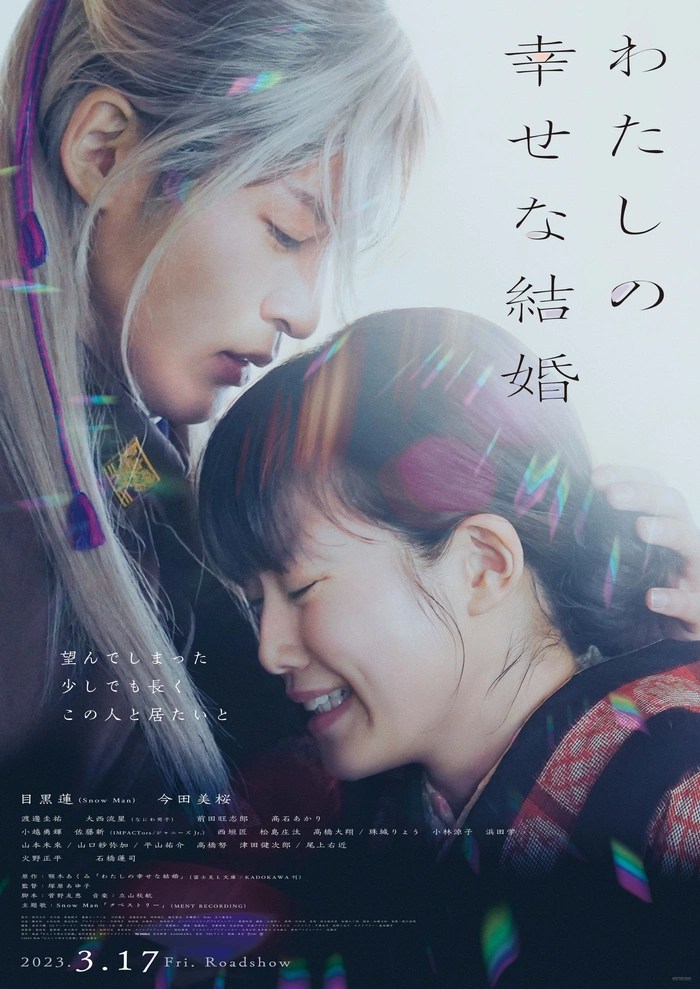
A young woman with chronically low self-esteem learns to love herself after bonding with a taciturn nobleman in Ayuko Tsukahara’s adaptation of the fantasy romance light novel series by Akumi Agitogi, As Long As We Both Shall Live (わたしの幸せな結婚, Watashi no Shiawasena Kekkon). Set in an alternate version of the late 19th/early 20th century in which the nation is ruled by an emperor who has the ability to foresee the future and leads a series of prominent clans of superpowered soldiers against “aberrations” who wreak havoc in the lives ordinary people, the film is effectively a kind of Cinderella story only the fairy godmothers are a kindly housekeeper a shady underground sect with the power to manipulate people’s minds. 

In any case, Miyo (Mio Imada) was born into a noble house the members of which have the ability to manipulate the wind though sadly she appears to have been born “powerless” and is bullied by her step-mother and step-sister who treat her as a servant. At 19, she learns she’s to be married off and is excited about finally escaping her abusive family home but also wary that it might not make much difference because her potential husband, Kiyoka Kudo (Ren Meguro), is said to be cruel and violent. All three of his matches have fled the house in under three days though being so used to mistreatment Miyo is sure that it will just be a matter of adjusting to her new circumstances. 

What she discovers is that Kiyoka doesn’t seem all that bad just a bit aloof and direct in his manner of speech. Nevertheless, she continues to believe that she isn’t good enough to marry him because she doesn’t have any magical powers and is convinced he will call off the engagement when he finds out. Meanwhile, she bonds with housekeeper Yurie (Mirai Yamamoto) after breaking protocol by helping out around the house for something to do though it is perhaps a bit odd that someone from such an apparently wealthy family has only one servant and seems to lead an incredibly simple life devoted to his role as a soldier helping to keep the aberrations in check especially now that the emperor is dying and someone has apparently released the pent up souls of fellow aberration fighters who died horribly and are filled with dangerous resentment.

Many of Miyo’s self-esteem issues are down to the way she was treated by her family and having lost her mother at two years old though there is obviously parallel in her literal “powerlessness” and the lack of agency that is afforded to her in having been kept a prisoner in the family estate only to be traded off in marriage by a father apparently out for whatever he can get for such a “mistake” of a daughter. It’s perhaps a slight failing in the narrative that she turns out to have powers after all rather than simply beginning to accept herself in the comparatively warmer environment of Kiyoka’s home even if it might also be a little awkward that her self-love is born of feeling loved by Kiyoka and to a lesser extent Yurie and immediately has her pledging to give her life for him if only he should ask it. 

For his part, Kiyoka is also undergoing something of a transformation in that it turns out he also felt estranged from his mother and is actually kind at heart just incredibly awkward and taciturn. The reason he didn’t bond with any of his previous suitors seems to be that he objected to their insincerity and the nonsense that goes along with being a member of the aristocracy like the concept of arranged marriage in itself, later taking Miyo’s family to task for their treatment of her claiming that he doesn’t really care about her social status or whether or not she has any powers. In any case, it’s love that helps her overcome her “powerlessness” even if she uses her newfound inner strength for someone else rather than herself, taking control over and her life regaining self-confidence as someone worthy of love, respect, and basic human decency not to mention happiness. A post-credits trail hints at a potential sequel or even series expanding on the franchise’s rich world building but for now at least it seems as if Miyo has found her happy ending, finally able to embrace life on her own terms rather than feeling as if she needs to make a mends for her existence.


As Long As We Both Shall Live screened as part of this year’s Fantasia International Film Festival.

Original trailer (no subtitles)

Tremble All You Want (勝手にふるえてろ, Akiko Ohku, 2017)

tremble all you want posterShojo manga has a lot to answer for when it comes to defining ideas of romance in the minds of its young and female readers. The heroines of Japanese romantic comedies are almost always shojo manga enthusiasts – the lovelorn lady at the centre of Christmas on July 24th Avenue even magics herself into a fantasy Lisbon to better inhabit the cute and innocent world of a manga she loved in childhood. The heroine of Tremble All You Want (勝手にふるえてろ, Katte ni Furuetero), Yoshika (Mayu Matsuoka), does something similar in creating an alternate fantasy world filled with intimate acquaintances each encouraging and invested in her ongoing quest to win the heart of a boy she loved in high school who became the hero of her personal interest only manga, The Natural Born Prince.

At 24 Yoshika is still obsessed with “Ichi” (Takumi Kitamura) who is forever number “One” in her affections. Working as an office lady in the accounts department, Yoshika’s fingers tip tap over the calculator all day long until she can finally go home and read about her favourite topic, extinct animals, on the internet before it’s time to head back to work. Because of her undying love for Ichi (whom she has not seen or heard from in many years), Yoshika has never had a boyfriend or engaged in “dating” – something which causes her a small amount of anxiety and embarrassment when considering the additional awkwardness of starting out at such a comparatively late age.

Yoshika’s dilemma reaches a crisis point when, much to her surprise, a colleague becomes interested in her. Kirishima (Daichi Watanabe), whom she rechristens number “Two”, is, like her, slightly shy and bumbling but also outgoing and with a need to say things out loud. Seeing as this is apparently the first time this has ever happened to Yoshika, she finds it very confusing – not least because she can’t decide if “dating” Kirishima is a betrayal of Ichi or if she is really ready to leave her Natural Born Prince behind.

The dilemma isn’t so much between man one and man two but between fantasy and reality, idealism and practicality. Yoshika, painfully shy, lives in a fantasy world of her own creation as we discover during a tentative, emotionally raw musical number in which she is forced to confront the fact that the reason she doesn’t know the names of any of the people we’ve seen her repeatedly engage with is that, despite her longing and her loneliness, she has never been able to pluck up the courage to actually speak to them. Thus they exist in her head as a series of nicknames, theoretical constructs of “friends” with whom to engage in (one-sided) conversations – a frighteningly relatable (if extreme) concept to the painfully shy. Deprived of her fluffy fantasy, Yoshika arrives home to collapse in tears and finds her world growing colder, riding the bus all alone and eventually cocooning herself in her apartment.

Thus when Kirishima starts to show an interest, Yoshika can’t quite figure out which “reality” she is really in. The idea that he might simply like her doesn’t compute so she assumes the worst and pushes him away in grand style, retreating to the entirely safe world of Ichi worship in which she, in a sense, has already been rejected so there is nothing left to fear. Coming up with a nefarious plan to meet Ichi by stealing the identity of a former classmate and organising a reunion, Yoshika’s fantasy is challenged by the man himself or more specifically his perception of events which differs slightly from her own owing to not placing herself at the centre. Though Yoshika had correctly surmised that Ichi was uncomfortable with the attention he received as the school’s “number one” and decided to ignore him as a token of her love, she remained unaware of the degree to which he suffered in her obsession with her own unrequited desires.

Wondering if she should just “go extinct” like the animals she loves so much who evolved in ways incompatible with life on Earth – literally too weird to live, Yoshika begins to lose her grip on the divisions between fantasy and reality, unable to accept the “real” attention and affection of those who would be her real world friends if she’d only let them while continuing to engage in the wilfully self destructive mourning of her illusions. Tremble All You Want (but do it anyway) seems to become Yoshika’s new mantra as she makes her first active decision to gravitate towards the land of the real despite her fear and the conviction that it will not accept her. Filled with whimsical charm but laced with a particular kind of melancholy darkness, Ohku’s tale of modern love in a disconnected world is a strangely cheerful affair even as our heroine prepares to swap her colourful fantasy for the potential comforts of the everyday.


Screened at the 20th Udine Far East Film Festival.

Original trailer (hit the subtitle button to turn on English subs)