 There are three kinds of actors – those who wait for roles, those who choose roles, and those who make roles for themselves. Ageing actress Go Ju-yeon (Kim Hye-soo) claims to be the third type, but at any rate she’s currently between gigs and facing professional scandals and personal crises from each and every direction. An unusual family drama, Familyhood (굿바이 싱글, Gotbai Singkeul, AKA Goodbye Single) is the coming of age story of a middle aged woman finally forced into adulthood through an unlikely friendship with a pregnant teenage girl.
A veteran TV star of over twenty years, Go Ju-yeon is perhaps better known for her scandalous relationships with younger men than her onscreen performance. Having worked hard to get where she is, perhaps Ju-yeon is entitled to play the diva, but her “difficult” personality alienates all but her most loyal staff. However, there’s one thing Ju-yeon has been missing – a traditional family life with a loving husband and children. She thinks her latest boyfriend, Ji-hoon (Kwak Si-yang), a fellow TV star twelve years her junior, may the “the one”, but as it turns out he’s a no good two timing louse using her for her money and star status.
Heartbroken Ju-yeon swears off men forever and decides to buy herself a slice of unconditional love by becoming a mother. Turned down for an adoption because of her obvious unsuitability as evidenced by her appearances in the tabloids and by the fact that she just made this decision a few seconds ago, Ju-yeon figures it’s worth the nine month waiting period to do things the old fashioned way. Unfortunately she’s left it too late as a doctor’s appointment reveals she’s already heading into the menopause. Ju-yeon’s luck changes when she comes to the rescue of a teenage mother in the lift when a more conservative family decides it’s OK to lay into a vulnerable child they don’t even know.
Ju-yeon hits on an idea – buy the girl’s baby and raise it as her own. Dan-ji (Kim Hyun-soo) is an orphan living with her tough as nails older sister so it doesn’t take her long to agree to Ju-yeon’s suggestion even if she has her misgivings. Coming with her own contract prepared detailing her monetary compensation, Dan-ji has given this a lot more thought than the mother in waiting Ju-yeon but a sisterly bond eventually begins to develop between the two women despite the clear instruction to avoid getting attached. However, as Dan-ji’s presence begins to reinvigorate her fortunes, Ju-yeon begins to forget about her original career/romance replacer mission and has less and less time for the surrogate teenage daughter she irresponsibly promised to take care of.
Having lost her mother at a young age and spent all of her adult life in the pampered showbiz arena, Ju-yeon is a forty year old awkward woman child with a severe case of tunnel vision. As Dan-ji points out, Ju-yeon is a pure hearted sort but she’s also selfish and immature, jumping from one thing to the next and never stopping to consider the effect of her actions on those around her. Ju-yeon’s decision to become a mother is a similarly rash and selfish one as she only considers the upside of the boundless love she’s about to receive from this tiny bundle who is duty bound to love her, whilst failing to think about the practicalities of child rearing from the impact on her career and social life to the negative publicity she will receive as a single mother in a still relatively conservative society.
It’s these kinds of double standards which the film seems to want to lay bare as Ju-yeon attempts to come to the rescue of Dan-ji, albeit for selfish motives. Dan-ji, planning to get an abortion, has told no one other than her best friend about the pregnancy and is worried about the school finding out, not least because she is their representative at an inter school art contest. The boy who fathered her child had the temerity to ask if it was his before stealing a ring belonging to his mother to pay for an abortion. He is now off on an international golfing trip representing the country, but Dan-ji is imprisoned, kept out of sight so that Ju-yeon can claim the child is hers. Ju-yeon and Dan-ji first meet when Ju-yeon takes a smug family to task over their decision to loudly criticise Ju-yeon for her “immoral” ways in a hospital lift. After a long journey Ju-yeon will do the same again, only more loudly and even help to win over a few supporters from the collection of conservative mothers waiting for their kids after the art contest.
Kim creates a cosy world filled with calming pastel colours almost as if Ju-yeon really does live in a nursery. Ju-yeon wants to be a mother but still needs mothering herself and mostly gets it from her best friend and stylist Pyung-gu (Ma Dong-seok). Despite vowing to look after Dan-ji at least until her baby is born, it’s Dan-ji who mostly ends up looking after Ju-yeon, providing comfort and comparatively grown up advice whilst Ju-yeon mopes and eats ice-cream. Only when her schemes backfire and Ju-yeon faces losing everything does she finally begin to realise how she’s taken the people in her life for granted. What emerges is a new kind of family in which good friends enjoy food together because they want to eat rather than because someone insisted on cooking. Taking in everything from the ageist sexism of the entertainment industry to teenage pregnancy and neglected children, Kim Tae-gon’s Familyhood is a smart, socially conscious comedy making a heartfelt plea for a more understanding world.
Reviewed at the 2016 London East Asia Film Festival.
Original trailer (English subtitles)
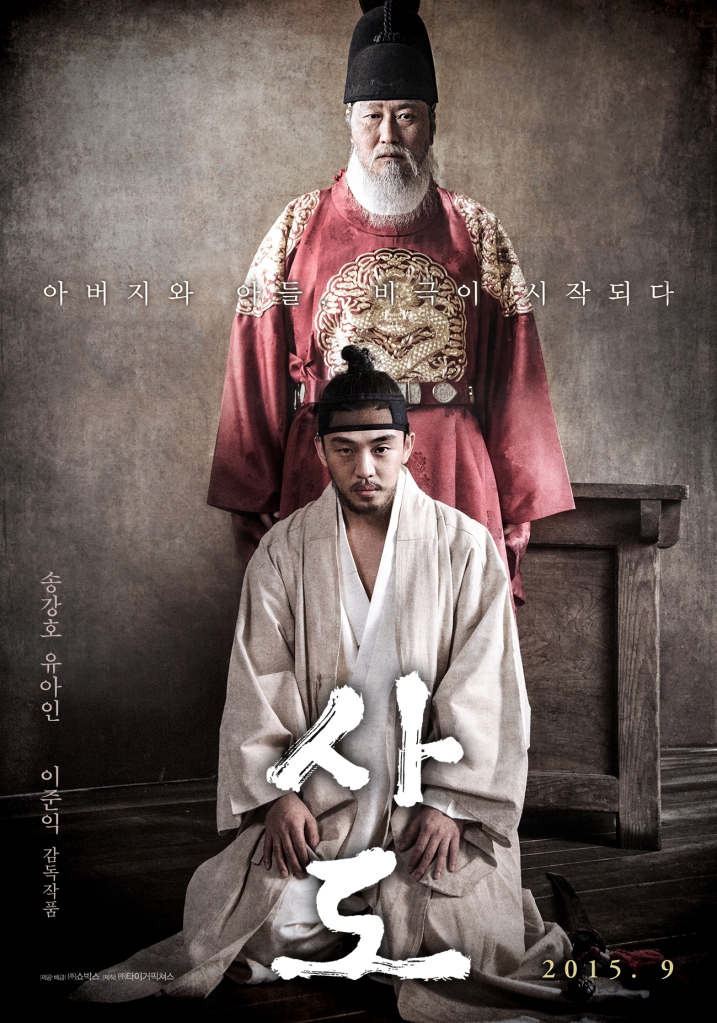 Which one is worse, the son who tries to kill his tyrannical father, or the tyrannical father who executes his own son and heir? A collection of sad stories all round, Lee Joon-ik’s The Throne (사도, Sado) is a historically inspired tale of familial conflict played out on a national stage. Where another nation might have entered into a bloody civil war, this very private tragedy keeps its bloodshed within the palace walls but still does not lack for cruelty.
 Windows on Worlds