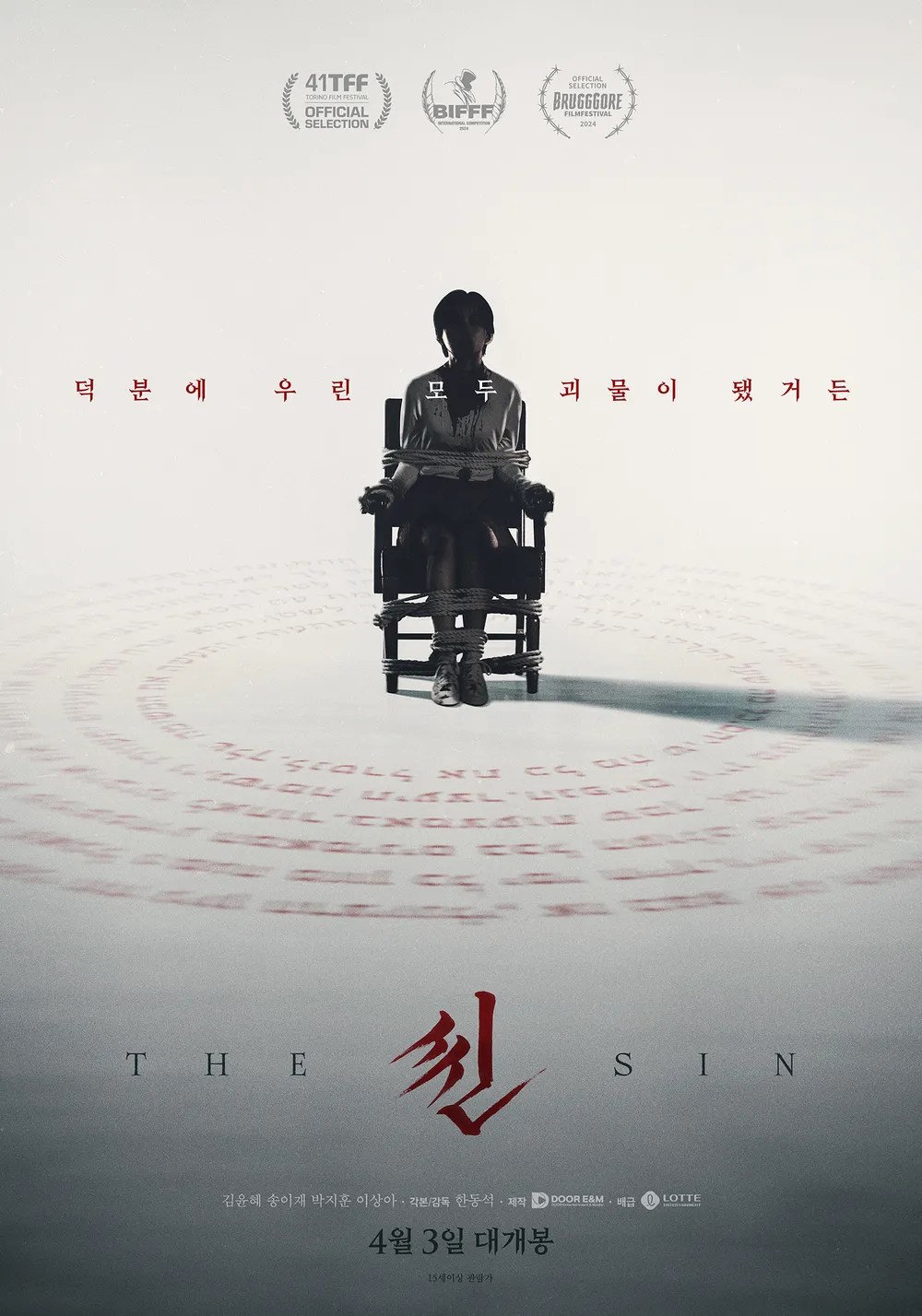
The Sin (씬, Han Dong-seok, 2023)

According to the opening title card of Han Dong-seok’s genre-hopping horror, sin is like a lost child that will one day come looking for its parents. The film’s ostensible heroine at times hears voices suggesting that someone or something will eventually come looking her, and later says that she is ready for their arrival, but before that we have to wonder what it is she means and what if anything that is happening is actually real or at least in keeping with our assumptions.

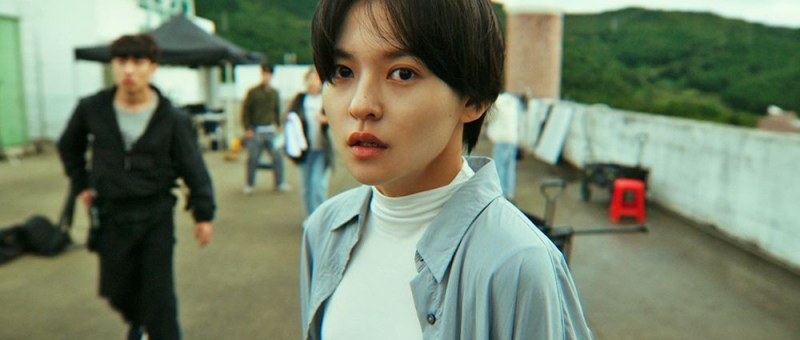
There are many reasons why we begin to feels we can’t trust Si-yeong’s (Kim Yoon-Hye) perspective. Not only is she already somewhat distant and preoccupied on her arrival at a disused university in the mountains but we also later learn that she’s taking a large amount of medication apparently for migraines and PTSD stemming from a barely remembered accident. She also seems less than pleased to encounter former colleague Chae-yoon (Song Yi-Jae) who brings up memories that seem unpleasant to her while there’s a kind of frostiness between them that’s only exacerbated by the fact Si-yeong was not even aware she’d have a co-star in this experimental dance movie directed by a man known for being “unkind” to actors. 

In any case, strange things do indeed begin befalling her from a body dropping right in front of her feet before she enters the building to the eventual murder and suicide of her colleagues who then return as zombie-like creatures. The film cycles rapidly through a series of genres beginning as a slasher with a Suspiria-like sense of eeriness as dancer Si-yeong’s mental state starts to unravel before drifting into the undead, cults, and shamanistic folk horror with the weird symbols dotted around the campus. 

Because things are very wrong on the outside too, Si-yeong even ends up running into a gang of murderous corrupt cops paranoid she’s found their stash of stolen drugs while otherwise pursued by riflemen apparently employed by a vengeful CEO. It’s true enough that we don’t know what’s going on for most of the film, and part of that may be that Si-yeong doesn’t know either because her mental state is unstable. We’re not even really sure if Chae-yoon is real or merely Si-yeong’s projection of her internal conflict, dressed as she is in the same outfit and with the same haircut to the point the two women are often barely distinguishable. Perhaps it’s this unpleasant memory that Si-yeong is trying to avoid, though it’s clear in very general terms that she’s running from something as much as she’s being chased and that her flight may be orchestrated to bring her to a specific location whether physical or spiritual.

What’s chasing her is the apparent “sin” of the title, though everyone might not see it as such or maybe believe their own sins were either justified or will be paid for later. For the purely evil, sin as a concept may not even exist if there’s no prospect of remorse though it’s hard to reconcile the docile, sweet and somewhat etherial Si-yeong with the fragmented memories of a past that may or may not be her own. “Thanks to you, we all became monsters,” she’s later told by someone about to something pretty monstrous but maybe they too were monstrous to begin with, or nobody was, and a well-meaning attempt to exorcise evil from the world has only produced more of it. 

Just when you think you have it all figured out, Han throws in a post-credits sequence pouring more fuel on the fire and hinting at even greater back story in a world ruled by dark and unseen supernatural forces. It doesn’t make sense, but wilfully so and frustrates in a positive way in our desperation to understand something that cannot be understood much as Si-yeong attempts to understand the rapidly disintegrating world around her. The concrete fact does seem to be that one must pay for ones sins, though those who do may not be the ones we’d expect. Gory and incredibly creepy, the film plays with our senses as much as Si-yeong’s, undermines our sense of reality, and finally leaves with the unsettling vision of a pervasive evil lurking in the mirror or the depths or the dark corners of a mind already shrouded in delusion. 


The Sin screened as part of this year’s New York Asian Film Festival.

International trailer (English subtitles)
Stateless Things (줄탁동시, Kim Kyung-Mook, 2011)

“We looked everywhere for a place for us to stay, but we could not find it anywhere” one of the twin heroes of Kim Kyung-mook’s indie drama Stateless Things (줄탁동시, Jooltak Dongshi) confesses. As the title suggests, Kim’s eventually surrealist drama follows those who no longer have a home and are instead condemned to wander the margins of an unforgiving city. Finding only loneliness and exploitation they long for an escape and perhaps find one if only in a moment of eclipse. 

Shooting in a more naturalistic, documentary style, Kim first focusses on the figure of Jun (Paul Lee), a young North Korean refugee who lost his mother in the crossing and his father to another woman in Busan. He works in a petrol station but is treated with disdain by his boss who has his eye on his female colleague, Soon-hee (Kim Sae-Byuk), who is a member of the Korean minority in China where most of her family reside. Though originally hostile towards each other, each wary of their mutual isolation and concurrent vulnerability, the pair later bond in a shared resentment of their boss who exploits Jun physically for his labour and seeks to exploit Soon-hee sexually. After each saving the other from the nefarious boss, the pair have no choice but to go on the run taking in a series of tourist spots while looking for another place to settle. 

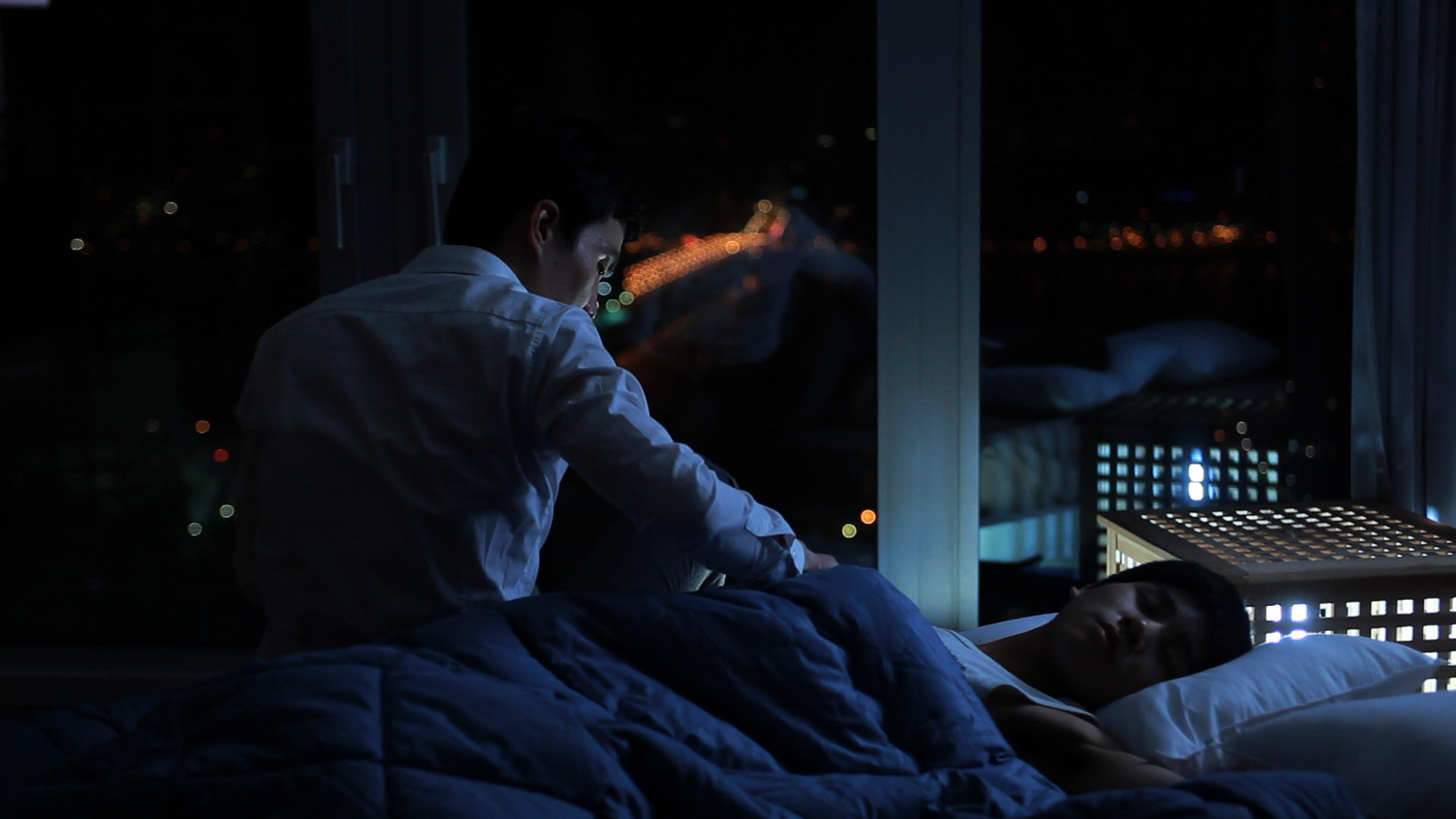
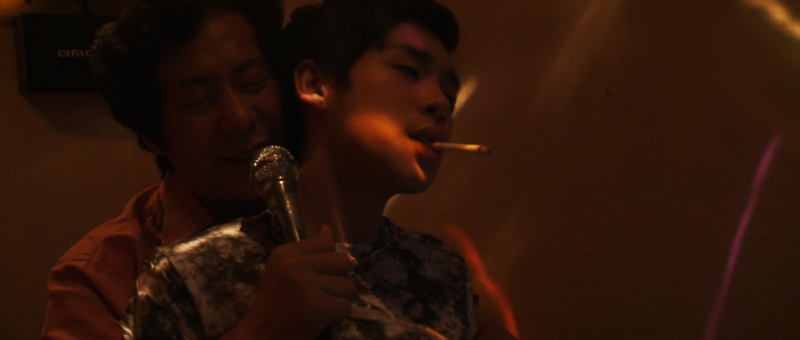
Meanwhile, across town, a young gay man, Hyun (Yeom Hyun-Joon), is a virtual prisoner in the home of his wealthy, married and closeted lover. He looks out across the midnight city and dances sadly alone in a luxury apartment in the sky while occasionally venturing out to meet other men, mostly older, who similarly only intend to exploit his body. “You have nowhere to go.” the exasperated Sung-woo/Sung-hoon (Lim Hyung-Guk) insists, thrown into jealous anxiety on visiting the flat and finding Hyun absent, yet he cannot really offer him a “home” and is all too aware of the transactional nature of their relationship. Though Hyun is also in a sense “stateless”, he has a power over Sung-woo and is able to wield his youth and beauty like a weapon if one he may not fully be able to control. In any case, he too is excluded from the mainstream society by virtue of his sexuality and socio-economic background. 

When Soon-hee and Jun visit a temple, he remarks on the incongruity of seeing a painting that features both a sun and a moon. She explains a folktale to him in which sun and moon are embodiments of siblings who climbed a rope into the sky to escape a hungry tiger. In his diary, Hyun also envisages a pair of twins one opening a door with his right hand as the other closes it with his left. In the surrealist sequence which closes the film, after a title card that appears 90 minutes in, the two men blur into one another as if they shared the same soul in an almost literal eclipse of the self. Kim nevertheless characterises them as sun and moon who cannot ordinarily share the same space. Jun occupies a world of street level sunniness until the light finally begins to dim leaving him alone in a dusky, rain-soaked city. Hyun meanwhile lives by night in his high rise apartment, a prisoner of luxury who flirts with danger for a sense of escape. 

Then again we might ask if Jun and Hyun are two sides of one whole, a sun and moon protecting the king who finds himself an exile. Kim shifts to scenes of emptiness, rooms without presence and streets without life as if the two men were ghosts of themselves hovering above a rootless Seoul, the sense of eeriness only deepened by Kim’s lengthy takes as he follows Jun walking a lonely path towards nowhere in particular because in the end he too has nowhere to go. Departing from the realism with which the film opened, the final sequence gives way to a kind of rebirth if only one of wandering that leaves its heroes at the mercy of a society continually unwilling to recognise their personhood. 


Stateless Things screened as part of this year’s Queer East .

Trailer (English subtitles)

The Man Standing Next (남산의 부장들, Woo Min-ho, 2020)

“You have my full support. Do as you please” so says the dictator, unambiguously manipulative but still somehow inspiring the loyalty of his many underlings perhaps still too wedded to an idea or at least an ideology to countenance moving against him. It turns out that nothing really changes and whether it’s feudal Joseon or the modern nation state, there is intrigue in the court. Neatly adopting the trappings of a ‘70s conspiracy thriller, Woo Min-ho’s The Man Standing Next (남산의 부장들, Namsanui Bujangdeul) explores the events which led to the assassination of President Park Chung-hee, father of the recently deposed president Park Geun-hye, by a member of his own security team. Many of the names have been changed and historical liberties taken, but the lesson seems to be that there is always a man standing next in readiness to inherit the throne. 

Our hero is KCIA chief Kim Gyu-peong (Lee Byung-hun), preparing as the film opens to halt Park’s (Lee Sung-min) increasing authoritarianism by assassinating him. A combination of the personal and the political Gyu-peong’s eventual epiphany is precipitated by an old friend’s “defection”. Park Yong-gak (Kwak Do-won), former director of the KCIA which operated as a secret police force propping up Park Chung-hee’s oppressive regime, is giving testimony to an American inquiry into the so-called “Koreagate” scandal in which the KCIA is accused of bribing members of Congress to propagate favourable views of the Korean president and reverse Nixon’s decision to pull US troops from South Korea. Yong-gak uses the opportunity to denounce Park Chung-hee, planning to publish a memoir titled “Traitor of the Revolution” as an exposé of the inner workings of the KCIA.  

Somewhat ironically, Gye-peong and Yong-gak are old comrades who fought together in the “revolution” led by Park in the early 1960s following the ousting of corrupt autocrat Rhee Syngman. Yong-gak has become disillusioned with their cause and with Park himself, but this largely ignores the fact that Park’s revolution was mainly a repackaging of Japanese militarism, something signalled by an exchanged between Park and Gye-pyeong in Japanese to the effect that their days of revolution were their best. All of which makes Yong-gak’s wistful eulogising of a betrayed ideal along with his supposed admiration for democracy somewhat ironic. The essential motivator in their loss of faith, however, is also a militaristic one. They learn firstly that like any dictator Park has been embezzling from the state for years and has a collection of slush funds in Switzerland. That’s not the problem, the problem is that to manage them he’s been running a “private” intelligence service unknown even to the KCIA. They’ve been displaced, and their hurt is personal more than it is political. 

Yong-gak calls Park a traitor to their revolution and objects to the continuing human rights abuses for which he himself as a member of the KCIA has been directly responsible. All of this creates a series of crises for Gye-peong who is torn between loyalty to his old friend and Park while increasingly worried for his own safety. He begins to suspect that Gwak (Lee Hee-joon), Park’s security officer who had not fought with them in the revolution, may be the mysterious “Iago” figure Yong-gak had been warned about by the CIA. Increasingly sidelined, Gye-peong continues to do Park’s dirty work but draws attention to himself in his resistance towards the president’s increasingly militaristic rhetoric. Pro-democracy protests have already broken out in Busan in response to Park’s “unfair” treatment of the city’s governor and the opposition party. Gye-peong advises reinstating the governor with an apology. Gwak says frame the protestors as communists and Northern sympathisers and send in the tanks. “Cambodia killed three million people, is it such a big deal if we kill one or two million?” Gwak blurts out in a quip which seems to catch Park’s attention, the president now thinking himself untouchable. A militarist perhaps but an educated man who speaks good English and gets on well with the Americans, Gye-peong does not see the Khmer Rouge as a source of inspiration nor, like Yong-gak, does he think those values align with the ones he fought for bringing Park to power. 

Then again, even in the immediate chaos of the early ‘60s, it’s difficult to see how you could join that particular revolution without assuming it would come to this. Gye-peong has apparently been OK with human rights abuses and mass oppression, but has been quietly reassuring himself and others that Korea is changing, Park is preparing to move aside, and they are progressing towards democracy. In true conspiracy fashion, Woo paints Gye-peong as a tragic hero, unable to reconcile himself with the choices he has made or the radically different version of the world he is now seeing, but taking what is essentially a personal revenge in return for a slighting from a man to whom he’d given his life. Perhaps in a sense he thinks he’s saving Park from himself, or merely protecting the revolution he fought for from a cruel traitor, but in the end lacks the courage to carry it through. He thought Gwak was his Iago, but he missed the “man standing next” in the shadows. As the April Revolution led only to Park, so Park leads only to Chun and second military coup even more brutal than the last. Nothing really changes, but the next revolution will have to be one enacted by more peaceful means because the spectre of authoritarianism is eclipsed only in the freedom from fear.


The Man Standing Next is available to stream in the UK from June 25 and on download July 5 courtesy of Blue Finch Releasing.

International trailer (English subtitles)