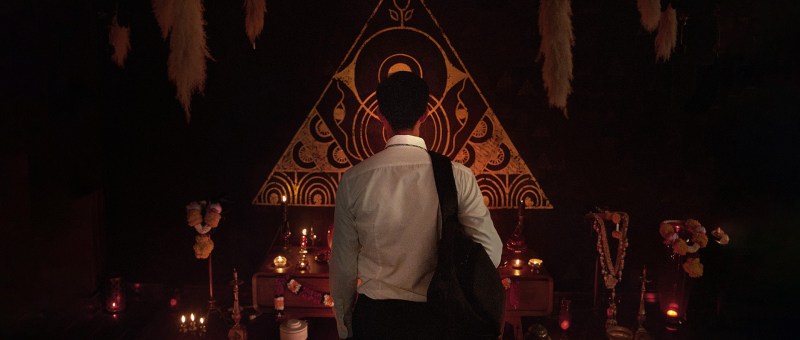

An inability to overcome the traumatic past leaves a family vulnerable to the dark machinations of a black magic cult in Sophon Sakdaphisit’s supernatural thriller, Home for Rent (บ้านเช่า..บูชายัญ). The film’s title is eventually revealed as a grim irony, the home in question a seat of the soul though like the director’s previous films it’s economic anxiety and social aspiration that open the door to damnation even if in this case there’s something more than fate in play.
All of Ning’s (Nittha Jirayungyurn) problems start when the flat she owns to let out is vandalised by a vacating talent. As she explains to the estate agent, Tom (Suphithak Chatsuriyawong), she can’t afford to refurbish it and the rent was covering the mortgage on the house she actually lives in which belongs to her husband, Kwin (Sukollawat Kanarot). Tom floats the idea of the family moving into the flat while they tidy it up and renting the house out instead, but Ning is worried Kwin won’t like the idea. She’s right, he doesn’t and suggests it would be easier to just sell the flat but Ning doesn’t want to do that either. The reasons for her attachment to it aren’t completely clear, but if she were keeping it as a safety net it might hint at a degree of insecurity in her marriage though as we later see she’s also job-hunting and not having much luck. Seeing the candidate next to her write down a much lower salary expectation she hastily changes hers too, fearing she’s pricing herself out of the market.
As for Kwin’s reluctance to move, it may be a degree of snobbishness in not wanting to leave his large suburban house in a wealthy area for a small flat where he ends up sleeping on the sofa because the couple’s daughter Ing (Thanyaphat Mayuraleela) can’t seem to settle. As it turns out, Kwin has other reasons for remaining attached to the house and not wanting anyone else to live there but even as it stands it seems far too big for their small family and an obvious financial burden. Yet Kwin’s outward anxiety is to do with finding “high quality” tenants given what’s just happened with the flat. Ning is reassured by Tom’s confirmation that the prospective tenants are a retired doctor and her daughter though as Kwin points out, it’s mere snobbishness to assume a doctor will be a better tenant than anyone else.
Nevertheless on meeting them, Kwin unexpectedly agrees only for Ning’s aunt and neighbour Phorn (Natniphaporm Ingamornrat) to report strange goings on at 4am such as ominous chanting and the sudden arrival of large numbers of crows. Strange things begin happening around Ning too, while Kwin’s behaviour has also become weird and irrational. Ning is however facing an uphill battle trying to get people to believe her that the couple renting her house are actually crazed cultists who may be targeting her daughter while others assume she’s going out of her mind because of the stress of maintaining it.
The space that’s for rent in fact seems to be the human body as it becomes clear what kind of home is being sought. Aside from financial worries, the curse essentially stems from the inability to accept loss, or perhaps also the attempt to escape it by assuming new identities rather than deal with a painful past. Only Ning remains in the dark in this triangular series of relationships with pyramids an often repeated motif mimicking the dark symbol of the cult. Sophon Sakdaphisit conjures a genuine sense of eeriness within the genial suburban environment that hints at a largely invisible but pervasive evil that has Ning and her family firmly in its sights. But in other and perhaps slightly uncomfortable ways, it may be the family that eventually repairs itself in what amounts to the complete integration of the once buried traumatic past which may have destroyed what once was but has birthed something new in its place that at last seems to be free of the gloominess that once overhung the family home having relocated to a much warmer and down to earth environment in the absence of both financial and aspirational anxiety but simply content to have found a place to call home.
International trailer (English subtitles)

 Windows on Worlds