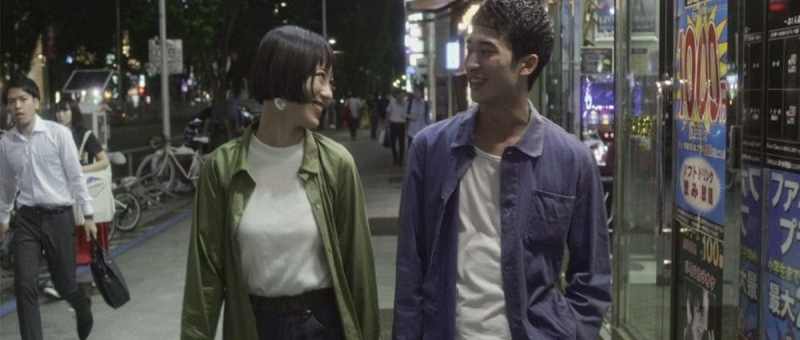

Life goes on as usual, until it doesn’t. The couple at the centre of Yutaka Tsunemachi’s debut feature Drifting Flowers, Flowing Days (この日々が凪いだら, Kono Hibi Ga Naidara), are about to hit the crisis of youth in which they begin to think seriously about their futures and fear that their lives can no longer continue simply as they were but also struggle to find direction while torn between what society views as a successful life and their own desires.
The crunch point comes when Hiroto (Hiroki Sato), a construction worker, and Futaba (Kaho Seto), who works in a florist’s, learn that their rundown apartment block is going to be demolished and they have six months to find somewhere else to live. While Futaba idly looks at wedding rings, she isn’t really sure how Hiroto views their relationship or if he’s even assuming they’ll finding somewhere new together. The financial strain of an unexpected move also has her wondering if she should give up her job in the florist’s, which she enjoys due to her love of flowers, and start looking for a regular company job but an attempt to talk about it with Hiroto only results in petulance born of male pride as he takes it as her complaining he doesn’t earn enough with his job as a casual labourer.
Another source of friction is that Hiroto seems reluctant to meet Futaba’s family while refusing to introduce her to his hinting at longstanding childhood trauma stemming from a legacy of domestic abuse and a father who lost himself in drink. Even so, he’s drawn to an older man at work, Haruo, who soldiers on despite his decreasing physical capability. When he is unceremoniously fired, the Haruo takes his own life having lost his both his means of supporting himself and his sense of purpose. Haruo might remind him of father though Hiroto feels somewhat guilty that he didn’t do very much to help while he was alive and resentful towards his heartless boss and colleagues who did nothing more than make fun of him.
This idea of people being disposable tools of corporate entities is further born out by the experiences of his hometown friend, Daigo (Masashi Yamada), who is feeling burned out by his dream job in the city largely thanks to a bullying boss and overbearing work culture. A friend who experienced something similar tells him she just quit her job and feels much better so if he doesn’t feel appreciated he should leave, but it’s not really that simple. Not only does he need a steady income to survive but there’s a degree of shame and trepidation in not following the conventional path, the same shame and trepidation that has Futaba worrying she’s being irresponsible in following her dream of opening a florist’s of her own rather than using her degree to get a better paid job and start saving for the next phase of adulthood while still uncertain if Hiroto is going to want to get married and settle down.
Experiencing another crisis that forces him to confront his childhood trauma, Hiroto sighs that his future is shrouded in darkness and he wishes that it was all set out for him an ironic inversion of the crisis experienced by others his age that they resent being railroaded into a life of conventional success that in fact does not make them happy. In any case, he emerges with a little more clarity about the kind of future he might want no longer so frightened of commitment or suspicious of familial bonds. What the youngsters experience is a perhaps premature end to their youth symbolised by the literal tearing down of their world in the soon to be demolished apartment block that forces them out of their inertia and onto a path towards a more settled adulthood. But equally that doesn’t necessarily mean that they have to abandon their dreams or live up to an ideal of conventional success if it’s not what they want but can begin to find other futures for themselves outside of the mainstream that are valid and satisfying. Tsunemachi follows them with a hazy detachment but captures something of the anxieties of contemporary youth still struggling to find accommodation with demands of living in a judgmental and uncertain society.
Drifting Flowers, Flowing Days screened as part of the 18th Season of Asian Pop-Up Cinema.
Original trailer (English subtitles)
 Windows on Worlds