Finding Her Beat (Dawn Mikkelson & Keri Pickett, 2022)

“We belong here, we deserve this.” It might sound like a redundant statement, but there are many reasons why the subjects of Dawn Mikkelson & Keri Pickett’s mostly observational documentary Finding Her Beat might have come to doubt their right to practice their art if not that simply to be who they are. As the opening text relates, taiko drumming has long been a male preserve and even if women were not expressly forbidden from playing conventional notions of femininity often forbad them. 

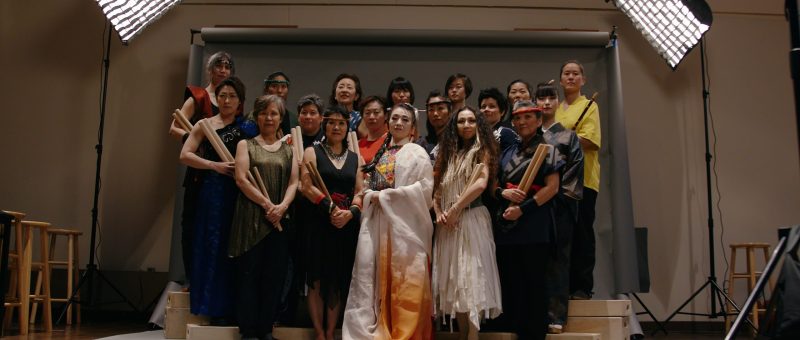
That’s in part the reason that Jennifer Weir, director of TaikoArts Midwest, embarked on the HERbeat project aiming to bring together female taiko players from the US, Japan, and around the world for a collaborative performance in Minneapolis. As Jennifer reveals, she is a Korean-American adoptee and had no particular reason to embrace taiko but like many of the other women who come to participate in the event, she has found a new home and community as a taiko drummer. The same is true for her wife, Megan, who once lived with a taiko drumming group in Japan before returning to the US and starting a family. 

Conversely, Chieko Kojima who is a founding member of the prominent taiko group Kodo on Sado Island explains that taiko gained a resurgence in the post-war era as young Japanese people looked for a way to rediscover traditional Japanese culture as a rejection of growing American cultural influence. Chieko herself had wanted to drum, but women were not really welcome to do so and so she became a dancer. Kaoly Asano’s practice at Gocoo is conversely rooted in post-war avant-garde performance art and incorporates other elements of traditional Shinto dance along with more modern influences such as trance and tecnho music. 

In a sense, their involvement with taiko is also a means of recovering a traditional culture that has often been mediated through a fiercely patriarchal society. Though there is no direct prohibition on women playing the taiko drums as there might be for entering a sumo ring, it has often been associated with masculinity as a celebration of physical strength and endurance. Socially enforced notions of gender therefore made it difficult for women to participate lest they be thought unfeminine and therefore unmarriageable particularly in ages in which marriage was the only secure path to a comfortable life for a woman. 

Many of the taiko players also mention that they have felt displaced within their societies, sometimes because those societies too did not accept their gender presentation or sexuality. They have all, however, found a source of solidarity as members of a taiko drumming group which is after all about togetherness and harmony. “In a way, taiko gave me a family” echoes Koaly Asano, “by meeting you, Tiffany, I finally felt I was not alone.” she affirms while talking to US-based taiko master Tiffany Tamaribuchi. For Asano, taiko is also a force that connect us with a place and the rhythms of the Earth. “What’s important is your sound, to transform your life into sounds” she adds as a kind of manifesto for her taiko. 

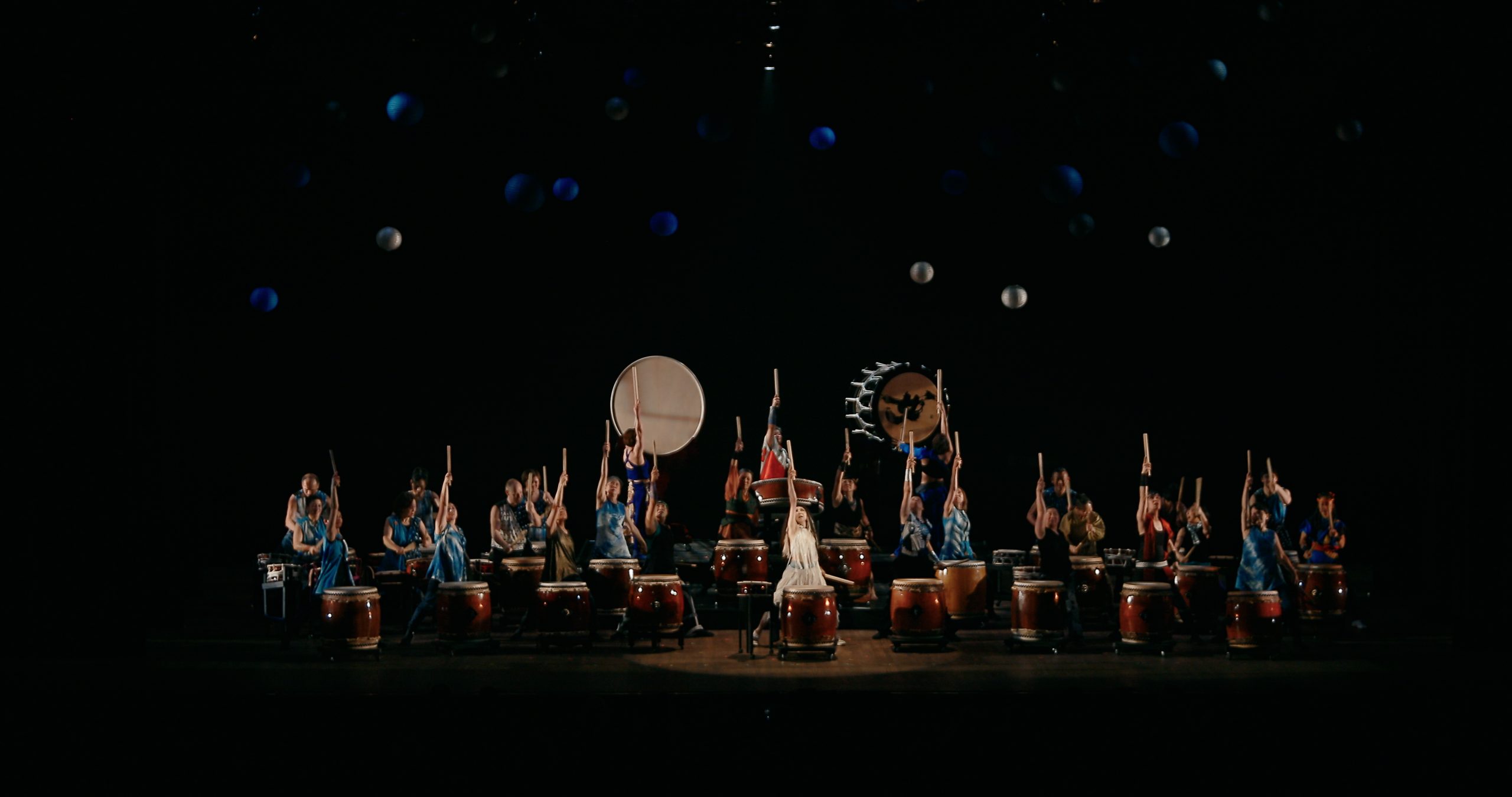
In a way it’s this sound translation that allows the women to come together, overcoming language barriers to find a common voice. Nevertheless, they are faced with a series of additional challenges including the looming coronavirus pandemic with the concert scheduled for February 2020. The show turns out to be the second to last staged in its venue for the almost two years of pandemic-related restrictions, while many of the drummers have already had future gigs cancelled in their home countries. All of which lends the concert an additional an additional weight and poignancy as the drummers prepare to claim a space only to have it taken away yet again. Nevertheless, the project does allow them to rediscover an international sense of solidarity along with individual pride in the practice of their art. Fittingly enough, the concert ends with a routine titled “Eijanaika?” which is both a reference to a carnivalesque protest movement during the Meiji Restoration, and a phrase which might be translated as “so what, what’s wrong with that?” neatly echoing the celebratory sense of defiance at the heart of HERbeat.


Finding Her Beat screened as part of this year’s San Diego Asian Film Festival Spring Showcase.

Trailer
Between Us (藍に響け, Yasuo Okuaki, 2021)

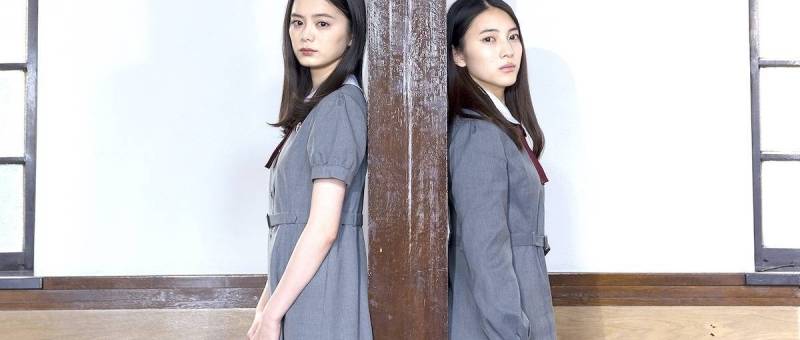
Hyper-individualism goes to war with collective harmony in Yasuo Okuaki’s taiko-themed coming-of-age manga adaptation, Between Us (藍に響け, Ai ni Hibike, AKA Wadaiko Girls). Reminded that “your sound is everyone’s sound” the closed-off heroine begins to realise you can’t always just do your own thing and expect everyone else to deal with it, but in the end shows remarkably little growth as even her otherwise positive contribution of helping a similarly troubled young woman quite literally find her voice is in itself achieved mainly through abrasive bullying not to mention a persistent ableism which otherwise entirely ignores her feelings. 

Okuaki opens with an intense scene as the heroine, Tamaki (Ayaka Konno), burns her ballet shoes alone on the beach at night before staring pensively out at the ocean. As we discover, Tamaki has a lot going on that she is reluctant to share with others. Something has evidently gone wrong at home, she seems worried about money and the modest house she shares with her mother who appears to work late often is filled with packing boxes suggesting they may only recently have moved. She hasn’t told her mum she’s given up ballet, partly it seems because she’s working part-time at the local supermarket which she has to keep a secret because the elite Catholic school she attends has a rule against part-time jobs. Wandering around alone however while her friends, who each seem to come from extremely wealthy families, assume she’s heading to ballet Tamaki becomes captivated by the sound of taiko drumming, eventually spotted by a young woman practicing, Maria (Sayu Kubota), who happens to be mute. 

Despite the impossibility of direct communication, Maria manages to covey her enthusiasm for the drums presumably picking up on something in Tamaki which, for unexplained reasons, she is extremely reluctant to explore. Fellow drummer Kahoko, however, is dead set against her joining the club even setting her a cruel and impossible challenge as a kind of entrance exam. The irony is that even as the sullen Tamaki stands up against low-level bullying from Kahoko who makes a basic training exercise seem like humiliating punishment, Tamaki becomes far too into perfecting the art of taiko, obsessively honing her craft and displaying natural ability but quickly losing patience with her fellow drummers who are mostly playing for fun and friendship. 

Tamaki is and remains distinctly unpleasant to be around while Kahoko seems to soften, becoming a source of support to the other girls, and poor Maria is rounded on by just about everyone including maternal figure Sister Nitche (Mariko Tsutsui) who was once herself a top taiko coach but for reasons unknown gave up the art, got religion, and became a nun. Sister Nitche was known as a demon coach, and the decision to reassume her role does indeed resurface an element of cruelty in her unseen in her role as high school teacher and carer at the attached children’s centre. Maria first bonds with Tamaki in revealing to her that she was rendered mute in a car accident and has been undergoing rehabilitative therapy in an attempt to regain her speech but that it hasn’t been going as well as she’d hoped. Yet both Sister Nitche and Tamaki eventually set on her, insisting that the reason she’s not making progress is because she’s not trying hard enough instead of, perhaps, reassuring her that even if she not able to improve her speaking it would still be fine and there’s no need to rush. 

The conflict seems to be between the ultra-competitive, deeply wounded Tamaki and the ethos of taiko which demands group harmony. There’s no point being a show off because the group must move as one, yet Tamaki struggles to accommodate herself to the idea of adapting to the collective rhythm insisting everyone attempt to match her speed while suggesting that those who can’t aren’t up to the task and should voluntarily resign rather than bring the group down, echoing the rather harsh survival of the fittest philosophy espoused by a transformed Sister Nitche. Just as she had, Tamaki later turns on Maria in the face of her own failure repeatedly insisting that she is a “loser” who wouldn’t fight for taiko or for her voice in a confrontation that leads first to a physical fight and then to an intense taiko battle that bears out the repeated notion of baring one’s soul through the beating of the drum. 

There is an unmistakable though unresolved homoerotisicm in the conflict between the two young women filled as it is with repressed emotion, frustration, and unspoken desires all of which appear to dissipate through the climax of the physically and emotionally intense taiko session. Nevertheless, there is also something in uncomfortable in the fact of Maria’s path towards finding her literal voice arising because of what is essentially abusive bullying rather than encouragement or positive support especially as it also denies her the right to speak her feelings honestly while no one is making much of an effort to listen to her. Tamaki meanwhile remains somewhat unsympathetic even in her silent concern for Maria betrayed by the unexpected warmth of her smile in seeing her deciding to return to taiko, her own buried troubles otherwise unresolved while her unforgiving hyper-individualism is tacitly condoned even as she learns to submit herself to the collective rhythm and finds through it the sense of connection she was perhaps missing. 


Between Us screened as part of this year’s Camera Japan

Original trailer (no subtitles)