
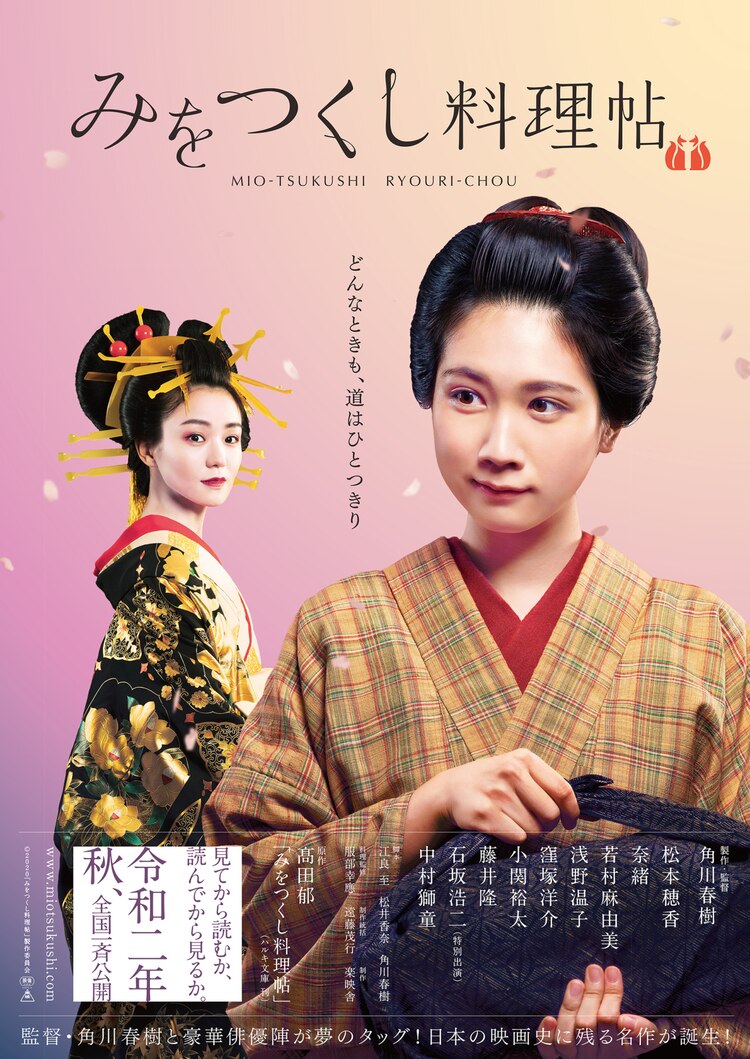
“Food nurtures like heaven” according to a piece of advice from a local doctor which quickly becomes a catchphrase of the heroine of Haruki Kadokawa’s slice of foodie cinema Mio’s Cookbook (みをつくし料理帖, Mi wo Tsukushi Ryoricho). Adapted from the novel by Kaoru Takada, the Meiji-era drama is at once a tale of a pioneering young woman making her way in fiercely patriarchal society, and a heartwarming exploration of chosen and re-formed families discovering new senses of solidarity in the of wake tragedy while resolving to extend that sense of community to other lonely souls.
The titular Mio (Honoka Matsumoto) meanwhile has had her share of loss, orphaned during a catastrophic flood and thereafter separated from childhood best friend Noe (Nao Honda) who simply disappeared. 10 years later, Mio and her adoptive mother Yoshi (Mayumi Wakamura) have relocated from Osaka to Edo though their lives have not been easy, Yoshi’s son having run off never to be seen again following the failure of the family restaurant. Mio is now working in a small cafe owned by a kindly older gentleman, Taneichi (Koji Ishizaka), but struggling to adapt to the sophisticated tastes of the capital with customers flatly refusing to eat her overly subtle oysters. A sullen samurai, Komatsubara (Yosuke Kubozuka), points her on her way by explaining that her food lacks “foundation” which is why she hasn’t yet found her groove.
Mio’s culinary journey is also one of growing confidence as she learns to reorient herself in her new city life eventually realising that the key lies in uniting the tastes of Osaka and Edo as if integrating the two cities into her essential identity. A fortune teller had once told her that she would suffer many hardships but eventually reach “blue sky beyond clouds”, discovering a taste of that in her unexpected success even as those around her marvel at the female chef, a hitherto unheard of phenomenon, as she climbs the ranks of the local restaurants with her innovative cuisine after taking over from Taneichi.
Yet her success also brings her enemies in the conservative and increasingly greedy Edo society. A rival restaurant rips off her signature dish and charges twice the price, a customer admitting that many will gladly pay more just to be seen doing so, less interested in the quality of the food than what is fashionable (times it seems do not change all that much). Even so “food is only as good as the cook” Yoshi is fond of saying believing that a bad person can’t make good food, something brought out by Mio’s compassionate nature as she continues to help those around her, vowing to “take vengeance through food” in concentrating on perfecting her craft and nourishing people’s souls rather than allowing herself to be beaten into submission by elitist intimidation.
Meanwhile she continues to wonder whatever happened to Noe, reflecting that she was lucky in having found Yoshi who took her in out of compassion and continues to stay with her all these years later while gaining a surrogate father in the kindly Taneichi who himself lost a daughter. Noe’s prophecy was that she would “rise like the sun” and achieve “world-conquering fortune” though as it turns out she was not so lucky even if the prophecy did in fact come true if ironically. Both women continue to suffer because of the world in which they live each prevented from pursuing their romantic freedom, Mio forced to give up on her probably impossible love for samurai Komatsubara in order to embark on a quest to save her friend through achieving true success with her restaurant while Noe is constrained by her inescapable life as an oiran.
Even so the film never really digs into the division placed between the women by the existence of the Yoshiwara into which one cannot enter and from which the other can never leave while the open ended conclusion that only advances a hope that the division may be breached perhaps suggests that it may never be, in part because it depends on Mio’s success as an independent woman in a feudalistic, patriarchal society. Meanwhile the two women continue to support each other in ways they can, Mio trying to raise her friend’s spirits with frequent care packages designed to remind her of home and their more innocent childhood smuggled in by supportive friends while each of them have in their own way found new families based on mutual compassion as a means of overcoming despair to rediscover a sense of hope for a better future founded on human solidarity.
Mio’s Cookbook streams until 27th February in several territories as part of Japanese Film Festival Online 2022.
Original trailer (English subtitles)
 Despite the potential raciness of the title, The Liar and his Lover (カノジョは嘘を愛しすぎてる, Kanojo wa Uso wo Aishisugiteru) is another innocent tale of youthful romance adapted from a shojo manga by Kotomi Aoki. As is customary in the genre, the heroine is cute yet earnest, emotionally honest and fiercely clear cut whereas the hero is a broken hearted artist much in the need of the love of a good woman. Innocent and chaste as it all is, Liar also imports the worst aspects of shojo in its unseemly age gap romance between a 25 year old musician and the 16 year old high school girl he picks up on a whim and then apparently falls for precisely because of her uncomplicated goodness.
 Windows on Worlds