The Letter (手紙, Jiro Shono, 2006)

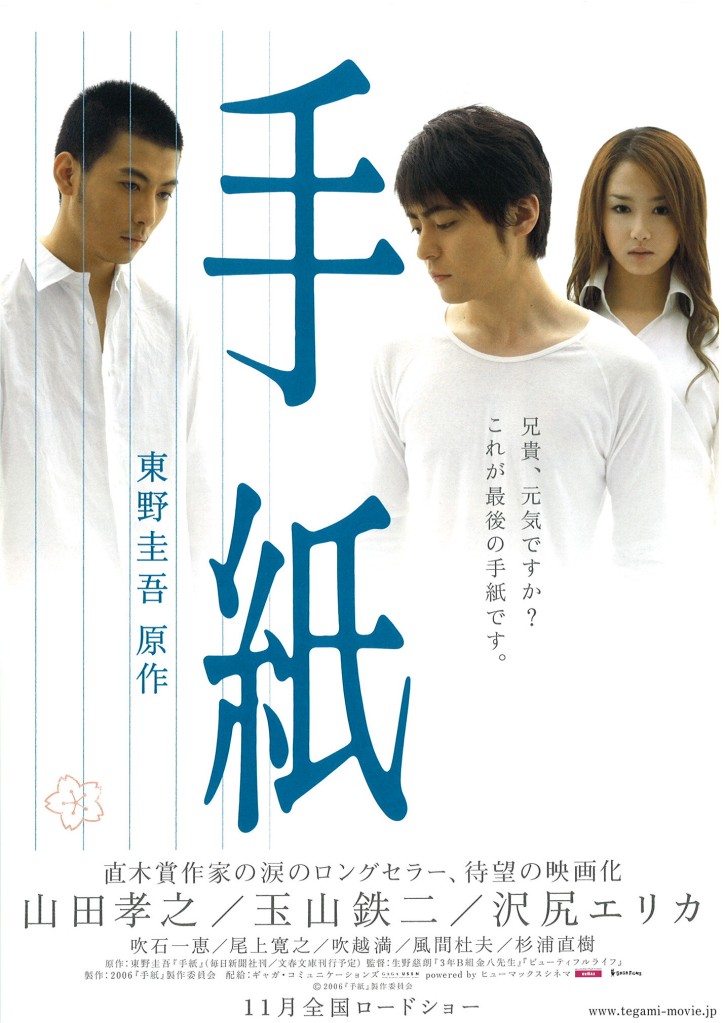
The Letter PosterWhen it comes to cinematic adaptations of popular novelists, Keigo Higashino seems to have received more attention than most. Perhaps this is because he works in so many different genres from detective fiction (including his all powerful Galileo franchise) to family melodrama but it has to be said that his work manages to home in on the kind of films which have the potential to become a box office smash. The Letter (手紙, Tegami) finds him in the familiar territory of sentimental drama as its put upon protagonist battles unfairness and discrimination based on a set of rigid social codes.
Nao (Takayuki Yamada) is a bright young man who had the chance to go to university and progress into a normal middle class life but is now slumming it as a blue collar worker at a factory. It transpires that his dismal circumstances began when he and his brother were orphaned meaning that his older brother Takashi (Tetsuji Tamayama) left school to get the money for Nao’s education. Working himself to the bone, Takashi was injured in a workplace accident and subsequently laid off. Desperate to provide for his brother, he turned to crime and unfortunately ended up killing an elderly woman during a burglary gone wrong and will spend the rest of his life in prison. The once close brothers now communicate through letters alone. With his university dreams shattered, Nao moves from place to place, forced out of employment and friendship groups each time someone finds out about his brother. Increasingly he comes to resent Takashi for the shadow his foolish actions continue cast over his life.

It is sadly true that this kind of social stigma towards the relatives of criminals is more prevalent in a society like Japan’s which prizes the overall harmony of the group (though I wouldn’t say it’s entirely absent here either). Every time Nao thinks he’s about to get somewhere, a background check throws up his imprisoned brother and it’s all over. Especially considering that his brother’s crime is a violent one perpetrated against an elderly lady, nobody is prepared to extend an understanding hand to Nao even though the crime itself has nothing to do with him (save being committed in his name) and its price should not be hanging on his shoulders.

It’s unsurprising then that Nao tries to conceal his brother’s existence, often claiming to be an only child with no living family. Though originally communicating warmly with Takashi in the letters, his growing resentment leads to a decline in their frequency and he rarely visits in person. The desire to hide his problematic past becomes a trigger in itself which leads to his having to give up on a dream of becoming a TV comedian just when it looked like his career was about to take off, and failure to tell a fiancée that he lied about being an only child also presents a serious crack in the couple’s relationship. Had he been more upfront and faced out the resulting reaction, he might have been able to work through it but once you’ve tried to lie sympathy dissipates entirely.

At the end of the day Nao is a young man with no one to guide him. He’s angry and he’s ambitious so he’s filled with resentment that he can’t have everything he thinks he deserves simply because of a series of things which happened to him none of which were his fault. Because of this, he makes a series of poor choices failing to see the things that are right in front of him. The dowdy girl next-door type from the factory is clearly in love with Nao but he isn’t interested – she doesn’t fit his slightly arrogant view of himself with her plainness and straightforward goodness. On the other hand, he’s immediately captivated by a beautiful and wealthy socialite who’s way out of his league. Of course, this is likely to end in tears – even if Nao didn’t already have skeletons in the closet the girl’s father has other plans for her which don’t include a marriage to a jumped up poor boy comedian.

The Letter suffers slightly in its focus on Nao and his troubles rather than being evenly split between the brothers. Takashi has paid a heavy price for his crime – he’ll be in prison for the rest of his life and the bright future he tried to buy for his brother has been ruined forever precisely because of the actions he was taking to ensure it. His only lifeline is the letters and the news he gets of Nao’s prospering in the outside world. Nao’s final decision to stop writing and not even tell his brother his new address so that the letters will no longer reach him is therefore a doubly cruel and selfish one. However, Takashi is only presented in relationship to his brother and his own pain and struggle becomes an undeveloped facet of the film.

As in all of Keigo Higashino’s work, secrets are the great enemy. The film only partially addresses the extreme unfairness of Nao’s plight as he’s continually persecuted for something that’s nothing to do with him. Guilty by association only, he is also in prison with no parole board to consider his case. The film even states that this kind of stigma is a perfectly natural thing which just has to be accepted – accept the truth, it says, and the world will open up to you. On balance this is a good message, but the idea that prejudice and social discrimination are things which just have to be endured is an uncomfortable one which sits at odds with the film’s otherwise positive messages of personal redemption and the importance of familial bonds. Uneven and occasionally tipping over into sentimentality, The Letter is something of a missed opportunity but nevertheless offers a thought provoking and emotionally satisfying melodrama in the best traditions of the genre.


Reviewed as part of the Japan Foundation Touring Film Programme 2016.

http://www.youtube.com/watch?v=6Ibsv_ZJ0d4

Monsterz (2014)

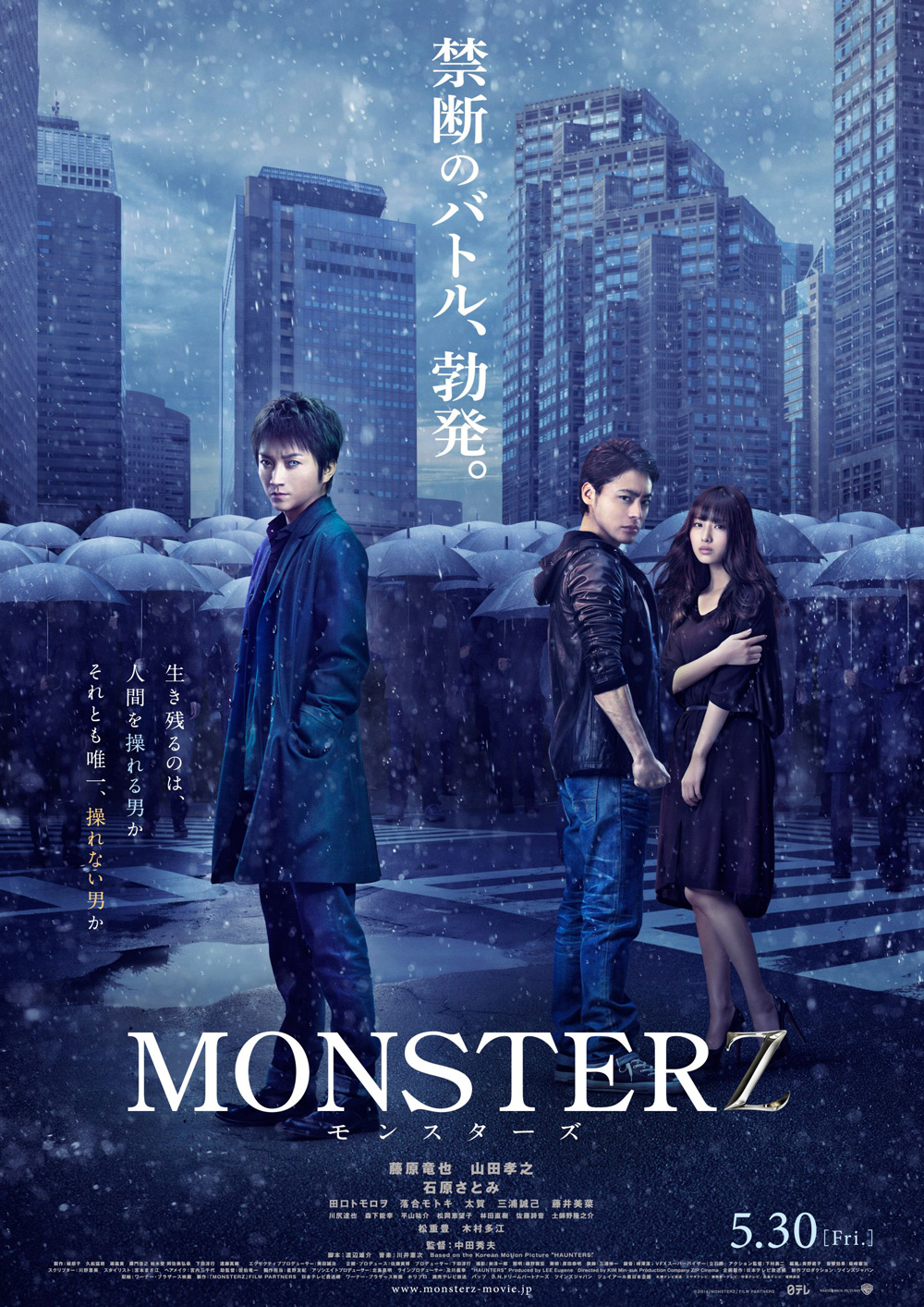
Monsterz_2014Hideo Nakata is best remembered as one of the driving forces of the J-Horror boom of the late ’90s thanks to his hugely influential Ring movies. However, despite a few notable hits including Dark Water, his career has seen something of a slump following a foray into American filmmaking with The Ring 2 – a sequel to the remake of his own Ring (though entirely different from his Japanese language Ring 2 completed in 1999). Monsterz sees him helming a remake of another foreign property – this time the Korean sci-fi thriller Haunters.

The film begins from the POV of Monster no. 1 (played by Tatsuya Fujiwara), who narrates much of the story and refers to himself solely as “monster”. Blindfolded, a small boy is dragged home by his mother only to be discovered by his abusive father who beats him and berates his mother whilst insisting “the monster” needs to die. At this point the blindfold comes off and the boy controls his fathers actions eventually persuading him to snap his own neck. Beginning to also control his mother, the boy stops short of giving her the same treatment and wanders off into the rain. Fast forward 20 years and the monster is now a criminal mastermind who uses his time freezing and mind control capabilities to make a living as a bank robber. However, one day he discovers someone who seems to be immune to his powers (Takayuki Yamada) and his whole world is shaken. The monster sets about removing this threat to his supremacy but it appears his opponent is also “a monster” – a man with super healing properties who cannot die! It takes a “monster” to fight a monster but which one will come out on top?

Yes, lots of predictably comic book style action adventures begin as the two guys with opposing super powers face off against each other. The most interesting aspect of the film is that it’s mainly told from the point of view of the otherwise unnamed “monster” though Nakata’s attempts to make him a sympathetic anti-hero never quite work out despite Fujiwara’s committed performance. The film’s ending is also unconventionally unresolved (though also very true to its American comic book roots) with a pleasing note of tolerance and inclusivity thrown in. However, that is in part facilitated by the lack of tension in the central dynamic – the two opposing forces are at a perpetual stalemate which only ends up feeling, well, stale – in a word. The monster’s freezing and mind control powers are impressive but the action sequences are much of a muchness and just get bigger rather than more interesting.

Having said that the action sequences aren’t unexciting, there are some impressive moments (bar the odd use of dodgy CGI and green screen). The main problem with the film is a slight mismatch in tones between Nakata’s portentous doom laden fatalism and the playful lightness of its comic book inspiration. The conventional hero, Shuichi, takes second lead here with his gang of sidekicks – otaku Akira and flaming queen Jun offering odd moments of comic relief. Though actually the role of Jun is another interesting inclusion as, despite offering a stereotypically “gay” character camping things up spectacularly, Jun is also presented fairly normally as a valued friend and comrade of the hero. His sexuality is merely a character trait, never a joke in itself which is a refreshing element particularly in a Japanese film. In the end, Monsterz aims to offer a message of tolerance and inclusiveness – that, oddly, there are no monsters and would be no villains if we could all just learn to accept each other’s differences and live together in harmony. However, the message is a little hamfisted and clumsily delivered and, some might feel, out of place in an action orientated film such as this.

Very typical of the comic book movie genre (though perhaps more Fantastic 4 than Dark Knight), Monsterz is middling mainstream fare which, while mildly diverting, fails to offer anything particularly memorable. A fine way to spend 90 minutes, Monsterz never outstays its welcome and offers generally high production values plus Nakata’s trademark visual flair but is unlikely to satisfy more genre savvy fans.

Dragon Head (ドラゴンヘッド, Joji Iida, 2013)

220992

Judging from the scene that surrounds Teru (Satoshi Tsumabuki) as he struggles to open his eyes, he’s either just waking up after the best party ever or something truly awful must have occurred. Where is he? Feeling around it seems like there are a lot of seats – a plane, or a train? Yes, a train. He remembers being on some kind of trip with his school mates – they were all on the train together so where is everyone? Struggling to get up, stumbling against walls he finds them – dead, all dead. Seemingly the only survivor of some kind of accident, Teru tries to get off the train to find out what’s happened and look for other survivors. It seems the train is trapped in a tunnel, both ends blocked by fallen rubble. Beginning to fear he really is all alone he comes across another boy perched in the window of an adjacent carriage. Small relief however as Nobuo (Takayuki Yamada) seems to be acting very strangely and muttering on about red lights and embracing the darkness. Evading him leads Teru further along the train where he finds another survivor, a girl – Ako, desperately hiding from Nobuo after witnessing him completely losing control whilst looking for survivors.

You might think this is where our three plucky teenagers club together to figure out how to escape the train wreck and get home, but no this is not that type of film. Quicker than you can say Lord of the Flies, Nobuo has gone completely crazy – painting a strange grin on his face with some lipstick he found and dotting his his chest with it too, he even makes a makeshift spear go with with new tribal outfit as a sort of dedicatory effort to his new red light god. He’s very much of the opinion that this stretch of tunnel is the only safe space left on earth and its three inhabitants have inherited a new eden, if they’d just learn to accept it. Teru and Ako though, clearly terrified by Nobuo’s transformation, do little other than wait for help to arrive. When serious tremors start to shake the tunnel and they no longer have any choice but to act they finally manage to climb out through a supply tunnel. What they find on the other side though is a vast desert of ash – all visible signs of human civilisation have been destroyed and they seem to be alone in the world.

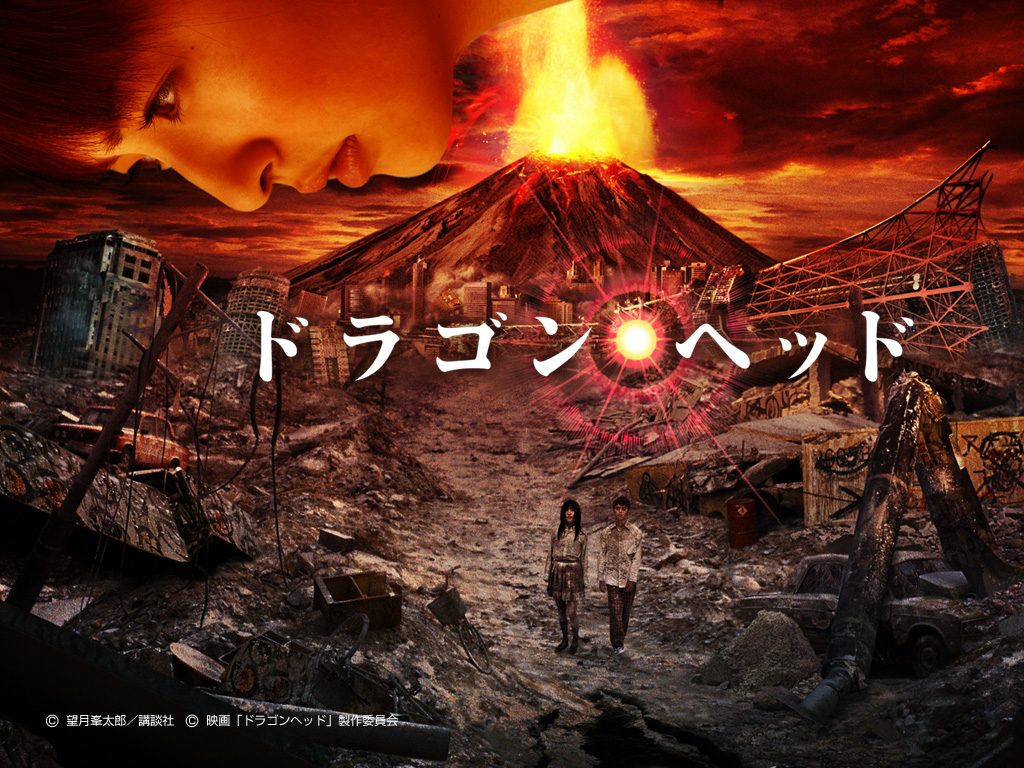
Dragon Head is a bleak, seventies style post-apocolyptic drama in which our ‘heroes’ discover that the threads that hold society together are incredibly weak and snap the moment the slightest pressure is placed upon them. Without spoiling too much, we never find out exactly what it is that has happened, only that whatever it was caused people to turn on each other in a terrible fashion and those few who have survived only want to forget. During in their travels our, frankly unbelievably clueless and incredibly lucky, duo come across a town full of men who’ve decided not to go on and don’t want anyone else to either; mercenary soldiers with dubious motivations; a pair of strange brothers who’ve been surgically altered to remove all trace of fear and sadness and myriad other examples of humanity’s darkest places.

In facing the successive crises, it has to be said that Teru and Ako are not exactly survival buffs. They react to each new situation in what might be termed a realistic fashion as far as two teenagers faced with seemingly impossible odds would do. Largely this means there is a fair amount of panic, crying, blind stumbling and a the recurrent idea of simply giving up. This realistic portrayal of ordinary people caught up in an extreme situation is quite refreshing and a direct contrast to the super smart, seemingly indestructible, level headed teens you often find in such movies. However, the vulnerability of the central couple may also be turn off those viewers who find them simply too whiny and wonder why they don’t get on with trying to find a better way to survive.

For what was seemingly quite a low budget picture shot on early digital, Dragon Head features some very impressive visuals. Making use of old school techniques like matte paintings alongside CG effects, the post apocalyptic landscape is rendered in an extremely convincing way and this is certainly one of those films that has made the best of what it had. In fact it benefits greatly from not relying on CGI to the extent other films of its era often did and so appears much less dated in comparison. Its real world effects and attention to detail mark it well above the some of the big budget disaster epics that began to appear around the turn of the century and help it become much more engaging as a result.

Dragon Head is not without its faults – it’s based on a manga which lends it an episodic structure which isn’t always conducive to good cinematic story storytelling. It’s also possible that some of the overarching mythology which isn’t really explored during the course of the film is more fully explained in the manga (not to mention the Seventies style ending) but really these are small problems. Dragon Head turns out to be much more impressive than you’d originally think it would be and offers a refreshing dose of bleakness that’s been absent from our screens for much too long.

Reviewed on R2 Japanese DVD release