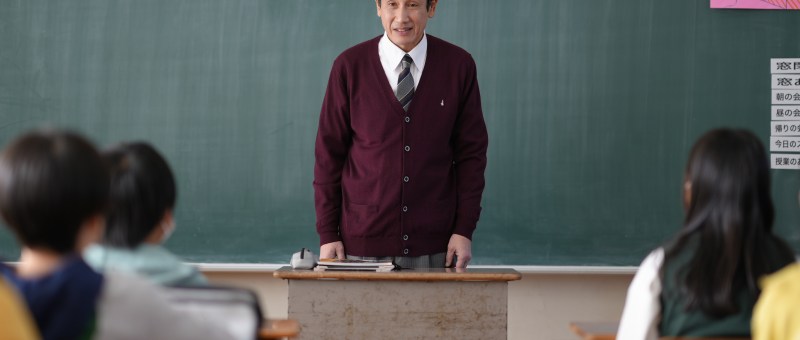
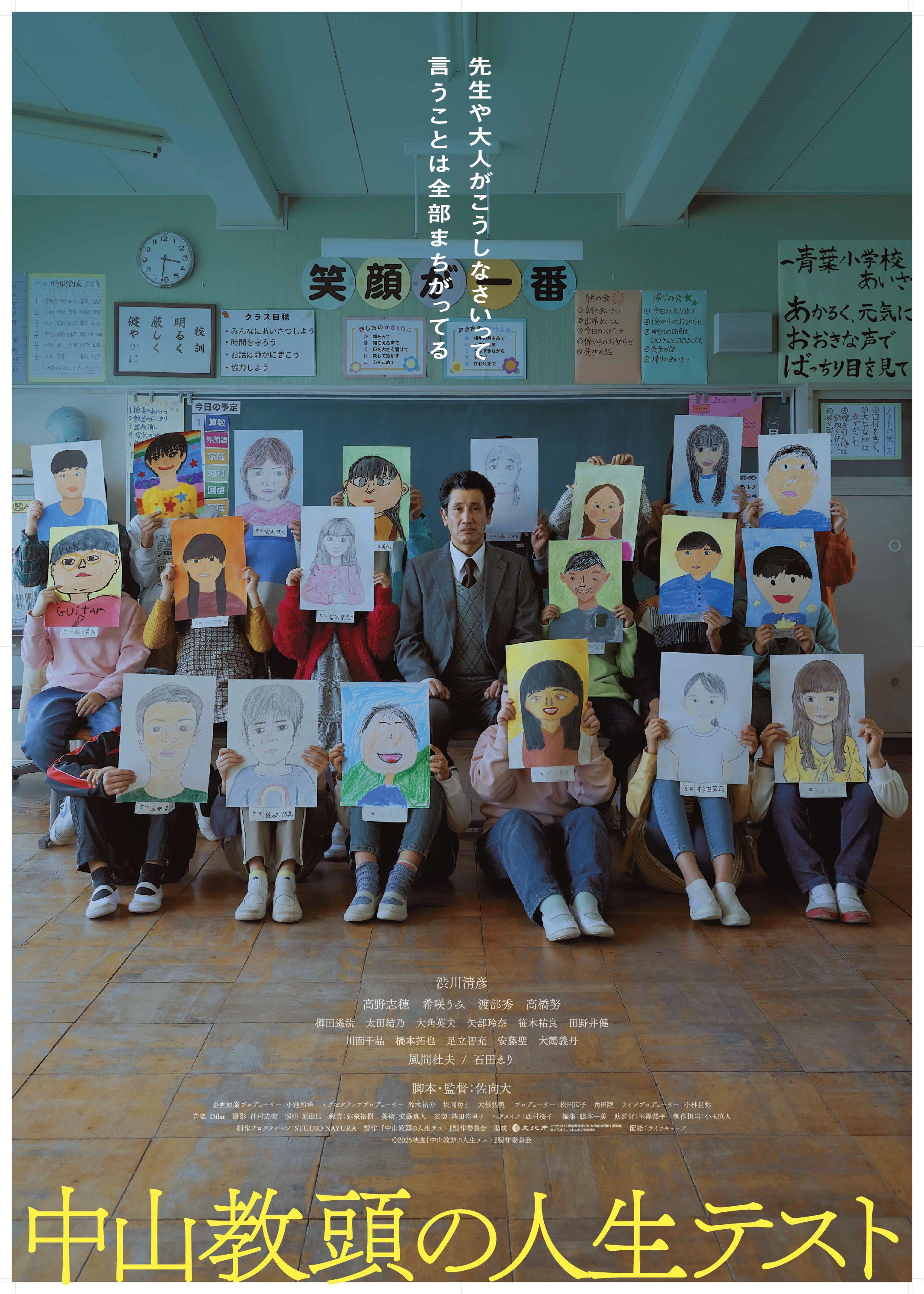
What is the place of the teacher in the contemporary society? Are they extensions of authority whose only role is to insist on order and produce children who will be obedient and know how to follow rules, or is it to educate and care for them so they can become the best versions of themselves free from the pressures of a conformist society? After taking some time away from active teaching, an absent-minded deputy headmaster finds himself confronted by just these contradictions as he’s suddenly tasked with taking over a class of primary school children while studying for the exams to qualify as a head teacher.
A mild-mannered man, it’s clear that Nakayama (Kiyohiko Shibukawa) is already overloaded and that the headmistress, Ms. Takamori (Eri Ishida), delegates most of her work to him. Though he was a frontline teacher for most of his career, he took an admin job after his wife’s death and seemingly lost his enthusiasm for the profession but quickly finds himself in the middle of a wider dispute about the scope of a teacher’s responsibilities to their students. He’s asked to take over after the current teacher, Kurokawa (Shu Watanabe), takes a leave of absence having come in for criticism from the children and their parents over his overly harsh teaching style. We see him force the children to repeat their morning greeting several times because they were not “in unison,” while he otherwise singles children out in front of the class for various rule infractions or poor performance. He appears to be more or less bullying some of the students, including Reona (Michiru Kushida), who comes from a single-parent family and is not able to get her mother to check her homework over for her because she just doesn’t have time.
There is a degree of push and pull between the teachers and parents over the shared responsibility for educating the child with some feeling that asking parents to do this kind of task is unreasonable while also reinforcing traditional gender roles in expecting there to be someone at home who is always available and dedicated only to raising children. This mistaken assumption disadvantages children like Reona while also stigmatising her in front of the rest of the class. Meanwhile, teachers are overly cautious of upsetting parents if they tell a child off in school. One irate father makes a point of coming in to see them when his son was merely questioned about something that happened after class and appears to be something of a bully himself. His son was one of the boys who criticised Kurokawa, and seems to have a lot of pent-up anger that could become a problem in the future but there isn’t much they can do about it at school.
Kurokawa had only been appointed because Ms. Takamori insisted on temporarily suspending the original teacher, Ms. Shiina (Shiho Takano), because of complaints about something that happened outside of school. She had accepted an invitation to a barbecue with the children’s families where a child fell over and was injured. Ms. Shiina was then criticised for not properly supervising the children though she had only been at the barbecue as a guest and wasn’t responsible for watching them. Nevertheless, she was criticised because her role as a teacher leads people to think that she should be somehow responsible for any children present even when attending in a personal capacity as a private citizen, further emphasising a blurring of the lines when assessing the boundaries around the roles of teacher and parent.
Ms. Shiina, who also appears to be queer coded, is presented as a more progressive teacher who doesn’t care about playing the game but only about the children’s welfare and wants them to grow up to be morally responsible people who can think for themselves. The irony is that Ms. Takamori may have been similar, later saying that Ms. Shiina reminded her of herself when she was younger, but because of the discrimination and prejudice she faced as a woman she decided her life would be best served by following all the rules so no one could complain. A former champion weightlifter, she had been criticised for a lack of femininity all her life and is also subject to the sexist and misogynistic judgements of the former headmaster, Kishimoto, who has made Nakayama his prodigy, but only if he plays the game which means becoming the kind of teacher who puts appearances first and enforces discipline rather than attempting to find out what’s going on in the children’s lives or fully understand the realities of class dynamics.
Indeed, it turns out to be the kids who are following the rules who are the worst and actively encouraging the semblance of order maintained through hierarchical bullying. Nakayama tries to investigate, but only arrives at half the truth and is torn between his desire to become a head teacher, which means submitting himself to the rigidity of the school system, and the idealism he once had for teaching. He finds himself effectively bullied, pressured into going along with things he doesn’t think are right which is the opposite of what he wanted for the children. As he eventually tells one of them, everything the teachers say is wrong, and what they really wanted to do was right, which is as close to admitting the irony of his position as it’s possible to get.
The film’s English title has its ironies too as this is also an examination of Nakayama’s principles and how far he’s willing to compromise on them to be validated by the system in becoming a headmaster. He betrays his principles when he takes the test, but gets away with it and is in fact uncomfortably praised for his hardline stance after lying to protect Ms. Takamori by saying it was his decision to suspend a pupil who was caught shoplifting and drinking though some criticise it for its unfairness on the child. After all, suspending them will just result in them having nothing to do and getting into more trouble. But on the other hand, some parents now see this child as problematic and don’t want them back at the school where they worry they may prove disruptive to their own children’s education and development.
The film offers no solutions though lands on the side of the children rather than the authority, sympathising with Ms. Shiina and encouraging Nakayama to regain his former idealism rather than become just another tool of an already oppressive social system. The fact that Nakayama loses his notebook implies a disregard for the kind of rules that are written in the headmaster’s manual and a return to his own judgement while leaving his final decision ambiguous as to which side of the line he will finally be on or whether he can really change this system from within. Though pretty bleak about the education system and its implications for the wider society, there is still a note of optimism in those like Ms. Shiina who don’t care about the rules so much as the children’s wellbeing that there is still a place for a more idealised form of teaching even within a fairly oppressive society.

PRINCIPAL EXAMINATION screens 31st May as part of this year’s Nippon Connection.
Trailer (no subtitles)

 Windows on Worlds