

Revolver LILY (リボルバー・リリー, Isao Yukisada, 2023)

A former assassin is drawn back into the light when an old colleague is framed for the murder of a small family in Isao Yukisada’s adaptation of Kyo Nagaura’s pulp novel, Revolver Lily (リボルバー・リリー). Set in the Taisho era, the film finds Japan at a crossroads amid an atmosphere of rising militarism in what is still a very poor country trying to change its fortunes through imperialism while those like Yuri (Haruka Ayase) attempt to stave off the oncoming apocalypse of war.

Though Yuri (whose name means “lily” in Japanese) had been part of a spy ring in Taiwan and trained to further Japan’s interest through political assassinations, she evidently came to see the error of her ways when the group was betrayed and an attack on their hideout led to personal tragedy. Since then, she’s lived as a well-to-do owner of a geisha house apparently under her own name which somewhat conflicts with the idea that she is simultaneously on an international most wanted list. In any case, she’s swept back into action when one of her former comrades, Kunimatsu, is accused of murdering the family of a man named Hosomi who is apparently on the run while militarists also seem to be intent on finding his teenage son Shinta (Jinsei Hamura).

Shinta, who was born with a lame leg which would presumably rule him out for military service, later becomes a kind of symbol of Japan as a more enlightened nation that no longer sees the need to use violence in order to advance its own interests. His father, Hosomi, had apparently done a series of dodgy deals with the military and then run off with all the money which is why they want to find him. It later turns out that he took the money not so much out of greed as that he was trying to turn the tide by growing the country economically in the hope that there would no longer be the need for imperialistic conquest.

Yet the money becomes a means of setting the army and the navy against each other in an increasingly straitened Japan in which neither feels they have the proper finding to pursue their ambitions. Constant references are made to the devastating economic impact of the 1923 earthquake, yet the authorities spend increasing amounts of money on waging war and there seem to be increasing numbers of soldiers on the streets. The army, in general, are depicted as loutish thugs with little on their side except brute force, while the navy in their pristine white uniforms are backroom plotters and always one step ahead.

But there is obviously a giant irony at the heart of the film in that as Yuri declares at the end, “fighting protest nothing,” having just taken out most of the Tokyo garrison in an effort to protect Shinta so that he can be preserved as a symbol of a new pacifist Japan. Though she tries to avoid mortally wounding anyone, Yuri is still prepared to use violence in order to combat it while the fact that merely fight on the side of capitalism suggests that there is, in fact, already a war going on between competing visions of the nation’s future which are both destined to come to pass. Capitalism, too, however, has its rough edges as symbolised by the grinning yakuza boss (Jiro Sato) who boasts of being “a man you can trust” but is only really ever on the side of greed and power.

Yuri, meanwhile, seems to be reawakened by her latest mission. She tells her assailant who accuses her of living in a state of nihilistic limbo, that she has made a choice a live which also symbolically aligns her with the new future opposed to the death cult that is militarism. Nevertheless, history tells us that whatever promises are made the militarists will win and the people will suffer. Yuri, however, continues fighting for peace with the film making full use of Haruka Ayase’s growing stature as an action star following on from franchises such as Caution, Hazardous Wife as Yuri effortlessly takes out huge numbers of army goons assisted by her female comrades. The closing scenes hint at further adventures for Yuri amid the vibrant Taisho-era setting taking on the forces of militarism with impeccable style and elegance.


Revolver LILY is available digitally in US from 27th January courtesy of Well Go USA.
POP! (Masashi Komura, 2021)

You’ve heard “turn that frown upside down”, but are you ready for turn that heart into a…well, perhaps that’s a sentence not worth finishing. The heroine of Masashi Komura’s MOOSIC LAB venture Pop! finds herself in a world of existential confusion on realising that what she assumed to be a heart symbolising love was in fact a giant bum intended to moon an indifferent society. Suddenly she doesn’t know up from down, her entire existence rocked as she contemplates life, love, and the pursuit of happiness on the eve of her 20th birthday. 

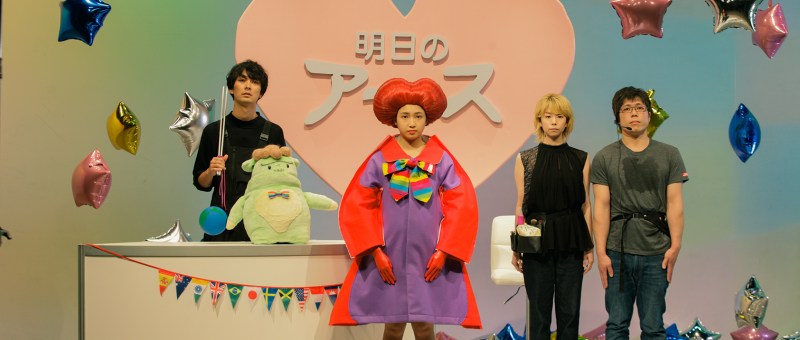
19-year-old Rin (Rina Ono) is currently the presenter/mascot character of local TV charity program “Tomorrow’s Earth Donation” which aims to collect money for the world’s disadvantaged children. Meanwhile, she also has a part-time job as a car park attendant which she takes incredibly seriously even though almost no one ever turns up (including her mysterious co-worker Mr. Numata). In fact, its Rin’s earnestness and youthful naivety which seem to set her apart from her colleagues, makeup artist Maiko later complaining that she makes others uncomfortable with her goody two-shoes act while her bashful present to puppeteer Shoji on his birthday of a framed portrait she’d drawn of him seems to elicit only confusion and mild embarrassment from her bantering co-workers. 

Nevertheless, she’s beginning to wonder about love, in her own way lonely and unfulfilled simultaneously confused and disappointed by the direction of her life. She dreamed of becoming an actress, but is now little more than a front for this strange enterprise in which she, characteristically, believes with her whole heart. Deep down, she just wants everyone to be happy and is sure that if people smiled more the world would be a brighter place. Wearing a giant red wig shaped like a heart, she reads out messages purporting to be from children outlining their dreams for the future even when they’re as banal and materialistic as wanting to become a race car driver. Unfortunately, however, she continually stumbles when asked to read a cue card featuring her own dream, fully scripted for the character she’s supposed to be playing. 

On her first audition, she was shouted out of the room by a director insisting her admittedly over the top improvised death scene was nothing more than attention seeking. The TV news attributes a similar motive to a mysterious bomber currently plaguing the city whom Rin accidentally witnesses one day fleeing the scene of his crime. For some reason struck by his strange presence, and perhaps disillusioned with her brief foray into online dating, Rin develops a fondness for him believing he is just like her because the pattern of his bombings corresponds to the shape of a giant heart enveloping the city. “We must get serious about saving the world!” she announces to her colleagues, “Let’s do it with a bang!” she ironically adds. She may, however, have slightly misunderstood his mission statement especially as when questioned as to his motives he tells her that he does it for the benefit of all because no one else will. 

In any case, she remains hopelessly naive, confused by a strange man who brings his van to the car park presumably for “privacy” and strangely unconcerned by an alarming message on an abandoned car left with its door open which states the driver won’t be needing it anymore. She role-plays direction and agency, but in the end goes nowhere until literally carried away by her “adult” realisation that it’s probably not possible for everyone to smile all the time and it’s not her job to make them. Caught up in the slightly duplicitous world of the cynical program makers who perhaps mean well but are hamstrung by the problems of contemporary Japan, desperate for pictures of smiling children only to realise that none are writing in and hardly any of them know any to ask, she maintains her desire for world peace even while privately conflicted in having lost sight of her own dream. Adopting a little of the bomber’s anarchist swagger, she allows herself to be swept up by a final flight of fancy towards a more cheerful world. Shot with a colourful “pop” aesthetic and a hearty slice of absurdist irony Komura’s strange fairytale is stuffed full of heart and has only infinite sympathy for its earnest heroine’s guileless goodness.


POP! screened as part of the 2021 Osaka Asian Film Festival.

Original trailer (no subtitles)