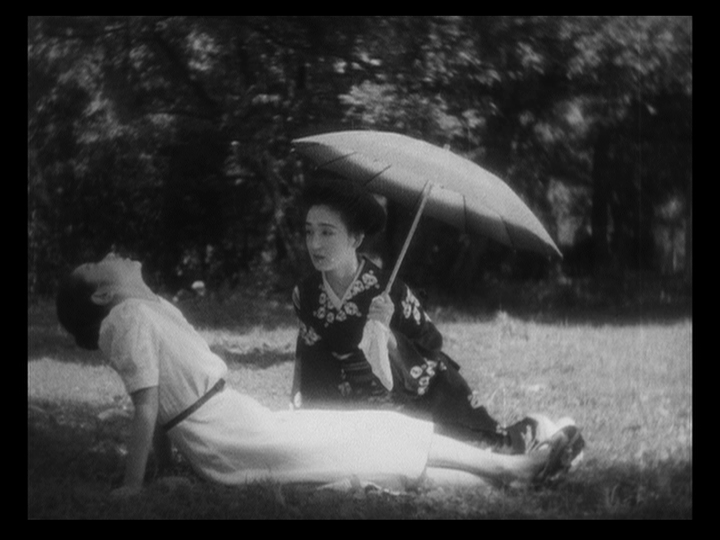
The Boss’ Son at College (大学の若旦那, Hiroshi Shimizu, 1933)

vlcsnap-2016-09-25-01h32m39s471It’s tough being young. The Boss’ Son At College (大学の若旦那, Daigaku no Wakadanna) is the first, and only surviving, film in a series which followed the adventures of the well to do son of a soy sauce manufacturer set in the contemporary era. Somewhat autobiographical, Shimizu’s film centres around the titular boss’ son as he struggles with conflicting influences – those of his father and the traditional past and those of his forward looking, hedonistic youth.

Fuji (Mitsugu Fujii) is the star of the university rugby team. In fact his prowess on the rugby field has made him something of a mini celebrity and a big man on campus which Fuji seems to enjoy very much. At home, he’s the son of a successful soy sauce brewer with distinctly conservative attitudes. Fuji’s father has just married off one of his daughters to an employee and is setting about sorting out the second one despite the reluctance of all parties involved. Everyone seems very intent on Fuji also hurrying up with finishing his studies so he can conform to the normal social rules by working hard and getting married.

Fuji, however, spends most of his off the pitch time drinking with geisha, one of whom has unwisely fallen in love with him. Like many teams, Fuji’s rugby buddies have a strict “orderly conduct” rule which Fuji has been breaking thanks to his loose ways. His top player status has kept him safe but also made him enemies and when an embarrassing incident proves too much to overlook he’s finally kicked off the team.

The times may have been changing, but Fuji’s soy sauce shop remains untouched. Gohei (Haruro Takeda), the patriarch, grumpily rules over all with a “father knows best” attitude, refusing to listen to his son’s complaints. In fact, he tries to bypass his son altogether by marrying off another employee to his younger daughter, Miyako. Though Miyako tries to come to the employee’s defence (as well as her own) by informing her father that “this way of treating employees is obsolete”, she is shrugged off by Gohei’s authoritarian attitude. He’s already tried this once by arranging a marriage for his older daughter but his son-in-law spends all his time in geisha houses, often accompanied by Fuji, and the match has produced neither a happy family nor a successful business arrangement.

Fuji is a young man and he wants to enjoy his youth, in part because he knows it will be short and that conformity is all that awaits him. His dalliance with a geisha which contributes to him being kicked off the rugby team is in no way serious on his part (caddish, if not usually so). However, when he befriends an injured teammate and meets his showgirl sister, Fuji falls in love for real. This presents a problem for the friend whose main commitment is to the rugby team who were thinking of reinstating Fuji because they have a big match coming up and need him to have any chance of not disgracing themselves. This poor woman who has apparently been forced onto the stage to pay her brother’s school fees is then physically beaten by him (if in a childishly brotherly way) until she agrees to break things off with Fuji for the good of the rugby team.

Fuji is finally allowed onto the pitch again, in part at the behest of his previously hostile father who thinks rugby training is probably better than spending all night drinking (and keeping his brother-in-law out all night with him). The loss of status Fuji experienced after leaving the team rocked him to the core though his central conflict goes back to his place as his father’s son. At one point, Fuji argues with a friend only for a woman to emerge and inform him that his friend had things he longed to tell him, but he could never say them to “the young master”. Fuji may have embraced his star label, but he doesn’t want this one of inherited burdens and artificial walls. Hard as he tries, he can never be anything other than “the boss’ son”, with all of the pressures and responsibilities that entails but with few of the benefits. Getting back on the team is, ironically, like getting his individual personality back but also requires sacrificing it for the common good.

In contrast with some of Shimizu’s post-war films which praise the importance of working together for a common good but imply that the duty of the individual is oppose the majority if it thinks it’s wrong, here Fuji is made to sacrifice everything in service of the team. At the end of his final match, Fuji remarks to his teammate that this is “the end of their beautiful youth”. After graduation, they’ll find jobs, get married, have children and lose all rights to any kind of individual expression. Fuji is still torn between his “selfish” hedonistic desires and the growing responsibilities of adulthood, but even such vacillation will soon be unavailable to him. Ending on a far less hopeful note than many a Shimizu film with Fuji silently crying whilst his teammates celebrate victory, The Boss’ Son Goes to College is a lament for the necessary death of the self as a young man contemplates his impending graduation into the adult world, but it’s one filled with a rosy kind of humour and an unwilling resignation to the natural order of things.
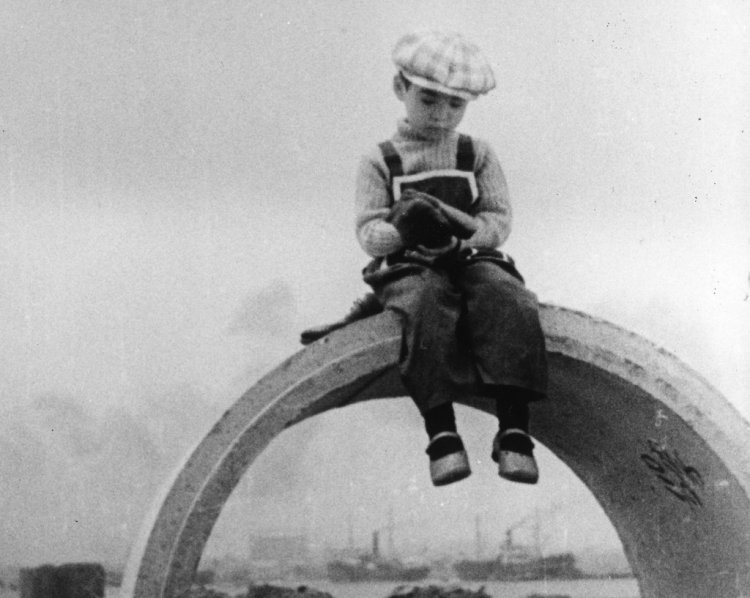


Every-Night Dreams (夜ごとの夢, Mikio Naruse, 1933)

Every Night DreamsFollowing on from Apart From You, Naruse returns to his exploration of working class women struggling to get by in a male dominated world in Every-Night Dreams (夜ごとの夢, Yogoto no Yume) also released in 1933. This time we meet weary bar hostess Omitsu who has a young son she’s raising alone after her deadbeat husband ran out on them a few years previously.

Omitsu doesn’t particularly like working in the bar, but as her mama-san grudgingly admits, she is quite good at it. She’s a modern woman who can drink and smoke and flirt to keep the guys buying drinks and wanting more though she’s finding it increasingly difficult to deflect some of the more intense interest such as that from a sleazy boat captain that her boss is eager to keep happy. Whilst at work, her son is looked after by a kindly older couple in her building who urge her to find a nicer line of business or get married again to a more reliable man.

The gentle rhythms of her life are disrupted when her long absent husband finally reappears. After first rejecting him outright, Omitsu eventually relents and lets him back into her life. However, despite his seemingly sincere pledges to change, get a proper job, start being a proper husband and father, Mizuhara fails to achieve any of his aims and also becomes increasingly jealous about Omitsu’s job at the bar. When their son, Fumio, is injured in an accident and requires expensive medical treatment, events reach a tragic climax.

Naruse would return to women alone facing a difficult economic future in many of his films but Omitsu’s situation is only made worse by the ongoing depression. Realistically speaking, there are few lines of work available to a woman in Omitu’s position and the more well regarded of them probably wouldn’t pay enough to allow her to keep both herself and her son, even as it stands she tries to borrow money from the bar to “reward” the older couple who watch Fumio while she’s working (though of course they wouldn’t take it). Omitsu herself feels there’s something degrading about her work and when her friend advises her to remarry, she exclaims any man worth a damn would run from a woman like her. Unfortunately, she may, in some senses, be right.

The man she ended up with, Mizuhara, is most definitely not worth a damn. It’s not entirely his fault he can’t find work – he does look for it and appears to want to find a job but in this difficult economic environment there’s not much going. Applying at factory, he’s turned down almost on sight because he’s a weedy sort of guy and doesn’t look like he’s cut out for physical labour. His inability to get ahead and provide for his wife and child sends him into a kind of depression and self esteem crisis which has him thinking about leaving again, especially as his increasing jealousy threatens his wife’s bar job which is their only form of income (whether he likes it or not). Fumio’s accident forces his hand into a series of bad decisions taken for a good reason but which again only cause more trouble for his family.

Naruse is a little flashier here than in Apart From You using canted angles, faster editing and even more zooms to hint at the panic felt by Omitsu in the increasingly distressing situations she finds herself in. Like the train accident in Flunky, Work Hard, the news that Fumio has been hit by a car is delivered in an expressionistic style beginning with his father putting down the boy’s toy car as a troupe of kids arrive and the screen is stabbed with a series of rapidly edited, alternating angle shots of intertitles mingled with the shocked reaction of the parents and the other children. If Naruse felt compelled to provide an ending with some sort of hint of far off promise in previous films, here he abandons that altogether as Omitsu laments her sad fate and instructs her son to grow up strong, not like his father, but like the mother who is doing everything she can to ensure his life won’t always be like this.


Every-Night Dreams is the fourth of five films included in Criterion’s Eclipse Series 26: Silent Naruse box set.

Ornamental Hairpin (簪, Hiroshi Shimizu, 1941)

ornamental hair pinShimizu goes on holiday! Again! Actually, when you think about it going on holiday is always inherently sad because just like everything else holidays end and you have to return to whatever it was that made you want to go on holiday in the place only with the painful reminder that a more cheerful world exists and you’re no longer in it. That rather depressing preamble out of the way, it’s time to join the temporary residents of a small hot springs resort in the picturesque countryside where a mislaid hairpin is about to kickstart a series of mini epiphanies in the diverse collection of guests.

We arrive at the inn in the company of Emi (Kinuyo Tanaka) and her friend Okiku (Hiroko Kawasaki) on a brief visit from the city. The inn is very full right now with a festival in town and everybody seems to want a massage! Another guest, the extremely grumpy professor Katae (Tatsuo Saito), is put out that the tour groups are sapping all the hotel’s resources and complains vociferously to his go partner who is staying at the inn with his two grandsons Jiro and Taro. Other guests at the inn include a mild mannered husband and his wife, Mr. (Shinichi Himori) and Mrs. (Hideko Mimura) Hiroyasu, and a recuperating soldier, Mr. Nanmura  (Chishu Ryu). Eventually the tour groups go home taking Emi and Okiku with them, but Emi discovers she’s left her ornamental hairpin behind and sends a letter offering to pay for the return postage if anyone should find it.

Mr. Nanmura finds it in his foot one day as he’s enjoying the hot springs and even though he’s not that bothered about it, complaining expert Professor Katae can’t make enough of a fuss about the supposedly shoddy conditions at the hotel. When the hotel owners write to Emi and explain to her what’s happened she jumps straight on a train to apologise in person.

Nanmura had actually been quite happy about getting skewered by the pin. He says he found it “poetic”, as if the atmosphere of the place had penetrated deeply into his skin. The supposedly learned Katae doesn’t quite understand the soldier’s poetic leanings and starts debating whether the owner of the pin will be pretty or not, as if that would make a difference to the soldier’s romantic construction of events. Emi is indeed very beautiful, through perhaps a little sad and obviously contrite about the pin. Everyone in the inn is quite invested in witnessing a true love miracle between the bizarrely crippled soldier and the wounded beauty from Tokyo.

Once again the inn is a constructed world, a safe haven far away from the trouble and strife which exists outside it. The guests indulge themselves in the tranquil atmosphere taking in the beautiful scenery and killing time on otherwise trivial pursuits which occasionally include projecting a kind of narrative on their new found friends. The two boys, totally bored by this deliberately unstimulating environment, turn everything into a competition – even cheering on their grandfather as snores along side the equally noisy professor with the result that pretty much no one else is getting any sleep. Later they help the injured soldier recover with a set of endurance games which see him trying to walk unaided from one tree to another and eventually across a bridge.

Further comic relief is provided by the Hiroyasus with the husband being the sort of mild-mannered man who has no idea what he actually thinks so he just goes along with everything everyone says (and later checks with his wife who has the ultimate authority). Hiroyasu often defers to the professor whose authoritative tone gets things done for him though he is in fact an extremely self centred prig who just loves to complain out of a desperate need to be validated. He’s the loudest snorer of all and is keeping everyone awake yet he constantly complains about the noise of the other guests and is quick to shout at the inn keeper when he can’t get a massage because they’ve been booked by the visiting tour groups the very presence of which also annoys him. Eventually he gets so grumpy he just goes home which is probably a win/win for everyone.

But what of Emi herself? She too is escaping from something. The loss of the ornamental hair pin and its rediscovery leading her to the inn and perhaps to Nanmura has pushed her into a further consideration of her life in Tokyo. She doesn’t want to go back, this brief respite has been too pleasant and she wishes it could go on like this forever, though she knows, of course, that it can’t. She doesn’t know what she’s going to do now, but at least while she stops at the inn the sun will light the way. This is 1941, Nanmura will probably be going back to the war, the future is uncertain for everyone, but in here everything is beautiful, calm, safe. It’s just a shame it can’t last.


Ornamental Hairpin (簪, Kanzashi) is the fourth and final film in Criterion’s Eclipse Series 15: Travels with Hiroshi Shimizu box set.

Clip of one of Nanmura’s “trials” (no subtitles):

https://www.youtube.com/watch?v=WojtILzbaBk

Japanese Girls at the Harbor (港の日本娘, Hiroshi Shimizu, 1933)

japanese girls at the harbourHiroshi Shimizu made over 160 films during his relatively short career but though many of them are hugely influential critically acclaimed movies, his name has never quite reached the levels of international renown acheived by his contemporaries Ozu, Naruse, or Mizoguchi. Early silent effort Japanese Girls at the Harbor (港の日本娘, Minato no Nihon Musume) displays his trademark interest in the lives of everyday people but also demonstrates a directing style and international interest that were each way ahead of their time.

A classic melodrama at heart, Japanese Girls at the Harbor begins with two school girls living their humdrum lives of commuting back and for to school in early 1930s Yokohama. Dora and Sunako attend a Catholic school in the “foreign quarter” of the city and are devoted best friends who swear they’ll stick together for ever. However, motorcycle riding bad boy Henry rips right through their friendship in the way that only a bad boy can. Sunako abandons Dora at the harbour to ride off with Henry (later apologising to her understanding friend) but it turns out that Henry likes hanging round with gangsters and also has something going with an older lady called Yoko.

Dora tells Sunako if she really loves Henry she’ll just have to accept him for what he is before going off to find the cheating louse herself and give him a piece of her mind. However, when Sunako catches Henry and Yoko together she loses the plot entirely and ends up running off out of the city. Time passes and Sunako returns but in shame as she’s become a prostitute living with a painter whom she doesn’t seem to care for very much at all. Can she repair the damage with the now married Dora and Henry and get herself out of the hell her existence has become, or is she forever doomed to the life of a fallen woman?

Made in 1933 just as Japan was heading into its militarist era, Japanese Girls at the Harbour has an oddly international mindset with its Western houses, names and a Christianising atmosphere. An international port, there’s plenty of the outside world to be found in Yokohama where things seem to leave much more often then they arrive. Sunako says watching the boats leave makes her feel sad, but it’s she who will go off on one of Shimizu’s trademark travels, running from a crime of passion and the ache of a breaking heart.

A true friend, Dora has not abandoned Sunako and is willing to welcome her back into her home. Henry, the first to meet Sunako (at her place of employ) is torn between the old attraction, feelings of guilt over what’s happened to her, and his responsibility to Dora as her husband. Shimizu introduces an interesting metaphorical device as Henry and Dora wind a ball of wool whilst sitting together in their Western style house but as soon as Sunako arrives it falls onto the floor and begins to unravel, eventually becoming tangled up around the feet of Henry and Sunako who dance in the living room while Dora prepares a meal. Suddenly seeing her married life unravel just like this shaggy ball of wool, Dora, though still devoted to her friend, begins to feel a little afraid that Sunako may be about to jump back on the bike with Henry, just as she did all those years ago.

Shimizu’s interest is much more with the two young women than it is with Henry who remains very much a prize not worth winning. This is Sunako’s fallen woman story – eventually she comes to feel that she’s bringing too much disruption into the lives of her old friends who were getting on so well before. Henry and Dora were her last lifeline to her old self, the only old friends she could still count on, but if she wants to save them (and herself) she will have to stay away and lose them forever. Her redemption lies in self sacrifice, in giving up something that made her profoundly happy for its own good despite the immense amount of suffering she will incur in doing so.

Shimizu was one of the earliest proponents of location shooting and he does make good use of the atmospheric Yokohama streets before heading indoors for the seedy, smoky clubs and cheap tenement housing. He also introduces a series of strange jump zooms at two moments of unusually high emotion which add a degree of panic to the scene as well as heightening the nuanced reactions of the characters in question. This, coupled with his use of dissolves which often sees characters simply evaporate from the frame like unwelcome ghosts of memory, lends to the almost noir-ish, melancholic tone with its dream-like blurring of the real and the merely recalled.

An interesting example of international cross pollination in the early 1930s before hard line militarism became entrenched, Japanese Girls at the Harbor is a pregnantly titled story of a wronged woman abandoned on the shore and left with the choice to board a boat to fairer climes or remain behind and risk destroying what she most loved. The past becomes something to be absorbed and then put to rest. Ghosts cannot travel by water, and so you must leave them behind, like girls at the harbour staring sadly at departing ships.


Japanese Girls at the Harbor is the first of four films in Criterion’s Eclipse Series 15: Travels with Hiroshi Shimizu box set.

Video clip of a climactic scene which showcases Shimuzu’s jump zoom technique (presented without musical score but does have subtitles for the really quite amazing intertitles which are a definite highlight of the film).

(Video clip courtesy of Mubi)