Arrow double whammy up at UK Anime Network as I review both of Arrow’s recent Yasuharu Hasebe releases – Massacre Gun and Retaliation!

Arrow have been turning up some hidden gems and neglected classics as they trawl through the world of the populist cinema from the Japanese golden age of the 1960s and 70s – they’ve already brought us the iconic Lady Snow Blood, the lesser known Blind Woman’s Curse, the anarchic Stray Cat Rock series and now, following on from their release of Seijun Suzuki’s famously crazy Branded to Kill they’ve turned their attention back to Nikkatsu Noir with Massacre Gun. The first of two releases from director Yasuhiro Hasebe who also directed three films in the Stray Cat Rock series (Retaliation will follow next month), Massacre Gun has everything any genre fan could wish for – depressed hit men, warring gangs, jazz bars, boxing clubs, stylish monochrome photography and the melancholic ennui that permeates all the best noir movies. Perhaps not quite as impressive as the greatest hits of Nikkatsu Noir such as the afore mentioned Branded to Kill or Nikkatsu’s other offerings like A Colt is My Passport, Massacre Gun is nevertheless another impressive entry in the studio’s short lived action output.
As the film begins, thoroughly dejected Kuroda has just been asked to carry out a hit on a woman who is in love with him – feelings which he may have have reciprocated but, but like any good lackey, Kuroda chose his boss over his heart and sent the love sick girl into a lake with a bullet in her chest. When Kuroda’s two younger brothers find out they do not approve and hot headed youngest brother Saburo who trains at a yakuza run gym hoping to become a a pro-boxer, decides to have a word with Kuroda’s boss, Akazawa. As might be expected things don’t go Saburo’s way and he’s brutally beaten to the extent his hands are all but crushed leaving him unlikely to box again. At this point, Kuroda wants out of the game – but for a yakuza hit man there is no out. His only option is to take down Akazawa’s empire and build one of his own.
Like most of Nikkatsu’s late ‘60s action output which would later retroactively become known as Nikkatsu Noir, Massacre Gun is heavily indebted to the American B-movie and particularly to the film noir. Its settings are those of “low culture”, Western bars and cafes where people drink expensive whiskey and wear sharp suits and sunglasses. In fact, the Kuroda brothers’ side business involves running a jazz bar with a half Japanese-half African American jazz singer playing piano in the corner and a pair of Western dancers doing some sort of scantily clad, artistic ballroom dancing routine in the middle. Most importantly it’s full of the classic Film Noir feeling of spiritual emptiness and existential ennui with the very depressed contract killer Kuroda at its centre.
A very male affair (perhaps the key missing element from a Film Noir is a femme fatale), the bulk of the film is the opposition between Kuroda on the one side and his former boss on the other. Other than the closeness with his two younger brothers and to a lesser extent the other workers at the club, Kuroda’s other most notable relationship is with his old friend Shirasaka who coincidentally married another woman Kuroda may have had feelings for. Though the two have enjoyed a close friendship up until now, Kuroda’s decision to leave Akazawa’s employ has meant Shirasaka has had to make a choice and he’s chosen Akazawa. The two are are now mortal enemies on opposing sides of a war – a fact which causes them both pain but which, nevertheless, cannot be otherwise.
Hasebe is best known for his striking use of colour which makes Massacre Gun a notable entry in his filmography as it’s the only one he made in black and white. Other than the perverse habit of sticking colours into the names of his leading characters and locations (the “Kuro” in Kuroda means “black”, the “Shira” in Shirasaka means “white” and the “Aka” in “Akazawa” means red making this one very complicated game of checkers), Hasebe still manages to make an oddly “colourful” film even in monochrome. Taking a cue from Suzuki, Hasebe has come up with a fair few arty and unusual compositions of his own though not quite to Suzuki’s absurd extremities and neatly retained the classic Nikkatsu Noir aesthetic in his superbly crisp black and white colour palate.
Coming as a late addition to the genre, Massacre Gun also takes a fairly unusual approach to violence with a far more explicit representation than would be expected from this period. Simply put – lots of people die in this film, many of them in quite exciting ways. Blood is everywhere and there are so many bullets fired you start to wonder if some one in the yakuza equivalent of the administration department isn’t having some kind of heart attack behind the scenes. Massacre Gun might not be the best entry in the Nikkatsu Noir series, but it is perhaps one of the most typical. Edgy and arty, exquisitely framed and perfectly photographed it brings out the effortless cool that came to symbolise Nikkatsu’s late ‘60s output. Aside from all that – it’s just fun as most of these films are. Another welcome release from Arrow who continue to root out these lesser known genre movies, Massacre Gun is a must see for fans of classic ‘60s action movies.
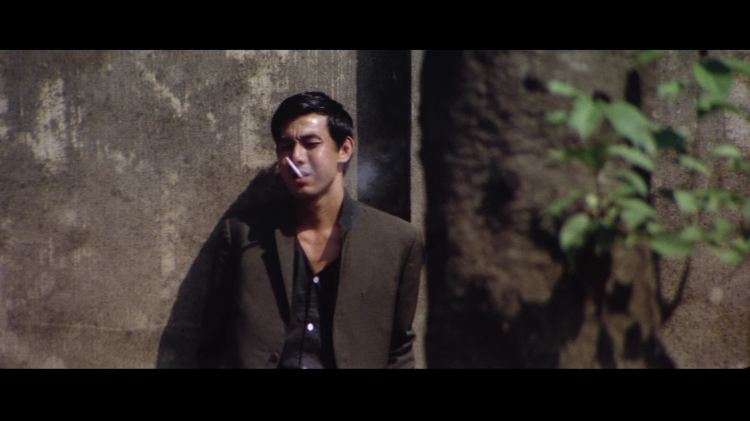
Arrow are back with another neglected classic of Japanese action cinema produced by Nikkatsu – Retaliation, a slightly later film from Yasuharu Hasebe director of Massacre Gun and three out of five of the Stray Cat Rock series. Unlike Massacre Gun (but like every other film Hasebe ever made), Retaliation is shot in colour and features Hasebe’s trademark use of it. Retaliation is very typical of its genre in someways and very not in others. It stands on something of a borderline seemingly symptomatic of Nikkatsu’s eventual slide into a producer of soft core pornography as their Roman Porno line of sex and violence based movies took over as their main production style. Not as strong as some of the other entries from around this time, Retaliation nevertheless marks itself out as an interesting addition to the genre.
Not one of the most exciting plots in yakuza movie history, Retaliation’s main mcguffin centres around trying to persuade some farming families to sell their ancestral land to developers who want to build a factory there. Having just been released from prison after taking the fall for gang murder, Jiro is offered the chance to head up his own group, however his patch is between two rivals and his best bet is to play the two off against each other as they both vie for this disputed farmland. One group is super old school and the other is the more modern type of thug who’ll do pretty much anything to get what they want – including abducting one of the farmer’s daughters and molesting her in the back of a car as a way to threaten her father. Jiro is given his own mini team to help out on his mission including an out of work actor and card shark, and another top yakuza guy who just happens to be the brother of the man he went to prison for killing and who has already vowed to killed Jiro in revenge. Jiro sometimes dreams of going straight and leading a different kind of life but gang loyalty still means something to him and those outside of the life aren’t always so understanding. Retaliation is the only way to stay alive in this new, empty yakuza world.
Retaliation starred three of Nikkatsu’s famed “Diamond Line” stars – Akira Kobayashi is the film’s lead leaving Jo Shishido playing second fiddle (his star had fallen a little at Nikkatsu and they didn’t see him as an actor who could carry a colour film as the leading man), and Hideki Nitani coming in third. Tatsuya Fuji and Meiko Kaji round out the almost famous section of the cast and each would soon find fame (or notoriety) in the new landscape of ‘70s Japanese cinema. There’s undoubtedly an air of everybody just doing what they do – it is after all what they’ve been employed for but at the same time no one’s really pushing themselves to do anything very notable. That said, you do have five of the biggest (or soon to be biggest) names of the time in one movie which gives it a feeling of a prestige project. However, in another move that anticipates the direction in which Nikkatsu was headed, the sex and violence quotient has been significantly upped.
Nikkatsu action films could already be shockingly violent for the time period, but Retaliation unfortunately adds a layer of sexualised violence against women which is undoubtedly being offered up as something for the viewer to enjoy. The early scene in which Meiko Kaji’s farmgirl is molested by a gang of thugs before being dumped at her parents’ house is unsettling on one level, but is shot with such a voyeuristic camera style that it’s difficult to not feel complicit in this fairly horrific act. There’s even another such sequence later in the film when one yakuza is forced to give up a girl he’s with so all his yakuza mates can have a go first which is again shot with a lingering camera often cutting back to the salivating gangsters. Of their time in one sense, these sadly salacious scenes of sexual violence against women filmed with an encouraging eye give the film an unwelcome sleazy quality from which it is hard to bounce back.
The other notable theme of the film is that it positions itself between the glamorous, modern samurai, gangster movies of the past and the grittier tales of modern thugs that were about to become the mainstream narrative. Jiro has been away for a long time, the yakuza world has moved on and his old clan would have died out if weren’t for another gang’s generosity. Jiro is the last of the honourable men who place loyalty above personal gain and seek to protect women and the put upon rather than exploiting them. Unfortunately, modern yakuza think differently and it’s no small irony that it’s a group of farmers they’re falling over themselves to ruin given that farmers are the very people old school yakuza, as the receivers of samurai values, would be expected to protect. Jiro and some of his cohorts still believe in these “old fashioned” ideas and are thought brave and noble. The other gangs who rape and torture women whilst forcing farmers off the land they’ve worked for centuries are not.
Again, it’s a fairly manly affair with women becoming little more than props to be used and abused throughout the film but the relationship between the two central guys Jiro and Hino takes on an oddly homoerotic context even ending with Shishido’s character getting rid of his girlfriend because he apparently falls in love too easily before telling Jiro that this is the first time it’s been with a guy. Considering their relationship began with Hino determined to kill Jiro, to end it with a quasi declaration of love (even half in jest) is a pretty steep character arc but one of the better things about the film.
Retaliation isn’t a perfect film, and it might not have the most exciting basis for its plot machinations but it certainly has its moments. Entertaining enough, the film is marred by its unpleasant treatment of women and takes a few dramatic missteps towards the end. The action is good however, as are the performances and production values. Perhaps not an essential Nikkatsu action movie but nevertheless a very interesting one from several different perspectives, Retaliation deserves a view from the genre’s committed fans.
Both available now in the UK on DVD & blu-ray from Arrow Films!
 Windows on Worlds