Scorpion: Double Venom (サソリ・女囚701号, Ryoji Niimura, 1998)

Scripted by Sasori in USA’s Daisuke Goto, Scorpion: Double Venom (サソリ・女囚701号, Sasori: Joshuu 701-go) brings Nami back to Japan but with an all new backstory and motivation for revenge. In the films up to this point, Nami is betrayed by a man she loves and thereafter seeks a revenge that becomes progressively less personal, striking out against entrenched patriarchy and societal misogyny. This time, however, she’s to avenge the death of a girl she couldn’t save, her sister, Yumi, who was kidnapped and murdered as a child.

Like that of Sasori in the USA, this Nami (Chiharu Komatsu) is a highly educated woman, in fact a doctor. Immediately recognising a patient as the man responsible for abducting her sister all those years ago she is left with a dilemma. She confronts him and he laughs at her. As it turns out, the statute of limitations on his crime ran out the day before, so Nami’s plan to turn him in to the police is rendered a no go. As he continues to taunt her and makes suggestive comments about the little girl inexplicably in the next bed sharing a ward with an adult man, Nami ends up stabbing him to death with her scalpel but just before he dies, he tells her that he didn’t kill her sister after all. It was his accomplice, a one-armed man!

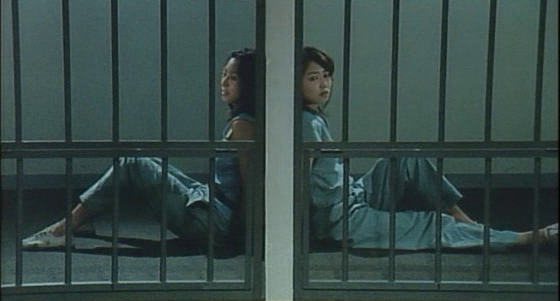
Nevertheless, Nami’s revenge will be delayed because she’s quickly carted off to prison for 10 years of hard labour. Unlike those in the other films, this prison is mainly run by women but the warden is a predatory lesbian who extracts sexual favours from the inmates with the vague promise of early parole and claims that this place is like heaven if you play by the rules. After getting sent to solitary for fighting, Nami befriends another woman, Sayuri (Miho Kiuchi), who reminds her of her younger sister, and discovers that she is shortly to be executed at the gallows hidden in the deepest recesses of the prison. Sayuri is apparently not guilty of the crime for which she is serving her sentence but was talked into taking the fall for a sleazy politician who murdered her friend so that her older sister’s medical bills would be covered. Her death sentence is for accidentally killing a guard during a previous escape attempt. All her subsequent attempts to escape have been so that she could see her sister one last time before she dies.

The theme this time is then sisterhood as the two women fill in the missing half for the other and bond in their shared misuse at the hands of the justice system. Nami becomes determined to save Sayuri in the way she couldn’t save Yumi, but her struggle eventually takes on a larger dimension in keeping with those of the previous films as she tries to get revenge for Sayuri too after discovering that her death sentence was partly handed down by the murderous politician trying to tidy up loose ends as he plans career advancement with the aid of his entire amoral aide, Naruse (Tomorowo Taguchi). Escaping from the prison, she literally and symbolically frees all of the women who then take their own revenge on the sadistic warden.

For all of its seriousness, the film does have its faintly ridiculous qualities such as Nami’s use of electrical wiring as a defibrillator that allows her to resuscitate Sayuri after she’s hanged by the warden at the politician’s instigation. She later uses these same wires ripped from the wall to electrocute the warden’s bruiser male guard though it’s Sayuri who hot wires the prison van so they can escape. Eventually, she’s hunted down by a man with a crossbow and in a nod to the original trilogy, stabs him in the eye. Still, with her own revenge still in progress, Nami effectively avenges all her sisters while fighting for justice. Tracking down the videotape Sayuri had hidden proving the politician’s guilt, she eventually exposes him along with all his corruption bringing down the complex network that had extended out into the prison and trapped so many other women. Now a fugitive, Nami chases the one-armed man and has once again become an avenger of women bringing justice to those failed by an inherently corrupt and misogynistic justice system.

A Snake of June ((六月の蛇, Shinya Tsukamoto, 2002)

Mr9TSdN - ImgurOne day, I will add some new content to this blog! Today is not that day. Nor is tomorrow, or the day after or the day after that (probably) but someday soon and for the rest of my life! Sorry, carried away there. Anyway, review of the newly restored HD blu-ray release of Shinya Tsukamoto’s masterpiece A Snake of June up at UK Anime Network. It’s very weird and I love it a lot.


Shinya Tsukamoto made his name with body horror infused, pulsing cult hits such as Tetsuo the Iron Man, Tokyo Fist and Bullet Ballet (all of which are also available in the UK on blu-ray courtesy of Third Window Films). He’s no stranger to the avant-garde, the surreal or the troubling but even then Snake of June takes things one step further than even his generally intense filmmaking would usually go. A literal “blue movie”, Snake of June is the story of one woman’s sexual awakening, her husband’s release from OCD and the final fulfilment of the couple’s relationship set against the backdrop of a cold and unfeeling city.

Rinko is an attractive, if slightly mousy, young woman who works a telephone counsellor at a Samaritans-like call centre. As for her homelife, she lives in an upscale Tokyo apartment with her salaryman husband Shigehiko. It’s unkind to say, but the couple are a total mismatch – Rinko, young and pretty even if a little shy, is obviously way out her slightly overweight, balding middleaged husband’s league. Though they seem to have a pleasant enough relationship, there’s no spark between them and they live more like friends or roommates than a married couple. Shigehiko also has an extreme love of cleaning and a touch of OCD that sees him more often caressing the bathtub rather than his wife.

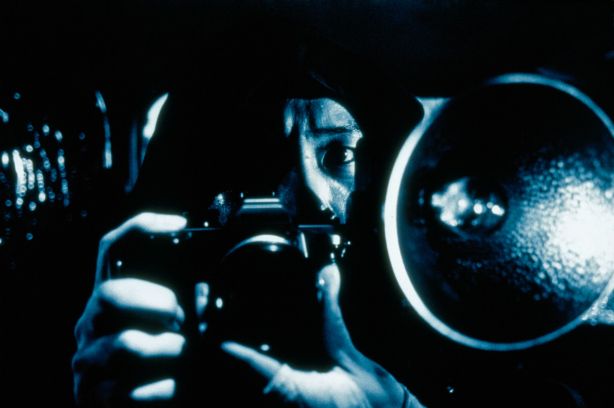
All that changes however when Rinko receives a mysterious envelope full of voyeuristic photos of her masturbating and looking up erotic material on the internet. Soon enough, it turns out these are a “gift” from a troubled photographer, Iguchi, who had planned to commit suicide before talking to Rinko on the helpline. Now he wants to help her by encouraging her to embrace her sexuality and her deepest, darkest desires. Iguchi sets her several tasks to set her on her way such as buying sex toys and walking through town in revealing outfits in an attempt to make her more comfortable with her own sexuality. However, having watched Rinko blossom, Iguchi eventually turns his attention to her husband and events take a decided turn for the surreal.

Erotic – yes, in some senses of the word, but never exploitative. Shot in a melancholy blue designed to mimic the color of the falling rainwater that stains a rainy season June in Tokyo, A Snake of June is a neon inflected journey into urban isolation where the demands of city life drown out the inner fire of those who live in it. Shy and repressed Rinko makes her first foray into town wearing the ridiculously short skirt her blackmailer has “prescribed” for her nervously, clutching a long umbrella in front of her like a shield. Making the same journey sometime later Rinko walks with a swagger, almost dancingly flirtatious she owns herself – her former shield is now a sword. Her “awakening” has nothing to do with her husband or with Iguchi, it’s something she’s achieved for herself and by herself and has left her a happier and more complete person than she’s previously been allowed to be.

Her husband, Shigehiko, by contrast hasn’t quite come to terms with this new version of his wife and even when graphically confronted with it responds in an entirely passive, selfish way. Cracking Shigehiko’s shell will require a little more than gentle coaxing, manipulation and blackmail and thus begins the nightmarish second volume of the film which becomes increasingly bizarre from here on out. Strange drowning themed sex shows where a woman bangs a drum and you have to wear a funny cone on your face which only lets you view everything through a tiny circle like the iris of a an old silent movie? It’s certainly an unorthodox solution.

Like all of Tsukamoto’s work, A Snake of June is exquisitely shot with its blue tint only adding to its native beauty. This new blu-ray edition from Third Window Films remastered from the original negative and supervised by Tsukamoto himself is a pristine presentation of the film which reveals all the tiny details that were rendered invisible by previous transfers. Strange and surreal, A Snake of June is a richly multilayered film dripping with symbolism, not to mention urban melancholy, that has lost none of its power in the intervening years since its shocking debut.


Stuck on Tsukamoto? Here are some more reviews by me:

Also, look out for a review of his latest movie Fires on the Plain which is ready to go some time soon!