
Home for Rent (บ้านเช่า..บูชายัญ, Sophon Sakdaphisit, 2023)

An inability to overcome the traumatic past leaves a family vulnerable to the dark machinations of a black magic cult in Sophon Sakdaphisit’s supernatural thriller, Home for Rent (บ้านเช่า..บูชายัญ). The film’s title is eventually revealed as a grim irony, the home in question a seat of the soul though like the director’s previous films it’s economic anxiety and social aspiration that open the door to damnation even if in this case there’s something more than fate in play.

All of Ning’s (Nittha Jirayungyurn) problems start when the flat she owns to let out is vandalised by a vacating talent. As she explains to the estate agent, Tom (Suphithak Chatsuriyawong), she can’t afford to refurbish it and the rent was covering the mortgage on the house she actually lives in which belongs to her husband, Kwin (Sukollawat Kanarot). Tom floats the idea of the family moving into the flat while they tidy it up and renting the house out instead, but Ning is worried Kwin won’t like the idea. She’s right, he doesn’t and suggests it would be easier to just sell the flat but Ning doesn’t want to do that either. The reasons for her attachment to it aren’t completely clear, but if she were keeping it as a safety net it might hint at a degree of insecurity in her marriage though as we later see she’s also job-hunting and not having much luck. Seeing the candidate next to her write down a much lower salary expectation she hastily changes hers too, fearing she’s pricing herself out of the market. 

As for Kwin’s reluctance to move, it may be a degree of snobbishness in not wanting to leave his large suburban house in a wealthy area for a small flat where he ends up sleeping on the sofa because the couple’s daughter Ing (Thanyaphat Mayuraleela) can’t seem to settle. As it turns out, Kwin has other reasons for remaining attached to the house and not wanting anyone else to live there but even as it stands it seems far too big for their small family and an obvious financial burden. Yet Kwin’s outward anxiety is to do with finding “high quality” tenants given what’s just happened with the flat. Ning is reassured by Tom’s confirmation that the prospective tenants are a retired doctor and her daughter though as Kwin points out, it’s mere snobbishness to assume a doctor will be a better tenant than anyone else. 

Nevertheless on meeting them, Kwin unexpectedly agrees only for Ning’s aunt and neighbour Phorn (Natniphaporm Ingamornrat) to report strange goings on at 4am such as ominous chanting and the sudden arrival of large numbers of crows. Strange things begin happening around Ning too, while Kwin’s behaviour has also become weird and irrational. Ning is however facing an uphill battle trying to get people to believe her that the couple renting her house are actually crazed cultists who may be targeting her daughter while others assume she’s going out of her mind because of the stress of maintaining it. 

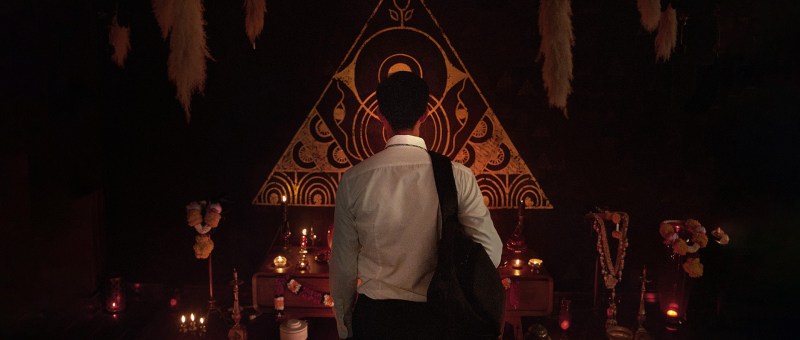
The space that’s for rent in fact seems to be the human body as it becomes clear what kind of home is being sought. Aside from financial worries, the curse essentially stems from the inability to accept loss, or perhaps also the attempt to escape it by assuming new identities rather than deal with a painful past. Only Ning remains in the dark in this triangular series of relationships with pyramids an often repeated motif mimicking the dark symbol of the cult. Sophon Sakdaphisit conjures a genuine sense of eeriness within the genial suburban environment that hints at a largely invisible but pervasive evil that has Ning and her family firmly in its sights. But in other and perhaps slightly uncomfortable ways, it may be the family that eventually repairs itself in what amounts to the complete integration of the once buried traumatic past which may have destroyed what once was but has birthed something new in its place that at last seems to be free of the gloominess that once overhung the family home having relocated to a much warmer and down to earth environment in the absence of both financial and aspirational anxiety but simply content to have found a place to call home.


International trailer (English subtitles)
The Con-Heartist (อ้าย..คนหล่อลวง, Mez Tharatorn, 2020)

Is love the greatest swindle of all? In these strange times scams are on the rise as amoral fraudsters attempt to take advantage of our various anxieties, hoping we’ll be just distracted enough to fall for one of their tricks. The heroine of Mez Tharatorn’s heist caper rom-com The Con-Heartist (อ้าย..คนหล่อลวง), however, had her heart stolen out from under her well before the world began to wind down and other than stealing back what was stolen from you what better way of getting revenge is there than scamming a scammer out of their ill-gotten gains. 

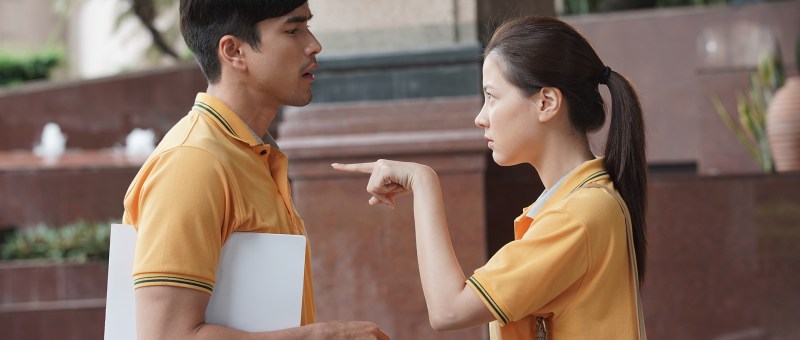
25-year-old Ina (Pimchanok Luevisadpaibul) used to work in a bank but now has an unsatisfying job as a credit agent chasing bad debt, a minor irony because she’s in a significant amount herself as the post-it notes lining her wall detailing various repayment dates demonstrate. It seems that Ina has been unlucky in love, meeting the suave and handsome Petch (Thiti Mahayotaruk) through an app and falling head over heels for him. Thinking it was the real thing, she didn’t really question it when he kept asking her to lend him money, eventually taking out a sizeable loan to supposedly pay for his tuition using her mother’s farmland as security. Realising she’d been scammed, Ina tried to go to the police but as Petch claimed she gave him the money willingly there’s nothing they can do while he unceremoniously dumps her even as she humiliates herself clinging to him. That’s one reason why when she’s cold called by con-man Tower (Nadech Kugimiya) claiming to be from the tax office she nearly falls for his obvious scam despite being a former bank employee presumably familiar with official protocols. Finally catching on she decides to play Tower at his own game, recording their conversation as she uses her connections to unmask his “true” identity and then attempting to blackmail him before hatching on a new plan – getting him to scam Petch to get her money back (along with a little satisfaction not to mention revenge) and thereby save her mother’s farm. 

“No one dies from being conned out of money,” Ina later tearfully explains, “It just breaks your heart. It makes you want to run into an electric pole and die.” Perhaps people really do die of being conned out of money, but still there is a moral judgement being made between men like Tower doing small scale, one-off telephone scams and those like Petch, heartless gigolos leveraging the sincere feelings of perhaps vulnerable women for financial gain. After breaking up with Ina, Petch got onto a sure thing with an older woman who runs a travel agency and is apparently financially supporting him with gifts of expensive suits and fancy cars while he works at her company. 

Ina and Tower’s scam aims to take advantage of his weakness by convincing her old Chinese teacher Ms Nongnuch (Kathaleeya McIntosh), who is in a mountain of debt herself, to pose as the cougarish CEO of a Chinese beer company. Scamming a scammer is always a challenge, but the trio, later a quartet roping in Tower’s weird con-man brother Jone (Pongsatorn Jongwilak), hope they can unbalance Petch by poking at his weaknesses to undermine his natural cynicism. During the course of their scheming, Tower and Ina begin to draw closer but Tower is after all a conman, maybe he’s just playing an extra long con and Ina is about to get her heart broken all over again or on the other hand her earnestness may just reform him. Who is swindling who? It might be difficult to say. 

Shot with the customary slickness of a Thai heist move, Mez Tharatorn’s comedy caper throws in a series of twists and reversals while playing on the ironies of good scammers and bad as the gang determine to take down the “wolf” Petch to protect meek “sheep” like Ina while she perhaps begins to fall for Tower precisely because she already knows she can’t trust him. An epilogue a year on from the original action brings us up to the present day in which everyone is wearing visors and bumping buttons with their elbows, but in an odd way there has been a kind of healing as even scammers find themselves caught out by their greed in the midst of a deadly disease.


The Con-Heartist screened as part of the 2021 Osaka Asian Film Festival

International trailer (English subtitles)

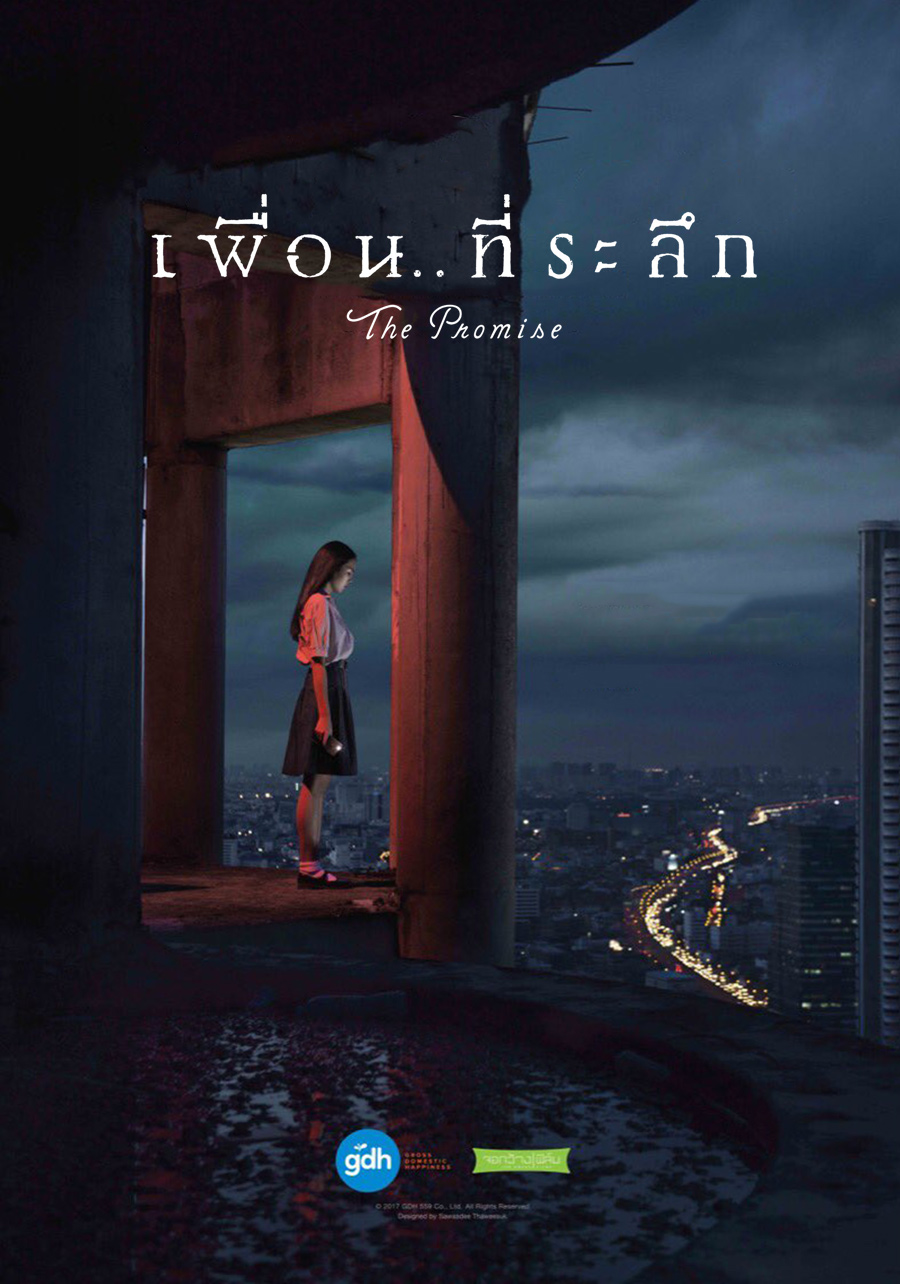
The Promise (เพื่อน..ที่ระลึก, Sophon Sakdaphisit, 2017)

The Promise Thai 2018 poster20 years on the Asian financial crisis continues to loom large over the region’s cinema, providing fertile ground for extreme acts of transgression born of desperation in the wake of such a speedy decline. Sophon Sakdaphisit’s ghost story The Promise (เพื่อน..ที่ระลึก, Puen Tee Raluek) places the financial crisis at its centre in its cyclical tales of betrayed youth who find themselves paying heavily for their parents’ mistakes through no fault of their own. Yet there is a fault involved in the betraying of a sacred promise between two vulnerable young people made half in jest in a fit of pique but provoking tragic consequences all the same. Sometimes lonely death chases the young too, trapping them in solitary limbo growing ever more resentful of their heinous betrayal.

In 1997, Ib (Panisara Rikulsurakan) and Boum (Thunyaphat Pattarateerachaicharoen) are best friends. Daughters of wealthy industrialists making an ill fated move into real estate with the building of a luxury tower block destined never to be completed, Boum and Ib may have been separated by being sent to different schools, but they spend all of their free time together, often hiding out on the construction site fantasising about sharing an apartment there and listening to sad songs on Ib’s ever present Discman.

When the crisis hits and their fathers are ruined, the girls pay the price. Not only are they left feeling betrayed and humiliated in being so abruptly ejected from their privileged world of mansions and horse riding, but also suffer at the hands of the fathers they now despite – Ib more literally as she is physically beaten by her strung out, frustrated dad. Already depressed, Ib talks ominously about a gun her mother has hidden in fear her father may use it to kill himself. When Boum falls out with her mum, she gives the go ahead for a double suicide but can’t go through with it after watching the twitching body of her friend, lying in a pool of blood after firing a bullet up through her chin.

20 years later, Boum (Numthip Jongrachatawiboon) is a successful industrialist herself, apparently having taken over her father’s company and turned it around. The economy is, however, once again in a precarious position and Boum’s business is floundering thanks to a set back on a high profile project. The idea is floated to finish the tower left incomplete by the ’97 crisis to which Boum reluctantly agrees. Meanwhile, Boum’s daughter Bell (Apichaya Thongkham) is about to turn 15 – the same age as she was when she agreed to die with Ib, and has recently started sleepwalking in ominous fashion.

Sophon Sakdaphisit neatly compares and contrasts the teenagers of 20 years ago and those of today and finds them not altogether different. In 1997, Boum and Ib keep in touch with pagers and visit photo sticker booths in the mall, splitting earphones to listen to a Discman while they take solitary refuge at the top of a half completed tower. In 2017, Bell never sees her friend in person but keeps in touch via video messaging, posting photos on instagram, and sending each other songs over instant messenger. Yet Bell, in an ominous touch, still graffitis walls to make her presence felt just as her mother had done even if she fetishises the retro tech of her mother’s youth, picking up an abandoned pager just because it looks “cool”.

In 2017, the now widowed Boum appears to have no close friends though her relationship with her daughter is tight and loving. A “modern” woman, Boum dismisses the idea that a malevolent spirit could be behind her daughter’s increasingly strange behaviour but finds it hard to argue with the CCTV footage which seems almost filled with the invisible presence of something dark and angry. Realising that the circumstances have converged to bring her teenage trauma back to haunt her – Ib’s suicide, the tower, her daughter’s impending birthday, Boum is terrified that Ib has come back to claim what she was promised and plans to take her daughter in her place in revenge for her betrayal all those years ago.

Bell is made to pay the price for her mother’s mistakes, as she and Ib were made to pay for their fathers’. Motivated by intense maternal love, Boum nevertheless is quick to bring other people’s children into the chain of suffering when she forces a terrified little boy who has the ability to see ghosts to help her locate the frightening vision of her late friend as she darts all over the dank and spooky tower block, threatening the financial security of his family all of whom work for her company and are dependent on her for their livelihoods.

In order to move forward, Boum needs to address her longstanding feelings of guilt regarding her broken promise – the suicide was, after all, her idea even if she was never really serious and after witnessing her friend die in such a violent way, she simply ran away and left her there all alone and bleeding. Yet rather than attempting to keep her original promise Boum makes a new one with her imperilled daughter – that she will keep on living, no matter what. The slightly clumsy message being that commitment to forward motion is the only way to leave the past behind, accepting your feelings of guilt and regret but learning to let them go and the ghosts dissipate. Sophon Sakdaphisit makes use of the notorious, believed haunted Bangkok tower to create an eerie, supernaturally charged atmosphere of malevolence but the ghosts are in a sense very real, recalling the turbulence of two decades past in which fear and hysteria ruled and young lives were cut short by a nihilistic despair that even friendship could not ease.


Screened at the 20th Udine Far East Film Festival.

International trailer (English subtitles)

Bad Genius (ฉลาดเกมส์โกง, Nattawut Poonpiriya, 2017)

Bad GeniusesThe world over, education is held up as the best path out of poverty but it is also true that the cards are stacked against those who come from disadvantaged backgrounds when it comes to academic success. Nattawut Poonpiriya’s Bad Genius (ฉลาดเกมส์โกง, Chalard Games Goeng) is part exam-set heist movie, morality play, coming of age tale, and attack on social inequality. Bright kids study hard for scholarships that will send them to foreign universities and then onto a secure middle-class life, but while they work themselves to the bone the less able rich kids get there first thanks to the resources and connections their wealth brings them. When locked out of a system, attacking it from underneath seems like a good idea, but then again there are always hidden dangers even the finest mind fails to see.

Lynn (Chutimon Chuengcharoensukying) is an extremely bright girl. Her father (Thaneth Warakulnukroh), a schoolteacher, wants to send her to an exclusive high school which has a reputation for sending graduates to foreign universities. Lynn’s achievements are impeccable and there’s very little chance the school won’t want her but her interview starts to go south when she wavers on the question of whether she actually wants to go there. Showing off her maths skills, Lynn proves that her dad will be paying a lot more in additional costs on top of the fees and she’s not sure it’s worth it.

This piece of honesty coupled with her swift mental arithmetic gets her offered a scholarship but Lynn finds it hard to settle in to her new “elite environment” until she ends up bonding with the less bright but cheerful and bubbly Grace (Eisaya Hosuwan). Things begin to come unstuck when Lynn ends up helping Grace cheat on a test so that she can achieve her dream of acting in the school play. Grace has a big mouth and so her boyfriend, Pat (Teeradon Supapunpinyo), also wants in on the action. Pat is not Lynn’s friend and she’s not keen but when he offers her a substantial amount of money Lynn can’t help but be swayed. Soon enough it’s not just Pat and Grace but half the school and Lynn finds herself plotting a complex conspiracy of examination fraud which involves international travel and extreme feats of memorisation.

The saddest part is, all of this starts as a mistaken attempt at friendship. Lynn’s first mistake was helping Grace cheat when became clear she’d never get the grades. She did this to help her friend who was worrying about being kicked out of the school play just because her maths is bad. Likewise she doesn’t want to help Pat, but doesn’t want to let Grace down and can’t deny the money is helpful. Little by little, Lynn is seduced by all the adoration she’s getting from these rich kids who wouldn’t give her a second look ordinarily but are now entirely dependent on her in their academic lives. Her finely tuned, systematising mind loves solving the puzzle of the perfect scam while her loneliness leaves her basking in her newfound popularity.

Lynn’s seduction into the world of cheating is partly born of a kind of class rage but it comes from a surprising direction. Grace, a blabbermouth, lets slip that the school charges its fees at a very uneven rate. The less able students like Grace and Pat are paying a kind of idiot tax. Not having met the academic requirements, they’ve bought their way in through paying higher fees and making donations to the school. Even Lynn’s father has payed a significant amount in “tea money” despite her scholarship. This knowledge provokes a kind of outrage in Lynn, disappointed with the school’s lack of integrity. Cheating gains an additional attraction in getting back at the “corrupt” school system, but Lynn hasn’t thought it through. She thinks this is a victimless crime – the dim rich kids get their grades and please their parents, she gets rich, everyone is happy. Lynn hasn’t considered how taking the rich kids’ money makes her an enabler of the very system she rails against in allowing them to continue using their privilege to get ahead at the expense of genuinely talented students like herself and her friend/rival Bank (Chanon Santinatornkul).

Smart as she is, Lynn is not so much of a people person and consequently it takes her quite a long time to realise she is being exploited. She’s drawn to Bank because, like her, he also comes from an impoverished background and reminds her of her father in his absentminded goodness. Lynn breaks her own heart when she realises that all her scheming has destroyed the thing she loved as Bank’s pure soul becomes corrupted by cynicism in realising it will never matter how many exams you pass, the rich kids will always have everything zipped up tight. Rather than join the rat race, there might be a better way for smart people to earn money fast by exploiting the obvious weaknesses of the elite’s spoiled children rather than expending time and energy playing by the rules.

Shot with rigorous attention to detail, Bad Genius is both tense exam room thriller and humorous teen drama which lays bare the negative effects of pressurised education and social inequality on the hopes and dreams of young people. Lynn’s passage from isolated smart kid to criminal mastermind is heartbreaking in its quietly devastating conclusion in which she realises honesty and integrity have their own value but also that the choice has always been hers and she has the power to own her own story rather than allow someone else to claim it for her.


Screened at the BFI London Film Festival 2017.

International trailer (English subtitles)