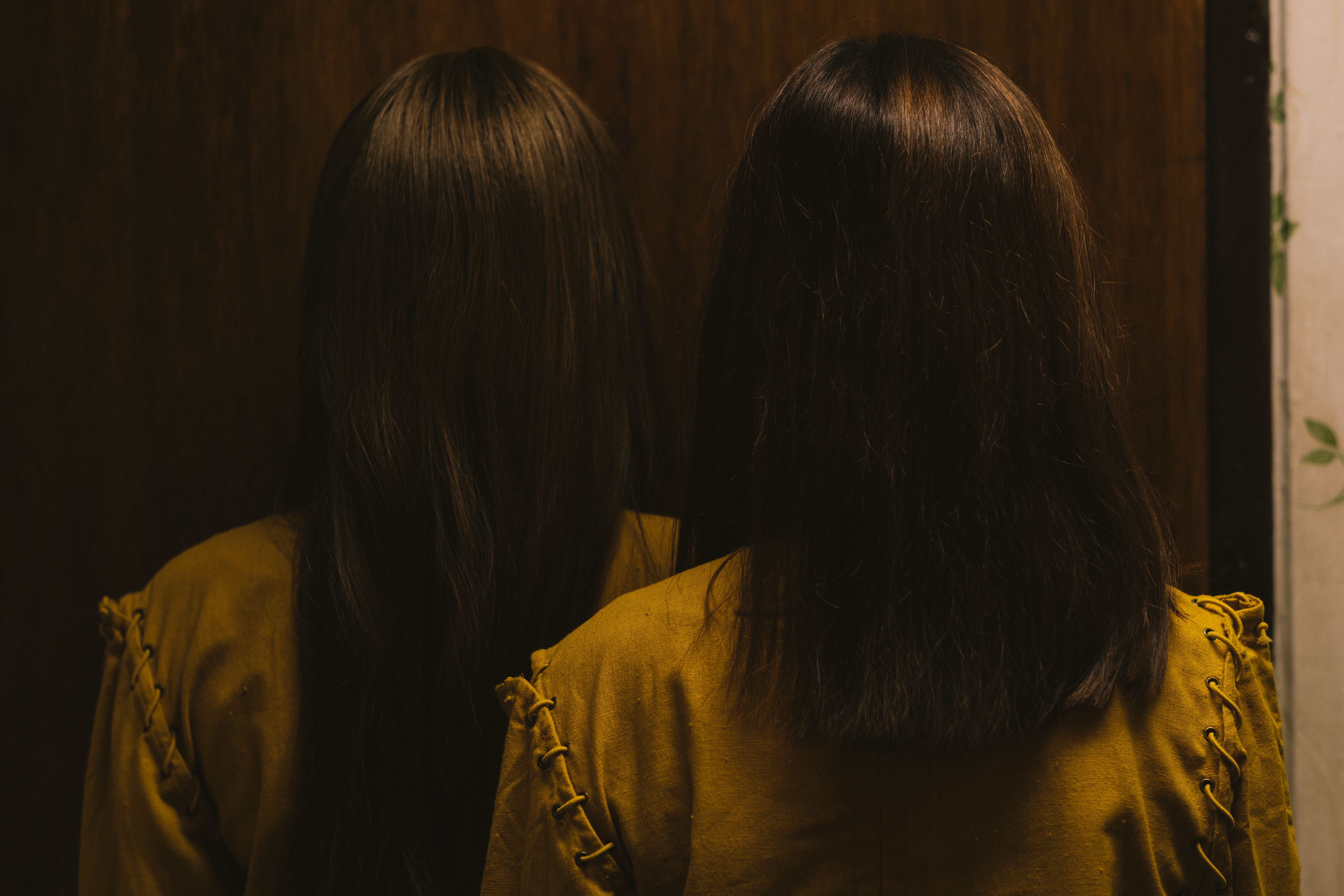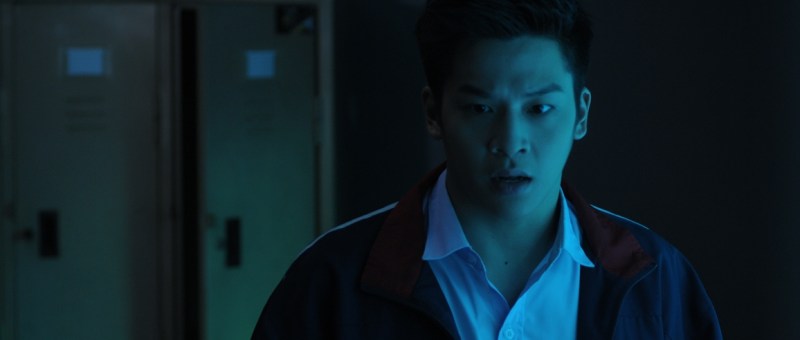

The Swimmers (ฝากไว้..ในกายเธอ, Sophon Sakdaphisit, 2014)

Fragile masculinity and male failure bring about tragic consequences in Sophon Sakdaphisit’s possibly ironically named psychological horror, The Swimmers (ฝากไว้..ในกายเธอ). Though some might alternately claim that its final resolutions are overly moralising or else morally ambiguous, it’s also true that the film otherwise has a progressive quality in suggesting that it wasn’t sex itself that was the problem but the failure to use protection and a subsequent inability on the part father to accept any responsibility for an unplanned pregnancy. 

At least, though it is revealed only gradually, it seems obvious to us that high schooler Perth (Chutavuth Pattarakampol) must have fathered Ice’s (Supassra Thanachat) baby and has kept quiet about it amid rumours that she took her own life after becoming pregnant. In actuality, there’s a lot more to it than that, but it appears as if he does this mostly out of a sense of awkwardness because Ice had been the girlfriend of his best friend and rival, Tan (Thanapob Leeratanakachorn), who, though they had broken up, is now determined to enact revenge on the dirtbag who got Ice pregnant and then presumably left her to deal with it on her own at which point she decided to end her life.

We can see that Perth idolises Tan and feels inadequate in his presence. After Ice’s death, he hooks up with another girl, Mint (Violette Wautier), and asks her if she would have been interested in him if hadn’t just won a gold medal in the swimming tournament. There are others that say he only won because Tan was not able to compete. Though Ice asks him to tell Tan about their relationship himself, Perth can’t do it and continues to act sheepishly around his friend out of some kind of bro code or fear of disappointing him. But we might also wonder if his desire for Ice is only a way of mediating his desire for Tan in the context of the obviously homoerotic relationship between them though in another sense it’s perhaps more that he simply wishes to become Tan and would be glad if he were out of the way. If that were the case, however, he’d forever be haunted by the spectre of his own inadequacy with no way of knowing if he could ever really have beaten his rival and psychologically will always be in second place. 

His failure to measure up to Tan also impacts on Perth’s fragile masculinity as his coach, who has begun an affair with his mother, pressures him to eat raw eggs to improve his stamina. The fact it’s eggs he’s eating has a continual irony while Perth begins to exhibit a degree of gender confusion as he puts on weight and loses his athletic physique. He’d jokingly told Ice, after explaining he didn’t bring a condom, that he’d carry the child if they got pregnant and is now convinced that, like the seahorses they’re learning about in class, he is actually gestating his unborn baby. Perhaps as Ice would have to have done, he wears baggy jackets, binds his belly, and attempts to hide his physique at the swimming pool in the hope of concealing what he fully believes to be a pregnancy that is also the result of his latent guilt for his treatment of ice coupled with the awkwardness of Tan finding out it was him who fathered her child.

Perth’s secrecy and cowardliness are directly contrasted with the equally problematic masculinity exhibited by Tan in his obsession with revenge which sees him attempt to hack Ice’s phone and social media accounts before later beating up another boy Perth had set up as a scapegoat. One could argue much of this could have been avoided if Perth had only been honest with Tan from the beginning about his relationship with Ice, but he was incapable of doing so and is willing to go to extreme lengths to conceal the truths about himself. Sophon Sakdaphisit, however, reveals them to us patiently and exposes Perth as an unreliable narrator, a snivelling coward and insecure sociopath who will do anything and everything to avoid facing reality. Though the film may suggest that he will face no consequences for his treatment of Ice, it simultaneously implies that he will forever be haunted by the spectres of his inadequacy, male failure, and hopelessness no matter how he may otherwise prosper in life.


International trailer (English subtitles)
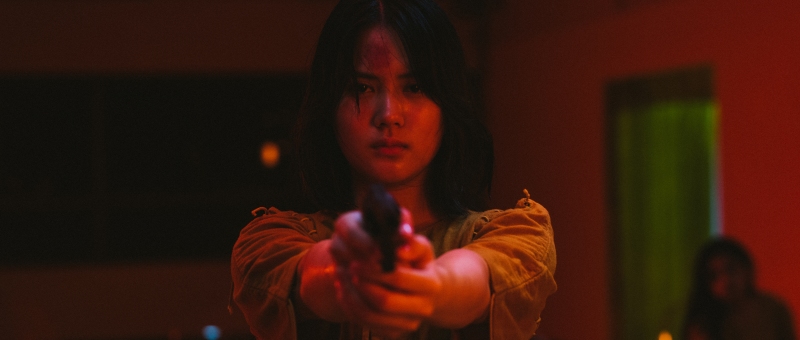
Faces of Anne (แอน, Kongdej Jaturanrasmee & Rasiguet Sookkarn, 2022)

A young woman wakes up in a grimy hotel room with floral wallpaper marked by damp stains. She discovers that the window is frosted over and won’t open while she has no idea of how she got there or who she is but otherwise instinctively knows that the face she sees in the mirror does not belong to her. She tries to call out and hears a voice from an adjacent room telling her to be quiet and that her name is “Anne”. Anne asks her how she knows if she can’t see her, but the voice just tells her that she knows her name is Anne with no further explanation. 

As it turns out in Kongdej Jaturanrasmee & Rasiguet Sookkarn’s Faces of Anne (แอน) every girl in the place has the same name and as gradually becomes apparent are all reflections of a single personality. The key Anne discovers that her face seems to change seemingly at random leaving her uncertain even within the bounds of her fractured identity. A psychiatrist tells her that a name is “not as important as who you are” while encouraging her to learn to accept the face she sees as her own, but she remains confused, abstracted from herself, and unable to reconcile her selfhood with its reflection. Meanwhile, she is stalked by a violent demon in the guise of a deer name Vitigo who wanders the hospital corridors taking out any Annes that it finds. 

What seems to be going on is an attempt to reintegrate the shards of a fractured personality into a coherent whole only it’s manifesting as a massacre of the self as the demon bumps off each of the multiple Annes insisting that only one, the “real” Anne, can be allowed to leave. But then no one is really only one person but presents a series of personas to the outside world all of whom can be said to be “real” even if otherwise inauthentic. In an illuminating flashback, high school girl Anne chats with another couple of girls about fake online profiles where they can share their “real” selves each of which of course have a completely different profile photo much as the serial Annes have a different face. What we can assume to be the key Anne expresses that she just wants to find a place where she can be completely herself and thinks she has one in a relationship with a boyfriend whose face we never see but had shades both of a man who might be her father and the hero of a video game the atmosphere of which seems to have coloured the aesthestics of her eerie mindscape. 

Some might find it easy to dismiss her identity crisis as teenage angst or to suggest that what she’s suffering from is a broken heart though Kongdej Jaturanrasmee & Rasiguet Sookkarn also make reference to a number of problems faced by young people in contemporary Thailand such as online harassment and bullying, sexual harrassment at school and the bad student movement protesting an oppressive educational environment laying bare the pressures on key Anne’s mind that might cause her to become estranged from herself. Asking probing questions about identity, the film wonders if Anne can learn to find herself as distinct from all of these images or if in the end identity and image are inextricably linked to the extent that they can no longer exist distinctly and Anne has no power to identify herself but must rely on the identification of others. Then again, the voice from the other room knows she is Anne without seeing her precisely as she is also Anne, identifying herself in the absence of image. 

Eerie and filled with a Lynchian dread in its hellish lightning and grimy hotel room setting, the film turns Anne’s psychodrama into an existential slasher in which she awaits the arrival of the Final Girl. Retracing her steps, she seeks escape in a pattern of trial and error unwittingly at war with herself even as tussles over identity and authenticity while trying to reconstruct a shattered identity by reclaiming the images of the past or perhaps as simply as the psychiatrist had put it learning to accept the face she now wears as her own. Haunting and empathetic, the film has only sympathy for the wandering ghosts of a fractured mind and the vague hope that together they can put Anne together again. 


Faces of Anne screened as part of this year’s New York Asian Film Festival

Original trailer (English subtitles)

Images: © M Pictures Entertainment Public Company Limited.

Die Tomorrow (พรุ่งนี้ตาย, Nawapol Thamrongrattanarit, 2017)

Die Tomorrow posterDeath gives life meaning, so they say, but if death is such a normal part of being alive, why do we live continually in its shadow? We spend our lives talking about a tomorrow which might never come, but it’s those tiny moments of mundanity which make life worth living. Nawapol Thamrongrattanarit’s Die Tomorrow (พรุ่งนี้ตาย) examines the “last day” of a number of oblivious citizens of Bangkok who are busy living life “as normal” little knowing that everything they do will be for the last time.

Shooting mainly within an oppressive square, Nawapol Thamrongrattanarit rams his point home with his first vignette in opening with a newspaper report recounting the death of a student in a road traffic accident the night before her college graduation. He then introduces us to a gaggle of excited students eagerly talking about horoscopes and their dreams for the future. We never quite figure out which of them will be dispatched to get more beer. It could be anyone, anywhere – even you, even right now.

As the ticking clock and time card remind us, 2 people die every second all over the world making dying possibly the world’s most popular activity. Most people dread it, but for one very elderly gentlemen it would be a relief. Convinced that his advanced old age is either a result of genetics or a mistake by someone upstairs, he selfishly wishes that he’d died before his wife and son so he wouldn’t have to go on enduring the pain of their loss. Meanwhile, a little boy quizzed on his beliefs about the afterlife is convinced that death is peaceful because everything just stops. He feels pretty much OK with the idea because he googled it straight away as soon as he found out so it all seems very straightforward. Nevertheless, he’d rather not know when death is coming because that would just make him “sad” and then he wouldn’t be able to enjoy his remaining time.

Death is, however, something you have almost no control over. A melancholy man gets his toenails clipped by his loving wife who is suffering from a terminal disease and awaiting a transplant. Grimly, he tells her that with every death there is fresh hope as he prepares for a trip abroad unaware that, as the preceding title card told us, a plane is about to go missing in the skies between Thailand and America. Meanwhile, across town a man pushes a stool up to his balcony and prepares to jump. Before he does so, he leaves a message for a friend instructing him to pass on his thanks and apologies to the others, affirming that he had no desire to bother them but he has tried his best and life is cruel. An old lover, presumably having her reasons and well within her rights, refuses to open her door to him and remains unrepentant even when her friend suggests she may regret it if he really does do “something stupid”.

With each death the frame expands to its fullest, as if echoing the sense of emptiness in the very present absence of the recently deceased. A brother somewhat irritated by his sister’s abrupt and unexplained return from the US, declares that her death (in a freak accident while parking his motorbike to take a picture of a cute puppy) has reminded him of the preciousness of life. He might have been embarrassed before, but now he makes a point of hugging and kissing his parents, telling those close to him they are loved in case there is no later opportunity to do so. The sad death of a salaryman, in his sleep in the stock exchange lying undiscovered for five hours, seems all the more absurd and pointless while that of a veteran musician, soon after getting his head massaged by his loving daughter, seems like the best of all ends – lying peacefully at home in the summer breeze. Yet as the old man tells us, those who are “young” should have no fear and simply live. Less about the omnipresence of death than the ephemerality of life, Die Tomorrow is a quiet paen to the small pleasures of being alive, discovered in mundanity and the knowledge that every breath may be one’s last.


Die Tomorrow was screened as a special preview at the BFI Southbank and opens in UK cinemas on 26th July courtesy of Day for Night. It is also currently available to stream in the UK via MUBI.

International trailer (English subtitles)